




US-Iran Diplomacy Hopes Pull WTI Below $100 as Gulf Supply Stays Constrained



A $16.79 Brent-WTI spread and 13% distillate shortfall show why lower crude prices may offer opportunity before physical supply fully recovers.
- Brent futures fell 2.08% to $101.71 and West Texas Intermediate (WTI) fell 2.14% to $98.15 on September 21 after President Trump signaled openness to meeting Iran's president.
- A drone attack shut Saudi Arabia's East-West pipeline, pushing more crude through Hormuz . Commodity vessel transits fell to 12 on September 19 and 20 from 35 a weekend earlier.
- A stalled United Nations week puts Brent on a path targeting its $103.87 September 18 settlement by September 30, while a US-Iran framework would keep WTI below the $100 support broken on September 21.
- A report of possible Trump-Pezeshkian talks cut Brent $2.16 in one session on September 21, showing how quickly oil prices can move on diplomacy headlines.
- A renewed Houthi strike on Yanbu or Brent reclaiming $103.87 could restore upward price pressure, with US distillate stocks 13% below the five-year average leaving little supply buffer.
US-Iran Diplomacy Hopes Drop Brent Futures to One-Week Low of $101.71
Brent futures fell 2.08% to $101.71 a barrel, while WTI fell 2.14% to $98.15, their lowest levels since September 10. The decline followed President Donald Trump's openness to meeting Iranian President Masoud Pezeshkian, showing how diplomacy hopes can quickly reduce oil's geopolitical premium even while Gulf supply remains constrained.
The sell-off reduced the geopolitical premium created by Houthi attacks on Riyadh and Yanbu, but physical supply remained constrained. J.P. Morgan estimated Middle East oil flows at 17.1 million bpd over 10 days, 6.1 million bpd below the 2025 average, leaving prices exposed to renewed upside if diplomacy stalls.
East-West Pipeline Outage Forces Saudi Crude Through Hormuz
Saudi Arabia shut the East-West pipeline after a drone attack and is targeting about half capacity within days. With Yanbu shipments disrupted, Saudi Aramco redirected more crude through Hormuz, lifting Saudi flows through the strait to 2.9 million bpd from 700,000 bpd in August. Total Saudi exports also recovered above 4 million bpd from 2.4 million bpd in August, showing rerouting can restore volumes but increases reliance on Hormuz.
The reroute increases Saudi reliance on Hormuz as US-Iran tensions keep shipping exposed to disruption. Houthi strikes on Yanbu also threaten Saudi Arabia's only export route that bypasses the strait. China has asked Iran to restrain the Houthis after a Saudi appeal, creating a diplomatic path to reduce that risk.
Hormuz Transit Drop to 12 Vessels Delays Supply Recovery Beyond the UN Week
Rerouting capacity is nearing its limit, with Gulf of Oman ship-to-ship transfers close to capacity and Hormuz transits falling to 12 vessels from 35 a weekend earlier. Daniel Takieddine, Chief Executive Officer of Sky Links Capital Group, told CNBC:
“Any setback or renewed deterioration in shipping conditions would tighten the physical market and restore upward pressure on prices.”
Gulf Supply Loss Widens Brent Premium Over WTI to $16.79
Gulf supply disruptions lifted seaborne Brent more than inland WTI. Spot Brent reached $118.06 against $101.27 for WTI, widening the premium to $16.79 from $4.54. Refiners using Brent-priced crude absorb that higher cost, while US retail diesel at $6.285/gallon raises costs for transport fleets.
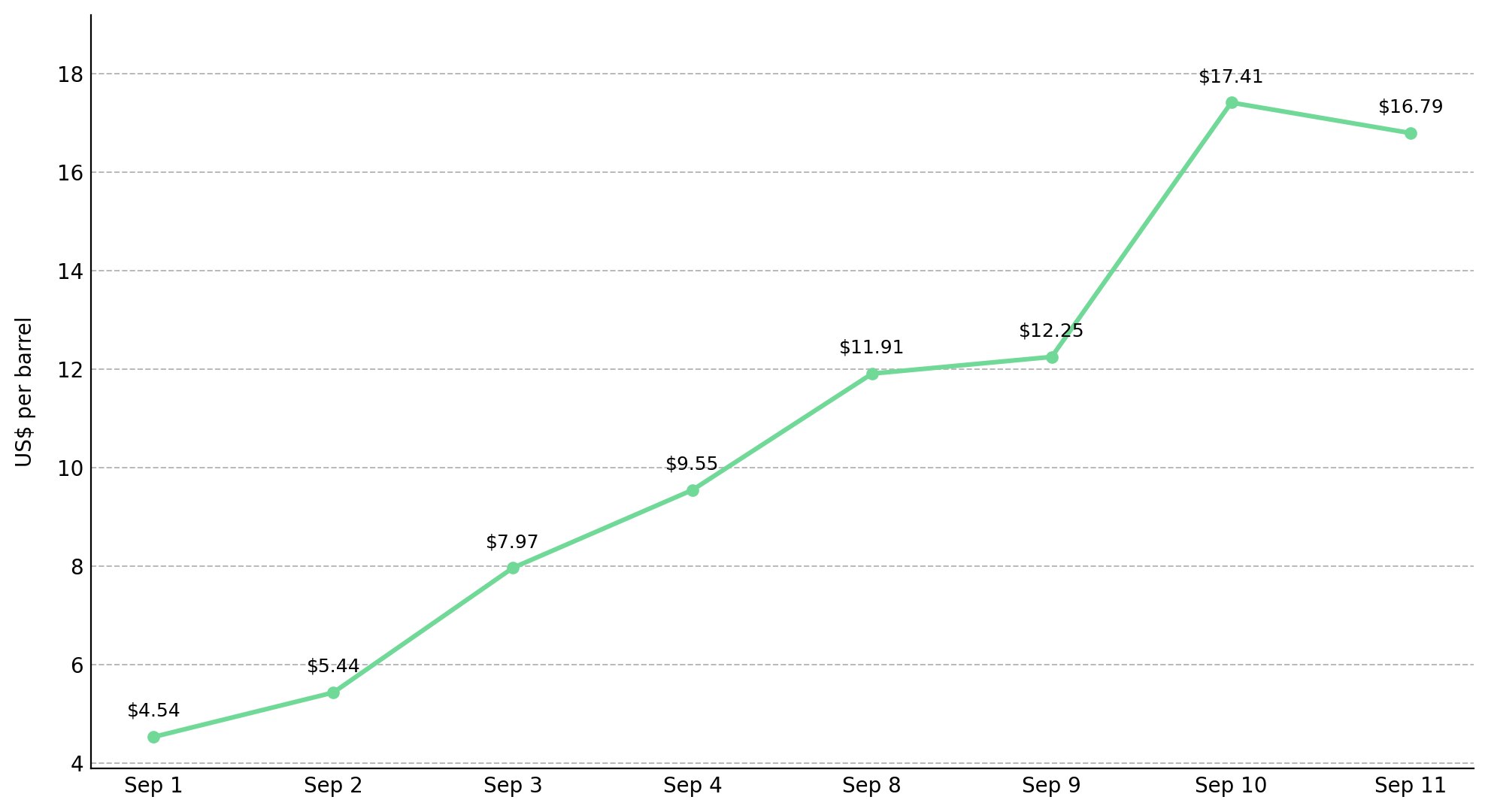
Saudi Aramco restored some export capacity by rerouting crude through Hormuz, but available transfer capacity is nearing its limit. US product exports averaged 7.8 million bpd over four weeks, up 14.5% year on year. WTI-priced producers and Gulf Coast refiners with export access can sell into higher-priced Brent-linked markets and benefit from the wider spread.
A report of possible Trump-Pezeshkian talks cut Brent 2.08% in one session, showing how quickly diplomacy headlines can move oil prices. Leveraged oil positions amplify those swings, so a 2% daily oil move should be used to set the maximum position size.
$100 WTI Break Shifts the Trade
Brent remains above $100 as Middle East oil flows run 6.1 million bpd below the 2025 average and Hormuz transits stay near 12 vessels. The supply constraint keeps Brent above WTI, allowing US exporters to sell lower-priced WTI barrels into higher-priced Brent-linked markets.
The current oil setup weakens if WTI closes below $100 for 10 straight sessions while weekend Hormuz transits recover to 35 vessels, narrowing the Brent premium, lower costs for refiners and transport fleets, and reduce the US export advantage. The EIA Weekly Petroleum Status Report will show whether distillate supply is recovering.
The contrarian case remains that lower prices do not refill the Strategic Petroleum Reserve, which holds 285.0 million barrels, 29.8% less than a year earlier, leaving lower prices as a potential entry point for long-term oil exposure.
Analyst's Notes





Subscribe to Our Channel







Stay Informed


