




'Earn-As-You-Build' Model: Why Self-Funded Junior Miners Are attracting Risk Averse Investors


The junior mining sector has always been a hard place to make money. It is about to get harder, not because the geology has changed, but because the capital environment has. Governments are quietly reshaping the tax treatment of retail investing, wealth managers are steering clients toward safer sleeves of the market, and the equity capital that used to flow into small-cap explorers is increasingly being rationed toward advanced projects and ETFs. In that environment, a small but growing group of juniors is doing something structurally different: starting small, generating cash, and using that cash to build the bigger project themselves.
This is not a compromise. Done properly, it is one of the more shareholder-friendly strategies available in the sector today, and it deserves to be understood on its own terms.
The Problem: Capital is Flowing Away from Explorers
Let's start with the headline numbers. Toronto exchanges raised more than $33 billion of mining equity in 2025, up roughly 60% year-over-year, and June 2026 alone saw juniors raise around $700 million, up 67% on the prior year. On the surface, that looks like a healthy market.
Look closer and the picture is very different. Small-cap explorers accounted for only about 12% of equity raised in 2025, down from roughly 31% five years earlier. The rebound has been almost entirely concentrated in advanced copper, gold, silver and critical-mineral developers, while early-stage explorers have been "increasingly starved of risk capital. Industry data indicates that fewer than 15% of listed juniors currently hold enough working capital to fund even 12 months of operations.
The retail picture is equally uncomfortable. In Canada, the Trudeau government's Budget 2024 proposed raising the inclusion rate from 50% to 66.67% for individuals on gains above C$250,000 and on all corporate/trust gains, originally effective 25 June 2024. It was first deferred to 1 January 2026, then cancelled outright by the Department of Finance on 21 March 2025 under PM Mark Carney. For 2026, the rate remains a flat 50% with no threshold and no tiered structure. Canadian retail investors have escaped the immediate squeeze, but the policy has been shelved twice in 18 months, so I've framed it as a live tail risk for TSX/TSXV juniors rather than a settled question.
In the UK, the Capital Gains Tax annual exempt amount has been cut from £12,300 in 2022/23 to just £3,000 for 2026/27, and CGT rates on shares now sit at 18% within the basic-rate band and 24% above it, applied uniformly to shares, crypto and property. The message from HMRC, and from most other Western tax authorities heading in the same direction, is unambiguous: taxable investing outside pensions and ISAs is being made steadily less attractive.
And in Australia, from 1 July 2027, the Treasury Laws Amendment (Tax Reform No. 1) Bill 2026 replaces the long-standing 50% CGT discount for individuals, trusts and partnerships with cost-base indexation plus a 30% minimum tax on net capital gains, applied broadly to all CGT assets including listed shares. Gains accrued before 1 July 2027 keep the existing 50% discount and the asset's market value at that date forms the cost base for the post-July 2027 gain, but the direction of travel is clear, the headline reward for holding a risky junior mining stock for more than 12 months is being materially cut back. Separately, Division 296 (the "$3m super tax") took effect on 1 July 2026 and applies additional tax to super balance earnings above A$3m, with a further tier at A$10m, relevant because SMSFs have historically been meaningful holders of Australian juniors.
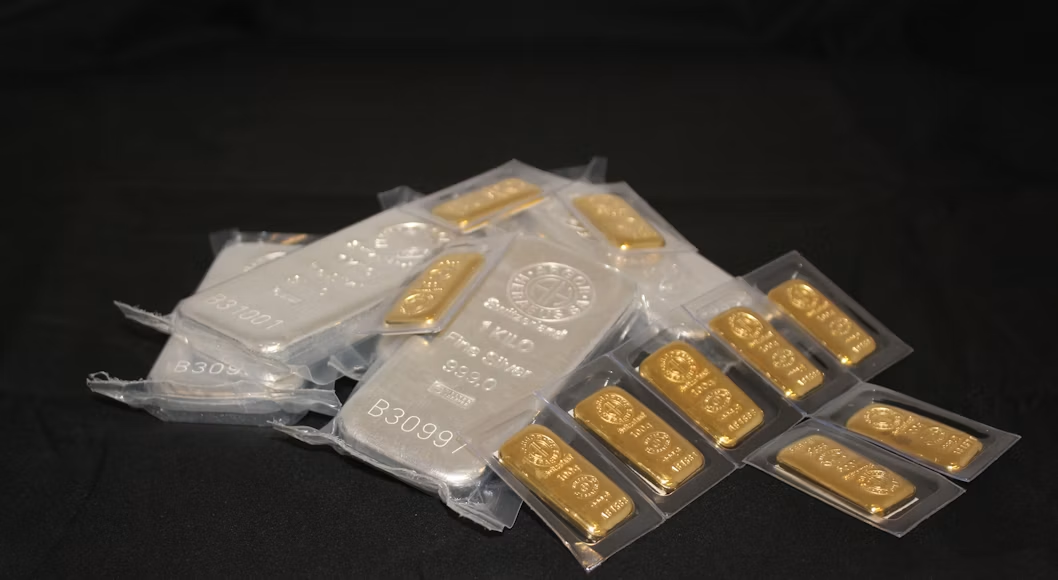
Brokers and wealth managers have read the memo. Retail clients are being pushed toward diversified ETFs and away from single-name junior mining stocks. Where mining exposure is recommended, it is typically through vehicles like the VanEck Gold Miners ETF (GDX), which is dominated by senior producers. GDX has outperformed its junior sibling GDXJ by more than 35% during the early stages of the current gold rally. Flows into gold ETFs have hit roughly $64 billion year-to-date, with a record $17.3 billion in September alone.
The net effect is a bifurcated market. Gold and copper prices are strong, majors are being rewarded, and yet the traditional retail base that once funded exploration is being taxed harder, advised away, and channelled into passive vehicles that never touch a genuine junior. For explorers still relying on the old model, raise equity, drill, raise more equity, drill more, the arithmetic has become brutal.
Investors in junior mining are being asked to underwrite long-dated, capital-hungry projects into a world where tariff regimes, export controls on critical minerals, resource nationalism, and shifting Western industrial policy can rewrite a project's economics between drill program and feasibility study. At the same time, the retail base that has historically funded exploration is being squeezed from the other direction, punitive capital gains treatment in the UK, a structural rewrite of the CGT discount in Australia, and a twice-shelved but still-alive inclusion-rate increase in Canada, while wealth managers steer clients into passive ETFs dominated by senior producers. The result is a maelstrom in which macro risk is rising precisely as the pool of patient, price-taking capital willing to fund early-stage juniors is shrinking, leaving explorers to compete for a smaller, more nervous audience on terms that have rarely been less forgiving. Against that backdrop, the 'earn-as-you-build' model, start small, generate cash, and fund the bigger project from your own operations rather than the market's mood, is a genuine ray of hope, because it is one of the few strategies that actually works better the harder the capital environment gets.
What "Explore-Raise-Dilute" Actually Costs Shareholders
The traditional junior mining playbook is structurally dilutive. Companies operate on a raise-explore-raise cycle: there is no revenue until a mine is in production, and getting to production requires years of successive capital raises. Each raise, typically with warrants, is often priced at a discount to the market, and lands on a share register that has already absorbed multiple previous rounds.
Even in a good market, this is expensive. In a market where risk capital is scarce and expensive, it becomes ruinous. A company that needs to raise $30 million at a depressed share price to prove up a resource may find that by the time the resource is defined, existing shareholders own a materially smaller share of a company that still is not generating a single dollar of revenue. Discoveries are made. Ownership evaporates.
Against this backdrop, a very different strategy has been quietly gaining ground.
The Self-Funded Starter Model; "Earn-as-you-Build'
The idea is simple, but the execution is not. Instead of raising equity to fund exploration on a large, capital-intensive deposit, the company identifies a smaller, near-surface, low-capex portion of its project, often oxide material that can be heap-leached without crushing or grinding, and builds that first. The starter operation is designed to reach cash flow quickly, typically within about a year of construction, and to fund the drilling, studies and eventual development of the far larger underlying resource from its own operating cash flow.
The critical point, and the one most easily misread by retail investors, is that the starter operation is not the endgame. It is a financing mechanism. It is a way of buying time, capital and optionality without touching the share register. The larger project remains the strategic prize; the starter simply pays for it.
Four companies illustrate the model at different stages of maturity, from steady-state producer down to pre-development.
TRX Gold - The Model in Steady State
TRX Gold (TSX: TRX; NYSE American: TRX) operates the Buckreef Gold Project in Tanzania and is arguably the clearest live example of the self-funded model working as advertised. The company states explicitly that its "business strategy is to utilize positive operating cash flow from operations to fund sustainable growth initiatives," and that "exploration is ongoing and self-funded".
Since 2021, TRX has delivered three mill expansions on time and on budget, culminating in a 2,000 tonnes-per-day facility completed in Q4 2024. The next expansion, a materially larger plant combining a 3,000+ tpd sulphide circuit, a 1,000 tpd oxide circuit and tailings retreatment, is expected to be financed from internally generated cash flow over 18-24 months. The company carries roughly $26 million in cash against only $2.3 million of debt. Shareholders are watching the mine grow into something meaningfully larger without repeatedly being asked for cheques.
Cabral Gold - The Model at the Starting Line
Cabral Gold (TSXV: CBR; OTCQB: CBGZF) is executing exactly the same logic at an earlier stage, on the Cuiú Cuiú project in Brazil. The company is explicit that it is pursuing "a two-stage development strategy" in which "cash flow from the initial Stage 1 starter operation will be used to drill off and expand the much larger hard-rock resource" and scope out a materially bigger Stage 2 mining and milling operation.
The Stage 1 starter is a modest 720,000-tonne-per-year heap-leach operation with capex of US$37.7 million, an after-tax IRR of 78% at a $2,500/oz gold price, and a payback period of ten months. Crucially, the entire Stage 1 build has been funded without an equity raise, through a US$45 million gold loan from Precious Metals Yield Fund that closed in November 2025. First gold pour was achieved in September 2026, and the district contains 50 targets peripheral to three known deposits and four hard-rock discoveries still to be drilled off.
In other words: the starter is fully funded, non-dilutive, and about to become the balance sheet that pays for everything else.
New Found Gold - The Model at Scale
New Found Gold (TSXV: NFG) is applying the same principle to a much larger prize: the Queensway project in Newfoundland. The recently released Preliminary Economic Assessment lays out an explicitly phased plan. Phase 1 is an open-pit mine requiring $155 million of initial capital and producing an average of 69,300 ounces per year at an all-in sustaining cost of $1,282/oz over Years 1-4. Phase 2 adds an on-site processing plant and in-pit tailings. Phase 3 brings underground mining online.
The company is direct about the logic: the phased design provides "lower upfront capital requirements, early revenue generation, funding of subsequent phases, processing of the highest-grade material first… and minimization of shareholder dilution". Phase 1 is designed to generate approximately $117 million in average annual after-tax operating cash flow, paying back its own capital in Year 2, with Phase 2 growth capital paid back in Year 5. The full 15-year mine life carries an NPV of $742 million and a 56% IRR.
Fitzroy Minerals - The Model Applied to Copper, Pre-Production
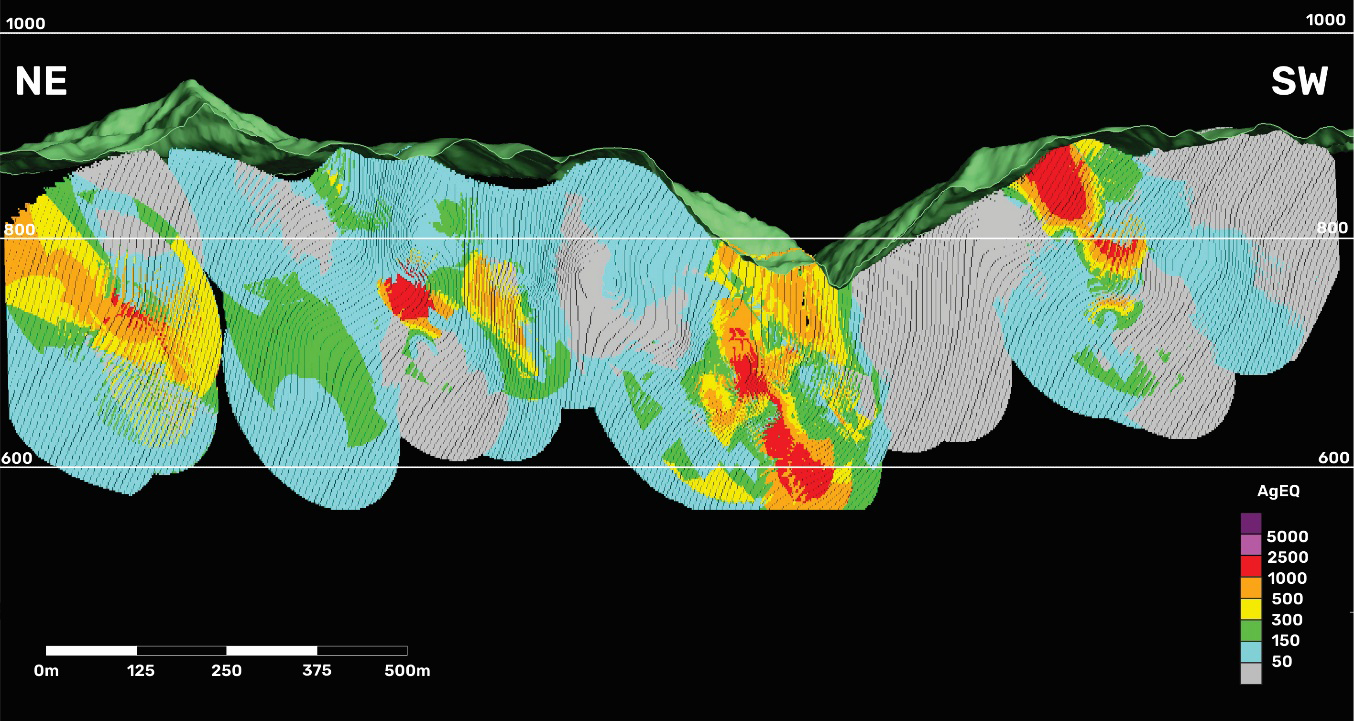
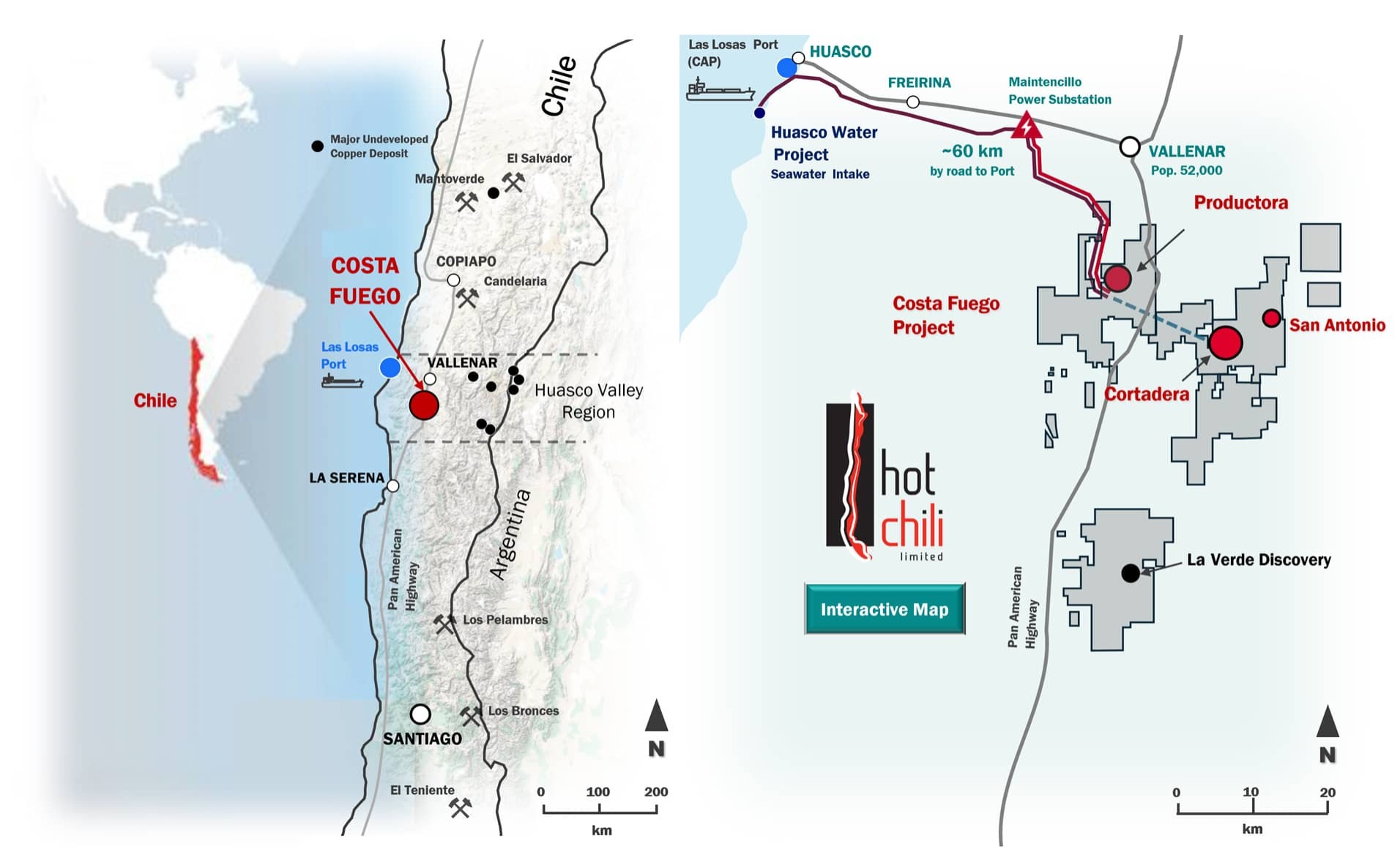
Fitzroy Minerals (TSXV: FTZ; OTCQX: FTZFF; FSE: C3Y) is applying the same architecture in copper, at an earlier point in the development curve. The Buen Retiro project in Chile's Atacama region carries two distinct value layers: a shallow oxide horizon suited to low-capital heap-leach processing, and a deeper, district-scale IOCG sulphide exploration target. The oxide starter is intended to generate cash flow at low capital intensity so that Fitzroy can advance the far larger sulphide programme without leaning repeatedly on the equity market and diluting shareholders.
Two structural features make the story unusually capital-efficient. First, under a Letter of Intent, Chilean copper producer Pucobre has offered Fitzroy access to at least 80% of the 800-tonne-per-month copper cathode capacity at its Planta Biocobre solvent extraction–electrowinning facility, which has operated continuously since 1992 and sits 60 km by paved highway from Buen Retiro. That access removes standalone plant construction from the development equation, benefits from grandfathered permitting, and materially reduces both capital intensity and execution risk. Second, Pucobre retains a 30% claw-back right within the Buen Retiro concessions, exercisable by reimbursing 90% of eligible spending, a structure that can return capital to Fitzroy without issuing a single new share.
The planned heap-leach operation targets roughly 10 million pounds per year of attributable (to Fitzroy) copper production at operating cost margins of $1-2 per pound, with a Pre-Feasibility Study targeted for Q1 2027 and potential first cathode production in late 2027 or early 2028. None of that is yet contractually locked in, the LOI is non-binding, commercial tolling terms remain to be negotiated, and the PFS still has to define the economics. But the shape of the strategy is identical to TRX, Cabral and New Found Gold: build the small thing first, using someone else's infrastructure and someone else's balance sheet where possible, and use its cash flow to fund the district-scale prize behind it.
Other Examples Worth Watching
The same architecture is showing up elsewhere. West African developer Cardinal Resources used a starter-pit design at Namdini, with a payback period of 21 months and a distinct starter-pit life of 27 months, before rolling into the larger reserve. More broadly, a wave of developers is now using low-capex oxide heap-leach starters paired with gold-linked debt to reach cash flow and fund hard-rock exploration without dilution. The pattern, oxide bridge, gold loan or infrastructure sharing, district drilling paid from cash flow, is fast becoming a template.
Why This Matters for Investors
The instinctive reaction to a small maiden resource is often disappointment. It looks modest. It looks like the ceiling. The self-funded juniors are asking investors to read the same announcement in the opposite direction, as the foundation of a much larger project that is now going to be financed on shareholder-friendly terms rather than punitive ones. There are three reasons that reframing is worth taking seriously.
First, it materially changes the risk profile. A conventional pre-revenue explorer is exposed to two hard-to-forecast variables: the geology and the capital markets. A self-funded producer with a starter operation retains the geological upside but has partially decoupled itself from the equity market. If sentiment turns, TRX Gold does not need to price a bought deal at a 30% discount to keep drilling, it keeps drilling out of cash flow. That is a genuinely different risk profile, not a marketing line.
Second, it aligns the company's growth with the shareholder's outcome. In the traditional model, every discovery is partially eaten by the next financing needed to develop it. In the self-funded model, the value created by the drill bit accrues to the existing share register because there is no new share register being printed to pay for it. The dilution component that has historically destroyed retail returns in junior mining is removed — or at least deferred until the larger project is materially de-risked and can be financed on far better terms.
Third, it works in exactly the market environment that is otherwise hostile to juniors. Higher capital gains taxes, ETF-driven capital flows, and wealth-manager caution do not disappear because a company has a good drill hole. They do, however, matter far less to a company that is not asking retail investors to underwrite its next exploration campaign. A self-funded developer can survive, and grow, through a period in which conventional explorers are being quietly starved.
What to Look For, and What to be Sceptical Of
The strategy is powerful but not magical. It depends on the starter operation actually performing as engineered, actually generating the expected cash flow, and that cash flow actually funding exploration that identifies and defines a sufficiently valuable hard-rock resource. Any of those links can break.
A serious self-funded story should have most of the following: a starter operation with a low capital intensity relative to project cash flow; a defined, credible path from Stage 1 economics to a materially larger Stage 2 or Phase 2 resource; financing that has already been secured on non-dilutive or minimally dilutive terms (gold loans, streams, project debt, government support); a management team with a track record of on-time, on-budget delivery; and disclosure that treats the starter as a means to an end rather than the story itself. TRX Gold's three consecutive expansions, Cabral's gold-loan-funded construction, and New Found Gold's explicit Phase 1-funds-Phase 2 arithmetic all sit inside that frame.
Be sceptical of companies that describe a starter operation in isolation, without a clearly defined larger project behind it. Be equally sceptical of companies whose starter economics only work at unusually high commodity prices, or whose "self-funded" plan is really a hoped-for future raise dressed up in different language.
The Bottom Line
The retail investor is being squeezed. Capital gains are being taxed more punitively, wealth managers are steering clients into ETFs and majors, and small-cap explorers are receiving a shrinking share of a growing capital pool. In that environment, junior mining companies that start small, control their cash flow, and use it to build the bigger project themselves are not settling for less. They are choosing a route that respects their shareholders' capital and that works in the market as it actually is, not the market as it used to be.
TRX Gold, Cabral Gold, New Found Gold and Fitzroy Minerals are four of the clearest current examples, spanning steady-state producer, near-first-pour developer, staged PEA-stage gold developer, and pre-PFS copper developer, but the model is spreading. For investors trying to find a way back into the junior space without accepting the dilution treadmill that has destroyed so many portfolios, they are worth understanding, not as a compromise on ambition, but as a more disciplined route to it. In a sector where most companies still have to raise money to survive, the ones that have arranged to fund themselves may quietly turn out to be the ones most likely to make you money.
Analyst's Notes





Subscribe to Our Channel








Stay Informed






















