




Fitzroy Minerals' Caballos Copper Project: What a 5-km Circular Anomaly Reveals About the Scale of the System


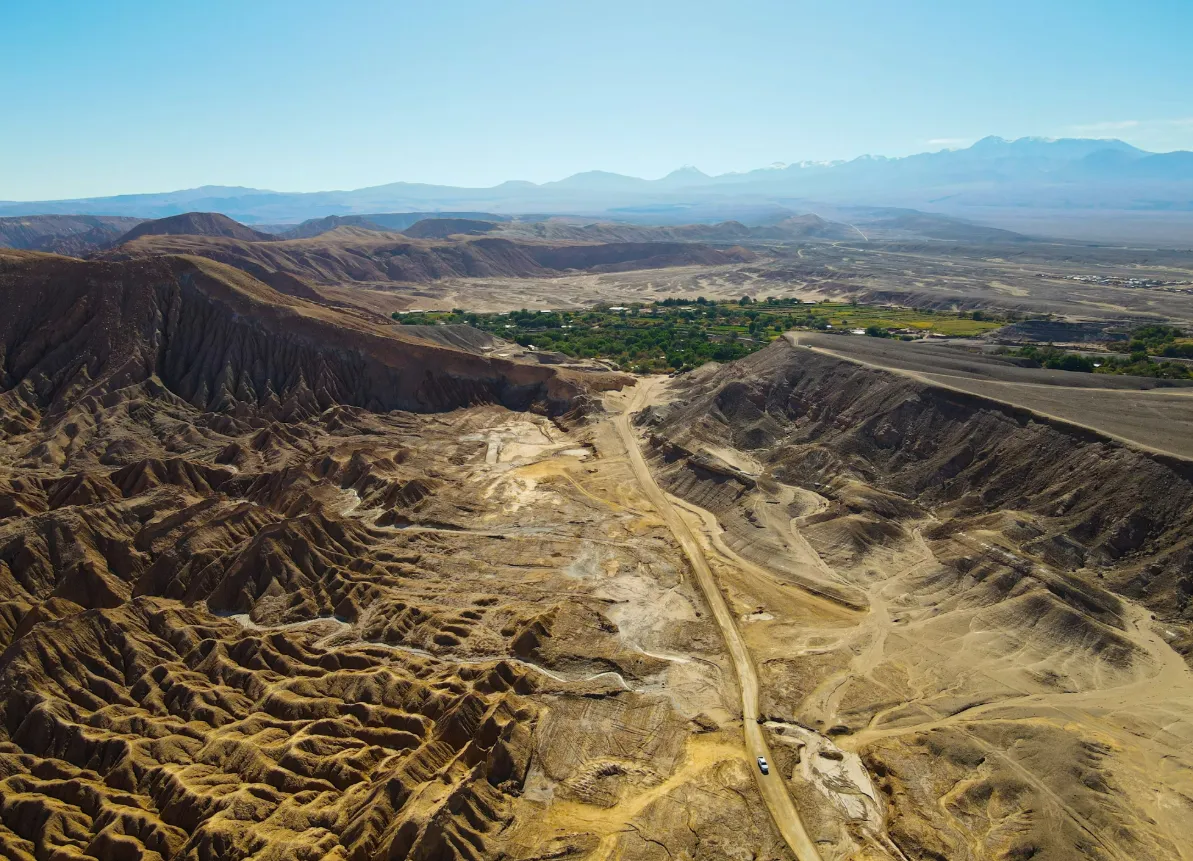
Fitzroy Minerals' MobileMT survey at Caballos returns a 5-kilometre porphyry anomaly and 14-km structural corridor, with the strongest copper-molybdenum-gold drill targets untested.
- Fitzroy Minerals has mapped a system-level geophysical architecture at the Caballos Copper Project in Chile's Valparaíso region, with a helicopter-borne MobileMT survey interpreted by Expert Geophysics Services Inc. (EGS) as consistent with a porphyry-style hydrothermal system across approximately 194 square kilometres.
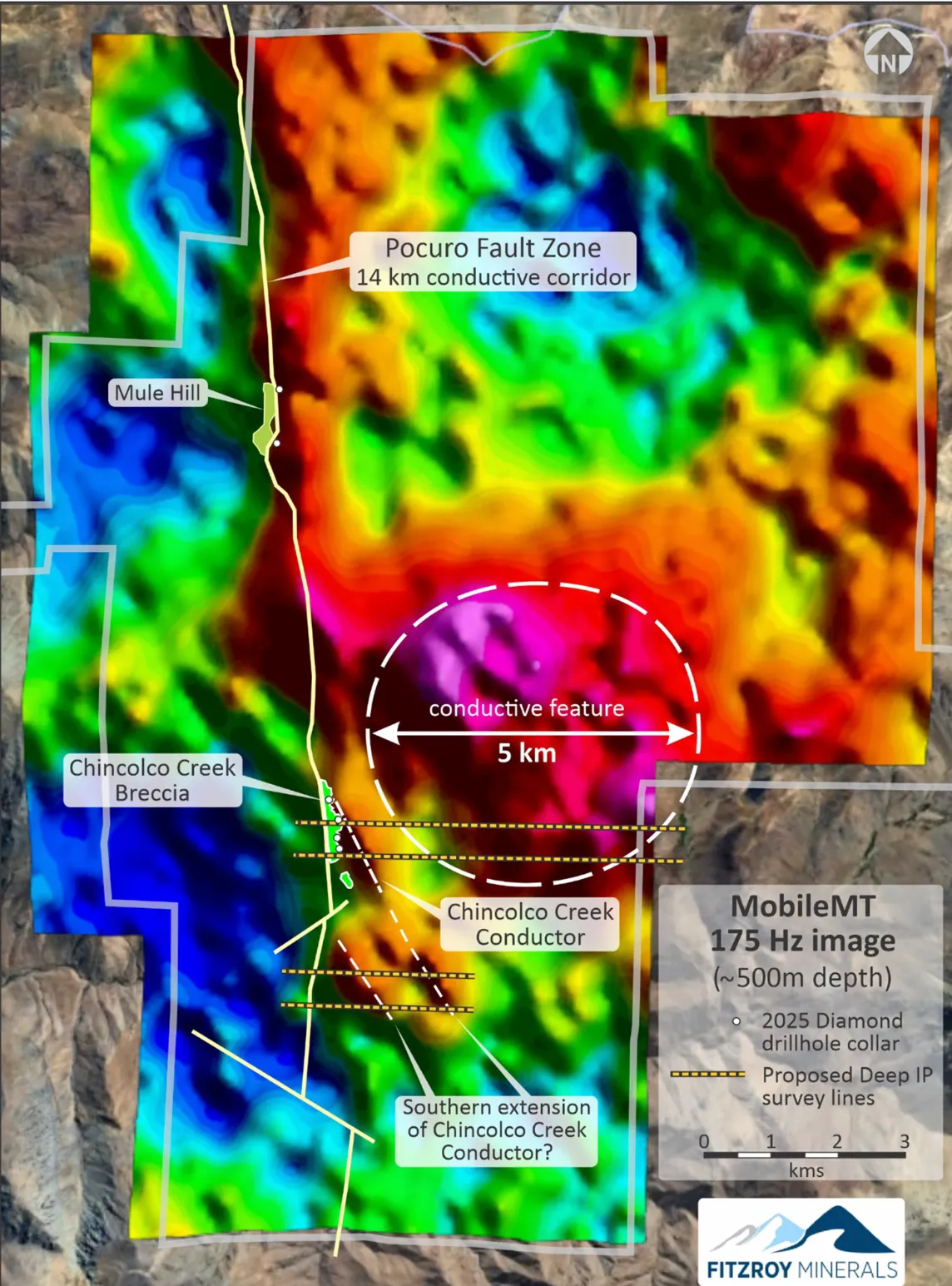
- The survey identified a circular conductive feature approximately 5 kilometres in diameter, with conductive continuity extending beyond the survey's effective depth penetration, interpreted by EGS as a porphyry-related hydrothermal system directly connected to copper-molybdenum-gold-rhenium mineralisation confirmed by 2025 drilling at the Chincolco Prospect.
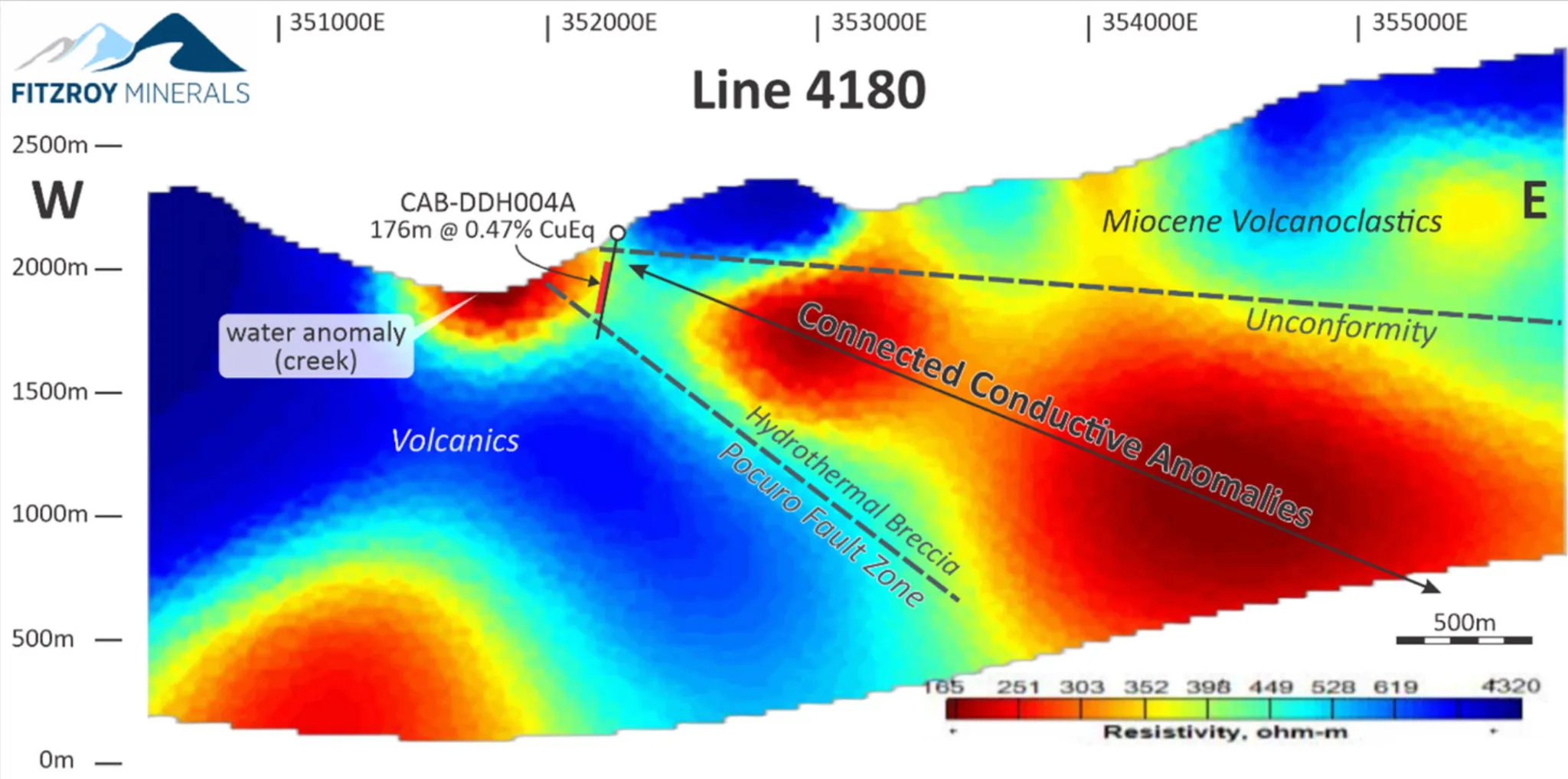
- The southernmost drill hole at Chincolco, which returned 176 metres at .47% copper equivalent from 156 metres, intersected only a weak portion of the conductive anomaly - the deeper, stronger portion and a 2.5 kilometres southward extension remain undrilled.
- A 14-kilometre north-south conductive corridor coinciding with the regional Pocuro Fault Zone has been identified across the project area, interpreted by EGS as a crustal-scale permeable structure consistent with porphyry copper systems.
- A deep induced polarisation (IP) survey and Phase 2 drilling are planned for the second quarter of 2026 through the first quarter of 2027 under a ~C$3-5 million budget, with the company's stated plan that future cash flow (FCF) from the Buen Retiro Heap Leach joint venture (JV) with Pucobre S.A. will fund non-dilutive exploration drilling at Caballos.
What Has Happened
Fitzroy Minerals Inc. (TSXV: FTZ, OTCQX: FTZFF) released results from a helicopter-borne MobileMT survey completed by Expert Geophysics Services Inc. (EGS) over the Caballos Copper Project in Chile's Valparaíso region. The survey covered 694 line-kilometres over approximately 194 square kilometres and identified multiple conductive and resistivity anomalies interpreted as consistent with porphyry-style hydrothermal systems, connecting those anomalies directly to copper-molybdenum-gold mineralisation confirmed by drilling in 2025. Prior to this survey, the Caballos exploration model was defined by a single-intercept drill discovery and two anomalies each measuring 1,200 metres in length.
The 5-Kilometre Circular Anomaly: What the Geometry Signals
The standout result from the MobileMT survey is a circular conductive feature approximately 5 kilometres in diameter, interpreted by EGS as a porphyry-related hydrothermal system with conductive continuity extending beyond the survey's effective depth penetration. A strong conductive zone dips eastward for approximately 1.5 to 2 kilometres before merging into the larger circular body. The survey data outline a structurally controlled zone of hydrothermal alteration and sulphide development, consistent with a porphyry-related mineralising environment. Overlying Miocene Farrellones Formation volcanoclastic rocks appear as a resistive cap above the conductive domain, and the anomaly retains a strong cylindrical shape at depth.
While the scale of the conductive footprint is significant, the continuity, grade distribution, and economic geometry of mineralisation remain untested outside the limited drilling completed to date.
President and Chief Executive Officer of Fitzroy Minerals, Merlin Marr-Johnson, was clear on the intent behind the survey:
"We will probably fly all of this doing MMT to have a good look at the architecture of the subsurface."
The Chincolco Extension: What Remains Undrilled
The survey identified a linear conductive anomaly approximately 1.5 kilometres long connected to 2025 Chincolco drill intercepts, which resumes after a cross-cutting fault and continues for 2.5 kilometres to the southeast of the southernmost drill hole - a section that has not been tested by any drill hole.
The southernmost hole along the Chincolco Creek Breccia intersected 176 metres at .31% copper, 249 parts per million molybdenum, and .04 grams per tonne gold from 156 metres. That hole intersected only a weak portion of the anomaly, and the deeper, stronger portion remains untested. The southern extension is covered by a low plateau of flat-lying Miocene volcaniclastic rocks of the Farrellones Formation, with the anomaly evident in shallow images, suggesting the overlying volcanic rocks may represent thin cover. The Caballos project holds 18,000 hectares of strategic licenses. Fitzroy documented a best drill intercept of 200 metres at .46% copper, .06% molybdenum, and .07 grams per tonne gold - including 98 metres at .78% copper, .11% molybdenum, and .12 grams per tonne gold.
The Pocuro Fault Zone: A 14-Kilometre Structural Corridor
A prominent north-south conductive corridor extending approximately 14 kilometres across the Caballos project area has been identified, spatially coincident with the mapped trace of the regional Pocuro Fault Zone. The inversion highlights this corridor as a major crustal-scale permeable structure and a potential pathway for mineralising magmatic fluids. Fitzroy had previously noted the Pocuro Fault Zone at a strike of more than 10 kilometres, with mineralised breccias containing porphyry clasts identified in the drill area.
The Funding Structure: How Buen Retiro Connects to Caballos
Fitzroy Minerals frames the two-asset structure clearly: the Buen Retiro Heap Leach joint venture (JV) with Pucobre S.A. is described as offering non-operated cash-flow potential to fund sulphide exploration, with Caballos identified as the exploration asset the structure is designed to support. It allocates a ~C$3-5 million budget to Caballos for the 2026 to early 2027 programme, covering the deep IP survey and Phase 2 drilling of 2,000 to 5,000 metres. The company holds approximately C$28 million in cash, with a C$10 million treasury buffer after the expanded 2026 work programme.
What to Watch Next
The immediate next step at Caballos is a deep IP survey planned for the second quarter of 2026, followed by Phase 2 drilling through the first quarter of 2027. The deep IP survey measures chargeability, a property sensitive to disseminated sulphides, stockwork mineralisation, alteration halos, and porphyry-style systems, and is intended to convert the MobileMT conductivity anomalies into ranked drill targets. In parallel, EGS has been commissioned to complete a 3D inversion of the key anomaly areas to refine high-priority drill targets across the project.
Marr-Johnson outlined the sequencing:
"We will be doing geophysics on Caballos, and we will be coming to phase two work and probably drilling."
At Buen Retiro, Fitzroy targets the initial pre-feasibility study (PFS) for the fourth quarter of 2026, following a mineral resource estimate (MRE) for the third quarter of 2026. Advancement of the Buen Retiro Heap Leach JV with Pucobre S.A. toward production is, therefore, a milestone that directly determines the pace of the Caballos drilling program.
FAQs (AI-Generated)
Analyst's Notes





Subscribe to Our Channel






Stay Informed


