




Fitzroy Minerals: Ranking Conductors & Chargeability, Not Copper Grade, to Find a Large Porphyry System


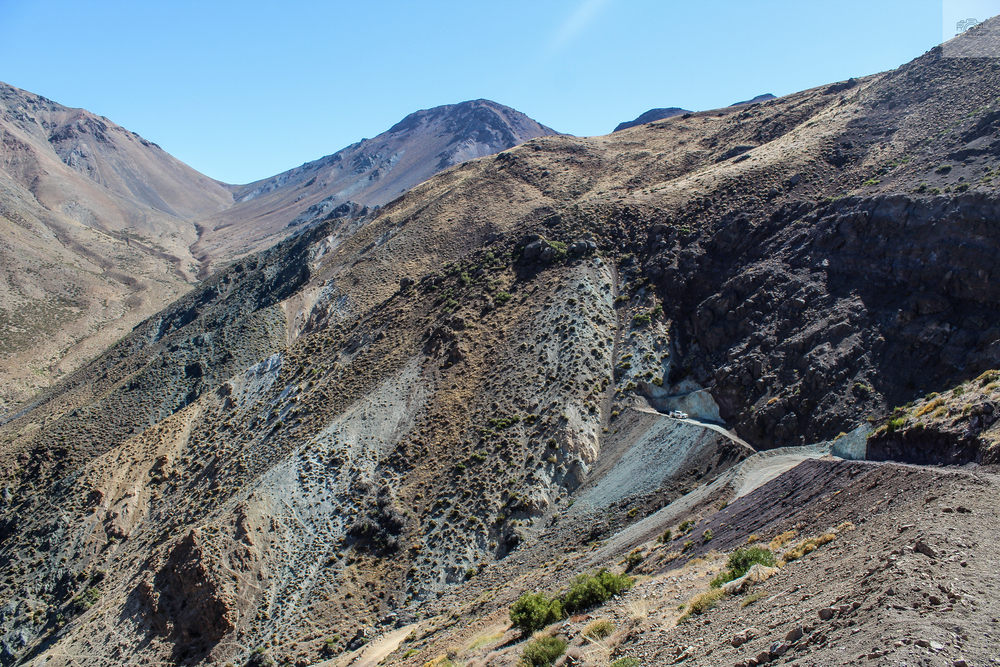
Fitzroy Minerals has planned 5,514 metres across 5 holes at Caballos. The metre split shows which of the 5 chargeability anomalies the company backs.
Project Overview
Fitzroy Minerals (TSXV: FTZ | OTCQX: FTZFF | FSE: C3Y) holds 18,000 hectares of licenses over the Caballos copper porphyry project in Chile's Valparaiso Region, 70 kilometres (km) south of the Los Pelambres mine and 100 km north of Los Bronces. Those two neighboring mines together host approximately 80 million tonnes of contained copper, which puts a grass-roots target inside a producing belt rather than a frontier one. The Caballos Project is a copper-molybdenum-gold-rhenium target with sulfide mineralization from surface, and it has no mineral resource estimate.
A ground geophysical survey over the project has now produced a set of chargeability anomalies, and the company has planned 5 diamond drill holes totaling 5,514 metres (m) to test them, targeting a September 2026 start. How those metres divide across the anomalies is the most specific statement available of which targets Fitzroy backs, and at what cost.
1. The Deep Induced Polarization Survey & Its Coverage
The survey that generated Caballos' drill targets covered 18.4 line-km across 4 lines, a narrow footprint within the much larger area imaged by the earlier airborne work.
Southernrock Geophysics S.A. completed a ground-based deep induced polarization (IP) chargeability and resistivity survey using pole dipole induced polarization and magnetotellurics, reaching approximately 1,500 m for the pole dipole component and nominally 3,000 m for the magnetotelluric component. Two-dimensional and three-dimensional inversions of chargeability and resistivity were run on the results. All four lines crossed the regional Pocuro Fault Zone (PFZ), and the survey's phase-tensor work found the dominant structural trends aligned roughly north-south or southwest-northeast to depths of perhaps several kilometres, with the north-south orientation matching that structure.
The lines were laid across conductive anomalies already identified by a heli-borne survey earlier in 2026, which covered a much larger area than the ground work. The ground survey, therefore, did not search for targets so much as test a shortlist of them, and every anomaly now holding drill metres was selected from a list drawn up before a single IP electrode went into the ground.
2. Five Anomalies & Four Drill Targets
Five anomalies appear in both the two-dimensional and three-dimensional inversion models, and the program tests 4 targets, leaving two anomalies with no metres at all.
The anomalies labeled C1, C2-A, C2-B, C3, and C4 are all evident in both inversions. The drilling program tests extensions of mineralization at Chincolco Creek, along with C2-B, C3, and C4. C1 and C2-A have no planned holes, no planned metres, and no described character beyond their confirmation in the models, which makes exclusion the first allocation decision the program records.
Prior drilling at Caballos returned mineralized breccias containing clasts of porphyry rocks, and the company has integrated that geology with both geophysical datasets into a single updated interpretation of the area.
3. The 1,900-Metre Hole at C2-B
The longest hole in the program, at 1,900 m, drills east into C2-B, the one anomaly whose cross-section shows the geometry of a classic porphyry system.
On the northern survey line, the C2-B chargeability anomalies extend over 3 km east-west across the far south of a circular feature. Below a clear horizontal break at approximately 2,000 m elevation, interpreted as the base of the unmineralized younger volcaniclastic Farellones Formation, two major chargeability anomalies flank a zone of moderate chargeability. That arrangement is a common feature in porphyry copper deposits, and in a classic porphyry model, the moderate zone between two outer walls of highly pyritic material is the main site of copper mineralization.
President and Chief Executive Officer of Fitzroy Minerals, Merlin Marr-Johnson, reads the C2-B section against that textbook model:
"The largest IP anomaly, C2-B, is consistent with a classic porphyry signature, comprising a strongly conductive and chargeable (pyritic?) outer shell surrounding an inner core."
The adjacent line to the south shows broadly similar anomalies at greater depths, which suggests a potential plunge of the main chargeability feature to the south-southeast. Committing the single longest hole to the target defined by that geometry makes the porphyry model itself, and not any drilled grade, the program's primary bet.
4. Hole Lengths at C3 & C4
C3 takes a 1,500 m hole drilled west and shares a second, shorter hole with Chincolco Creek, and C4 takes 1,250 m hole drilled west. C4 is a large, shallow anomaly approximately 1 km wide and 1 km deep on one of the two southern lines, broader and slightly less thick vertically on the other, and it lies directly below the Farellones Formation contact. Its moderate resistivity profile may or may not be a function of vein density, or of silica or gypsum content. The anomaly lies near the junction of the north-south PFZ and the cross-cutting east-west structure that hosts the Alicahue River.
C3 is a chargeability anomaly rising obliquely toward the surface close to where drilling took place in 2025 at the Chincolco Creek target, and Fitzroy believes it could be related to the fault zone and to the sulfide mineralization intersected in that prior drilling. Neither C3 nor C4 sits as deep as the C2-B target, and the planned lengths follow: 1,500 m and 1,250 m, compared with 1,900 m.
5. Two Short Holes at Chincolco Creek & C3
The two shortest holes in the program run 514 m east into C3 and Chincolco Creek together and 350 m west into Chincolco Creek, where 2025 drilling already recovered copper from the core.
Drilling in 2025 at the Chincolco anomaly returned 200 m grading 0.46% copper, 591 parts per million (ppm) molybdenum, and 0.07 grams per tonne (g/t) gold from 66 m depth, including 42 m at 1.20% copper, 1,764 ppm molybdenum, and 0.23 g/t gold. True widths of those intercepts are estimated at approximately 75% of the down-hole intervals. The 200 m interval grades 0.81% copper equivalent on assumed recoveries of 85% for copper, 90% for molybdenum, and 50% for gold, and at three-year trailing average prices of US$3.99 per pound for copper, US$21.37 per pound for molybdenum, and US$2,043 per ounce for gold, with no metallurgical test work yet completed at the project.
Those results predate this survey and are background to it rather than an output of it. Mineralization was intersected from the surface, and the geophysical anomalies at C3 could extend that known mineralization along strike and at depth. A 350-metre hole is a cheap way to find out. Setting two short extension holes against 3 deep tests spreads the program across very different odds.
6. Chargeability & the Limits of the Method
The best-confirmed mineralization at Caballos produced one of the weakest geophysical responses, which bounds what the anomaly hierarchy can tell investors.
The abundant sulfide mineralization intersected in Chincolco Creek drilling did not have a very strong associated conductivity anomaly, probably because that mineralization is disseminated and because quartz and gypsum veining are abundant there. Chincolco shows a subtle anomaly extending southward and at depth along the projection of the fault zone. The survey contractor describes the zones of induced polarization response across the project as presumably related to the presence of disseminated sulfide mineralization, a formulation that stops well short of confirmation.
Marr-Johnson keeps the chargeability interpretation at the level of probability:
"In the Caballos geological setting, it is highly probable that the chargeability corresponds with sulphide mineralization - a view also held by the contractor, Southernrock Geophysics."
Geophysical surveys are not definitive; the results are still in the early stages of interpretation, and there is no guarantee of a mineral discovery. Because Chincolco shows that strong mineralization can register faintly, the ranking these metres express is a ranking of geophysical response, and the coming program is a test of how closely that response tracks copper.
7. Program Funding & the September Start
The program's budget is stated in metres, and the cash intended to fund future drilling comes from an operation that has not started producing.
5 holes have been planned against a drilling budget of approximately 5,500 m, and the individual hole lengths total 5,514 m. Planning is underway for a September 2026 start. The company held a treasury of C$25 million as of May 2026, and management put company-wide spending at roughly C$1.4 million per month as of late June 2026, which sets the scale of what a 5,514-metre program consumes relative to available cash.
Marr-Johnson ties the drilling budget to a revenue stream that has yet to begin:
"The plan is that future cash flow from the Buen Retiro Heap Leach operation will fund non-dilutive exploration drilling."
Key Takeaway for Investors
- Two confirmed anomalies get nothing. C1 and C2-A appear in both the two-dimensional and three-dimensional inversion models yet receive no planned metres, which makes exclusion the program's first ranking decision.
- The longest hole backs a geometry, not a grade. A 1,900-metre hole is drilled east into C2-B because its cross-section shows two chargeable walls flanking a zone of moderate chargeability, the arrangement predicted by a classic porphyry model.
- The shallower target draws the shorter hole. C4 is a shallow anomaly, approximately 1 kilometre wide and 1 kilometre deep, lying directly below the Farellones Formation contact, and it draws 1,250 metres, whereas the deeper C2-B target draws 1,900 metres.
- The method has a demonstrated blind spot. Abundant sulfide mineralization at Chincolco Creek did not produce a strong conductivity response, probably because it is disseminated and because quartz and gypsum veining is abundant, so the anomaly hierarchy ranks geophysical response over confirmed copper.
- The budget is set in metres, not dollars. Fitzroy held a treasury of C$25 million as of May 2026 against company-wide spending of roughly C$1.4 million per month, and the drilling it intends to fund with copper oxide cash flow depends on production that has not yet begun.
Bottom Line
Caballos has gone from a set of conductive anomalies to 5 confirmed in both inversion models, and the drilling program prices that set in metres: 1,900 m east into C2-B, 1,500 m west into C3, 1,250 m west into C4, 514 m east into C3 and Chincolco Creek, and 350 m west into Chincolco Creek. C1 and C2-A were confirmed in both inversion models and left undrilled. The program's own disclosure supplies the caveat, because the one place at Caballos where sulfide mineralization is already known produced a weak geophysical signal, so the hierarchy being drilled ranks conductors and chargeability, not copper grade. There is no mineral resource estimate at Caballos, and no completed metallurgical test work, and the first holes are targeting a September 2026 start.
Analyst's Notes





Subscribe to Our Channel









Stay Informed


