




Hormuz Mine Strikes Tie Oil's Surplus Trade to US Naval Staying Power



November's oil sell-off may offer an attractive entry point into non-Gulf crude producers as supply disruptions challenge surplus forecasts.
- Brent settled up 3.5% at $94.61 a barrel and West Texas Intermediate (WTI) rose 2% to $83.68 on November 25, 2026, after a Houthi strike claim on Saudi Arabia's Ras Tanura refinery and Iranian reports of Hormuz mine strikes.
- As of November 25, 2026, October's global oil inventory buildup depended on a US-organized tanker shuttle and blockade of Iran, leaving the anticipated supply surplus vulnerable to disruptions in naval operations.
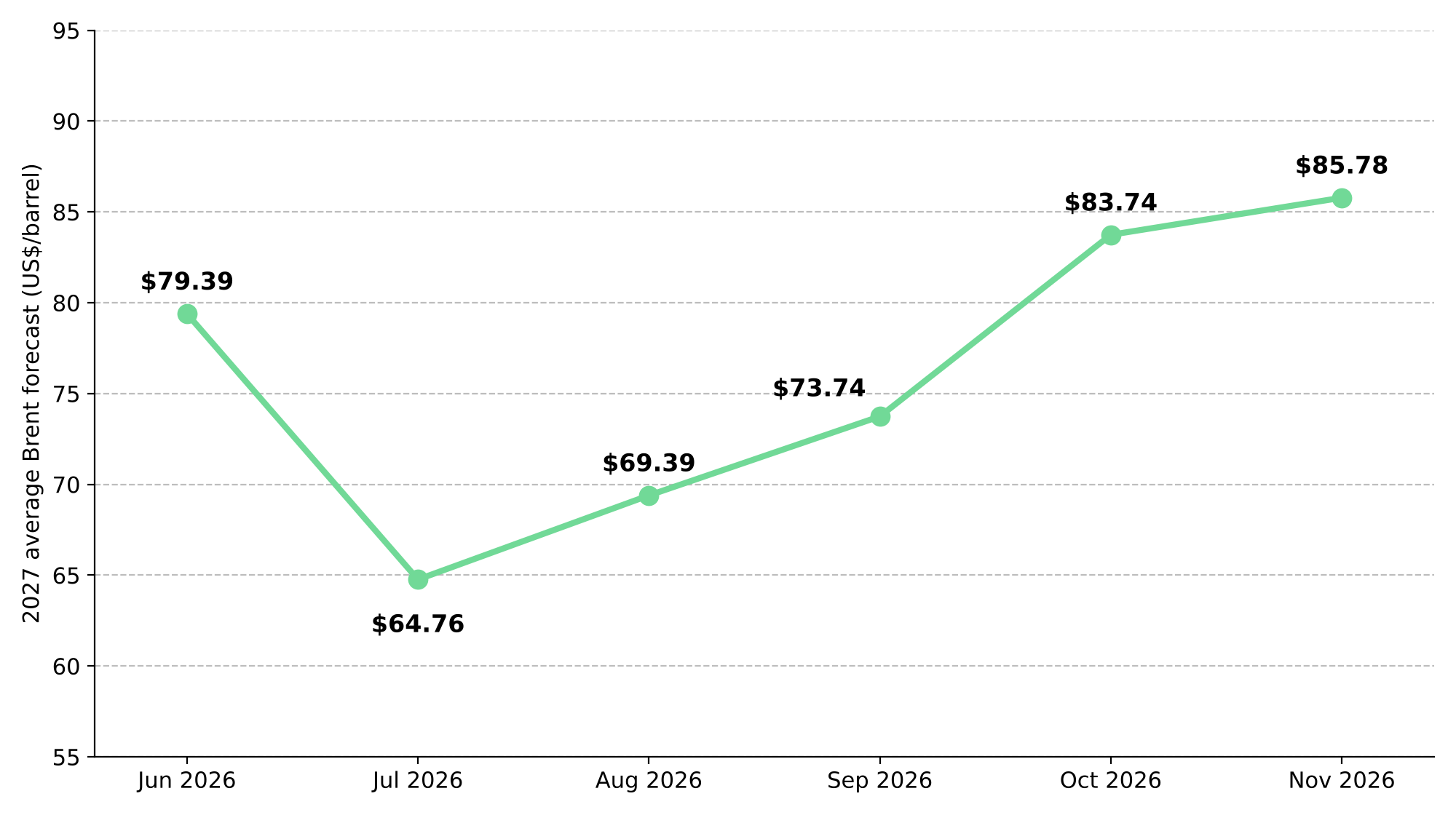
- The US Energy Information Administration's (EIA) November 2026 Short-Term Energy Outlook raised its 2027 average Brent price forecast to $85.78 per barrel from $64.76 in July, assuming most Middle East oil production outside Iran returns to pre-conflict levels by mid-2027.
- Iran's mine-strike claims remain independently unverified, while uncertainty over the duration of US naval operations strengthens the investment case for oil producers outside the Persian Gulf.
- A cut in the EIA's 2027 Brent price forecast below $85.78 per barrel would mark the first downward revision since July, signaling greater confidence in a supply surplus and potential downside for oil prices.
Ras Tanura Attack & Mine Strikes Lift Brent 3.5% After November Slide
Brent and WTI futures settled at $94.61 and $83.68 per barrel, respectively, after Yemen's Iran-aligned Houthis claimed strikes on Saudi Arabia's Ras Tanura refinery and Riyadh's financial district. Iranian state media reported that two tankers struck mines and exploded in the Strait of Hormuz, while the Iranian Army later reported a tanker catching fire after striking a mine, though neither mine-strike report has been independently verified.
The rebound follows a nearly 25% decline over three weeks in November driven by supply surplus expectations, while threats to Ras Tanura, a major Saudi export terminal, challenge assumptions of uninterrupted supply. US commercial crude inventories rose 1.1 million barrels to 418.9 million but remained 3% below the five-year average, limiting the buffer against further supply disruptions.
US Naval Shuttle Carries the Gulf Exports Behind October's Stock Build
Gulf crude exports recovered through alternative routes rather than a reopened Strait of Hormuz. Kpler reported that 40% of regional crude bypassed Hormuz through Saudi and UAE pipelines, while most shipments crossing the strait relied on offshore tanker transfers, including those along Oman's coast. Daily Iranian reports of mine strikes and declining Gulf crude flows recorded by Kpler highlight the vulnerability of these arrangements, particularly for exports from Ras Tanura that still require passage through Hormuz.
Iran's crude exports fell to 15,806 barrels per day in October under the US blockade, prompting further attacks on commercial shipping. John Kemp, Independent Energy Analyst, noted that October's global oil inventory buildup depended on the US tanker shuttle and blockade, whose high enforcement costs threaten their medium-term viability and the anticipated supply surplus.
Slowing Gulf Exports Test the Surplus Path Behind 2027 Brent Forecasts
Daniel Hynes, Senior Commodity Strategist at ANZ, warned that the widening conflict threatens the recovery in Persian Gulf crude exports, which rose last week but continue to decline overall. Despite November's sell-off, the EIA raised its 2027 Brent price forecast for four consecutive months to $85.78 per barrel, even assuming most Middle East oil production outside Iran returns to pre-conflict levels by mid-2027.
Hormuz Shuttle Risk Moves Oil Value to Barrels That Need No Escort
Chinese independent refiners paid $6 to $9 per barrel above Brent for Iraqi and UAE crude, compressing refining margins when crude costs rise faster than fuel prices. With US refineries operating at 97.5% capacity, limited spare capacity leaves fuel markets vulnerable to further Gulf supply disruptions.
Iraq restarted its 120,000-barrel-per-day Kirkuk-Fishkhabour pipeline and is targeting exports of 500,000 barrels per day to Turkey. While Gulf producers must expand alternative export routes, non-Gulf producers selling crude at Brent- or WTI-linked prices can benefit from higher benchmarks without incurring Hormuz-related rerouting costs.
The duration of US naval operations and the outcome of OPEC+'s November 29 meeting on 2027 production policy remain uncertain. Brent's nearly 25% decline over three weeks underscores the importance of sizing positions in non-Gulf oil producers to withstand comparable price declines while retaining exposure to a potential recovery.
Who Pays for Oil's Escorted Surplus
October's inventory buildup, which contributed to November's sell-off, depended on US naval operations rather than a return to normal Gulf exports. Reported mine strikes threaten to increase the cost of maintaining these operations, leaving the anticipated supply surplus vulnerable to renewed disruptions and creating potential upside for oil prices.
November's oil price decline may offer a lower entry point into non-Gulf crude producers, whose exports do not depend on US naval escorts through Hormuz. Valuations should treat the anticipated supply surplus as conditional on continued US naval operations rather than an assured recovery in Gulf exports.
Maintaining exposure to non-Gulf crude producers preserves potential upside if global oil supply falls short of surplus forecasts.
Analyst's Notes





Subscribe to Our Channel









Stay Informed


