Sun Valley Minerals Drills New Vein Model in Uruguay


Sun Valley Minerals is drilling Tarumán Main in Uruguay after trenching 23.65 m at 10.03 g/t gold, with Kinross Gold backing and C$14.6M in cash.
- Sun Valley Minerals listed on the TSX Venture Exchange on October 27, 2026, and is funded for up to 15,000 m of RC drilling and 10,000 m of diamond drilling.
- The company is testing northwest-trending veins that most historical B2Gold holes at Tarumán Main were drilled sub-parallel to.
- Trenching at Tarumán Main returned 23.65 m at 10.03 g/t gold and 64.60 m at 2.61 g/t gold, and assays for another 764 m of trenching are still pending.
- Kinross Gold holds 14.9% of Sun Valley Minerals and Altius Minerals holds 7.7%, and Sun Valley owns its 2 drill rigs and the historical B2Gold core.
- The high trench grades at Tarumán Main come from weathered regolith that may be enriched, so Sun Valley's first drill assays are the main test of whether the gold continues at depth.
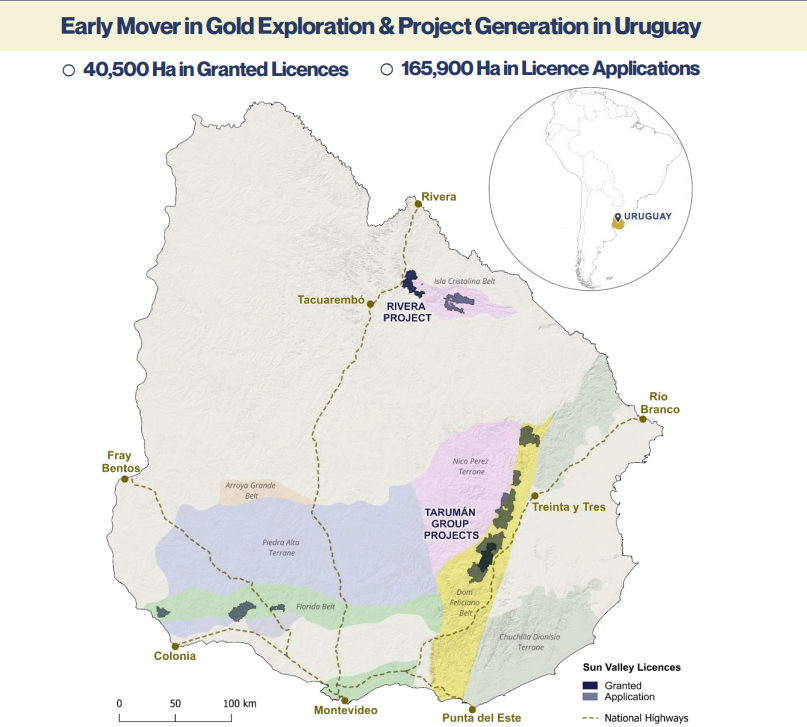
Uruguay has a short mining history and little modern gold exploration. Sun Valley Minerals (TSXV:SUNV) has been assembling, since early 2020, a 100%-owned gold portfolio there across 3 geological belts, and listed on the TSX Venture Exchange on October 27, 2026. The company holds 40,500 hectares (ha) in granted licenses and a further 165,900 ha in license applications.
The listing brings a funded maiden drill programme at its Tarumán Main project into public view. Sun Valley reports C$14.6 million in estimated cash at September 30, 2026, 2 company-owned drill rigs, and funding for up to 15,000 meters (m) of reverse circulation (RC) drilling and 10,000 m of diamond core drilling. Kinross Gold holds 14.9% of the shares. The drilling tests a geological model that differs from the one used by the project's previous operator.
Restaking a Belt Left Behind
Sun Valley's starting point was historical work by B2Gold. The major entered Uruguay at the end of 2010, completed most of its drilling in 2011 and some in 2012, and moved away at the end of 2012 as it advanced a mine in Namibia. Founder, President & CEO of Christo Stemmet met Uruguayan geologist Matías Eguia, now President of Uruguay Operations, in 2019. The pair incorporated a local company in early 2020 and restaked part of the former B2Gold ground.
Under B2Gold's earn-in agreement with a local company, the data stayed behind when B2Gold left. Sun Valley acquired it and owns the historical core and data. Across a 30 kilometer (km) stretch, B2Gold defined 3 large gold-in-soil anomalies and drilled about 10,000 m. At Tarumán Main, 69 holes were drilled, where the best historical intercept listed is a 24.25 m at 5.61 grams per tonne (g/t) gold from 18.6 m. Sun Valley has since staked about 150 km of the belt, and Stemmet describes Sun Valley as the only foreign company currently exploring in Uruguay.
A Different Geological Model at Tarumán Main
Tarumán Main hosts a 3 km by 1.5 km gold-silver-in-soil anomaly that remains open to the north, south, and west. Outcrop is limited. Bedrock typically lies at or within about 2 m of surface under a thin soil blanket. Sun Valley has taken more than 5,000 structural measurements and run 5 types of geophysical survey.
The company's model separates two controls on mineralization. The host is a northeast-trending fold and thrust belt containing a reactive carbonate unit. Younger northwest-trending quartz-sulfide veins and breccias cut across that belt. President and Chief Executive Officer of Sun Valley Minerals, Christo Stemmet, explained why the company treats the veins as the source of the gold:
"What we learned from the government geophysics and from our own work we've taken over 5,000 structural measurements [...] There's structures coming in from the Northwest that cross cuts the belt. We think the fluids were introduced by a younger event that's related to these veins that are coming in."
The highest surface grades sit with the veins. Where vein swarms cut the reactive unit, secondary replacement mineralization extends along the foliation, and massive sulfides form in fold hinges. Historical drilling mainly targeted the northeast-trending replacement style, and the company presentation states that most holes ran sub-parallel to the northwest-trending vein system. Stemmet said the highest grades occur where both controls overlap.
Interview with Christo Stemmet, President & CEO of Sun Valley Minerals
Trench Results & the Maiden Drill Programme
Sun Valley completed 5,405 m of trenching across 59 trenches in April 2026. Results included 23.65 m at 10.03 g/t gold, with 8.70 m at 24.02 g/t, from a trench with partial results received. A second trench returned 64.60 m at 2.61 g/t, including 27.30 m at 5.01 g/t, and a third returned 127.30 m at 1.16 g/t. Assays for 764 m of trenching remain outstanding.
The best trenches come from an area of about 800 m by 400 m that the company calls the southern zone, where a large vein swarm crosses the soil anomaly. The RC rig is drilling shallow holes through that zone to locate high-grade shoots, either along the northwest-trending veins or as massive sulfide replacement in northeast-dipping hinge zones.
Sun Valley had completed 10 RC holes for 553 m and 427 m of diamond drilling, with its second diamond hole nearing completion. The first diamond hole intersected host-rock foliation and crosscutting veins at about 40 to 50 degrees. The company said this supports the chosen orientation for testing both styles. The first batch of drill samples was scheduled for dispatch to ALS Laboratories in Mendoza, Argentina. On the eastern side, a structure shows surface sulfides and a geophysical anomaly, and a magnetotelluric survey identified conductors to 600 m. The company is targeting holes of more than 600 m there to test it as a possible feeder.
Beyond Tarumán Main: Plumas Doradas, Keana & Rivera
Plumas Doradas lies 15 km north-northeast of Tarumán Main. It hosts a 2.5 km by 1 km historical gold-in-soil anomaly. All 7 historical holes, totalling 1,500 m, intercepted gold, including 2.25 m at 19.51 g/t from 49.4 m. Sun Valley is applying for drilling rights there and is targeting a drill programme early in 2027.
Keana, 8 km south-southwest of Tarumán Main, has a 2.8 km historical gold-in-soil anomaly and has never been drilled or mechanically trenched. In the north, the Rivera project lies along strike of the historical San Gregorio mine. Sun Valley has worked Rivera for about 3 months, and Stemmet called the early signs very positive. Stemmet confirmed that Tarumán Main takes roughly 90% of capital allocation for the moment.
Backers, Team & Capital Structure
Kinross Gold first invested in November 2024 at 9.9%, raised its stake to 14.9% in a later financing, and maintained that level in the most recent raise. Altius Minerals holds 7.7% and the Gignac family holds 4.1%. The board, management, and advisors hold 17.2% while institutions and high-net-worth and retail holders have the rest. The company listed by direct listing on a non-offering prospectus rather than through an initial public offering or reverse takeover.
Sun Valley has a C$61.7 million market capitalisation based on the most recent C$0.75 financing. About 40 technical staff work on site, supported by an in-house portable X-ray fluorescence laboratory. Vice President, Exploration Laubser Pepler previously ran exploration for Allied Gold in Côte d'Ivoire. Advisory board chair David Underwood led the team behind the 3.2 million ounce Twin Hills discovery in Namibia.
The Investment Thesis for Sun Valley Minerals
- Sun Valley holds 100% of a portfolio across 3 geological belts in Uruguay, with 40,500 hectares granted and 165,900 hectares under application.
- The drill programme is funded for up to 15,000 meters of reverse circulation drilling and 10,000 meters of diamond drilling, with estimated cash of C$14.6 million at September 30, 2026.
- The company is testing northwest-trending veins that historical drilling largely ran parallel to, which gives the new holes a different angle on known mineralization.
- Trenching at Tarumán Main returned 23.65 meters at 10.03 grams per tonne gold and 64.60 meters at 2.61 grams per tonne gold, although these intervals lie in weathered material that may be enriched.
- Kinross Gold holds 14.9% and Altius Minerals holds 7.7%, so the company has 2 strategic shareholders at the exploration stage.
- Watch for the first drill assays from the shipment to ALS Laboratories, the remaining 764 meters of trench results, and the deep holes planned on the eastern structure.
The case at this stage depends on whether drilling confirms continuous mineralization below the weathered profile at Tarumán Main.
Macro Thematic Analysis
Uruguay saw only a short stint of exploration and mining activity in the 1980s and 1990s, mainly in the north around the San Gregorio mine. The country pairs that thin exploration record with institutional stability. It ranked 17th on the 2025 World Corruption Perception Index and 12th on the 2025 World Democracy Index, generates about 95% of its electricity from renewable sources, and has a paved road network and year-round field conditions. Stemmet said Uruguay's mining code is its own but closest to Brazil's, with an online cadastre system, and that little has changed for the company through a change of government since 2020.
Stemmet described the opportunity this creates for an early entrant:
"There are very few places in the world where you can stake an entire belt, [and] fewer places where that happens to be in a good jurisdiction. And then Uruguay is definitely a good place to be."
The geological link to Namibia gives that frontier a reference point. Reassembling Africa and South America places Tarumán in the same Pan-African and Brasiliano age terrain that hosts multi-million ounce gold deposits in Namibia. For gold explorers, the comparison offers a model of the deposit styles the belt could host, though it does not establish that Uruguay hosts them.
TL;DR
Sun Valley Minerals listed on the TSX Venture Exchange on October 27, 2026, after building a 100%-owned gold portfolio in Uruguay. It holds historical B2Gold core and data, owns 2 drill rigs, and is funded for up to 15,000 meters (m) of reverse circulation and 10,000 m of diamond drilling, with C$14.6 million in estimated cash. The company is testing northwest-trending veins that historical holes mostly drilled parallel to. Trenching at Tarumán Main returned 23.65 m at 10.03 grams per tonne (g/t) gold and 64.60 m at 2.61 g/t, though these lie in weathered material that may be enriched. Kinross Gold holds 14.9%. First drill assays and 764 m of pending trench results are the next tests.
FAQs (AI-Generated)
Analyst's Notes





Subscribe to Our Channel




Stay Informed