




Hormuz Recovery Pushes WTI Down 1.6%, but $5.313 Diesel Keeps Mining Fuel Costs Elevated


Hormuz recovery lowers crude prices, but refinery constraints keep diesel and mining fuel costs elevated until refined fuel supply recovers.
- West Texas Intermediate (WTI) fell 1.62% to $82.24 and Brent fell 0.98% to $88.16 after Commonwealth Bank of Australia said Strait of Hormuz traffic had recovered to 30% to 35% of pre-war levels. Lower crude prices reflected improving shipping flows, while the physical crude market remained tight.
- US commercial crude inventories fell 7.2 million barrels to 404.5 million, 6% below the five-year average, while refineries operated at 97.2% of capacity, showing the price decline reflected improving shipping flows rather than weaker crude supply.
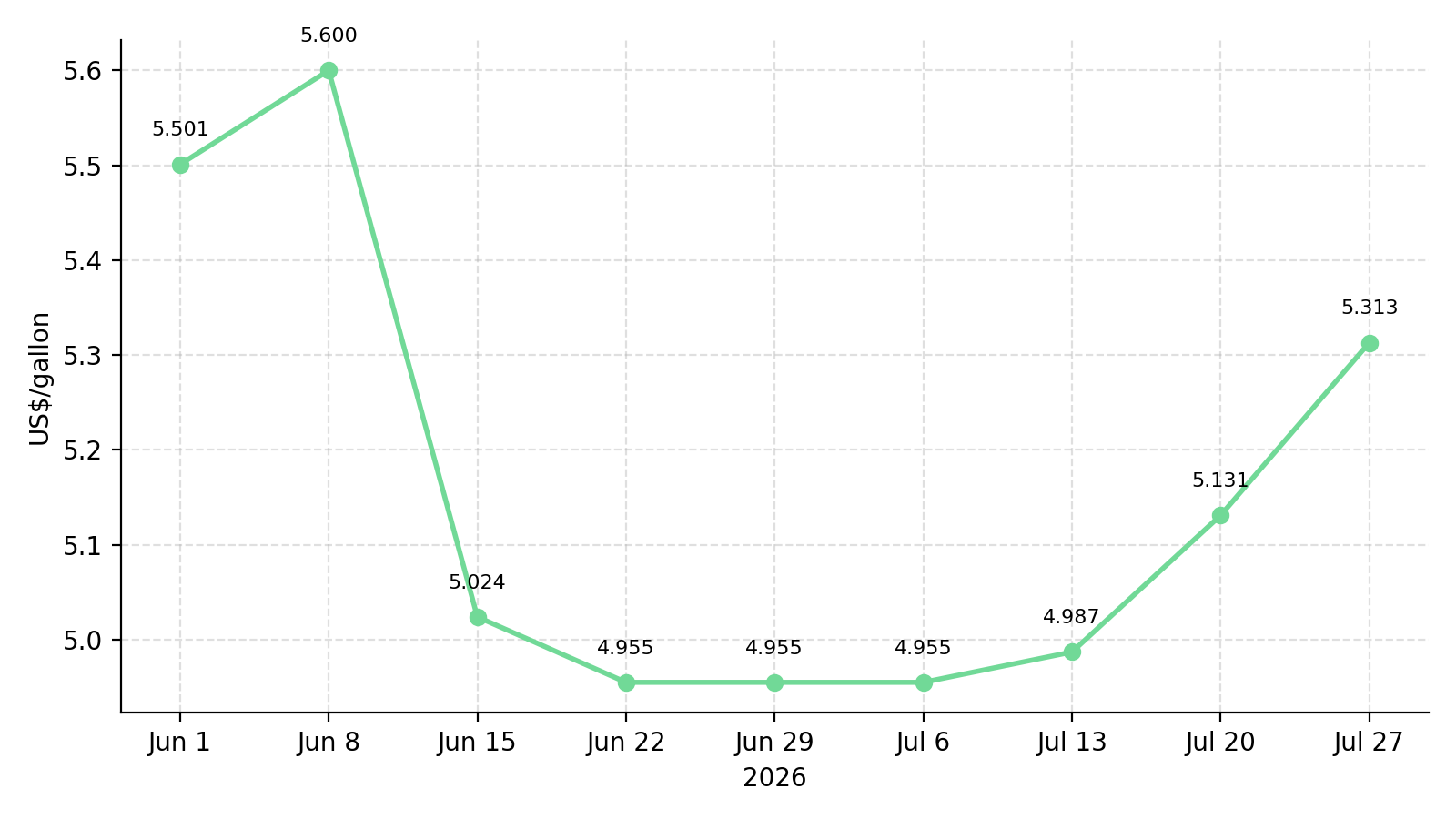
- US retail on-highway diesel rose to $5.313 per gallon, up $1.508, or 39.6%, year over year, showing lower crude prices had not reduced mining fuel costs.
- Since June 1, WTI futures have fallen about 22%, while ultra-low sulfur diesel futures have fallen just over 9%, confirming that lower crude prices have not translated into lower diesel costs.
- Commonwealth Bank of Australia said Hormuz flows returning to 50% to 60% of normal would restore crude oversupply, but mining fuel costs would continue to depend on refinery constraints.
Brent Falls to $88.16 as Hormuz Traffic Recovers, but Physical Crude Supply Remains Tight
WTI fell 1.62% to $82.24 and Brent fell 0.98% to $88.16 after Commonwealth Bank of Australia said recovering Hormuz flows had reduced shipping disruption concerns. Despite the pullback, both benchmarks remained about 20% higher for the month, showing lower crude prices reflected improving shipping conditions rather than weaker crude supply.
US commercial crude inventories fell 7.2 million barrels to 404.5 million, 6% below the five-year average, while refineries operated at 97.2% of capacity, showing the price decline reflected improving Hormuz flows rather than weaker physical crude supply.
Refineries Run at 97.2% of Capacity, Keeping Diesel Prices Elevated Despite Lower Crude
Gulf crude exports recovered by 6.5 million barrels per day in June to 16.1 million, but refined product and liquefied petroleum gas exports remained below half their pre-war levels because major Gulf refineries had not resumed exports, showing crude and diesel prices responded to different supply constraints. US refiners had just 497,000 barrels per day of spare capacity, leaving little room to offset the product shortfall and keeping diesel prices elevated even as crude exports recovered.
Ukrainian strikes on Russian refineries reduced Russian fuel exports, tightening diesel supply even as crude shipments recovered. President Donald Trump backed adding Iran tariffs to a bipartisan sanctions bill targeting Tehran and Moscow, increasing the risk of further disruption to refined fuel trade. Because the US imported only $1.4 million of goods from Iran in 2025, the proposal would primarily affect countries buying Russian energy rather than US-Iran trade, reinforcing pressure on diesel markets rather than crude supply.
$62.84 Diesel Crack Spread Signals Refinery Constraints Could Keep Fuel Costs Elevated
The US ultra-low sulfur diesel crack spread reached $62.84 per barrel, its highest level since early June, showing refinery restart delays continued to constrain fuel supply even as crude shipments recovered. Rory Johnston, founder of the Commodity Context, said oil market tightness remained concentrated in refined products rather than crude, supporting the view that diesel prices could remain elevated even if crude prices weaken.
Base case: Hormuz traffic returns to 50% to 60% of normal, the level Commonwealth Bank of Australia said would restore crude oversupply and pull Brent toward its June average of $85.40. Gulf refined product exports remain below half their pre-war level, keeping diesel prices and mining fuel costs elevated despite weaker crude prices.
Bull case: Hormuz traffic stalls at 30% to 35% of normal flows, distillate inventories remain near 110.6 million barrels, about 10% below the five-year average, retail diesel remains above $5.313 per gallon, and the Strategic Petroleum Reserve, at 307.7 million barrels, 95.1 million below a year earlier, provides limited capacity for another large emergency release.
$5.313 Diesel Prices Favor Lower Diesel-Intensity Mining Operations Despite Higher Fuel Costs
Gasoil accounts for about half of Australia's oil demand and is essential to mining, agriculture, and long-distance road haulage. The IEA reported Australian retail diesel prices were 47% higher year over year in early May 2026. In the US, on-highway diesel reached $5.313 per gallon on July 27, including $6.067 on the West Coast and $6.670 in California. By contrast, propane and propylene inventories were 34% above the five-year average, while Mont Belvieu propane traded at $0.710 per gallon, little changed from $0.711 a year earlier, showing the supply imbalance remained concentrated in middle distillates.
Because supply tightness remains concentrated in refined products rather than crude, screening should focus on open-pit exposure, haul distance, grid connection, and fuel hedge coverage and expiry dates. Underground and grid-connected operations consume less diesel per tonne than long-haul open-pit mines, making mine design a key determinant of fuel cost exposure.
The IEA reported on July 10, 2026 that Gulf export refinery loadings had not resumed and no restart schedule had been published, leaving the timing of additional fuel supply uncertain. Company filings allow fuel hedge coverage and hedge expiry profiles to be assessed. Fuel costs could rise further, and mining equities remain subject to full capital loss.
Watch Gulf Product Exports After 50% to 60% Hormuz Recovery to Gauge Diesel Costs
Diesel prices above $5.00 per gallon reflect distillate inventories of 110.6 million barrels, about 10% below the five-year average, while refiners operate at 97.2% utilization. Until distillate inventories rebuild or refining capacity expands, refining margins should remain elevated, preserving a cost advantage for lower diesel-intensity mining operations.
The first reversal signal is Hormuz traffic reaching 50% to 60% of normal, the level Commonwealth Bank of Australia said would restore crude oversupply, while diesel prices are unlikely to decline until Gulf refined product exports recover above half their pre-war level, allowing refining margins and mining fuel costs to fall.
If Gulf refined product exports recover above half their pre-war level and distillate inventories return toward the five-year average, refining margins should narrow and mining fuel costs should decline. Until then, mine design, haul distance, grid connection, and fuel hedge coverage are likely to matter more than weaker crude prices. The EIA Weekly Petroleum Status Report, EIA weekly retail diesel price data, and the IEA Oil Market Report remain the indicators to watch.
Analyst's Notes





Subscribe to Our Channel






Stay Informed


