




Dune Oil's US$0.91 Post-Raise Metric: Farm-In Carry, Resource Class & Well-Rate Assumptions


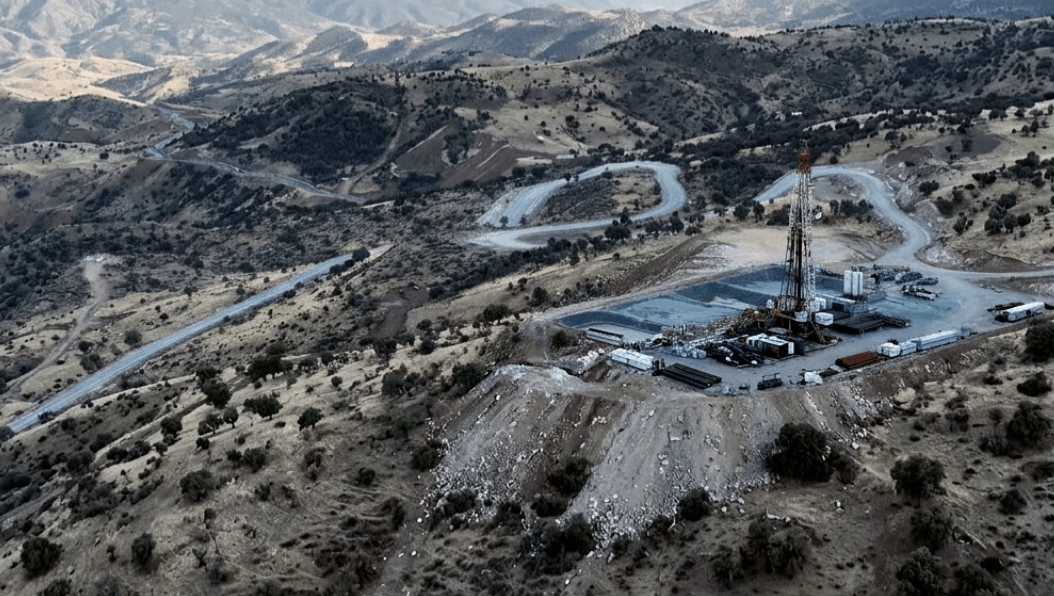
Dune Oil's $0.91 post-raise metric reflects new capital, contingent resources, farm-in costs, and well-rate assumptions shaping Block M47's valuation in Türkiye.
- Dune Oil’s value increases from $0.21 to a modeled $0.91 per net best-estimate contingent resource barrel because the calculation adds debt conversion and new capital, not because of a market re-rating.
- The company’s 27.6 million net barrels remain contingent resources rather than reserves, with management identifying a flow test as the step required before any portion of the resource can be converted into reserves.
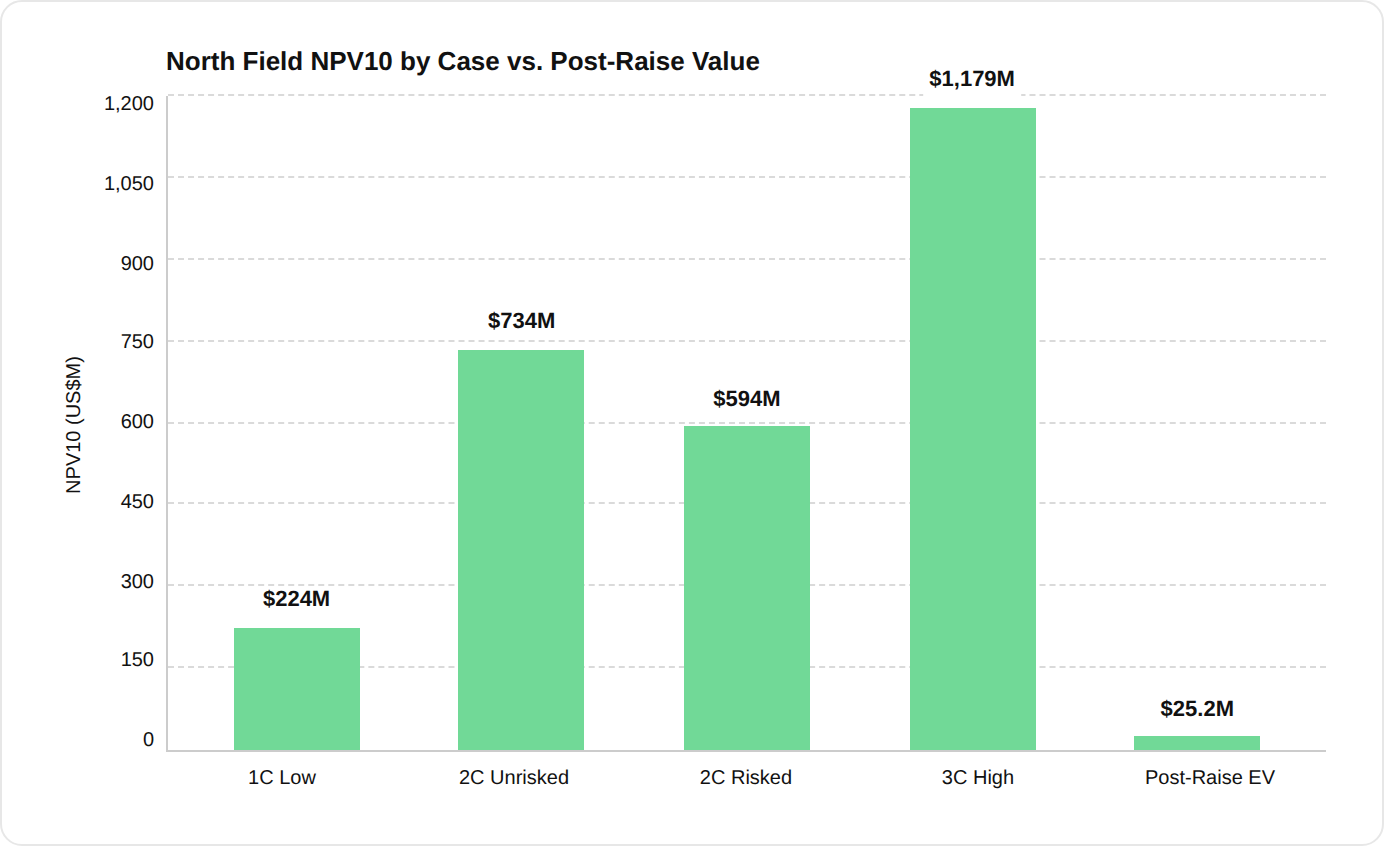
- Chapman Petroleum Engineering estimates a before-tax net present value (NPV10%) of $734 million for the 2C case, or $594 million risked at an 81% chance of development, compared with Dune’s modeled $25.2 million post-raise value.
- Dune must fund 40% to 80% of specified well and seismic costs during its $15 million earn-in, concentrating its highest cost exposure in 2026 and 2027 before production revenue begins.
- The development case depends on well performance, with Chapman assuming an initial rate of 800 barrels per day per vertical well while management describes a couple hundred barrels per day as typical for the targeted vertical completion.
Dune Oil's Valuation Sits Below Even the Low-Case Resource Estimate
Dune Oil Corp. (CSE: DUNE | OTCQB: TRLEF | FSE: Z62) is valued at US$0.21 per barrel of net best-estimate contingent (2C) resource against a US$2.58 peer median, and its planned recapitalization is calculated to lift that figure to a modeled US$0.91. This analysis examines three factors behind that gap: resource classification, the farm-in carry, and well-rate assumptions.
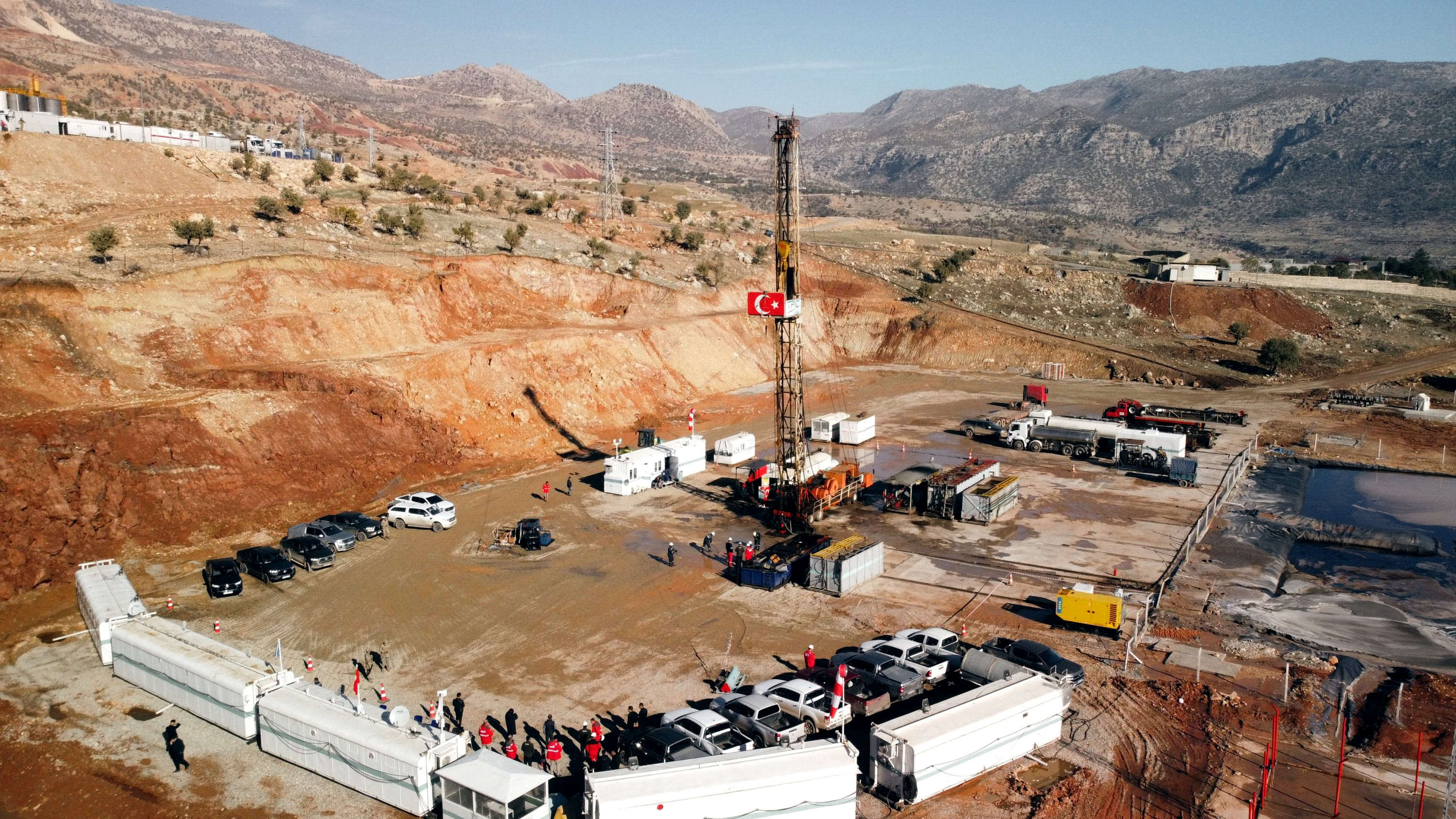
Formerly Trillion Energy International Inc., Dune has an agreement to earn a 29% working interest in Block M47, a conventional light oil discovery in the Gabar region of southeastern Türkiye. The company lists 113 million common shares, 128 million shares on a fully diluted basis, and a C$20.1 million market capitalization, all of which include the conversion of convertible debentures. The company’s per-barrel calculation separately uses a C$8 million market capitalization figure, before debt conversion and the new raise; the two market-capitalization figures are not reconciled in the supplied materials.
The Peer Comparison Mixes Reserve-Backed & Contingent-Only Companies
The company prices two groups of peers, producers and exploration-stage companies, and lists prospective-only names for context, using April 2026 data. Producers ShaMaran Petroleum (TSXV: SNM), which operates in the same Zagros carbonate geology as M47 in Kurdistan, Iraq, and Vaalco Energy (NYSE: EGY) are valued at US$3.41 and US$3.32 per barrel, respectively, of combined proved plus probable reserves (2P) and 2C resources on a working-interest basis. Exploration and early-stage peers Sintana Energy (TSXV: SEI) and TAG Oil (TSXV: TAO) are valued at US$2.58 and US$1.45 per 2C barrel, respectively, and neither reports material 2P reserves.
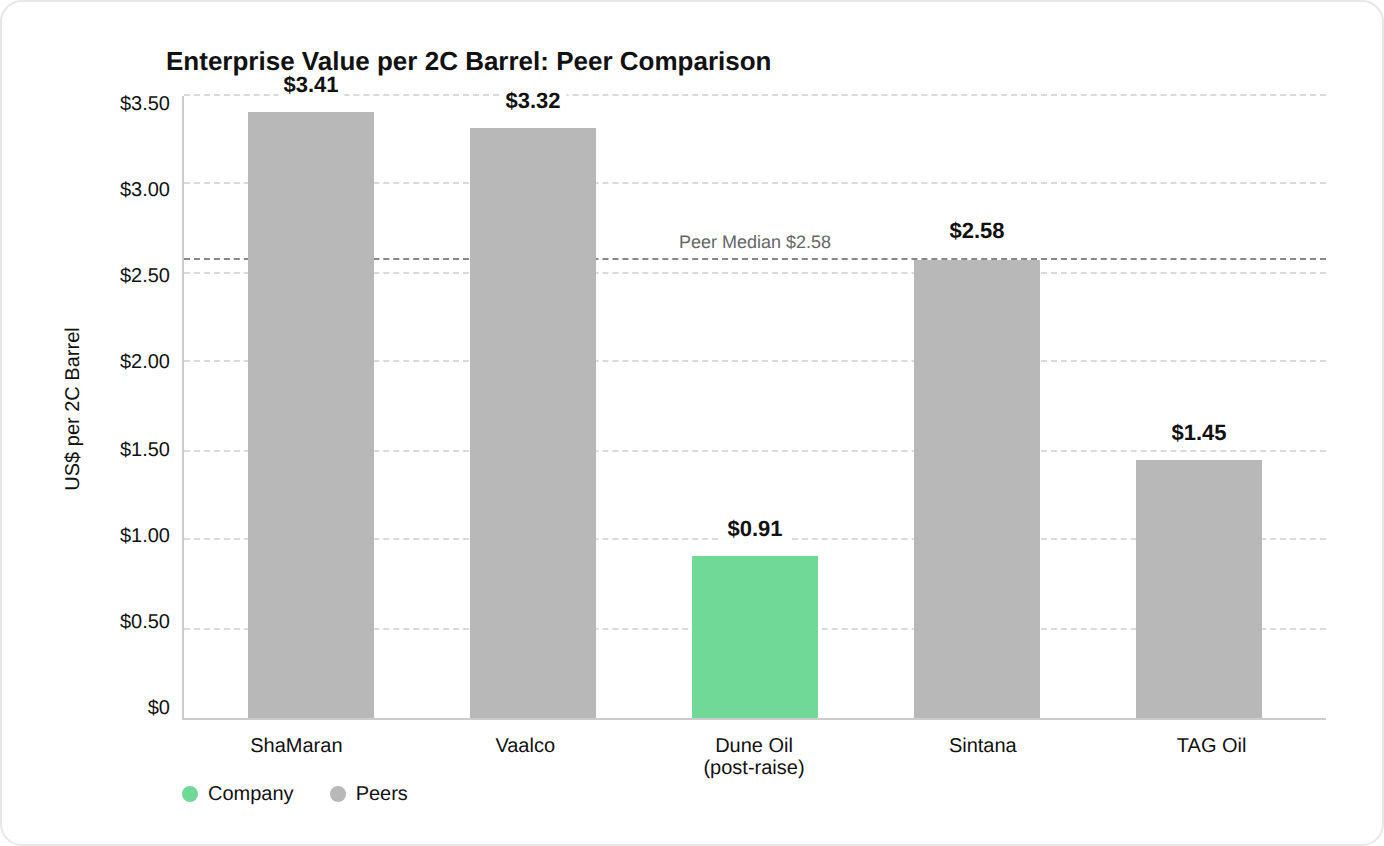
The highest multiples include reserves that Dune does not have; management identifies a flow test as the step required to book reserves.
President & Chief Executive Officer of Dune Oil, Scott Lower, described how management sees re-ratings occurring:
"The upside includes reratings at every level. When you rerate from contingent to reserve based on low-cost production testing, you get a value bump. Companies with reserves trade higher than companies with just contingent resources, and companies with production trade at a much higher level than pre-production companies."
Management has identified a flow test as the remaining step before part of the 2C can be converted to reserves, and it was targeting flow within 2 to 3 months at the time of the interview.
Recapitalization Lifts the Metric to US$0.91 per Barrel
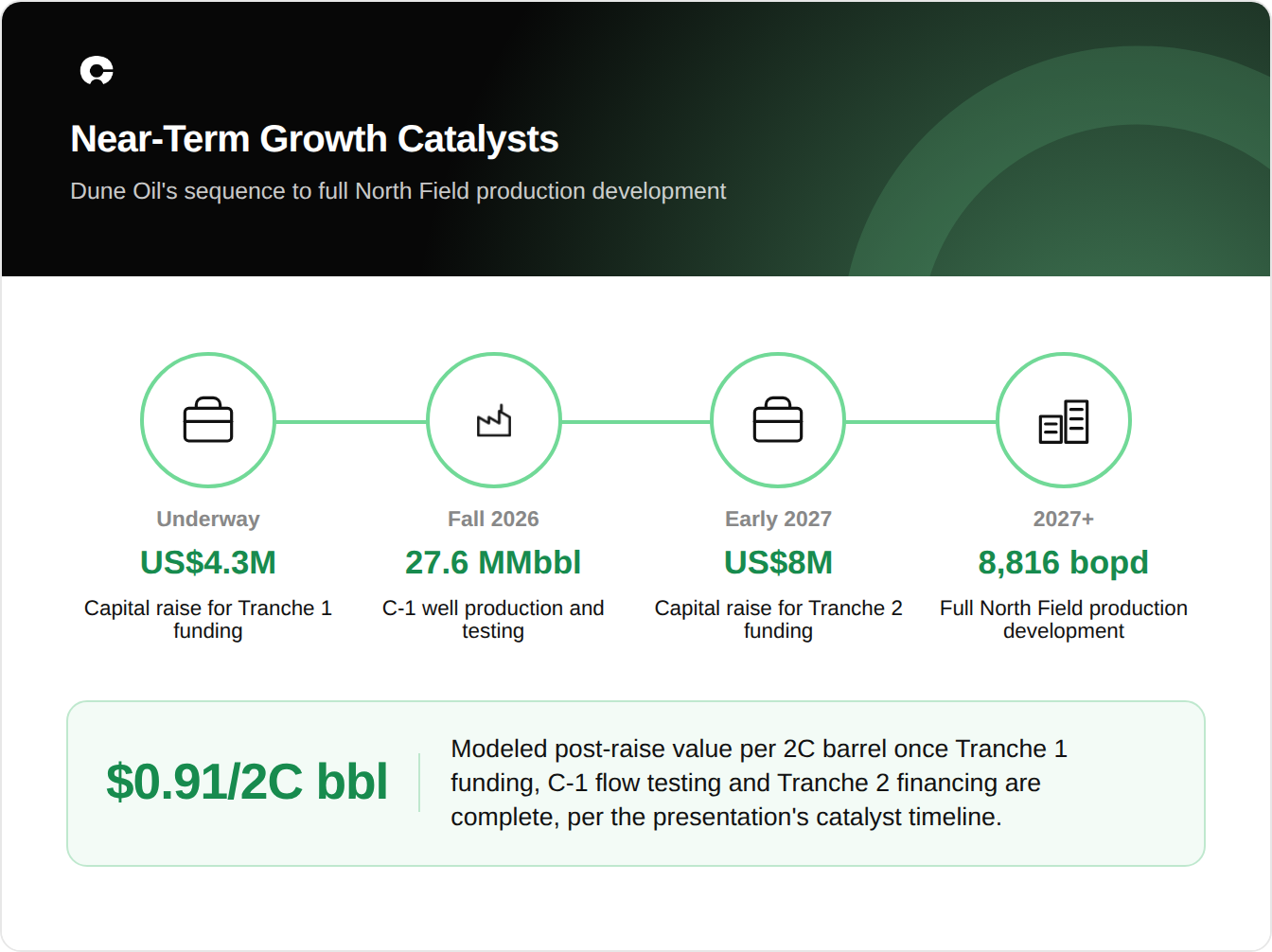
The company's post-raise calculation starts from a C$8 million market capitalization, adds C$10 million of debt conversion and a C$17 million raise to reach C$35 million, and converts that at 0.72 to US$25.2 million, or US$0.91 per 2C barrel. The raise is marked as underway as Tranche 1 funding, with a second raise for Tranche 2 shown for early 2027, and Lower described pre-production financing as more likely to be an equity raise. In the company's calculation, the increase comes from adding converted debt and new capital to the numerator. The supplied materials do not disclose the issue price of the new shares.
Lower said Dune must provide US$4.3 million in September 2026 to fund operations. Lower addressed the timing tolerance around that payment:
"We're confident, we're going to get the money in September. No one is going to say, 'If you're a week late, the deal's off,' because everybody needs money to make that go."
The August 27, 2026, appointments include Director Neil Maedel, who was Director of Business Development at Manas Petroleum, which raised more than US$250 million through equity financings and asset farm-outs, and Chief Operating Officer Jordan Coleman, who led the activation of 4 producing wells in Chad for CG International, with aggregate potential exceeding 5,000 barrels of oil per day.
Farm-In Carry Front-Loads Dune's Cost Exposure
Block holder Derkim holds 51%, Dune is earning 29%, and local drilling company GYP holds 20%. Dune's US$15 million is payable in 2 tranches, with US$800,000 advanced and US$14.2 million remaining. Tranche 1 in 2026 covers 1 to 2 new wells, a re-entry of the North Field discovery wells, an early production facility, and a 40-kilometer staged seismic program, with the presentation showing a Dune/GYP cost split of US$4.3 million and US$2.5 million. Tranche 2 in 2027 covers a minimum of 3 new wells, potential horizontal wells, and additional seismic, with a Dune/GYP cost split of US$8 million and US$2.5 million.
During the earn-in, management said Dune pays 40% of a single well and 80% of the seismic program and subsequent wells, against its 29% interest, carrying the 51% holder for the next 4 wells because that partner funded earlier wells. Once the US$15 million is spent, costs are shared pro rata, and each subsequent well is roughly US$1 million net to Dune. Dune's highest cost per unit of interest falls, on these terms, in 2026 and 2027, the same period in which it is raising equity with no production revenue.
Under the standard joint operating agreement, a partner that does not pay its share of a well forgoes that well's profits and risks. The work program targets 600 to 1,000 barrels of oil equivalent per day net to Dune by its completion. Additional wells beyond the minimum program are expected to be paid for through cash flow from development.
Per-Well Netback & Payback Estimates
Dune plans to truck early production 130 kilometers to the Tüpraş Batman refinery, and it estimates a US$ 50-per-barrel operating netback at a US$72 Brent oil price, with a 12.5% royalty and a 25% corporate tax rate in Türkiye.
Lower contrasted that fiscal regime with production-sharing structures elsewhere in the region:
"Turkey has a 25% corporate tax, so you're keeping 50% after-tax profit margins. In places like Iraq or Syria, you only get production sharing contracts where you keep very little."
The company also estimates an approximately 2-month payback and a US$5.5 million first-year netback per well. Lower estimated a 2 to 3-month payback on post-earn-in wells costing roughly US$1 million net, assuming 500 barrels per day per well, while Chapman's 2C case assumes an initial rate of 800 stock-tank barrels per day per well in its notional vertical-well schedule and approximately 1.16 million barrels recoverable per well gross.
Lower described a couple hundred barrels per day as typical for a vertical completion in an 8-meter zone such as the one targeted at C-1. Management plans to use lateral wells of perhaps 300 to 500 meters, which Lower said would produce four times vertical output, and which the company lists as potential horizontal wells in the 2027 tranche.
Prospective Resources & Dilution Risks
The per-barrel figures cover only the North Field 2C resource, so prospective resources are excluded from the denominator of both calculations. Chapman assigns mid-case (P50) prospective resources of 13,093 thousand stock-tank barrels net to Dune at Mid Prospect #1 and 7,895 thousand stock-tank barrels at South Prospect #1. Türkiye Petrolleri Anonim Ortaklığı also completed the Yatağankaya well on the neighboring Block M48 in June 2026, about 500 meters outside M47; gravity data and surface anticlines indicate that most of that structure lies on M47, and it is not yet included in the resource report.
Prospective seismic contractors completed site visits on July 29 and 30, 2026, with Dune targeting a contract award and, upon completion, its next drilling locations. These targets carry discovery risk and draw on the same earn-in capital, and the company places development of any new discoveries in 2028 and beyond.
Dune's resource disclosure states that contingent resources are not reserves and that there is no certainty that any portion will be commercially viable, and that the Chapman NPV10% figures are before income tax, while the peer multiples are dated April 2026. The company's 128 million fully diluted share count includes options, warrants, and debenture conversion; it does not state the post-raise share count, and a second raise is shown for early 2027 with pricing for neither disclosed.
The Investment Thesis for Dune Oil
- Dune Oil's modeled post-recapitalization value of US$0.91 per barrel of net best-estimate contingent resources is calculated from a larger capital base rather than a market re-rating of its 27.6 million barrels.
- Peer multiples of up to US$3.41 per barrel include proved plus probable reserves, so part of Dune's discount relates to resource classification, and management identifies a flow test at the already-drilled C-1 well as the step to booking reserves.
- Chapman Petroleum Engineering's low-estimate net present value at a 10% discount rate is US$224 million, compared with the company's modeled post-raise value of US$25.2 million. The best estimate is US$734 million unrisked and US$594 million risked.
- Dune funds 40% to 80% of well and seismic costs during its US$15 million earn-in, after which management estimates each well at roughly US$1 million net to the company.
- A company-estimated US$50 per barrel netback at US$72 Brent oil and a management-estimated 2- to 3-month payback on post-earn-in wells at 500 barrels per day per well support a cash-flow-funded development model, which the company states covers additional wells beyond the minimum program.
Dune Oil's discount coincides with identifiable conditions: no reserves, no production, a front-loaded earn-in, and a Tranche 1 equity raise, with a second raise expected in early 2027. The valuation case rests on a measurable sequence of closing the Tranche 1 financing, flowing the C-1 well, and demonstrating well rates that support Chapman's development economics.
TL;DR
Dune Oil's move from US$0.21 to a modeled US$0.91 per net 2C barrel is calculated from recapitalization inputs rather than a higher share price. The peer gap reflects missing reserves, a US$15 million earn-in in which Dune pays 40% to 80% of costs, and the difference between the couple hundred barrels per day described as typical for a vertical completion and the initial rate of 800 stock-tank barrels per day in Chapman's case, behind its US$734 million unrisked NPV10%.
FAQs (AI-Generated)
Analyst's Notes





Subscribe to Our Channel


Stay Informed


