How to Position When Mining Stocks Fall Harder Than Metals



Funds selling for cash hit mining shares harder than gold and copper. Cash runway, cost position and US inflation data shape which miners recover first.
- Australia's mining sub-index fell almost 13% in the week to 20 November, its worst week since 2020, while spot gold and LME copper each fell about 9%.
- The selling came from funds raising cash during the AI-linked equity selloff and from Fed minutes showing nearly all officials favored further rate rises, rather than from company results.
- Largely fixed mining costs turn each metal price move into a larger swing in profit, and higher rates cut the value of developers whose cash flows lie years away.
- Physical copper in China stayed tight, with the Yangshan import premium near its $500-a-tonne record, and both gold and mining shares rebounded on 23 November.
- Producers with net cash and no near-term capital need, and developers funded through construction, avoid the heavier dilution facing juniors that must sell shares at depressed prices.
Cash-Driven Selling Says Little About the Miners it Hit
Mining shares fell further than the metals they produce last week, and the selling made no distinction between strong and weak companies. Australia's mining sub-index, weighted toward the largest and best-funded producers, fell almost 13% in the week to 20 November, its worst week since the early stages of the Covid crash in 2020. Spot gold fell 9% and three-month copper on the London Metal Exchange (LME) fell about 9%.
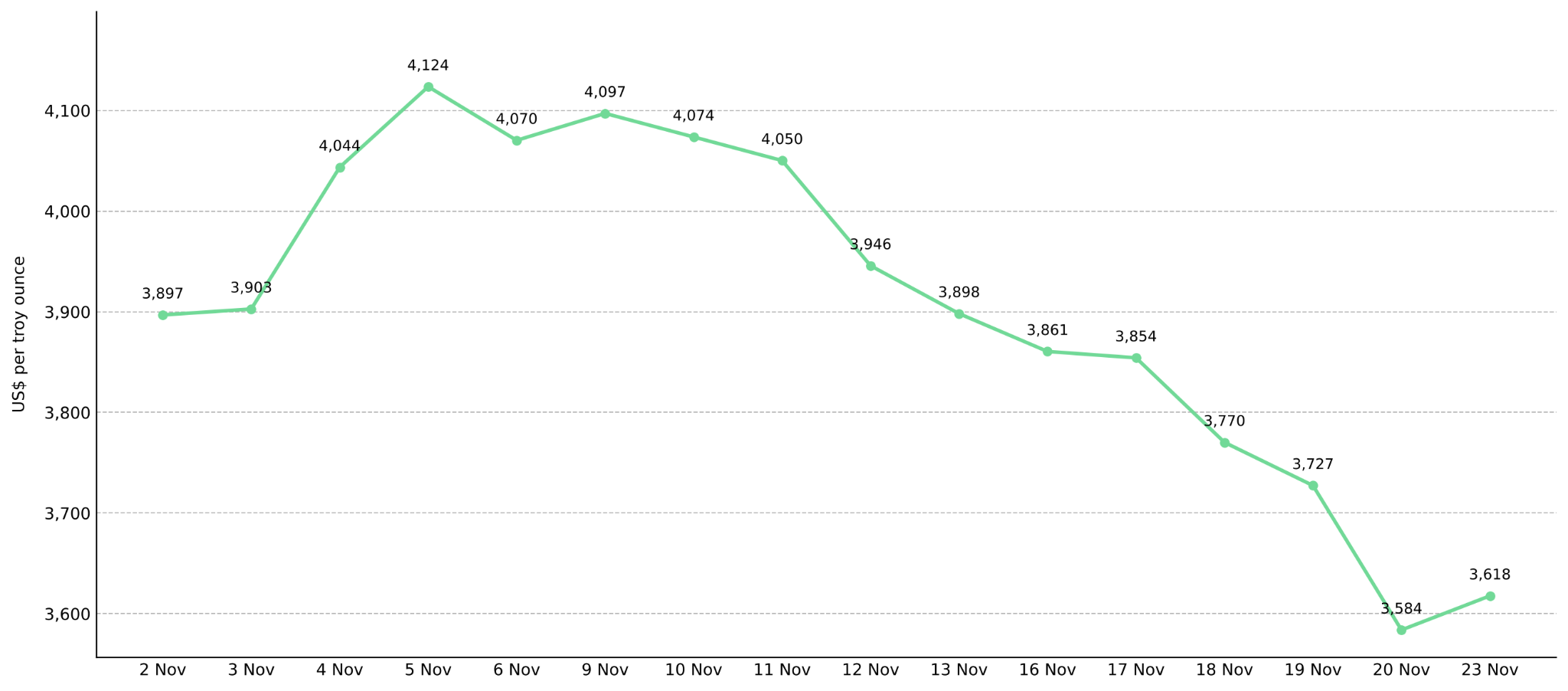
The selling did not start in mining. Part of gold's fall was due to an AI-linked equity selloff, which prompted some fund holders to sell gold to raise cash. Mining shares sat in the same funds and were sold for the same reason. On 23 November the ASX 300 metals and mining sector opened 0.6% higher, and gold miners rose 2%, as spot gold climbed 2.4% to $3,617.41 an ounce.
Thin Margins and Distant Cash Flows Swing Hardest in Both Directions
A mine's costs barely move when metal prices do. Operating leverage, the gap between a largely fixed cost base and a moving price, means a 9% fall in revenue removes a larger share of profit, and thin-margin producers lose proportionally more. Developers with no revenue are valued on cash flows years away, so a higher discount rate, the rate used to convert future cash into today's money, cuts their value even when the metal holds.
The second link is the cost of money. Minutes of the Fed's October meeting, released on 18 November, showed nearly all participants favored further rate rises, while the dollar traded near its highest level in 19 months. Physical copper did not confirm the sell-off. China's Yangshan import premium held at $495 a tonne on 20 November, a day after a $500 record.
US Inflation Data Sets the Timing of a Rebound
Two outcomes follow from the October Personal Consumption Expenditures (PCE) index, the Fed's preferred inflation gauge, due on 25 November. A soft print extends Monday's repricing: CME FedWatch already shows a half-point December hike fully priced out, and operating leverage then runs in reverse, lifting miners faster than metal. A hot print revives half-point pricing before the 9 December Fed decision, keeps the dollar firm and extends forced selling, with pre-revenue juniors hit hardest.
The consequence lands between 25 November and the Fed decision on 9 December. A hot core PCE reading that returns a 50-basis-point hike to CME FedWatch pricing would mark a second leg of selling for mining shares. In copper, premiums falling from their record as imported metal arrives would show the physical squeeze in China ending and remove the main support under copper producers.
Cash and Low Costs Decide Which Miners Recover First
Last week's losses in mining shares came mostly from funds selling liquid assets for cash and from a higher cost of money. Measured demand weakened only in iron ore, where Chinese steel output and mill profits fell. Physical copper in China stayed tight, and gold's rebound began within one session.
Shares of iron ore producers fell several times further than the ore itself, so much of the drop reflects forced selling rather than lost earnings, and the excess is the part most likely to return once the selling stops. Gold miners still earn wide margins at current prices, and producers with net cash, low costs and no near-term capital need can fund operations and growth without new equity, whatever the share price does. Copper producers selling spot cargoes into China capture premiums above the LME price, while sellers on annual contracts receive the premium fixed at the start of the year.
Junior explorers and pre-revenue developers carry the largest exposure. Raising equity after the sell-off issues more shares for each dollar raised, and the dilution stays even if prices recover. Neither Wednesday's PCE result nor the end of forced selling can be known in advance, but cash runway can: a company funded into 2027, with no share sale due before the 9 December Fed decision, faces price swings without forced dilution, while one needing new money before then faces both.
Analyst's Notes





Subscribe to Our Channel






Stay Informed