




ICG Silver & Gold Grows Historical Database, Fast-Tracking the Path to a Maiden Resource


ICG Silver & Gold (CSE:ICG) doubles its historical drilling database to 40,000m at Tuscarora, Nevada, skipping core drilling ahead of a Q1 2027 resource.
- ICG's historical drilling database at Tuscarora has grown from 25,000 metresto 40,000 metres. An independent third-party geologist has confirmed this as sufficient alongside the current 3,000-metre RC programme to support a maiden inferred resource without additional core drilling.
- The Phase 1 RC programme, budgeted at roughly $1.5 million, is testing six targets across the Central and East Zones prioritising continuity between known high-grade veins over standalone grade hits.
- South Navajo, the target with the district's best-known historical intercept, is not covered in the Phase 1 program as management is already confident in roughly 80% of its historical data.
- Assay results are expected between August and October 2026, with a maiden mineral resource estimate targeted for Q1 2027.
- ICG's approximately C$18 million market capitalisation trades at a discount to profiled Nevada exploration peers valued between C$24 million and C$160 million.
Nevada's Tuscarora District has produced more than 500,000 ounces of gold and 7.6 million ounces of silver historically, sitting at the intersection of the Carlin and Independence Trends alongside neighbours like Barrick's Goldstrike and First Majestic's Jerritt Canyon. For ICG Silver & Gold Ltd., the district's appeal was never really in question. The harder problem, since listing on the CSE on March 2026, has been proving out how much of the roughly 10,000-acre land package is genuinely drill-ready versus merely inherited. Steven Sirbovan, President, CEO and Director, shares updates on the company's Phase 1 reverse circulation ("RC") drill programme gets underway at the Silica target.
District-Scale Historical Database Boosted
The single biggest development since ICG's prior interview is in the data room. Sirbovan said the company's historical drilling database has grown from 25,000 metres to 40,000 metres, sourced from labs, physical archives, and records dating back to the 1960s. He described the process as "a bit of a data aggregation effort," with a dedicated team working through both digital and manual records alongside the active drill programme.
The expanded dataset matters because ICG contracted a third-party mineral resource geologist to assess whether the historical core and RC drilling was reliable enough to support an inferred resource without further core drilling of its own. Sirbovan was direct about the outcome:
"Part of why we contracted the third party was to help us figure out the quality of the core drilling and the RC drilling, to figure out if we needed to add a core program to what we're doing now. And the great news is we don't have to. In order to get to an inferred resource, we've got what we need plus the drilling we're doing now."
Roughly 10% of the 40,000-metre database is diamond core, much of it drilled by prior operator American Pacific Mining, with pulps and rejects retained.
Six Targets, One Drill Programme
ICG's Phase 1 programme has commenced and now underway with Major Drilling International, is a 3,000-metre RC campaign budgeted at roughly $1.5 million. The company is sequencing six priority targets starting at Silica, then Battle Mountain and King's Vein in the Central Zone, before moving to Grand Prize and East Pediment in the East Zone, and returning to Modoc. Around 80% of metres will be spent in the Central Zone and 20% in the East Zone, which Sirbovan described as more silver-focused. The sequencing, he said, was largely a matter of logistics - proximity of targets to the drill rig - rather than a ranking of which target is most likely to return the strongest grades.
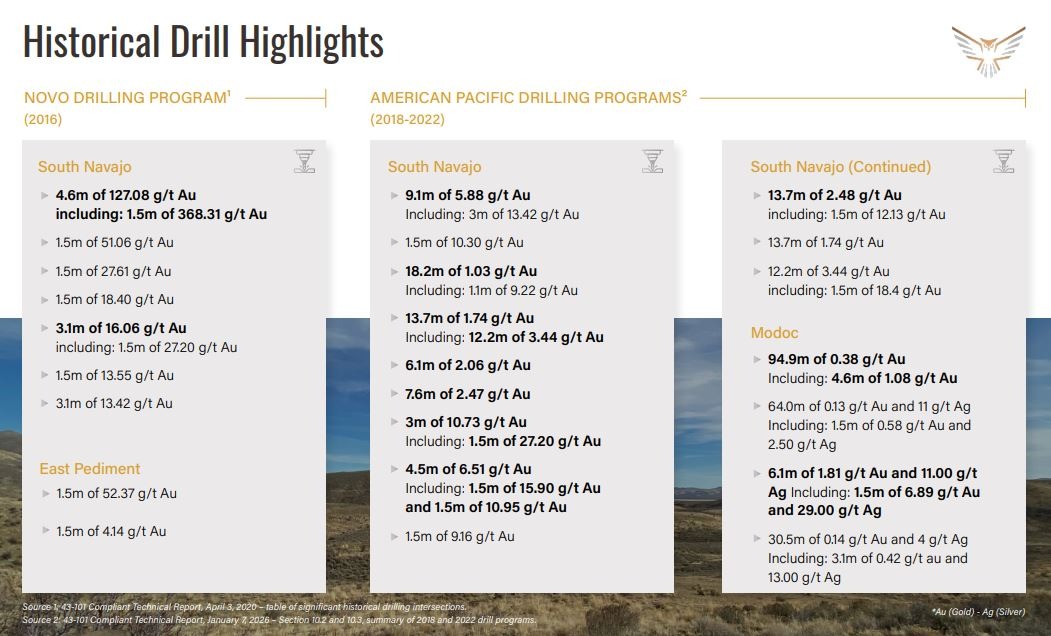
Notably, South Navajo which was the target with the densest historical drilling, including a 2016 Novo Resources intercept of 4.57 metres at 127.08 g/t gold (including 1.52 metres at 368.31 g/t gold) isn't part of Phase 1 at all. Management believes it can rely on roughly 80% of the historical data there without further verification drilling, freeing the current budget to add inventory at less-tested targets instead.
Continuity Over Grade
Sirbovan was careful to frame the programme's goal as understanding continuity rather than chasing headline grades.
"We're not just going and twinning the best holes hoping to hit the same figures as others have for a splashy press release. We're very focused on how do we add to the inventory that we've got across the district."
The company is specifically probing what lies between known high-grade veins, looking for a lower-grade, wider halo that could materially change the economics of the district if it holds up, and using the RC programme to test whether some of the previously separated Modoc, Silica, and Battle Mountain targets are in fact connected by a shared feeder system at depth.
RC drilling carries a known limitation here: the risk of "smearing" chips between intervals, which can blur true grade and width. Sirbovan said the team is managing this through careful rig preparation and sample handling at one-and-a-half-metre intervals, with QA/QC protocols led by VP Exploration Korbon McCall, who has been re-verifying historical assay certificates directly with the labs.
Interview with Steven Sirbovan, CEO, ICG Silver & Gold
Road to Q1 2027 Resource Estimate
ICG is targeting its first mineral resource estimate in Q1 2027, without needing further drilling beyond the current 3,000-metre programme to get there. Sirbovan pointed to capital discipline as central to that plan:
"It's my goal not to drain the cash balance all the way down to its last penny. We've got to manage that and see if the market is going to react to what we're seeing out of the ground."
Assay results are expected from August through October 2026.

On broader market conditions, gold's pullback from recent highs toward the $4,000/oz area hasn't changed ICG's calculus, according to Sirbovan, who noted the company priced its go-public financing in December 2025 in a comparable environment. The framing sets up the district-scale thesis Sirbovan is building on two potentially overlapping epithermal systems, one gold-dominant, one silver-dominant, across a single large land package with an interpretation prior operators hadn't pursued at this scale.
The Investment Thesis for ICG Silver & Gold
- ICG controls 100% of a 10,000-acre, district-scale land package sitting at the intersection of the Carlin and Independence Trends, immediately adjacent to a defunct open-pit mine (Dexter) that was economic at $400/oz gold in the early 1990s.
- The company's historical drilling database has grown to 40,000 metres alongside the current 3,000-metre RC programme to support an inferred resource without additional core drilling which is a meaningful capital-efficiency advantage.
- Management is targeting a first mineral resource estimate in Q1 2027, with an internally stated ambition of at least 500,000 gold-equivalent ounces as an initial baseline rather than a ceiling.
- Assay results from the current six-target Phase 1 programme are expected between August and October 2026 providing a near-term catalyst window for investors.
- At an approximately C$18 million market capitalisation, ICG trades at a discount to Nevada exploration peers profiled at C$24 up to C$160 million, several of which are earlier in their resource pathway.
- Watch item includes verification of the historical South Navajo dataset and whether the Silica/Battle Mountain/Modoc targets prove structurally connected which would materially strengthen the district-scale continuity thesis.
- Risk to monitor: RC-only drilling in Phase 1 leaves open questions about vein continuity and true width that only a subsequent core programme, if required later, could fully resolve.
Macro Thematic Analysis
Gold and silver exploration companies operating in Nevada continue to benefit from the state's status as the world's top-ranked mining jurisdiction, but the current cycle is also rewarding a specific kind of capital discipline: getting to a maiden resource without over-spending on verification work that's already been done by someone else. ICG's approach - leaning on an expanded historical database and a third-party technical sign-off to skip a core programme - reflects a broader theme among small-cap Nevada explorers this year, where tight share structures and modest treasuries make metres-per-dollar as important a metric as grade itself. As Sirbovan put it, framing the company's read on the current financing environment:
"When you think about where investors came in and where they were looking to pay for us, we're actually in a more favourable environment right now than we were before."
With silver's industrial demand profile increasingly decoupled from pure investment demand, and US domestic gold production at 15-year lows even as majors look down-cap for M&A targets, district-scale silver-gold explorers with substantial historical datasets and near-term resource catalysts remain a segment worth watching into year-end.
TL;DR
ICG Silver & Gold's historical drilling database at its Tuscarora District project in Nevada has grown from 25,000 to 40,000 metres, and is confirmed by third-party geologists that the company doesn't need additional core drilling to support a maiden inferred resource. The current 3,000-metre RC programme is testing six targets across the Central and East Zones, with assays expected August through October 2026 and a first resource estimate targeted for Q1 2027. CEO Steven Sirbovan says the goal is continuity between known high-grade veins rather than chasing standalone grade hits, positioning ICG currently valued around C$18 million well below Nevada exploration peers.
FAQs (AI Generated)
Analyst's Notes





Subscribe to Our Channel








Stay Informed






















