




P2 Gold's Gabbs Development Gains Another Lever: Car Body Adds an Early Cash Flow Option



P2 Gold adds Car Body to Gabbs as an early heap-leach option that could generate cash flow six months into construction ahead of the main mill and SART circuit.
- P2 Gold has added Car Body as a third development zone at Gabbs, creating a potential early heap-leach phase ahead of the main mill and Sulphidization-Acidification-Recycling-Thickening (SART) circuit.
- Car Body contains little copper and is therefore expected to bypass the copper-removal circuit required for the Sullivan and Lucky Strike zones.
- Column testing of approximately 31.5-kilogram samples returned 95.6% gold recoveries after 73 days, but commercial-scale performance remains unproven.
- P2 Gold says contract mining, contract crushing and a leased portable carbon-in-column plant could allow Car Body to generate cash flow roughly six months into construction.
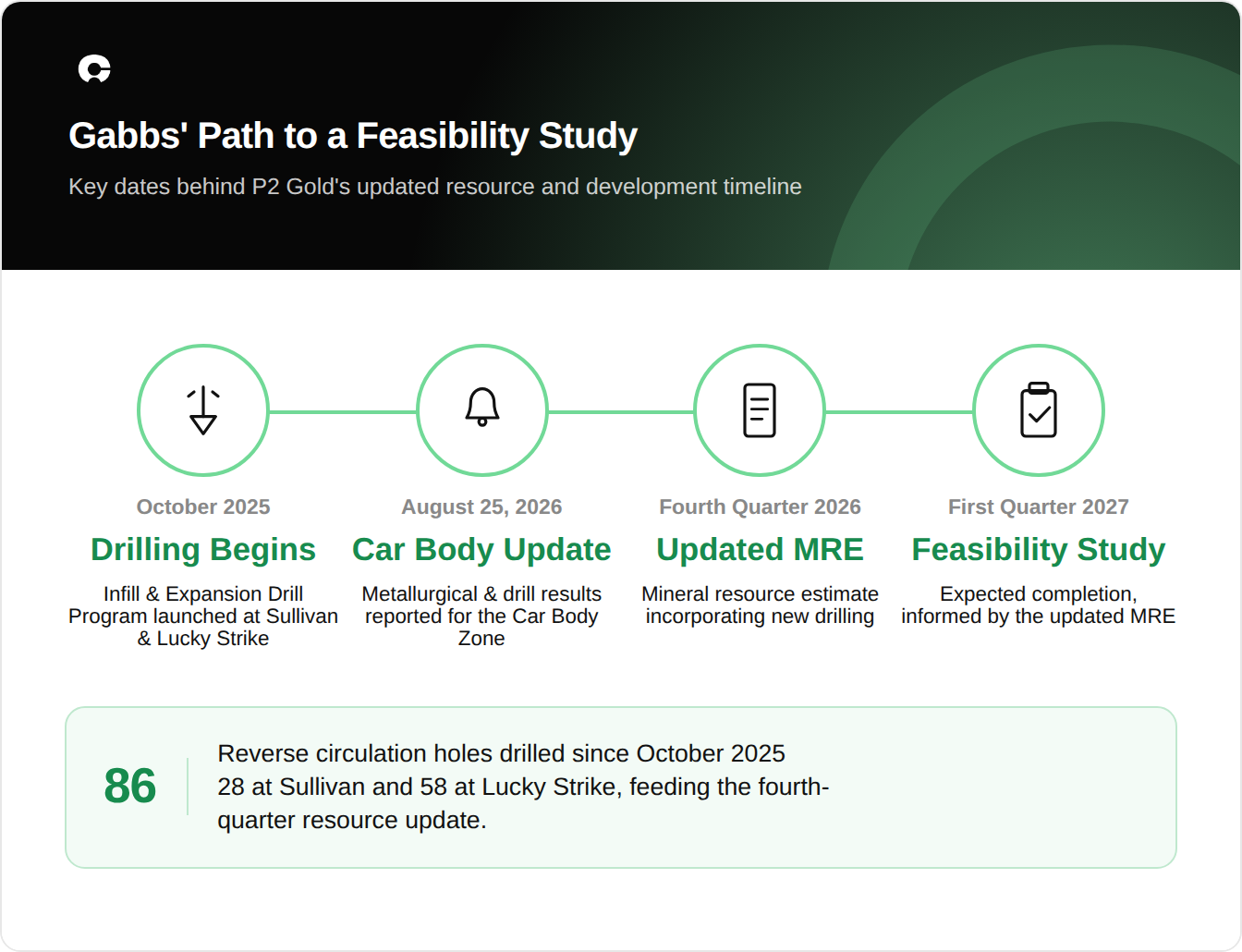
- The updated mineral resource estimate (MRE) is now expected in the fourth quarter of 2026, while the feasibility study (FS) has moved to the first quarter of 2027 and must establish whether the early-production sequence is economic.
A Third Zone Enters the Development Sequence
P2 Gold (TSXV: PGLD | OTCQB: PGLDF) has added Car Body as a third zone in the proposed development sequence at Gabbs. Sullivan and Lucky Strike remain the project's principal copper-gold zones, where the economic recovery of both metals depends on the Sulphidization-Acidification-Recycling-Thickening (SART) circuit.
Chief Exploration Officer of P2 Gold, Ken McNaughton, explained:
“Gabbs is an extremely viable project that's been overlooked over the years because of the copper-gold association. But with the advent of SART technology, we're able to extract both the gold and the copper and produce a very viable mine.”
That explanation applied specifically to Sullivan and Lucky Strike. P2 Gold's August 25, 2026, update introduced a different development lever: Car Body contains little copper and is therefore expected to bypass the SART circuit. Its inclusion creates a potential route to begin producing gold before the main mill and SART infrastructure are completed.
The Core Gabbs Story Remains Sullivan & Lucky Strike
Sullivan and Lucky Strike are the porphyry zones behind Gabbs' current resource, estimated in an April 2024 mineral resource estimate (MRE) at 1.16 million ounces of gold equivalent Indicated and 2.29 million ounces of gold equivalent Inferred, with P2 Gold targeting more than 5 million ounces of gold equivalent as drilling continues.

Both zones outcrop at the surface, and both remain open for expansion, Sullivan down-dip and Lucky Strike in all directions. Together they form the mill-based development concept, in which SART manages the copper associated with gold recovery. The August update introduces a new zone to the plan; it does not restate or revise the Sullivan and Lucky Strike resource figures above.
Car Body Changes the Timing Question
Car Body is smaller than either zone, and P2 Gold has described it as such: a low-sulphidation epithermal gold deposit carrying minor silver and little copper. That absence of material copper is the operative detail behind the rest of this section. Three diamond holes drilled specifically to supply feasibility-study (FS) metallurgical samples returned column leach recoveries reaching 95.6% gold after 73 days, alongside drill results that included 39.62 meters at 0.76 grams per tonne of gold in one of the drill holes. Because there is no material copper to remove, P2 Gold says Car Body ore is expected to bypass the SART plant that Sullivan and Lucky Strike need.
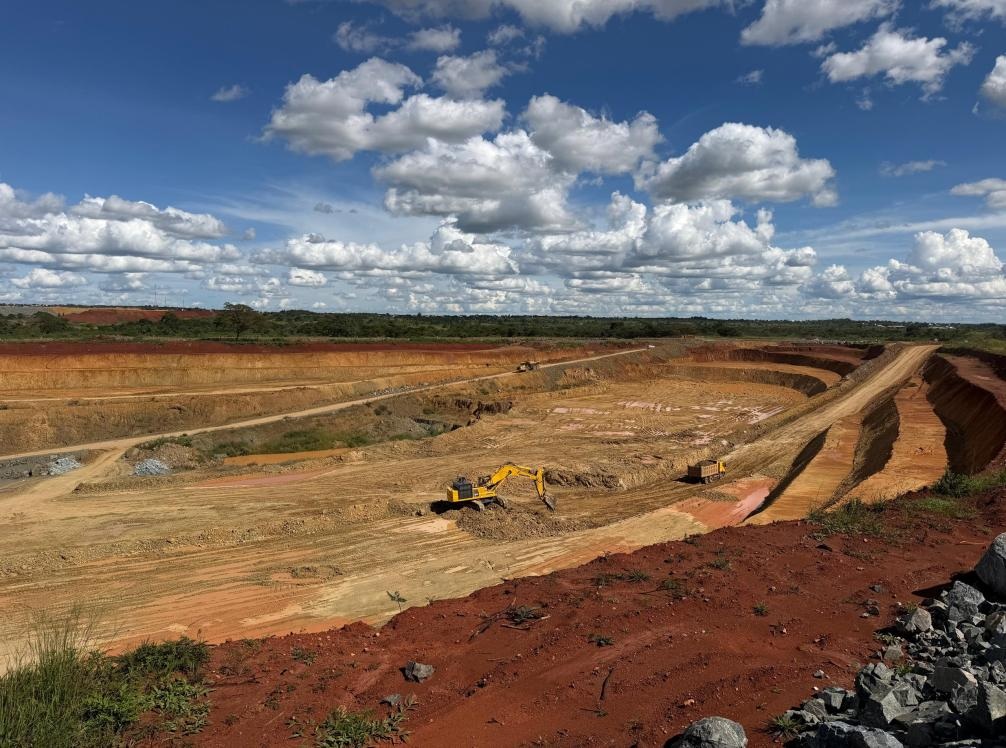
That distinction lets P2 Gold treat Car Body differently in the construction sequence. Rather than waiting on the full mill and SART circuit, the company plans to stack and irrigate Car Body ore using contract crushing, contract mining, and a leased portable carbon-in-column plant as soon as the heap leach liner is in place, a sequence it says could generate cash flow roughly six months into construction.
Management has added that the zone has demonstrated the potential to contribute meaningfully to Gabbs' economics by providing cash flow from gold leaching during the project's construction phase. Put simply, Sullivan and Lucky Strike still define how big Gabbs can eventually be; Car Body now speaks to when the project can start generating cash.
The Test Is Whether Optionality Becomes a Mine Plan
The drilling behind both parts of the story has continued in parallel. Since the Infill and Expansion Drill Program began in October 2025, P2 Gold has completed 86 reverse circulation holes, 28 at Sullivan and 58 at Lucky Strike, which will feed into an updated MRE that the company now expects in the fourth quarter of 2026. That MRE will underpin an FS that P2 Gold now targets for completion in the first quarter of 2027. That is a later date than the fourth-quarter 2026 completion shown in the company's own 2026 plans. Permitting baseline studies supporting the Mining Plan of Operations remain on schedule, and permitting continues to be the critical path to production.
More Optionality, but More to Prove
Car Body does not replace Sullivan and Lucky Strike as the resource backbone of Gabbs; it offers a potential answer to a different question: how early the project can start generating cash once construction begins. Whether that optionality survives contact with a completed mine plan depends on two things still to come: the fourth-quarter mineral resource update, and the first-quarter 2027 FS, which will determine whether sequencing Car Body ahead of the main mill and SART circuit actually works on an economic basis.
Several parts of the Car Body plan remain to be proven at commercial scale rather than in test columns. The recovery figure cited above comes from approximately 31.5-kilogram laboratory samples, not from ore stacked in the field, and the leased portable carbon-in-column plant and contract crushing and mining arrangement have not yet been put in place. P2 Gold has also not disclosed a specific cash-flow figure for the concept, only a roughly six-month timeline from the start of construction. The FS should be the first step in translating that plan into numbers investors can hold the company to.
FAQs (AI-Generated)
Analyst's Notes





Subscribe to Our Channel







Stay Informed






















