ATHA Energy Extends RIB North Uranium Mineralisation Continuity to 1.45km, Rigs Still Running Through September


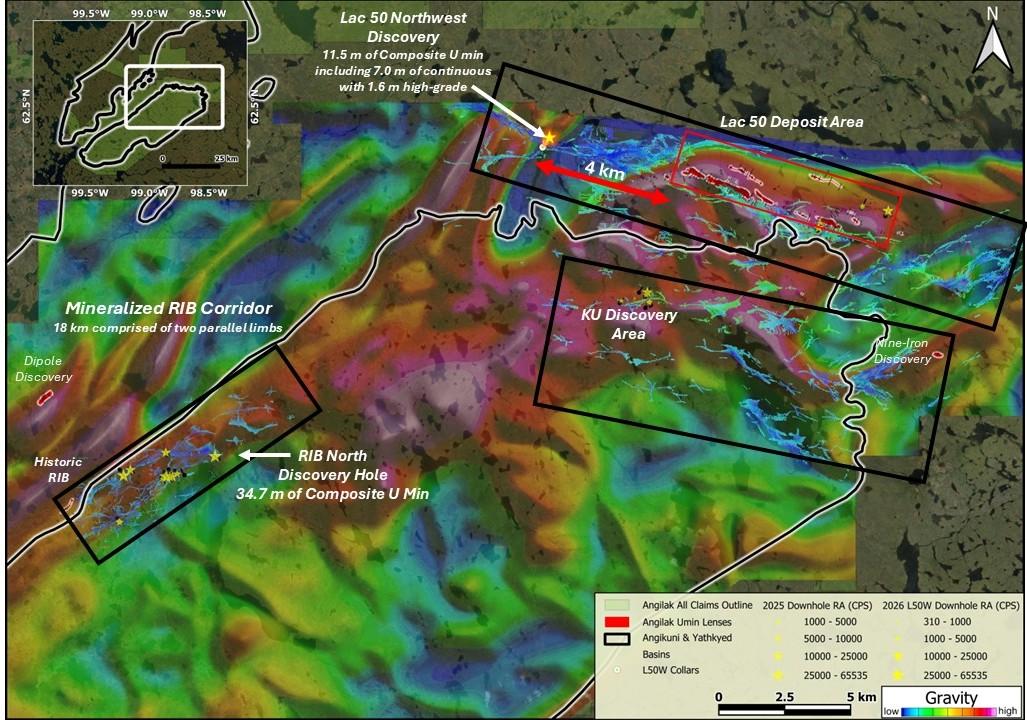
ATHA Energy expands RIB North uranium mineralisation to 1.45km at its Angilak Project in Nunavut, backed by a $63m capital raise and Q4 geophysics.
- ATHA Energy has confirmed mineralisation continuity at its RIB North Discovery over 1.45 kilometres, up from 300 metres reported earlier in the year.
- The strongest result of the batch intersected 20 metres of composite uranium mineralisation across fifteen zones including 1.3 metres of high-grade material.
- A secondary mineralised horizon on the western limb of the corridor has now been traced over approximately 220 metres of strike length.
- The company raised $63 million in the first quarter of 2026, funding its largest-ever exploration program across three drill rigs through the end of September.
- Management expects 3D inversion modelling results from a basin-wide geophysical survey in the fourth quarter of 2026, which could generate the next round of drill targets.
Uranium explorer ATHA Energy Corp. (TSXV:SASK) used World Nuclear Association (WNA) week in London to confirm what its 2026 Angilak Exploration Program has been building toward all year: continuity. On 8 September 2026, the company released preliminary results from an additional seven diamond drillholes at the RIB North Discovery, extending confirmed mineralisation continuity from 300 metres to 1.45 kilometres along the eastern limb of the Mineralized RIB Corridor (MRC) at its 100%-owned Angilak Uranium Project in Nunavut. Speaking to Crux Investor, CEO Troy Boisjoli placed the results in the context of a uranium market he believes is entering a structurally different phase, one where buyers can no longer assume pounds will be available whenever they need them.
Two Discovery Corridors, One Basin
Angilak sits in the Angikuni Basin, a jurisdiction ATHA has controlled in its entirety since building out from an initial 3.5 million acre Athabasca Basin land position to 7 million acres today, alongside its Central Mineral Belt project in Labrador and its newly discovered basement-hosted GMZ uranium showing in the Athabasca Basin. Within Angilak, the company is advancing two separate corridors in parallel: the Lac 50 Deposit Corridor, home to an existing exploration target of 61 to 98 million pounds U3O8, and the Mineralized RIB Corridor, where 2025 drilling delivered four discoveries, including a maiden RIB North intersection of 34.7 metres of composite uranium mineralisation grading up to 8.16% U3O8 over 0.5 metres.
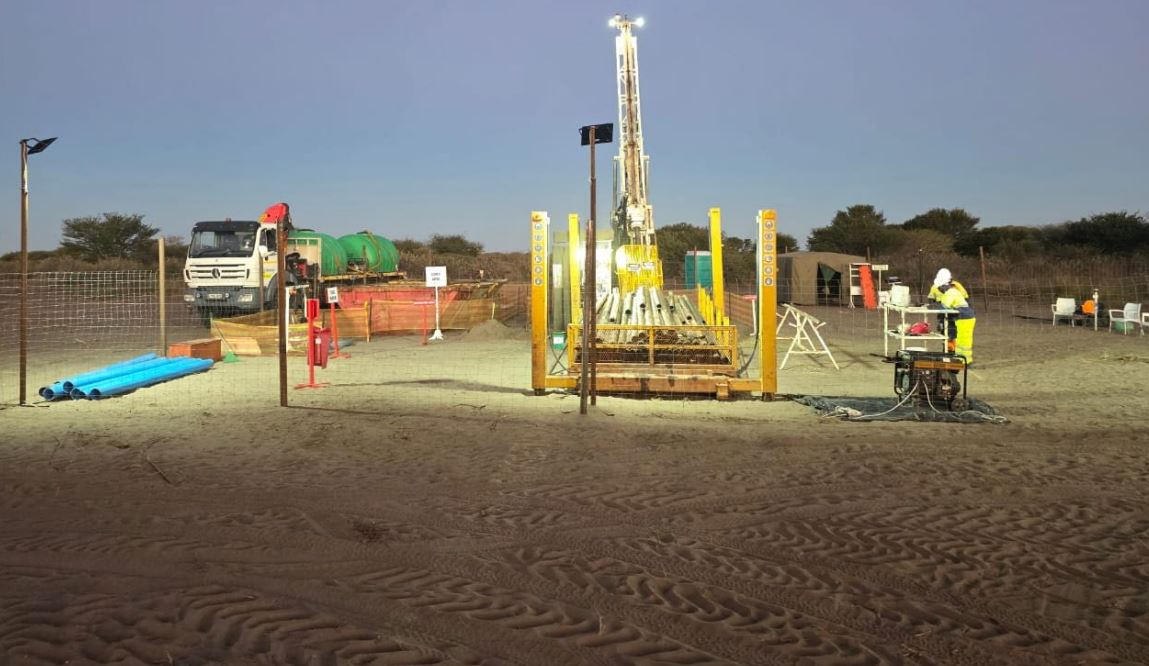
The 2026 program - ATHA's largest to date - is built around confirming that neither corridor is a one-off. Three drill rigs have been running since 1 May 2026 and are scheduled to continue through the end of September, while an airborne MMT geophysical survey completed in late July is expected to deliver 3D inversion modelling results across the entire Angikuni Basin in the fourth quarter.
RIB North: Behind the Continuity Claim
The seven newly released holes build on eight holes reported in July. All seven intersected uranium mineralisation. The standout was collared roughly 250 metres along strike to the northeast of the original 2025 discovery hole and returned 20.0 metres of total composite uranium mineralisation across fifteen zones between 494-700 metres, including 1.3 metres of high-grade material. The strongest single interval within that hole ran 1.5 metres from 661.5-663 metres, averaging 8,453 counts per second (CPS) on the downhole gamma probe with a peak of 26,680 CPS.
Another drill stepped out at roughly 370 metres to the northeast, intersected 13.0 metres of composite mineralisation over five zones, with its widest interval running 4.0 metres at an average of 1,013 CPS. One tested 430 metres to the southwest, returned 7.0 metres of composite mineralisation across six zones, including a 1.5-metre high-grade interval averaging 4,275 CPS with a peak of 20,138 CPS. On the western limb of the MRC, a secondary, separate mineralised horizon first identified, afollow-up hole intersected 3 metres of composite mineralisation and extended that horizon's confirmed strike length to approximately 220 metres.

ATHA classifies high-grade mineralisation as any interval exceeding 10,000 CPS, and has lowered its reporting cutoff from 500 CPS to 300 CPS based on 2024 and 2025 assay results, which showed that readings above 300 CPS consistently correspond to grades above 0.01% U3O8. All intervals reported are core widths; true thickness has not yet been determined.
Interview with Troy Boisjoli, CEO of ATHA Energy
Addressing Discovery Risk First
Boisjoli's central argument to Crux Investor was about sequencing, not just geology. He has argued consistently that the greatest risk facing a company at ATHA's stage is not access to capital or capital markets sentiment, but simply failing to find something of scale in the first place - a risk he believes the company deliberately front-loaded rather than deferred.
"The number one risk for companies of our stage and scale is actually discovery risk, particularly in uranium. Uranium deposits are not easy to find. They're not easy to build, produce, et cetera. But they're not easy to find."
That philosophy explains why ATHA spent 2024 and 2025 on regional geophysics and widely spaced step-out drilling - testing targets kilometres apart before committing to tighter delineation spacing rather than moving straight to resource definition drilling around the historic Lac 50 deposit it acquired.
A Genuinely Unusual Geological Model
Perhaps the most consequential claim in the interview was Boisjoli's description of the underlying deposit style. ATHA's technical team, working with outside geological consultants, now believes the mineralisation at Angilak is structurally controlled and basement-hosted, associated with albite-hematite alteration and graphitic, sulphide-bearing structures - and that it behaves less like a typical Athabasca Basin uranium system and more like an orogenic gold system.
"We brought in a bunch of subject matter experts to help us wrap our heads around this. What we're seeing is that this uranium system is actually very analogous to an orogenic gold system so then the scale implications of that are significant."
Boisjoli noted that conductive geology in the Athabasca Basin frequently extends for hundreds of kilometres without hosting a primary uranium target, whereas at Angilak the graphite and sulphide introduced into the system make conductive zones themselves prospective - a claim that, if it continues to hold up in the geophysics due later this year, would support drilling well beyond the roughly 1.45 kilometres tested so far along a structural trend management believes extends for tens of kilometres.
Financial Position & Capital Discipline
ATHA raised $63 million in the first quarter of 2026, a figure Boisjoli described as deliberately sized to insulate the company from quarterly share-price volatility rather than to fund a specific target. Part of that came from a $25 million US investment by Queen's Road Capital, whose Warren Gilman relaxed his usual investment criteria to participate earlier than he typically would. The raise allows ATHA to keep drilling through weak uranium-price periods instead of throttling back exploration to manage its cost of capital - a dynamic Boisjoli sees as central to executing a multi-year continuity and delineation strategy without being forced into a poorly timed financing.
The Investment Thesis for ATHA Energy
- Continuity, not just discovery, is now the story: confirmed mineralisation over 1.45 km at RIB North converts a single 2025 discovery hole into a system investors can begin to model with more confidence, though not yet a defined resource.
- Two parallel corridors reduce single-asset risk: Lac 50 already carries a 61-98 million pound exploration target, while RIB North is being built out independently - a broader base than a single-deposit junior.
- Geological thesis, if confirmed, changes the addressable scale: management's orogenic-analogy model implies conductive geology across the wider Angikuni Basin could be prospective, not just the areas already drilled.
- Balance sheet reduces financing risk through year-end: $63 million Q1 2026 raise funds the full 20,000-metre, three-rig drill program without requiring a mid-cycle raise.
- Q4 2026 geophysics is the next re-rating catalyst: 3D inversion modelling across the full Angikuni Basin could generate the next round of drill targets and test whether the regional thesis extends beyond RIB and Lac 50.
- Watch for resource-stage signalling: management has flagged that maturing a portion of the project into a formal resource is the logical next step once continuity work concludes, likely a 2027 conversation.
- Valuation remains genuinely difficult to model: management itself concedes standard discounted-NAV approaches don't yet fit a multi-corridor, pre-resource asset of this scale, which cuts both ways for investors used to conventional comparables.
Macro Thematic Analysis
ATHA's results land in the middle of a uranium market that Boisjoli believes is undergoing a structural, not cyclical, shift. For most of the past several years, discussion at industry gatherings like WNA week centred on emerging long-term demand from new reactor builds and life extensions. That conversation, in his view, has moved from abstract to operational - buyers are now asking how new capacity actually gets financed, built and fuelled, and how nuclear component supply chains keep pace with growing reactor demand.
That dynamic - a buy side historically accustomed to abundant spot and term supply, meeting a discovery pipeline that has thinned across the industry - is the backdrop against which ATHA is positioning its exploration spend. Very few pre-resource companies, in Boisjoli's assessment, are actually focused on carrying discoveries through to development-stage assets at scale; most either sit on legacy resources or hope to be acquired. Whether that scarcity of genuine explorers translates into a valuation premium for the handful still drilling is the open question for investors watching this space into 2027.
TL;DR
ATHA Energy (TSXV:SASK) has extended confirmed mineralisation continuity at its RIB North Discovery from 300 metres to 1.45 kilometres, based on seven newly released diamond drillholes at its 100%-owned Angilak Uranium Project in Nunavut. The standout hole, RIBN-DD-011, intersected 20.0 metres of composite uranium mineralisation including 1.3 metres of high-grade material. A separate horizon on the western limb of the same corridor has been extended to roughly 220 metres of strike. Backed by a $63 million capital raise in Q1 2026, ATHA is running its largest-ever drill program, with basin-wide 3D geophysical inversion results due in Q4 2026 as the next catalyst.
FAQ (AI-generated)
Analyst's Notes





Subscribe to Our Channel







Stay Informed