




Indonesia's Quotas Might Backfire: Nickel Below $17,000 and Smelters Idle



Indonesia cut its 2026 nickel ore quota 30%, yet LME nickel sits near $16,570 as Philippine ore imports keep smelters fed and warehouse stocks climb.
- LME three-month nickel traded near $16,570 per tonne on 1 September 2026, the lowest since July, despite Indonesia cutting its 2026 ore quota to 260-270 million wet metric tonnes from the 379 million approved for 2025.
- LME warehouse stocks rose in August to 268,314 tonnes, so the ore restriction has not reached refined metal.
- Indonesia imported 11.4 million tonnes of Philippine ore between January and July, against 6.82 million a year earlier, replacing most of the withheld feedstock.
- Rotary kiln electric furnace utilization fell to 76% from 84% a year earlier, moving the cost of the policy onto domestic processors rather than onto metal buyers.
- A sustained LME stock drawdown below 250,000 tonnes, or confirmation of the 30% acid leach cuts under consideration, is the trigger that would confirm the quota is binding.
Quota Cut Enters Eighth Month as Nickel Slips Below $17,000
LME three-month nickel traded near $16,570 per tonne on 1 September 2026, its lowest level since July, after LME warehouse stocks rose 0.8% during August to 268,314 tonnes. Indonesia's Ministry of Energy and Mineral Resources set the 2026 RKAB ore quota at 260-270 million wet metric tonnes in February, against 379 million wet metric tonnes approved for 2025, with the stated aim of lifting prices.
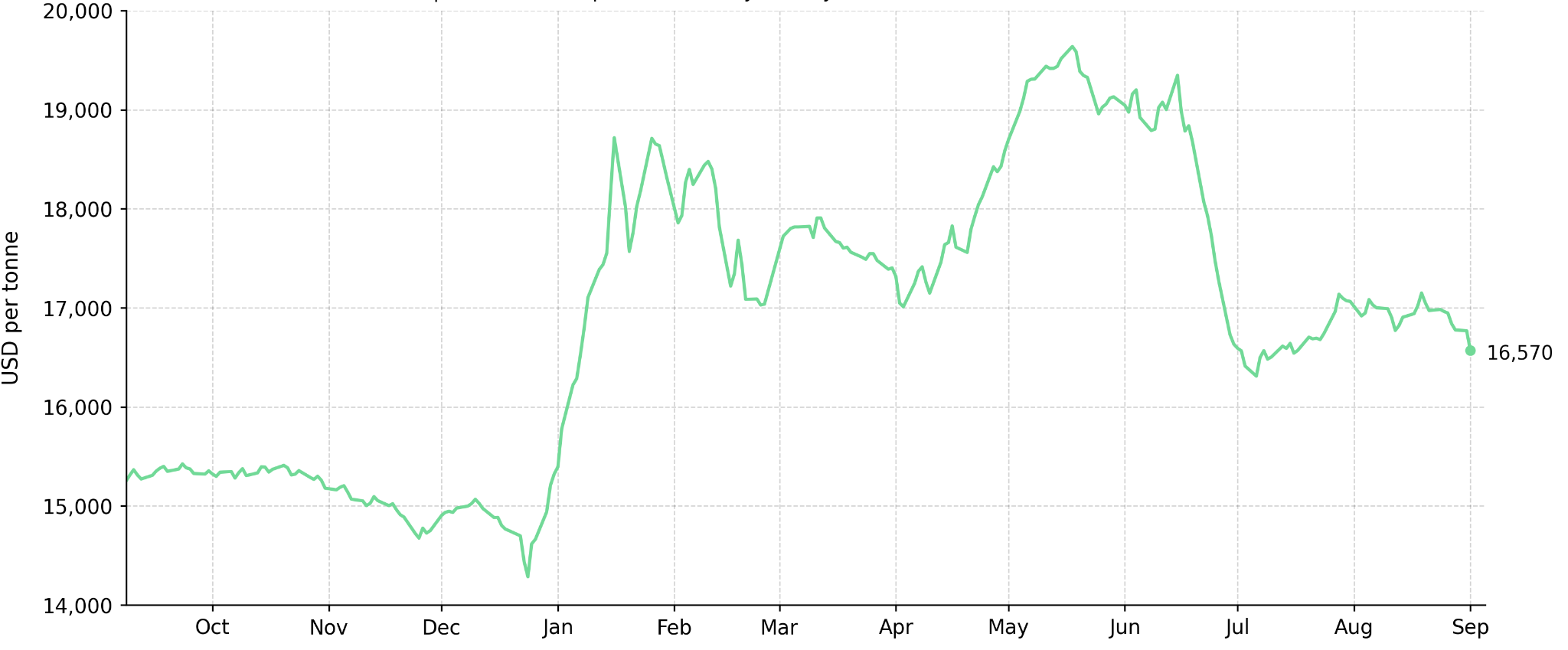
That removed roughly 110 million wet metric tonnes, close to 30% of annual output from the source of about two-thirds of global mined nickel. Refined metal is now cheaper than on 6 May, when nickel reached $20,000 per tonne. The shortage exists in ore. It has not arrived in metal.
Philippine Ore Imports Offset Jakarta's Cut and Keep Smelters Fed
A mining quota constrains mine output, not furnace throughput, and Indonesian processors closed the gap by buying abroad. Indonesia imported 11.4 million tonnes of Philippine nickel ore between January and July 2026, against 6.82 million tonnes in the same period of 2025, a rise of 67%. Sulfur arrivals also improved through the third quarter, restoring mixed hydroxide precipitate output at projects that had been reagent-constrained.
The policy stays leaky because Jakarta controls permits rather than furnaces. The Ministry reverted to annual RKAB approvals from the previous three-year cycle, and in July confirmed no broad increase, granting only limited additional volumes to smelters with acute feedstock shortages, with those allocations still pending. Foreign operators have pushed back: in May the China Chamber of Commerce in Indonesia wrote to President Prabowo Subianto over abrupt policy shifts, copying the Chinese embassy in Jakarta.
Ore Shortage Hits Domestic Processors Before It Reaches Refined Supply
Substitution takes time to break down. Philippine cargoes are seasonal, with monsoon months from November restricting shipments, and the country's own output is committed partly to Chinese buyers. Acid leach operators carry a second dependency, since imported sulphuric acid cannot be replaced from domestic supply at scale.
Two outcomes follow. If Jakarta holds the line and approves only targeted allocations, the International Nickel Study Group's forecast 32,000-tonne deficit for 2026 begins drawing exchange stocks, and prices move toward the $17,000 to $19,000 band Fastmarkets and Wood Mackenzie forecast for the year. If the reported proposal to lift the quota toward 360 million tonnes is approved, that deficit disappears, refined supply returns to surplus, and pricing reverts toward the $14,400 per tonne area traded in December 2025.
The International Nickel Study Group publishes its balance monthly, and the LME publishes warehouse stocks daily.
Utilization Below 80% Compresses Processor Margins and Raises Country Risk
The margin compression is landing inside Indonesia, not on metal buyers. Rotary kiln electric furnace utilization fell to 76% from 84% a year earlier, according to the Indonesian nickel industry association, because plants sized for 340 to 350 million wet metric tonnes of feed are competing for a smaller domestic pool and paying imported-ore freight on the balance.
The test that separates exposures here is operational flexibility: whether an asset can switch feedstock, and whether it can idle without breaching covenants. Weda Bay, the Eramet subsidiary in Halmahera, saw its allocation cut from roughly 42 million to 12 million wet metric tonnes, exhausted that quota by the end of May 2026, and moved partly into care and maintenance. Operations without import logistics or balance sheet slack absorb the same shock without that option.
RKAB revisions are discretionary, unscheduled, and announced without notice, so nobody outside the Ministry can time them. Position sizing, not timing, is the variable a retail holder controls here, and a wrong-way position in a policy-driven metal can lose value quickly.
The Signal That Would Guide Nickel's Direction
Refined nickel stays capped while LME stocks hold above 260,000 tonnes and Chinese stainless steel futures trade below CNY 14,000 per tonne. Holders of physically hedged stainless exposure and buyers on alloy surcharge formulas benefit while both conditions hold.
A state controlling most of the world's mine supply cut output by 30% and still could not lift the price yet, because substitute ore existed and exchange inventories were already full. Concentration converts into pricing power only when stocks are thin.
None of that makes the sector uninvestible. Value moved rather than disappeared, toward ore traders and miners outside Indonesia. Prices below $17,000 per tonne are now forcing the shut-ins the quota failed to engineer, while the permitting regime behind it raises the cost of the next Indonesian expansion. Weaker supply growth on a multi-year view is the direct consequence of a policy that caps prices today.
Analyst's Notes





Subscribe to Our Channel
.png)

.png)





.jpg)
Stay Informed


