Geiger Energy Eyes Strong Assays & Financing for 25,000m Drilling Programme at Aberdeen


.jpg)
Geiger Energy (TSXV:BEEP) makes two first-hole uranium discoveries at Fox and Apollo on Nunavut’s Kiggavik trend. Assays pending, 25,000 m 2027 plan.
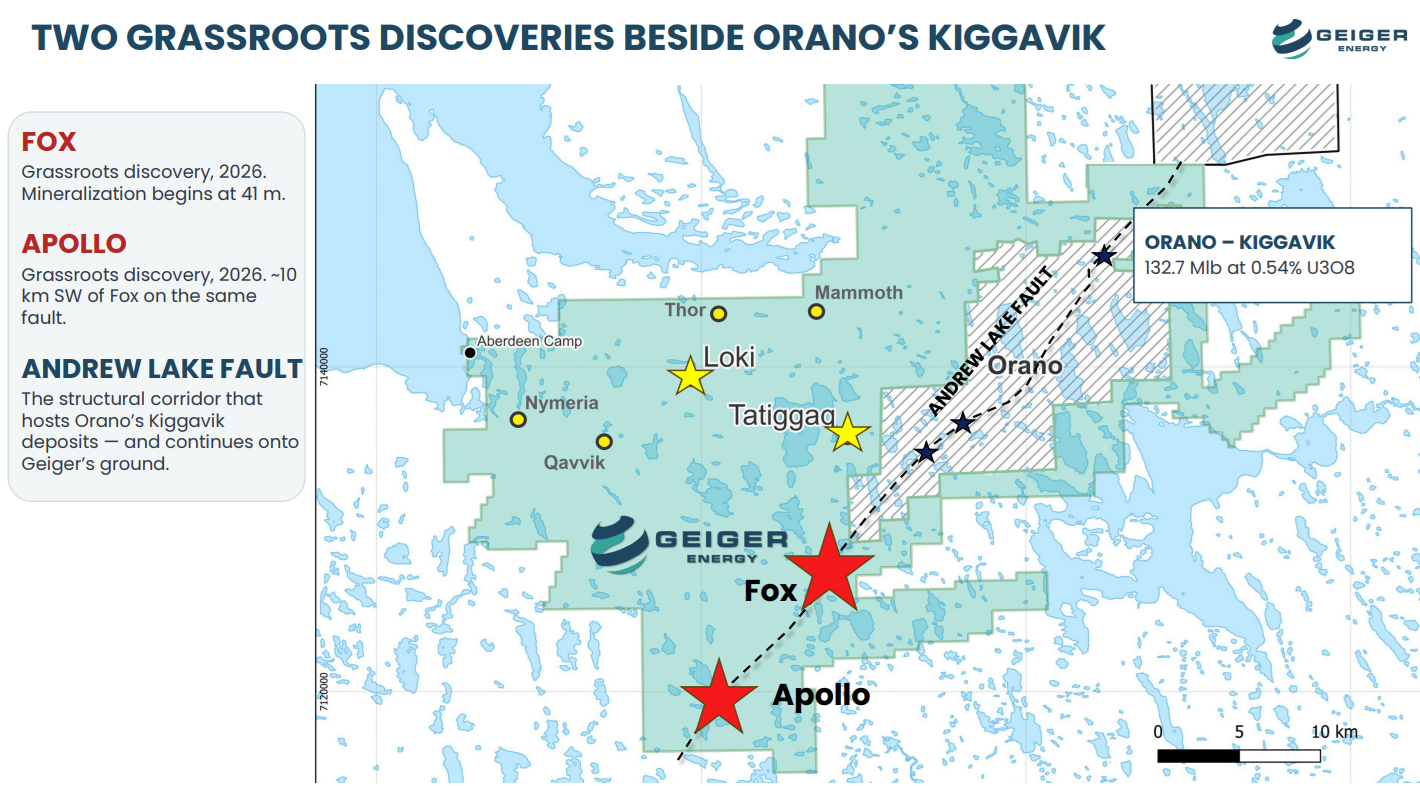
- Geiger Energy made two first-hole uranium discoveries on never-drilled targets at Fox and Apollo, which lie 10 km apart on the Andrew Lake Fault.
- At Fox, hole FOX26-003 intersected five radioactive zones over 89.8 m from 41 m depth, with a peak reading of 15,022 cps.
- Meanwhile at Apollo, a step-out hole drilled 100 m from the discovery hole returned 45 m of elevated radioactivity from about 40 m depth.
- Thelon targets average about 250 m deep and cost about C$200,000 each to test, well below the cost of comparable Athabasca targets.
- The company's projected C$20 million, 25,000 m programme for 2027 depends on new financing in the current junior uranium market.
For four decades, Canadian uranium exploration has centred on Saskatchewan’s Athabasca Basin, where most prospective ground has long been staked. The Thelon Basin in Nunavut shares key geological traits but has seen a fraction of the drilling. Geiger Energy Corp. (TSXV:BEEP, OTCQB:BSENF) is betting that this gap is one of the sector’s most overlooked discovery opportunities.
President and CEO Dr. Rebecca Hunter set out the results of the 2026 season at the company’s Aberdeen Project. Late in the season, Geiger drilled two targets that had never been tested. Both returned uranium mineralisation in their first holes. The targets, Fox and Apollo, sit roughly 10 km apart on the Andrew Lake Fault and structure also hosts Orano’s Kiggavik deposits next door.
The Andrew Lake Fault: Chasing the Kiggavik Trend
Hunter’s thesis rests on one structure. The Andrew Lake Fault is a northeast-trending fault that runs through Orano’s Kiggavik-area deposits and continues for about 17 km across Geiger’s ground. Orano reports a historical estimate of approximately 127.3 million pounds of U₃O₈ in the Indicated category and 5.4 million pounds in the Inferred category for Kiggavik.
Hunter had targeted the trend for several years, but logistics kept the drills near camp at Tatiggaq and Loki. With about three weeks of the 2026 season left, the company moved both rigs south to Fox and Apollo. Both targets were chosen using gravity, magnetics and structural interpretation. Each sits where east-northeast faults cut the main northeast structure. Hunter sees these intersections as likely mixing zones for uranium-bearing fluids.
Fox: Thick, Shallow and Increasingly Strong
Fox is a 1.3 km gravity anomaly a few kilometres south of the Orano property. The first hole hit weakly elevated uranium as soon as the drill cleared the overburden. Hunter said readings of up to around 100 counts per second (cps) persisted over roughly 50 m. Background on the company’s handheld scintillometer is about 30 cps.
That thickness caught her attention. At Tatiggaq, she noted, a hole is either clearly in mineralisation or out of it within three metres.
The third hole strengthened the signal. A 25 m step-back to the northwest, intersected five zones of mineralisation over 89.8 m from 41.0 m depth. The strongest zone returned 5.3 m from 56.6 m depth, peaking at 15,022 cps on the downhole probe. A deeper zone peaked at 9,512 cps. All three Fox holes intersected mineralisation or extensive alteration. Together they test only about 50 m of a 1.3 km target.
So far the mineralisation sits in steep fractures. Hunter expects Fox to behave like Tatiggaq, where steep feeder structures bleed out into flatter pods that carry the tonnage. Next season the company will step back to the northwest to look for the core of the system, then step along strike in roughly 25 m increments.
Interview with Dr. Rebecca Hunter, President & CEO of Geiger Energy
Apollo: A Second System 10 km Along Strike
Apollo is larger, comprising three gravity lows over roughly 3.5 km according to Hunter (3.7 km in the company presentation). Only the central anomaly has been drilled.
The first Apollo hole returned elevated radioactivity with localised readings above 400 cps. Hunter then chose a bolder 100 m step-out to the southwest. A second hole intersected 45 m of elevated radioactivity from approximately 40 m to 85 m depth. Core readings largely exceeded 70 cps, with localised readings of up to 180 cps. The downhole probe recorded up to 402 cps in the most broken, clay-altered part of the fault, where core recovery was poor. Alteration and sporadic radioactivity continued to about 240 m.
The readings are weaker than at Fox. Hunter argues that the sheer volume of low-level radioactivity matters more at this stage than peak values. She pointed to tens of metres at three to eight times background, accompanied by the alteration and host rocks the model calls for.
Follow-up drilling will step back into the footwall of the Andrew Lake Fault, where much of the mineralisation appears to accumulate. Hunter noted that at Kiggavik, mineralisation can also cross into the hanging wall. She said that finding radioactivity alongside alteration, rather than alteration alone, changes the picture.
"There's still lots of other ones. Now we know that Fox Apollo trend is lighted up, there's about seven other significant gravity anomalies along that trend. And so it kind of just opens, we know that that trend's fertile.
All radioactivity figures come from downhole probes and handheld scintillometers. They indicate the presence of radioactive minerals only and are not a substitute for assays. Assays from Fox and Apollo are pending.
Catalysts & the 2027 Funding Question
The drilling season runs from about June to mid-September or October, and the camp is now closed. Near-term news flow will come from assays. Hunter hopes to have Fox and Apollo assays later this autumn, though she would not commit to a date. Results from Tatiggaq and Loki are also due over the coming months.
The bigger question is scale. Geiger currently runs two drills. The company sets out a projected 2027 programme of about 25,000 m across roughly 100 holes, using four to five rigs on a budget of about C$20 million. It would test around 12 targets, five to eight of them new, at an estimated all-in cost of about C$800 per metre. This programme is projected and depends on financing that has not yet been raised.
"For us, our struggle is that we've never been able to do that significant drill program. It's not a question in my opinion of "If" on this project, it's just a question of getting enough drilling in. And so 25,000 meters like that would require five drills in an extensive budget, and if we could do that, we could find out how big Fox is., we could drill out Apollo, and we could have some good ideas now on extending of Tatiggaq."
Hunter acknowledged that the junior uranium market is weak. She said Geiger’s share price has held up since the discoveries while many peers have fallen. Company's presentation shows a share price of C$0.22, 88.1 million shares outstanding and a basic market capitalisation of about C$20 million. Retail investors hold 58% of the register.
The board is also discussing how to streamline the company around Aberdeen. Hunter said options for the Athabasca assets include distributing or selling them. No decision has been announced.
Investment Thesis for Geiger Energy
- Geiger has made two first-hole discoveries on previously undrilled targets along the Andrew Lake Fault, the structure that hosts Orano’s Kiggavik deposits.
- Fox has produced the strongest results so far, including a peak of 15,022 cps within 89.8 m of mineralised zones starting at 41 m depth.
- Only about 50 m of Fox’s 1.3 km anomaly and one of Apollo’s three gravity anomalies have been drilled.
- Shallow targets and an estimated test cost of about C$200,000 per target allow more discovery attempts per dollar than in the Athabasca Basin.
- At a basic market capitalisation of about C$20 million, the market is assigning modest value to two discoveries and more than 50 targets.
- Monitor Fox and Apollo assays, expected later this autumn, as the first laboratory confirmation of grade.
- Monitor financing for the projected C$20 million, 25,000 m programme in 2027, along with any decision on the Athabasca assets.
Macro Thematic Analysis
Uranium supply has long depended on a small number of high-grade districts. In Canada, the Athabasca Basin has dominated since the major discoveries of the 1980s. Geiger’s presentation makes the point that those discoveries came once the basin model was properly understood, not at the start of exploration. McArthur River and Cigar Lake are still mined today.
Geiger’s case is that the Thelon now sits where the Athabasca stood in the 1970s. The basin is known to be fertile because Kiggavik exists. What it lacks is a body of modern drilling. Very few groups are exploring it, and Geiger controls a large position along its best-known trend.
She draws a parallel with the Canadian diamond rush. Few believed the Northwest Territories could host economic diamonds until the Ekati discovery in 1991. Canada’s first diamond mine followed in 1998, and much of the value went to those who already held ground. Hunter argued that the geology was always there, and that the district needed people willing to push it.
For investors, the implication is that district-scale discoveries are rare and early entry can capture a disproportionate share of the value. That logic works only if follow-up drilling delivers. Frontier basins do not always become producing districts. The Thelon’s remoteness, short season and limited infrastructure are real costs. Still, a proven neighbour, shallow targets and almost no competition is an unusual combination in a sector where prospective ground is scarce. If Fox or Apollo grow into a deposit, the read-through would extend beyond one company to the basin as a whole.
TL;DR
Geiger Energy drilled two never-tested targets on the Andrew Lake Fault in Nunavut’s Thelon Basin late in the 2026 season, and both returned uranium in their first holes. At Fox, drills intersected five zones over 89.8 m from 41 m depth, peaking at 15,022 cps. At Apollo, a 100 m step-out returned 45 m of elevated radioactivity from about 40 m. The fault also hosts Orano’s Kiggavik deposits. Targets are shallow and cost about C$200,000 each to test. Assays are pending, and a projected C$20 million, 25,000 m programme for 2027 depends on financing.
FAQs (AI Generated)
Analyst's Notes





Subscribe to Our Channel






.png)
Stay Informed