




Inside Buen Retiro: The Staged Copper Model Fitzroy’s $26M is Built Around


Fitzroy Minerals' Buen Retiro holds oxide heap leach & IOCG sulphide potential in Chile's top copper belt, funded by a $26M raise.
- Buen Retiro sits in Chile's Punta del Cobre iron oxide copper gold (IOCG) belt, the same district that hosts Lundin Mining's Candelaria and Capstone Copper's Mantoverde, and Fitzroy Minerals' drilling has confirmed the same rock types as both of those producing operations.
- The project offers two distinct value layers: a shallow oxide horizon suited to low-capital heap leach processing, and a deeper IOCG sulphide target with district-scale potential that is currently being drilled for the first time.
- Fitzroy Minerals is advancing a heap leach joint venture (JV) with Pucobre, a Chilean copper producer whose solvent extraction and electrowinning (SX/EW) plant at Planta Biocobre has been in continuous operation since 1992 and sits 13 km from Copiapó.
- A preliminary economic assessment (PEA) is underway targeting the oxide starter pit in the southwest zone, supported by key intercepts including 135 m at 0.73% copper from surface and 30 m at 3.50% copper from 130 m.
- The $26M financing announced in February 2026 fully funds the exploration programme and property commitments at Buen Retiro, removing near-term equity dependence and enabling execution based on technical milestones.
- Infrastructure advantages including low elevation, proximity to the Pan-American Highway, grid power, and an existing processing facility reduce capital intensity relative to many comparable early-stage copper projects.
Buen Retiro in Context
The Punta del Cobre district south of Copiapó, Chile, is one of the most productive copper-producing corridors in the world. Within a roughly 20 km by 5 km north-south belt sit Lundin Mining's Candelaria mine, Capstone Copper's Mantoverde operation, and the newly permitted Laferola project. After 25 years of mining, Candelaria still holds over one billion tonnes of measured and indicated mineral resources. Mantoverde has recently delineated approximately 50 million tonnes of late-stage iron oxide copper gold (IOCG)-style mineralisation now heading into production. Laferola has received permits for a 90,000 tonne per annum copper-in-concentrate operation with a 15-year mine life.
Fitzroy Minerals’ Buen Retiro project is located within this same district, 43 km southwest of Candelaria. The company has drilled core that mirrors the rock types documented at all three of those operations, confirmed by Fitzroy’s Chief Operating Officer during a site visit to both Mantoverde and Candelaria.
Merlin Marr-Johnson, President and Chief Executive Officer of Fitzroy Minerals, on the geological alignment across the district:
"There's the flagship asset of Lundine Mining Candelaria there you've got the flagship asset of Capstone copper called Manta Verde and there's a new deposit called Laferola all of which we've got the same geology that we can see of all of those three deposits within Beniro"
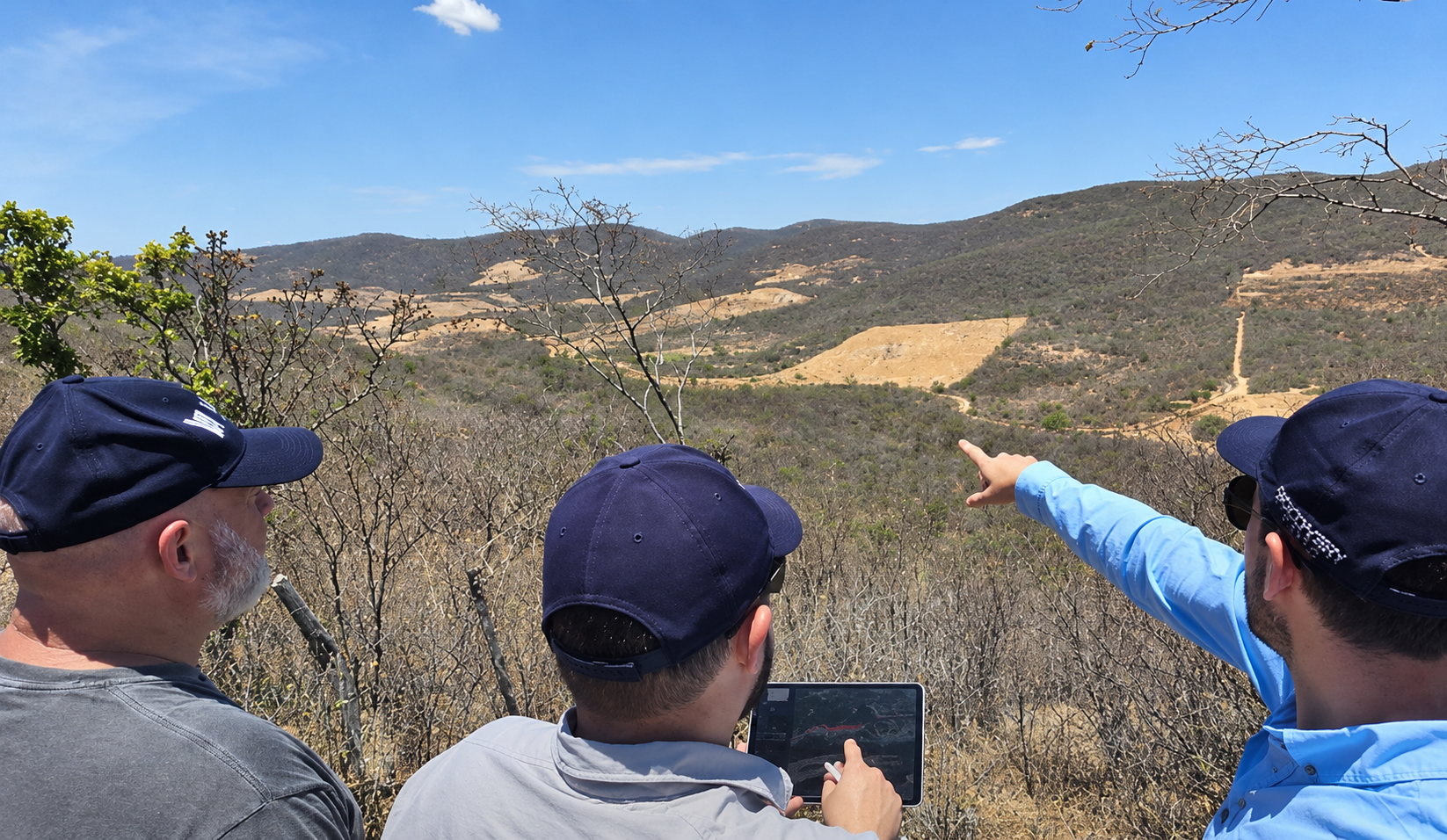
That comparison is grounded in core photography. Fitzroy’s Chief Operating Officer visited both Mantoverde and Candelaria and documented matching rock types at Buen Retiro across multiple mineralisation styles, including copper sulphide breccias, disseminated sulphide stringers, and the same host rock sequences present at both operations.
The Oxide Case: Near-Term Heap Leach Potential & Drilling Results
Buen Retiro has a prior production history. The Manto Negro open pit was operated by Pucobre from 2005 to 2009, producing approximately 1.3 Mt at 1.2% soluble copper, processed at Pucobre’s Planta Biocobre solvent extraction and electrowinning (SX/EW) facility near Copiapó. Heap leaching is a low-capital processing method in which a leaching solution is applied to crushed ore stacked on lined pads, dissolving copper for recovery through SX/EW circuits.
The oxide horizon at Buen Retiro extends to approximately 60-80 m depth in the northern zone and deeper than 100 m in faulted southern zones, where native copper is frequently observed at the base of oxidation, reflecting supergene enrichment, a natural process that concentrates copper near the oxidation boundary. Oxide mineralogy dominated by tenorite, chalcocite, chrysocolla, and native copper is amenable to heap leach processing. All are amenable to heap leach processing, some in the presence of oxidising agents such as salt.
Recent diamond drilling across 14 holes has returned a median intersection of 27m at 0.55% copper across the project. Key results underpinning the preliminary economic assessment (PEA) include 135 m at 0.73% copper from surface in hole BRT-DDH06 and 30 m at 3.50% copper from 130 m in hole BRT-DDH13.
The PEA starter pit targets an 800 m section of a 1,400 m continuous mineralised zone in the southwest area, where infill drilling, geotechnical work, sterilisation drilling, and metallurgical studies are now underway. Heap leach column test work is ongoing to confirm bulk-scale metallurgical performance, a critical step before the PEA can establish processing assumptions. Geotechnical and sterilisation drilling are required to validate pit design parameters and confirm the absence of mineralisation beneath proposed waste areas, both of which are standard prerequisites for a PEA-level economic model.
The Pucobre Partnership: Infrastructure Already Built
The Pucobre relationship is a structural component of Fitzroy Minerals' development approach at Buen Retiro. Pucobre is a listed Chilean copper producer that generated 77.5 million pounds of copper in 2023. Its Planta Biocobre SX/EW facility has been in continuous operation since 1992, operates at a fraction of its capacity, and can produce up to 800 tonnes of copper per month.
Fitzroy Minerals is in active discussions to structure a heap leach joint venture (JV) with Pucobre. Under the proposed model, Fitzroy would deliver oxide ore to Planta Biocobre for processing, with the operation run by Pucobre. Marr-Johnson has described the target attributable production as approximately 10 million pounds of copper per annum for Fitzroy, with a stated margin range of $1-2/lb. This non-operated structure limits Fitzroy’s capital exposure while maintaining economic participation in the project.
Marr-Johnson on the commercial rationale for the non-operated structure:
"That operation has given us the potential for near-term nonoperated cash flow which we think will distinguish us from many many other explorers in the market."
The project sits at an average elevation of 370 m in low-relief desert terrain, 5 km from the Pan-American Highway and high-voltage transmission lines, with grid power crossing the eastern concessions. These infrastructure characteristics reduce capital requirements and support project economics at the PEA level.
The IOCG Sulphide Target: Deep Mineralisation & District-Scale Potential
Below the oxide horizon, drilling has begun to test sulphide mineralisation. Four holes have now been drilled into the sulphide zone beneath the Manto Negro pit area. Each of holes 40, 41, and 42 returned disseminated copper sulphide mineralisation over more than 149 m of continuous intersection. This confirms sulphide mineralisation is not isolated to individual intercepts but is distributed across an induced polarisation (IP) survey target covering approximately 3 km by 2 km. To the north of the pit, sulphide mineralisation transitions toward a Candelaria-style disseminated character, including 21 m at 0.41% copper and 0.11 g/t gold from 241 m. To the south, classic Punta del Cobre IOCG-style copper sulphide breccias emerge at depth. The structural architecture and mineralisation styles align closely with what Lundin Mining and Capstone Copper have documented at Candelaria and Mantoverde respectively.
A separate blind discovery made via a regional reverse circulation (RC) hole approximately 2.5 km from the main pit extends the mineralised footprint beyond the main pit area. That hole returned 36 m including 5 m at 1.33% copper on an 800 m northeast-trending geophysical anomaly, matching the orientation Capstone Copper has identified for its recently delineated late-stage IOCG mineralisation at Mantoverde.
Marr-Johnson on the significance of the blind discovery 2.5 km from the main pit:
"We've hit exactly that kind of stuff but we hit it 2 and a half kilometers away with an RC hole that was just doing some kind of regional test work... This is really interesting. It's a new style of mineralization."
The target carries district-scale potential but remains at an early stage, with geophysics and further drilling required to assess continuity and scale. The geological signals from the first four sulphide holes are consistent with the setting that produced billion-tonne IOCG deposits elsewhere in the belt.
Capital Allocation: The Staged Development Model & the $26M Work Programme
The sequencing at Buen Retiro reflects a deliberate capital allocation strategy. The oxide heap leach JV with Pucobre is designed to generate non-operated cash flow at relatively low capital intensity, using infrastructure that already exists. That cash flow, if achieved, reduces Fitzroy's dependence on equity markets to fund the parallel sulphide exploration programme.
The $26M financing announced in February 2026, funds the work programme that underpins this model. Capital is allocated to Buen Retiro exploration and property commitments as the primary use of proceeds, enabling the PEA, infill drilling, metallurgical testwork, and the first push into the sulphide IOCG target, all without reliance on further equity raises in the near term.
For investors, the significance of a fully funded work programme at a pre-resource stage is that execution risk shifts from financing availability to technical outcomes. Fitzroy’s near-term milestones, including PEA completion, resource definition, and finalisation of the Pucobre joint venture terms, are now contingent on drilling and study results rather than capital market conditions. The financing remains subject to TSX Venture Exchange approval, with closing expected around March 24, 2026, meaning the programme is not yet formally underway pending that approval.
Key Risks: Pre-Resource Status, Unfinished JV Terms, and Early-Stage Sulphides
Buen Retiro remains pre-resource, meaning no National Instrument 43-101 (NI 43-101) compliant mineral resource estimate has been completed. The PEA and heap leach JV structure are works in progress, with terms not yet finalised with Pucobre. The Pucobre clawback right, which allows Pucobre to acquire up to a 30% interest in the local subsidiary at a price based on three times 30% of cumulative investment, introduces a potential dilution of Fitzroy's project-level interest.
Metallurgical performance at bulk sample scale has not yet been confirmed, and heap leach column test work is ongoing. Sulphide drilling is at an early stage with only four holes completed, and the induced polarisation anomaly covering 3 km by 2 km remains largely untested. Additional geophysics and systematic drilling are required before the sulphide target can be evaluated at resource level.
The Investment Thesis for Fitzroy Minerals
- Fitzroy Minerals has matched Buen Retiro core against Candelaria and Mantoverde samples, confirming the same iron oxide copper gold rock types that underpin two of Chile’s largest producing operations.
- The oxide heap leach joint venture with Pucobre is structured as a non-operated arrangement using Planta Biocobre, an existing solvent extraction and electrowinning facility, with Buen Retiro oxide ore delivered for processing under a proposed commercial arrangement.
- The Manto Negro pit produced approximately 1.3 Mt at 1.2% soluble copper from 2005 to 2009, confirming oxide processability and providing operational precedent ahead of the preliminary economic assessment.
- Low elevation, proximity to the Pan-American Highway, grid power, and the existing Planta Biocobre processing facility reduce capital expenditure requirements relative to projects that require standalone processing infrastructure.
- The 3 km by 2 km induced polarisation anomaly, the blind northeast-trending discovery, and over 149 m of continuous disseminated sulphide intersections in early holes strengthen the case for a large-scale iron oxide copper gold target beneath the oxide starter pit.
- The $26M raise funds exploration commitments, property obligations, and the preliminary economic assessment at Buen Retiro without reliance on near-term equity raises, reducing financing risk at the pre-resource stage.
Buen Retiro presents two distinct technical components: a near-term oxide heap leach pathway supported by an existing operator partnership and almost 33,000 m of drilling, and an early-stage iron oxide copper gold sulphide target in an established copper district. The $26M raise funds the technical work required to define the resource, advance the preliminary economic assessment, and begin testing the sulphide target at depth. Significant technical and commercial uncertainties remain, including resource definition, metallurgical confirmation at scale, and finalisation of the Pucobre joint venture terms.
TL;DR
Buen Retiro is a pre-resource copper project in Chile’s Punta del Cobre iron oxide copper gold belt, in the same district as Lundin Mining’s Candelaria and Capstone Copper’s Mantoverde. It is structured around two layers: a near-term oxide heap leach pathway via a joint venture with Pucobre, and a deeper iron oxide copper gold sulphide target confirmed by three of four drill holes returning over 149 m of continuous mineralisation. The $26M raise announced in February 2026 funds the preliminary economic assessment, infill drilling, and the first phase of sulphide exploration. Resource definition, metallurgical confirmation, and finalisation of the Pucobre joint venture terms remain outstanding.
FAQs (AI-Generated)
Buen Retiro is a pre-resource project with a prior production history at the Manto Negro open pit, confirmed IOCG geology across both oxide and sulphide horizons, a proposed non-operated heap leach arrangement through Pucobre's existing solvent extraction and electrowinning (SX/EW) plant, and a 33,000 m drilling database supporting the ongoing PEA.
Fitzroy Minerals is advancing a JV with Pucobre, a listed Chilean copper producer, to process Buen Retiro oxide ore at Pucobre's Planta Biocobre SX/EW facility near Copiapó. The plant has operated since 1992 and runs at a fraction of its capacity. This structure provides potential non-operated cash flow for Fitzroy at relatively low capital intensity, using infrastructure that already exists.
Buen Retiro is at a pre-resource advanced exploration stage. The project database covers almost 33,000 m of drilling. Recent diamond drilling across 14 holes has returned a median intersection of 27 m at 0.55% copper. Three sulphide holes have each returned over 149 m of continuous disseminated sulphide mineralisation. A PEA targeting the oxide starter pit is now underway.
Key risks include the pre-resource status of the project, unfinished JV terms with Pucobre, Pucobre's 30% clawback right on the local subsidiary, unconfirmed bulk-scale metallurgical performance, early-stage sulphide drilling, and the financing remaining subject to TSX Venture Exchange approval.
Pucobre holds a clawback right that allows it to acquire up to a 30% interest in Fitzroy Minerals’ local subsidiary, priced at three times 30% of cumulative investment to date. If exercised, this would dilute Fitzroy’s project-level interest in Buen Retiro. The clawback is a known structural feature of the joint venture arrangement and is one of the key terms investors should factor into their assessment of Fitzroy’s effective economic exposure to the project.
Analyst's Notes





Subscribe to Our Channel






.png)
Stay Informed


