




Koryx Copper Seeks Re-Rating as Upsized Haib PFS Nears Completion


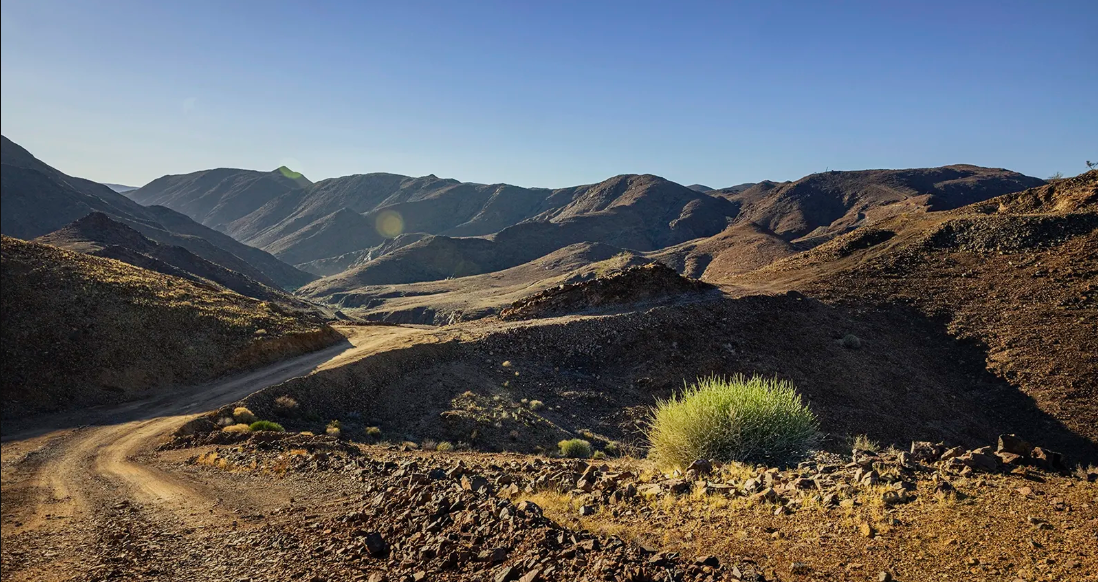
Koryx Copper (TSXV:KRY) expects its Haib PFS by end-November 2026, with a 48 Mtpa all-mill flowsheet and output expected above 100,000 tpa.
- Koryx Copper expects to publish the Haib PFS before the end of November 2026, and management expects it to beat the 2025 PEA substantially.
- Heap leaching has been removed, and the base case now crushes 48 Mtpa, with coarse particle flotation rejecting about 12 Mtpa of gangue.
- Agreements with NamPower and NamWater have defined the power and water routes, which reduces two long-standing infrastructure risks.
- Securing financing for expected capex of $1.5 billion to $2 billion is the key risk, and the company plans to address it through a strategic partner in 2027.
- Koryx trades at 0.24 times P/NAV against a developer median of 0.28 times, so a successful PFS could support a re-rating.
Copper development projects that combine scale, existing infrastructure and a credible path to construction are becoming harder to find. That scarcity sits at the centre of the investment case for Koryx Copper S.A. (TSXV:KRY), the Luxembourg-domiciled developer advancing the 100%-owned Haib Copper Project in southern Namibia. Speaking in London during LME Week, President & CEO Heye Daun said the company expects to publish its Pre-Feasibility Study (PFS) before the end of November 2026. He expects the results to be substantially better than the September 2025 Preliminary Economic Assessment (PEA). Koryx has spent two years reworking a large, low-grade porphyry deposit with a long exploration history. The PFS is the document that will show whether that technical work produces a project that lenders and strategic partners can back. The company is pitching the study as the trigger for closing a valuation gap that its own peer benchmarking puts below the developer median.
From Turnaround to Pre-Feasibility
Haib is one of only a few Paleoproterozoic porphyry copper deposits in the world, carrying molybdenum and gold credits alongside copper. It has been explored by Falconbridge, Rio Tinto and Teck over several decades, and more than 160,000 metres of drilling has been completed on the property since the 1970s. Daun’s team took control of Koryx in 2024 and set out a technical strategy of right-sizing and optimising the project, then making it bigger and better. The same group previously built and sold Auryx Gold to B2Gold for $180 million in 2011 and Osino Resources to Shanjin International Gold (formerly Yintai Gold) for C$368 million in 2024, both Namibian projects.
The recently completed infill programme of more than 55,000 metres was designed to lift grade and convert Inferred material into the Indicated category ahead of the PFS. The March 2026 Mineral Resource Estimate (MRE) stands at 744 million tonnes Indicated at 0.28% copper (0.32% copper equivalent, or CuEq) and 579 million tonnes Inferred at 0.24% copper (0.28% CuEq). Daun was measured about the impact of individual intercepts. He noted that a block of roughly 1.5 billion tonnes is hard to shift on average grade. He pointed instead to higher-grade pockets the mine plan will target. Recent holes include 74 metres at 0.61% CuEq, including 8 metres at 1.74% CuEq.
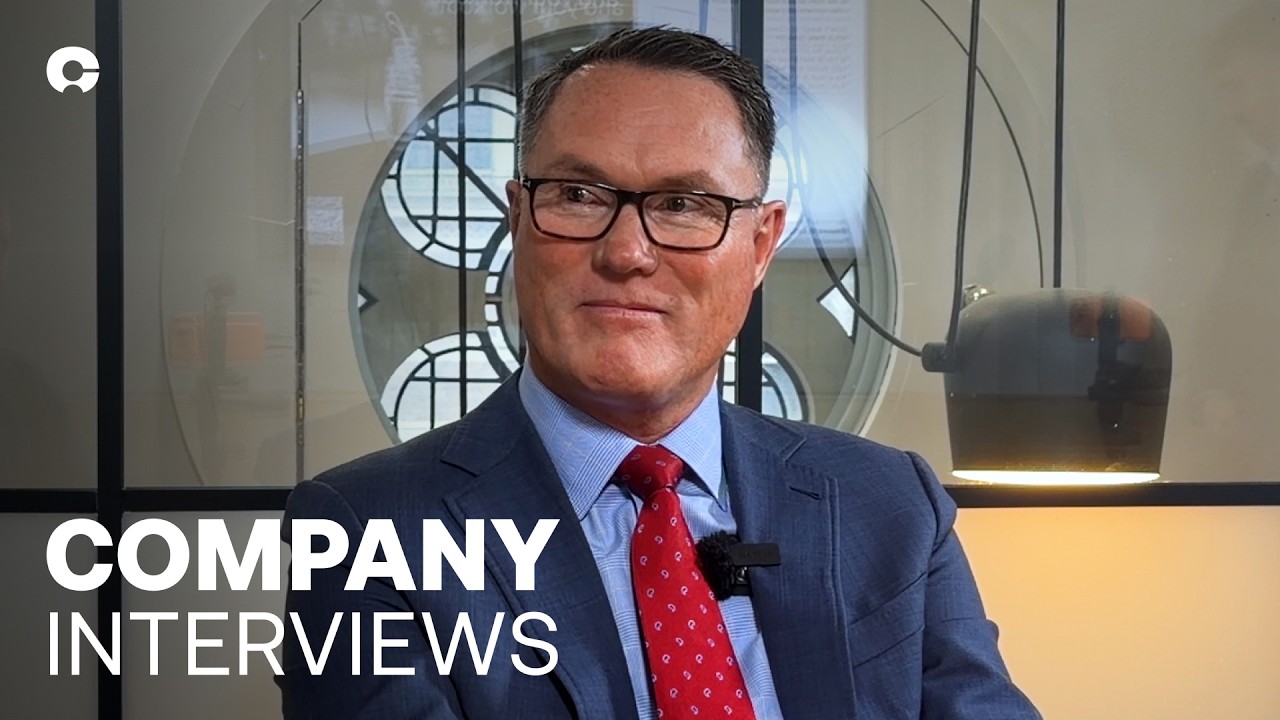
Interview with Heye Daun, President & CEO, Koryx Copper
A Simpler, Larger Flowsheet
The most significant change since the PEA is the processing route. Daun explained that the original thesis of sulphide heap leaching works in the laboratory but is not credible at industrial scale. Test work confirmed that Haib needs to be a milling and flotation operation. The interim PFS update published on 8 October confirmed that heap leaching is no longer expected to form part of the PFS base case, with all production now coming through the mill.
A debottlenecking study by lead engineer DRA Global has set PFS base case crushing throughput at 48 million tonnes per annum (Mtpa). Coarse particle flotation (CPF) is expected to reject roughly 12 Mtpa of coarse gangue grading 0.05% copper before the main flotation circuit. That leaves 36 Mtpa of higher-grade feed for a hybrid circuit of conventional tank cells and Jameson cells. The comparable PEA case was a 28 Mtpa mill alongside 7 Mtpa of heap leaching. The company has also selected a single tailings storage facility site from nine candidates, capable of holding the full life-of-mine total of about 1.15 billion tonnes.
The Baseline to Beat
The September 2025 PEA set the benchmark. It outlined an after-tax net present value (NPV) of $1.351 billion at an 8% discount rate and a copper price of $4.31 per pound. It also showed an after-tax internal rate of return (IRR) of 20.1%, development capital of $1.559 billion and a payback period of 3.9 years. Average payable copper production was 92,000 tonnes per annum over the first ten years, across a 23-year mine life. C1 cash costs were $1.81 per pound and all-in sustaining costs (AISC) were $2.05 per pound over the same period.
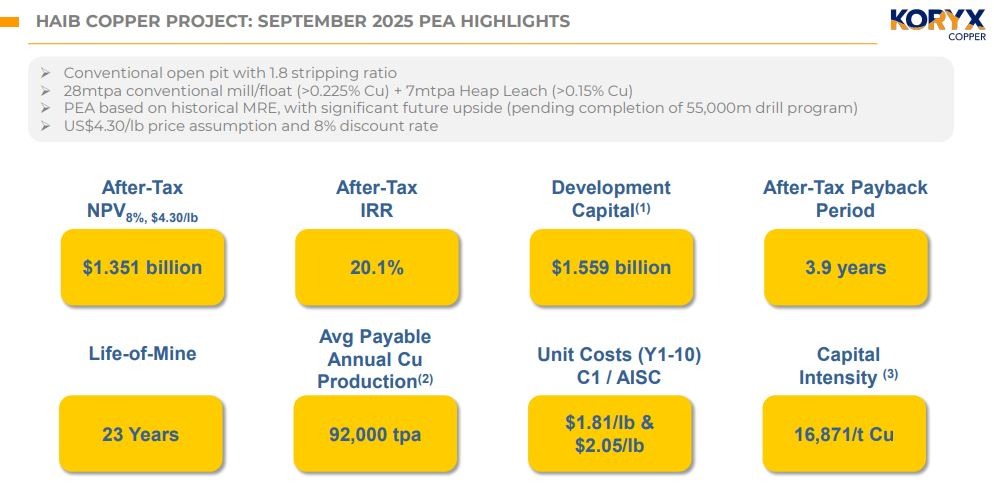
Daun would not give PFS numbers ahead of publication. He said final recovery and drill results were due within a week. He expects annual copper output to be well over 100,000 tonnes. He indicated that capital expenditure would land somewhere between $1.5 billion and $2 billion. He added that a large share of the capital estimate already rests on supplier quotes rather than factoring, closer to definitive feasibility study (DFS) practice.
That emphasis on estimate quality reflects who the study is really written for. Daun said retail share buyers drive the share price day to day, but
“the ultimate test is the corporates or the project financiers, the banks, the real money, the big money that comes in to build this mine. They focus on quality.”
Infrastructure & Permitting
Daun said power was once seen as Haib’s main constraint but is now de-risked. Electricity will be drawn through the Namibian grid but sourced from South Africa, where he said Eskom has surplus capacity in the nearby Northern Cape. Koryx has signed a Memorandum of Agreement (MoA) with NamPower. The planned supply is a 68-kilometre, double-circuit 220 kilovolt line from the Harib substation, supplemented by solar photovoltaic generation and battery storage.
Water will come from the Orange River, selected as the lowest-cost option, via a single abstraction point about 9 kilometres south of the mine and an off-channel storage reservoir. Koryx has signed a Memorandum of Understanding (MoU) with NamWater. Daun put the water scheme’s capital cost at about $150 million. He said a materially larger scheme would require another round of permitting, which he described as an option for a future owner rather than a current constraint.
On permitting, the Environmental and Social Impact Assessment (ESIA) and Environmental Management Plan supporting the Environmental Clearance Certificate were submitted to the Ministry of Environment, Forestry and Tourism on 19 August and 4 September 2026. The company is planning for a review period of up to six months. Daun said broad support from government, local communities and the wider population helps Namibian projects move through permitting faster.
Closing the Valuation Gap
Daun was direct about where he believes the market has mispriced the company.
“...we will put on the table a world-class, simple, long-life, low-cost, scalable... copper mine. Potential copper mine. That should be valued at a share price that’s substantially higher than ours is currently.”
The company’s own benchmarking places Koryx at 0.24 times price to net asset value (P/NAV), against a copper developer median of 0.28 times. At C$3.41 on 15 September 2026, the fully diluted market capitalisation was about C$460 million. Five research analysts cover the stock, with published targets ranging from $4.50 to $8.00.
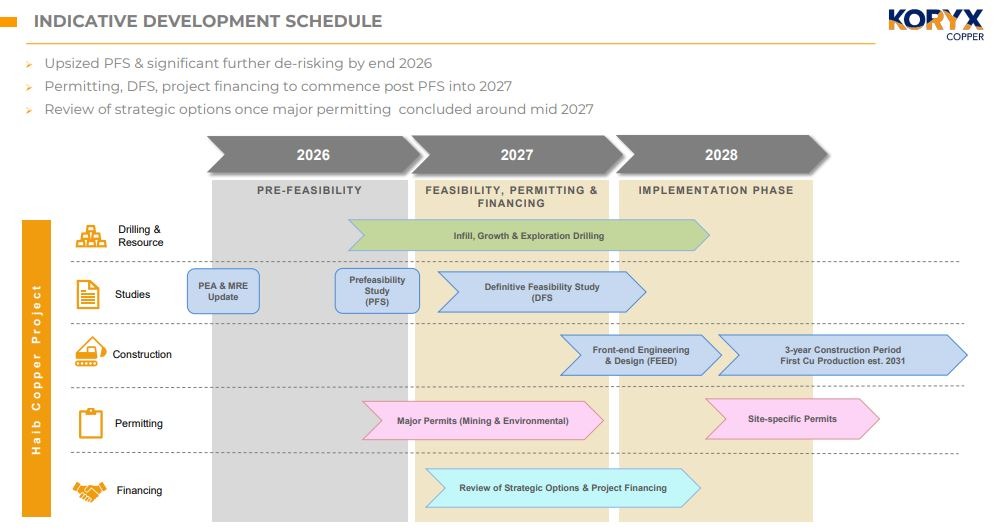
Daun identified project financing uncertainty as the largest obstacle to a re-rating. The steps planned after the PFS target that directly: financing certainty, endorsement from credible technical groups and the introduction of a strategic investor. The indicative schedule shows the DFS, major permits and a review of strategic options and project financing running through 2027. A front-end engineering phase and a three-year construction period would follow, with first copper production estimated in 2031.
Investment Thesis for Koryx Copper
- The PFS, due before the end of November 2026, is the next major catalyst, and management expects results to be substantially better than the PEA.
- Removing heap leaching and adding CPF and Jameson cells has simplified the flowsheet while raising base case throughput to 48 Mtpa.
- Power and water routes are now defined through agreements with NamPower and NamWater, reducing two historical infrastructure risks.
- Project financing for capital expenditure of $1.5 billion to $2 billion remains the key risk, and investors should monitor progress on a strategic partner during 2027.
- Investors should track the Environmental Clearance Certificate decision, which is a condition for the Mining Licence the company has applied for.
- The stock trades at 0.24 times P/NAV against a developer median of 0.28 times, leaving room for a re-rating if the PFS and financing steps deliver.
Macro Thematic Analysis
Copper demand is being pulled by electrification, grid investment and data centre build-out, while new supply has struggled to keep pace. Large discoveries are rare, and many existing projects face long permitting timelines or water and political risk. That leaves a short list of development assets capable of producing more than 100,000 tonnes of copper a year.
Daun said one of the clearest signals of market tightness is in treatment and refining charges, the fees smelters receive to process concentrate. He described them as deeply negative, which indicates strong competition for copper concentrate.
His view of what this means for strategic buyers is clear.
“...fundamentally speaking with supply and demand situations extremely positive for copper, and that’s why the corporates and companies that we meet and that we talk to, they all have copper right up at the top of their strategic ambitions.”
Geopolitics adds another layer. Competition between Western and Chinese capital for critical minerals has sharpened, and some commentators have suggested Chinese investors are pulling back from African assets. Daun said Koryx is not seeing that, and reported interest from both sides. Namibia’s position matters here. It has attracted recent Chinese investment in uranium and gold, including the Osino transaction, while keeping close ties with Europe and the United States.
Cost position also counts in a scarce market. Using Wood Mackenzie data, Koryx places Haib’s PEA all-in sustaining cost in the second quartile of the global copper cost curve. Its capital intensity sits in the lower half of a broad group of undeveloped copper projects. For buyers screening on size, cost and jurisdiction, that narrows the field.
TL;DR
Koryx Copper expects to publish the Pre-Feasibility Study for its Haib Copper Project in southern Namibia before the end of November 2026. CEO Heye Daun expects results to be substantially better than the 2025 PEA, which showed a $1.351 billion after-tax NPV and 20.1% IRR. Heap leaching has been dropped. A 48 Mtpa all-mill flowsheet now uses coarse particle flotation to reject about 12 Mtpa of gangue. Power and water routes are agreed with NamPower and NamWater, and environmental applications have been submitted. Daun expects output above 100,000 tonnes per annum and capex of $1.5 billion to $2 billion. He sees financing, a strategic partner and broader institutional ownership in 2027 as the path to closing the company’s valuation gap.
FAQs (AI-Generated)
Analyst's Notes





Subscribe to Our Channel




Stay Informed


