




Lifezone Moves Kabanga Toward 2026 FID While Securing Musongati Exclusivity for Regional Nickel Scale


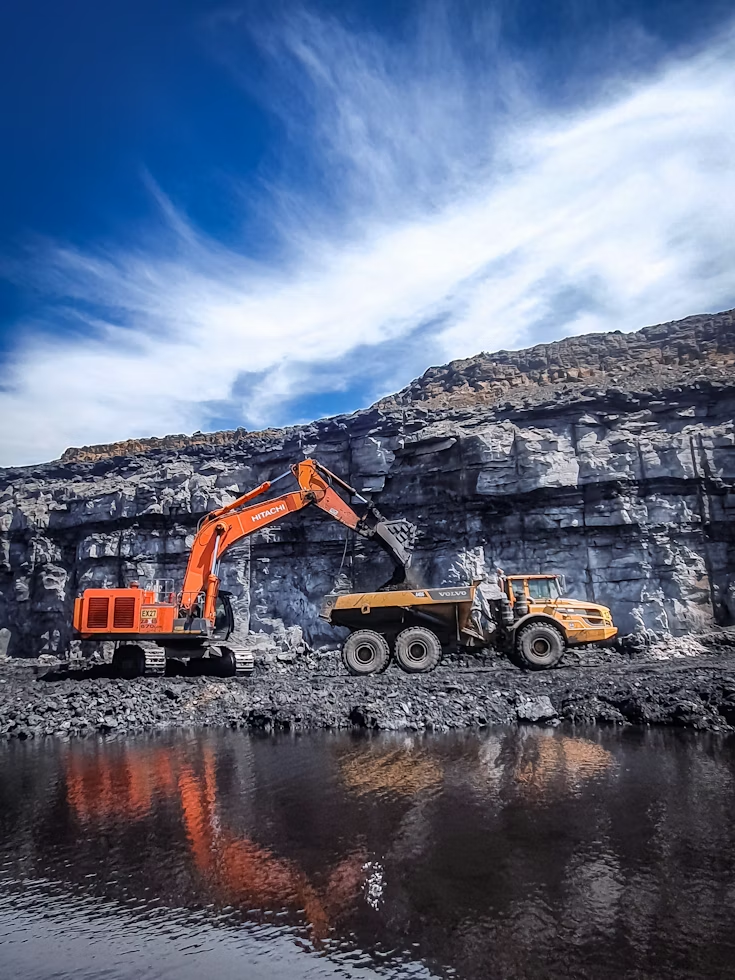
Lifezone secures Musongati nickel exclusivity in Burundi while advancing Kabanga Nickel Project through financing, permits, and execution toward 2026 final investment decision.
- Lifezone signed a 14-month exclusivity agreement with the Government of Burundi over Musongati in March 2026, adding a second East African nickel workstream.
- The agreement begins with a 30-day scoping phase that will use prior project data to shape a longer exploration and economic feasibility program.
- Musongati sits about 125 miles, or about 200 kilometers, southwest of Kabanga and was previously defined as a resource of more than 140 million tons.
- Kabanga remains the core asset, with 84% ownership, 52.2 million tonnes of proven and probable reserves on a 100% basis, an 18-year mine life, and all-in sustaining costs (AISC) of US$3.36 per pound payable nickel net of by-product credits.
- Musongati adds regional scale and optionality, but the current equity narrative still depends primarily on whether Kabanga converts financing progress and execution readiness into final investment decision in 2026.
The Musongati Exclusivity Agreement & the Initial Work Program
Lifezone Metals announced in March 2026 that it had signed an exclusivity agreement with the Government of Burundi covering the Musongati nickel laterite project. The signing ceremony took place at the US Department of State in Washington, DC. The announcement adds a Burundi workstream alongside the company’s existing project base in Tanzania.
The agreement runs for 14 months and begins with a 30-day scoping phase. During that period, Lifezone’s in-house team is expected to use prior project data to define a longer-term plan for exploration and economic feasibility work. The exclusivity period may then be extended to cover that broader program.
At this stage, the agreement is limited to exclusivity and initial assessment. It does not yet establish a defined development plan for Musongati, and it does not alter Kabanga’s position as the company’s principal advanced asset.
Musongati’s Deposit Scale & Position Within the East African Nickel Belt
Musongati is described by Lifezone as Burundi’s most important nickel deposit and as a large-tonnage open-pittable nickel laterite resource. The project lies within the Kabanga-Musongati Alignment of the East African Nickel Belt, which is the geological link behind the company’s regional framing.
The deposit is located about 125 miles, or about 200 kilometers, southwest of Kabanga in Tanzania. The project has been explored and evaluated for roughly 50 years. A 2011 study defined a resource of more than 140 million tons, while earlier work also indicated by-product potential in copper, cobalt, gold, platinum-group metals, and scandium.
The current agreement does not update those historical project metrics. It gives Lifezone exclusive access to assess a deposit that is already known, geographically close to Kabanga, and large enough to support a broader East African nickel platform narrative.
Kabanga Remains the Core Asset & the Main Source of Near-Term Value
Kabanga remains the centre of the current company story. Lifezone holds an 84% interest in the project, while the Government of Tanzania holds 16%. The company also retains full operating control and 100% offtake rights.
On a 100% basis, Kabanga contains 52.2 million tonnes of proven and probable reserves grading 1.98% nickel, 0.27% copper, and 0.15% cobalt. The mine plan is built around an 18-year mine life and 3.4 million tonnes per annum steady-state throughput. Attributable resources exclusive of reserves comprise 18.3 million tonnes of measured and indicated material at 1.20% nickel, 0.18% copper, and 0.10% cobalt, plus 13.5 million tonnes of inferred material at 2.08% nickel, 0.28% copper, and 0.15% cobalt.
The project is also further advanced than Musongati on execution. Lifezone reports more than 620 kilometers of drilling completed, more than US$435 million invested, a Special Mining Licence already in hand, and board approval for the execution readiness phase. The feasibility study was completed in July 2025, and mineral reserves were declared for the first time in the project’s 50-year history. That set of technical, ownership, and permitting facts is why Kabanga remains the main source of nearer-term project value.
Kabanga Economics & Cost Position in the Current Financing Context
Lifezone’s feasibility work outlines an after-tax net present value (NPV) at 8% of US$1.58 billion and an after-tax internal rate of return (IRR) of 23.3%. Pre-production capital is estimated at US$942 million, with payback in 4.5 years from first production. On the company’s figures, the project carries a 1.4x ratio of NPV to pre-production capital.
The operating cost profile is one of the main reference points in that financing context. Lifezone reports all-in sustaining costs (AISC) of US$3.36 per pound of payable nickel, or US$7,408 per tonne, net of by-product credits. Total site operating cost is put at US$70.10 per tonne milled. The economic model uses price assumptions of US$8.49 per pound nickel, US$4.30 per pound copper, and US$18.31 per pound cobalt.
Chief Financial Officer of Lifezone Metals, Ingo Hofmaier, positions the project's cost structure against November 2025 nickel pricing.
“Our all-in sustaining costs are US$3.36 per pound, net of by-product credits, which is well below current and relatively low nickel prices.”
These are study-based figures rather than realised operating results. Even so, they form the economic basis for the ongoing financing process and provide the numerical context for Kabanga’s position within the company’s broader project portfolio.
Bridge Funding Is in Place While Project Financing Moves Forward
The move from feasibility economics to project finance is already underway. Lifezone closed a US$60 million Taurus Mining Finance bridge facility in August 2025, with the stated purpose of funding early works and development activities toward financial close and final investment decision. The company also completed a US$15 million registered direct offering in November 2025.
At the group level, Lifezone reported consolidated cash of US$20.1 million, convertible debt of US$52.3 million, and a bridge loan balance of US$20.0 million in December 2025. The broader project financing process is being led by Societe Generale. Lifezone describes active engagement with development finance institutions, commercial lenders, export credit agencies, and potential strategic investors, alongside an anchor expression of interest from the US Development Finance Corporation (DFC), and engagement from DFIs and export credit agencies in Europe and Japan, including the Japan Organization for Metals and Energy Security (JOGMEC).
Hofmaier frames lender engagement as an active diligence process rather than an early outreach phase.
“We are very well advanced in due diligence exercises with several of them; the DFC is public, JOGMEC is public.”
The distinction at this stage is between funding already secured for the development phase and the full financing package still required for project construction. The bridge facility and equity raise are completed actions. Financial close and final investment decision remain the next major project milestones.
Permits, Infrastructure & Tanzania Partnership Support Execution
Kabanga’s execution profile is also shaped by what is already in place on the regulatory and infrastructure side. The project has its Special Mining Licence, and the environmental and social impact assessments have been approved for both the mine site and the resettlement areas. The Resettlement Action Plan is aligned with International Finance Corporation Performance Standard 5, and 96% of cash compensation agreements had been paid as of July 2025.
Hofmaier points to the permissions already in place when discussing readiness for the next stage.
“We have a framework agreement, a Special Mining Licence, and most of the other operating licences we would currently need for the start of construction.”
Lifezone also points to power, the Tanzanian Standard Gauge Railway, the Julius Nyerere Hydropower project, and DP World’s investment in the port of Dar es Salaam as part of the broader execution setting. The Framework Agreement with Tanzania is presented as a public-private partnership, and the localisation plan includes about 1,090 direct jobs at steady state, with roughly 91% expected to be filled by Tanzanian nationals.
Regional Scale, Supply-Chain Positioning & Critical Minerals Relevance
Lifezone is framing Musongati and Kabanga together as part of a wider East African nickel platform. The proximity between the 2 deposits supports that regional description and gives the company a larger deposit base within the same belt.
The company also places Kabanga within a wider supply-chain context. Lifezone describes the project as an alternative source of nickel to a market concentrated in Indonesia and Chinese-backed refining, and as a strategic critical metals asset relevant to US and allied supply chains. Lifezone's proprietary hydrometallurgical processing technology, Hydromet, is presented within that same framework as a more sustainable and cost-effective refining and recycling route. Musongati is an added regional deposit, while Kabanga remains the project with the advanced technical and financing work already underway.
Risks, Dependencies & Watch Points
Musongati remains at the scoping stage. The 14-month exclusivity period begins with a 30-day review phase, and any extended exclusivity, exploration plan, or economic work will depend on what follows from that initial assessment. The historical resource and by-product references provide context, but they are not a substitute for current-stage technical work.
Kabanga is considerably further advanced, but it still depends on remaining approvals, commercial tenders, completion of the full financing package, and final investment decision. Financing discussions are active, but not complete. The company is also evaluating strategic financing options, including a potential asset-level alternative, which leaves part of the eventual funding structure open.
Over the next 6 to 12 months, the central remaining catalysts are Kabanga’s progress toward financial close and final investment decision. Musongati broadened the company’s East African position, but its practical significance is still likely to be judged alongside Kabanga’s ability to move into the next phase of development.
The Investment Thesis for Lifezone Metals
- Lifezone has added regional nickel scale whileKabanga remains the main source of near-term value.
- Kabanga combines reserve scale, grade, mine life, and operating cost position in a way that can support project financing if execution continues on schedule.
- The Musongati agreement broadens the East African nickel inventory under review and gives Lifezone a second development path at low initial capital commitment.
- The financing process has moved beyond the concept stage, with bridge funding closed, lender diligence underway, and public evidence of development finance institution and export credit agency engagement.
- Permits, infrastructure, and the Tanzania government partnership reduce part of the execution burden at Kabanga, while final approvals and tenders are still pending.
- The key measure for the equity remains Kabanga’s ability to translate readiness into financial close and a final investment decision, rather than the mere presence of a second project.
Musongati extends the company’s regional footprint and adds a second nickel workstream. The near-term corporate sequence, however, remains centered on Kabanga’s financing, approvals, and final investment decision timetable.
TL;DR
Lifezone has added a Burundi growth option through a 14-month exclusivity agreement over Musongati, but the current investment case still depends on Kabanga moving from financing progress and execution readiness into a final investment decision. Musongati adds regional scale and a second nickel workstream, while Kabanga remains the flagship project with reserves, economics, permits, and an active project finance process already in place.
FAQs (AI-Generated)
Lifezone signed a 14-month exclusivity agreement with the Government of Burundi over the Musongati nickel project. The agreement starts with a 30-day scoping phase that will use prior project data to define a longer exploration and economic feasibility plan.
No. Musongati adds regional scale and a second workstream, but Kabanga remains the flagship asset and the main driver of nearer-term valuation change. That is where the reserve base, economics, financing effort, and execution readiness currently sit.
Kabanga already has defined reserves, a mine plan, cost metrics, permits, and an active funding process. Those are the elements that still need to convert into construction and later cash flow visibility.
The company still needs to complete remaining approvals, commercial tenders, and the full financing package. Technical work linked to critical-path construction and broader execution readiness also remains part of the path.
The key catalyst is whether Lifezone can convert Kabanga’s current readiness into a financial close and final investment decision. Musongati adds strategic breadth, but Kabanga remains the nearer-term project test.
Analyst's Notes





Subscribe to Our Channel



.png)
.png)




Stay Informed


