Madsen Alone Targets 47,000 Ounces in 2027: 7 West Red Lake Gold Checkpoints


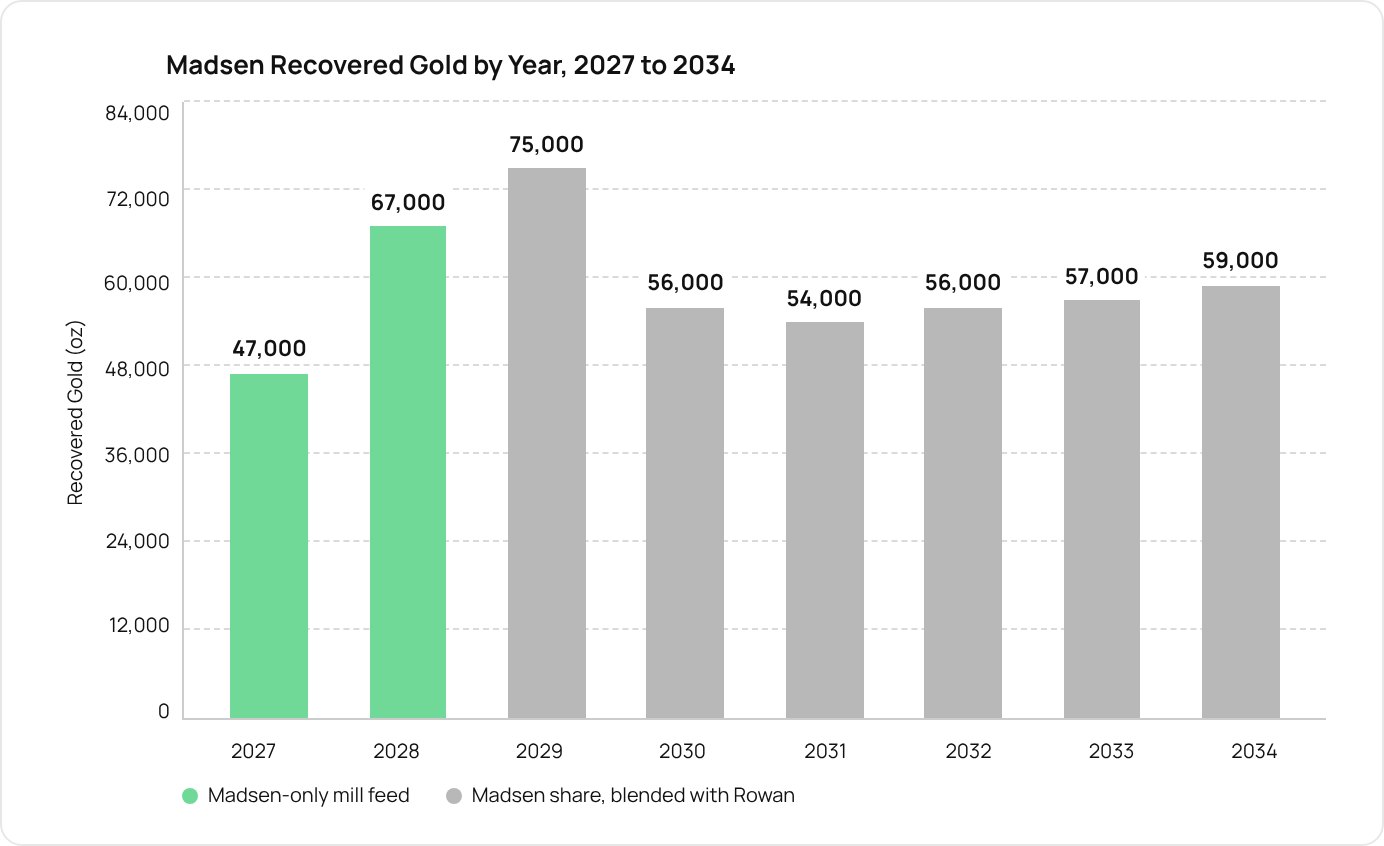
West Red Lake Gold's integrated pre-feasibility study has Madsen alone producing about 47,000 ounces in 2027 and 67,000 in 2028, before Rowan ore arrives.
Project Overview
West Red Lake Gold Mines (TSXV: WRLG | OTCQX: WRLGF) has built the first 2 years of its integrated pre-feasibility study (PFS) around the Madsen Mine. The study took effect on September 1, 2026, and was published on November 4, 2026. It combines the operating mine in Ontario's Red Lake Gold District with the high-grade Rowan Project in a production plan centered on the existing Madsen mill. SLR Consulting (Canada) Inc. prepared it with input from Fuse Advisors Inc., Knight Piesold, and Nordmin Engineering Ltd., and the plan incorporates Madsen's operating performance to date.
Madsen declared commercial production in January 2026, and its revised guidance for the year is 27,000 to 32,000 ounces (oz). The PFS lays out a 10-year mine life. Its opening years are the part of that plan an investor can measure against a mine that is already producing, because the mill feed in 2027 and 2028 comes from Madsen alone.
1. Rowan Feed Starts in 2029
Rowan ore does not reach the Madsen mill until 2029, and the PFS has the mill processing Madsen ore only in 2027 and 2028. Rowan is expected to begin development in 2028, with first gold production anticipated in 2029. Its ore is to be trucked about 80 kilometers by road to the Madsen mill rather than processed at its own mill.
From 2029 through 2034, Rowan ore is blended with Madsen ore at about 1:2, with the mill running at 1,350 tonnes per day (tpd). That 6-year blended window produces the study's average of 108,000 oz a year. The opening 2 years fall outside that window, as do 2035 and 2036, when the mill again takes only Madsen ore. The company's roadmap labels 2027 to 2028 its "Operating Leverage" stage, with Rowan development and the mill and tailings expansion toward 1,350 tpd starting inside it.
2. Madsen Is Planned for 47,000 oz in 2027 & 67,000 oz in 2028
The PFS sets Madsen's recovered gold at about 47,000 oz in 2027 and about 67,000 oz in 2028. Those figures compare with the 27,000 to 32,000 oz guidance for 2026. Madsen produced 22,102 oz through the first 9 months of the year: 5,667 oz in the first quarter, 8,576 oz in the second, and 7,859 oz in the third. Mill throughput rose 52% from the first quarter to the third quarter.
After 2028, Madsen's share of output is about 75,000 oz in 2029, 56,000 oz in 2030, 54,000 oz in 2031, 56,000 oz in 2032, 57,000 oz in 2033, and 59,000 oz in 2034. Rowan adds about 25,000, 49,000, 48,000, 60,000, 48,000, and 60,000 oz over those same years. Madsen alone then produces about 89,000 oz in 2035 and 34,000 oz in 2036, and every figure in the schedule is recovered gold based on Probable reserves.
3. Fork & the 904 Complex Replace Remnant Ground
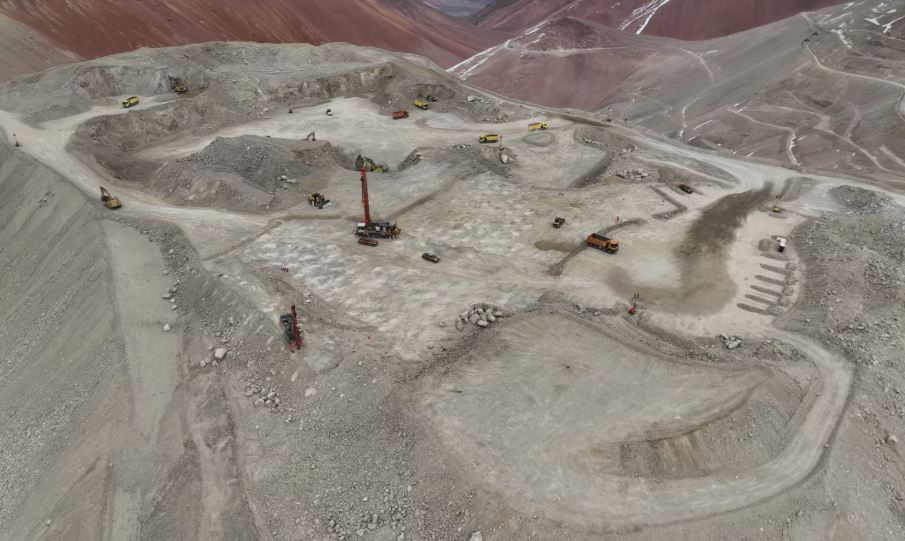
The 2027 step depends on new, non-remnant feed from Fork and the 904 Complex. Mining in 2026 came from the 4447, 955, and 960 complexes, and the 904 Complex and the Fork satellite deposit enter the PFS production profile in 2027. Fork is a near-surface, non-remnant deposit 250 meters (m) from existing Madsen infrastructure, with Probable reserves of 258,000 tonnes (t) at 4.85 grams per tonne (g/t) for 40,000 oz of gold. Initial development there is underway in the second half of 2026. Fork also holds a current resource of 59,500 oz Indicated at 5.9 g/t and 26,000 oz Inferred at 4.7 g/t, dated January 1, 2026, which the company aims to convert through further drilling.
Remnant ground still forms part of the plan. About 13% of planned tonnes lie adjacent to historical workings, which require probing, drainage, and backfilling before the ore is mined. President and Chief Executive Officer of West Red Lake Gold Mines, Shane Williams, separates the remnant-bound 2026 from the mine plan that follows:
"This year Madsen versus next year Madsen is a completely different project. This year Madsen, we had some remnant mining to go through, but the majority of our mining and our mine plan next year is based on non-remnant areas."
The move to non-remnant areas falls in 2027, the year the plan sets Madsen's output at about 47,000 oz.
4. The Mill Permit Is Expected to Move From 800 to 1,000 tpd
The mill permit is set on an 800 tpd annual average, and the next processing step is a permit change to 1,000 tpd. The mill averaged 867 tpd in the third quarter of 2026, up from 842 tpd in the second, and a secondary cone crusher was installed in September 2026. On several days, the mill has run at 1,000 tpd. Documents for that change are being prepared for the authorities, with discussions covering water and tailings management. Williams gives a timeline for that application:
"So that's ongoing as we speak. So I do expect that by Q1 of next year to be in a position to do 1,000 tons a day."
The PFS raises Madsen output to as much as 1,200 tpd in some years. In the Madsen-only years, the mill grinds ore to 80% passing 75 microns, a measure of how fine the ore is ground, then coarsens to 106 microns at the expanded 1,350 tpd.
5. Ramps Move the Ore Until the Shaft Hoists in 2028
Ore reaches the surface by truck on the ramps today, and hoisting through the #2 Shaft from 10 Level is scheduled to start in 2028. Madsen has 2 existing ramp systems joined by a connection drift. The #2 Shaft is being reconditioned to enable hoisting, with later refurbishment planned to extend to 17 Level, and the work is progressing toward an anticipated hoisting capacity of approximately 700 tpd. Williams ties the shaft to the depth of the mine rather than to the next few years of output:
"So for the next number of years, we don't see that dependency on the shaft. But as we get deeper in Madsen mine and it gets into the deep depths of the mine and explore the new areas, that's where the dependency on the shaft kicks in, not for a number of years."
In the plan, the 2027 output moves to the surface via a ramp, a year before shaft hoisting starts.
6. Hiring & Contractors Set the Run Rate
Madsen's mining rate fluctuated throughout 2026, and the company is adding crews to reach a full run rate. The average mining rate rose from 572 t in the first quarter of 2026 to 867 t in the second quarter, then fell to 710 t in the third quarter. Labor shortages are an industry-wide issue, and Madsen has ramped up hiring and brought in contractors.
Madsen and Rowan both carry heavily fixed costs, and labor and contractors make up around 50% to 60% of them. In the PFS, all-in sustaining cost declines as production increases, with a life-of-mine average of US$2,457 per ounce at a long-term gold price of US$3,568 per ounce from 2030. The study's price deck for the Madsen-only years is higher, at US$4,597 per ounce for gold in 2027 and US$4,482 per ounce in 2028.
7. Dated Steps Through 2028
Several dated steps fall in the Madsen-only years before Rowan starts. West Red Lake Gold is to file the NI 43-101 technical report on SEDAR+ within 45 days of November 4, 2026. The permit change is expected by the first quarter of 2027, and Fork and the 904 Complex are expected to enter production in the same year.
The tailings expansion is to be built in 2027, and the 13L East Drive advances through 2027 and 2028 to open additional mining fronts. Resource expansion drilling continues alongside it, after 65,000 m of definition drilling at Madsen since the January 1, 2026 resource date. In 2028, shaft hoisting from 10 Level and Rowan development are both scheduled to begin, a year before Rowan's anticipated first gold.
Key Takeaways for Investors
- The pre-feasibility study has the Madsen mill processing Madsen ore only in 2027 and 2028, with Rowan's first gold production anticipated in 2029.
- The plan sets Madsen's recovered gold at about 47,000 ounces in 2027 and about 67,000 ounces in 2028, against 27,000 to 32,000 ounces guided for 2026.
- Fork and the 904 Complex enter the production profile in 2027 as Madsen moves to mainly non-remnant ground.
- The mill permit is set at an annual average of 800 tonnes per day, with a move to 1,000 tonnes per day expected by the first quarter of 2027.
- Shaft hoisting from 10 Level and Rowan development are both scheduled to begin in 2028.
Bottom Line
West Red Lake Gold's integrated PFS opens with 2 years during which Madsen supplies all mill feed, at about 47,000 oz in 2027 and 67,000 oz in 2028. Those years follow a 2026 guidance of 27,000 to 32,000 oz, with 22,102 oz produced through the first 9 months. The plan relies on Fork and the 904 Complex as new non-remnant feed, and on a mill permit that moves from an 800 tpd annual average to 1,000 tpd. Ore travels up the ramps until shaft hoisting starts, scheduled for 2028. Each of those steps has a date attached, from the permit change expected by the first quarter of 2027 to the tailings expansion in the same year. West Red Lake Gold enters 2027 with a plan calling for 47,000 oz from Madsen alone, 2 years before Rowan ore reaches the mill.
Analyst's Notes





Subscribe to Our Channel







Stay Informed