Sunday Lake Gold Targets Maiden Fenelon Reserve in Funded 2028 Prefeasibility Study


Sunday Lake Gold is drilling 50,000 m at Fenelon to support a maiden gold reserve in a fully funded prefeasibility study targeted for early 2028.
- Sunday Lake Gold holds C$71 million in cash as of September 2026 which fully funds a prefeasibility study on its Fenelon gold project in Quebec targeted for the first quarter of 2028.
- Fenelon March 2025 preliminary economic assessment cut throughput to 3,000 tonnes per day and outlines 107,000 ounces of gold a year at an all-in sustaining cost of US$1,046 per ounce.
- The company s running a 50,000-metre infill drilling programme with 7 drills at Fenelon to upgrade the inferred half of the mine plan and support a maiden mineral reserve.
- Agnico Eagle at 19.6%, Waratah Capital Advisors at 19.9% and Eric Sprott together hold about half of Sunday Lake Gold after a C$56 million private placement in May 2026.
- Sunday Lake Gold expects metallurgical variability test results for Fenelon in the first quarter of 2027.
Sunday Lake Gold (TSX:SNDY), renamed from Wallbridge Mining last October 2026, is drilling to move its Fenelon gold project in northern Quebec from a resource-based valuation to a reserve-based one. The company controls about 600 square kilometers of ground covering 80 kilometers (km) of the Sunday Lake Deformation Zone on the Quebec side. Agnico Eagle's Detour Lake mine lies on the western end of the same structure, and Senior Exploration Consultant Mark Petersen described it as Canada's largest producing gold mine today.
Fenelon is at preliminary economic assessment (PEA) stage, and the company is targeting a prefeasibility study (PFS) in the first quarter of 2028. About C$71 million in cash at September 30, 2026 funds that work. Petersen and the company's new head of project development, Sylvain Goyette, outlined how a rescaled 3,000 tonnes per day (tpd) mine plan, a winter infill programme running 7 drills, and a reshaped shareholder register feed into the PFS.
Rightsizing Fenelon for Margin Over Scale
The March 2025 PEA cut Fenelon's planned mining and processing rate to 3,000 tpd from 7,000 tpd in the 2023 study. Petersen said the company sized the project so it could take it to commercial production on its own. At a US$2,200 per ounce gold price, the PEA outlines average production of 107,000 ounces a year, rising to 127,000 ounces a year over the first 5 years, when the plan mines to a higher cutoff grade. Initial capital is C$579 million, sustaining capital is C$449 million, and all-in sustaining costs (AISC) average US$1,046 per ounce. The study returns an after-tax net present value at a 5% discount rate (NPV5%) of C$706 million and an after-tax internal rate of return (IRR) of 21%.
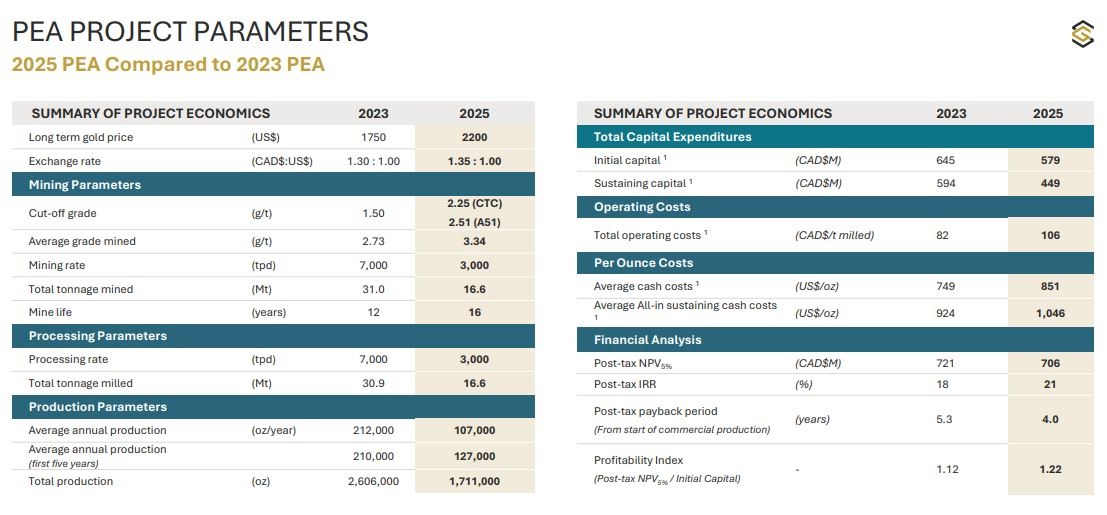
The smaller plan produces 1,711,000 ounces over a 16-year mine life, including a ramp-down in the final years, at an average mined grade of 3.34 grams per tonne. Petersen said it mines about half of the Fenelon resource and leaves the rest for future development. He added that staying under 5,000 tpd means the company only needs to work with provincial permitting agencies.
Petersen acknowledged that costs will rise from the PEA figures. Goyette said the cost structure leaves room for that, and that the operation would remain cash generative at the bottom of the gold price cycle even with a 30% cost overrun. He also noted the PEA used US$2,200 per ounce gold, which leaves price upside in the study.
Existing Infrastructure & Modular Construction Target Cost Control
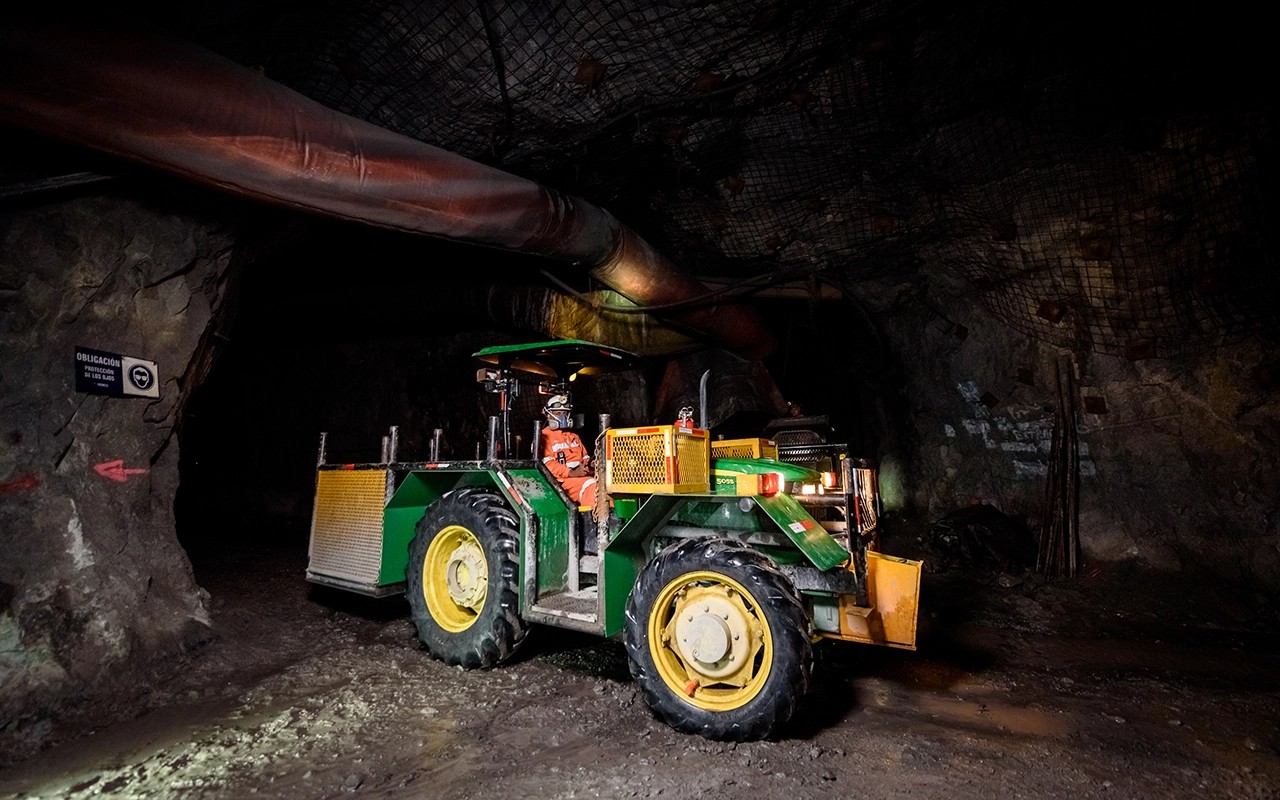
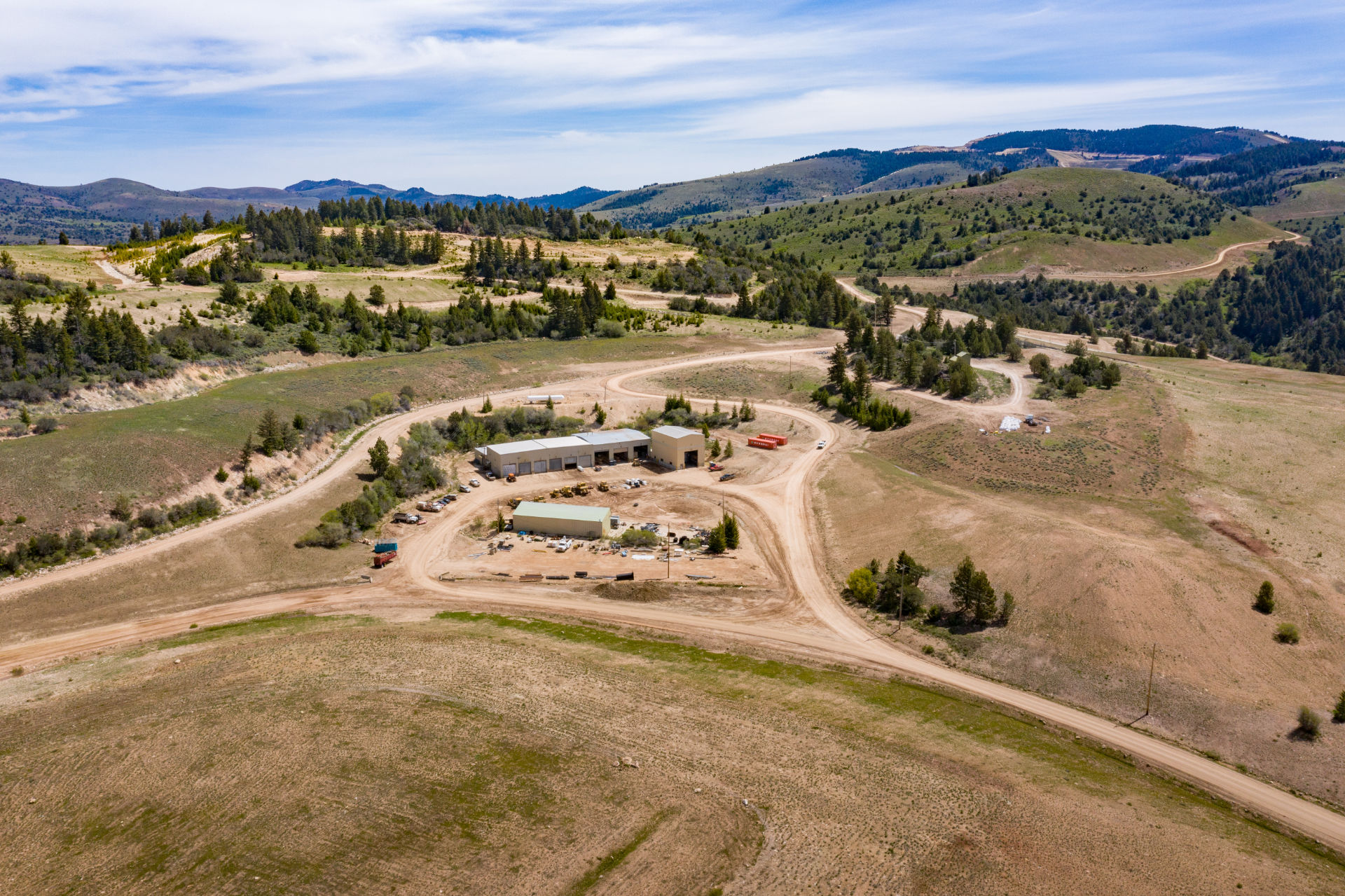
Goyette joined Sunday Lake Gold one week before the interview. He is originally from the region, delivered the Perseverance project after working with the team there in 2007, and has held roles with Glencore and Falconbridge Noranda, including the Koniambo project, which he put at about $8 billion. He said the first lever on capital cost is starting small, and the second is the infrastructure Fenelon already has, including a camp, an adit, past underground development and a previous open pit.
Vice President, Project Development and Operations of Sunday Lake Gold, Sylvain Goyette, said that site history changes how the project should be judged:
"All of these factors are typically the key driver to a cost overrun. So I do believe that while it is seen as a greenfield project, it is significantly derisked because we have a lot of available information."
For the PFS and the feasibility study (FS) that follows, Goyette plans to design the plant for modular construction. Components would be prefabricated and preassembled in shops in towns a few hundred km from site, which cuts the labour hours that must be brought to a remote location. He also said the 5,000 tpd permitting threshold leaves room to design at 3,000 tpd and expand throughput later at a lower grade if gold prices support it, with capital deployed in stages.
Infill Drilling Targets a Maiden Reserve
Half of the PEA mine plan is in the indicated category and half is inferred, according to Petersen. Fenelon's 2025 resource holds 1.75 million ounces (Moz) indicated and 1.65 Moz inferred. The largest PFS work stream is an infill programme of 50,000 meters (m) aimed at the gaps in the inferred volumes inside the mine plan. The target is a nominal 30 to 35 m hole spacing, the density Petersen said is needed for indicated classification.
Petersen said the last of 7 drills arrived on site the week before the interview. The helicopter-supported winter programme is designed to finish drilling by the end of the first quarter of 2027, with a new block model due at the end of the second quarter of 2027 for the mine design team. At full strength, 400 to 500 m of core reaches the core shack each day.
The main output of that drilling is Fenelon's maiden mineral reserve, a central deliverable of the PFS. Petersen said the stock trades at about $13 per resource ounce, which he called low, and that a reserve ounce commands a higher valuation than a resource ounce.
Interview with Mark Petersen, Senior Exploration Consultant & Sylvain Goyette, VP Project Development and Operations of Sunday Lake Gold
Metallurgy Tests Variability Across the Mine Life
Earlier testwork on Fenelon returned average gold recovery of 96%, with about 30% recovered by gravity at the front end of the circuit. Petersen said metallurgists who have reviewed the project see scope for more gravity recovery because the deposit contains a lot of coarse gold.
The current programme collected about 850 kilograms of representative material. The team split the PEA mine plan into 5-year segments and ran targeted infill drilling to sample the mining volume in each, looking for variability through the life of the mine and across the deposit. The samples are at a lab in Kamloops, British Columbia, with results targeted for the first quarter of 2027. A wildfire evacuation over the summer cost the team 2 months, which Petersen said the company used to plan the infill programme.
Balance Sheet & Strategic Shareholders
Sunday Lake Gold closed a C$56 million private placement on May 22, 2026, which Petersen described as all cash with no warrants. The raise funds the PFS. Petersen credited CEO Brian Penny, the first Chief Financial Officer of Kinross Gold, with negotiating the terms.
The financing reshaped the register. Agnico Eagle lifted its stake to 19.6% from just under 10%. Waratah Capital Advisors, a Toronto fund management company new to the stock, took 19.9%, and Eric Sprott holds 9.0%. Retail and other holders account for the rest, and Petersen estimated that about half of that group is smaller funds and family funds that do not have to report.
Waratah nominated a new director, a metallurgist and engineer, and Agnico Eagle already has a board representative. Agnico Eagle also asked for an informal technical advisory committee with 2 members from each company. Petersen said the committee has not yet met formally, and he expects meetings in 2027 as more data comes in. He added that Agnico Eagle's interest extends beyond Fenelon to the wider belt.
The Investment Thesis for Sunday Lake Gold
- Sunday Lake Gold held about C$71 million in cash at September 30, 2026, which funds the Fenelon prefeasibility study targeted for the first quarter of 2028.
- The 2025 preliminary economic assessment outlines 107,000 ounces of gold a year at an all-in sustaining cost of US$1,046 per ounce, using a US$2,200 per ounce gold price.
- A 50,000-meter winter infill drilling programme targets conversion of inferred ounces to the indicated category, which supports a maiden mineral reserve.
- Agnico Eagle at 19.6%, Waratah at 19.9% and Eric Sprott at 9.0% together hold about half of the shares outstanding.
- Monitor the metallurgical results targeted for the first quarter of 2027 and the updated block model targeted for the end of the second quarter of 2027.
- Cost inflation, half of the mine plan still classified as inferred, and northern Quebec geotechnical and water conditions are the main risks to the study outcome.
Drilling through the first quarter of 2027 will show how much of the mine plan can be converted to reserve ounces, and Petersen said the company is fully funded through the PFS.
Macro Thematic Analysis
Fenelon's redesign puts cost structure ahead of resource size, and the company's own studies show how far costs have moved. Average cash costs rose to US$851 per ounce in the 2025 PEA from US$749 in the 2023 study, and AISC rose to US$1,046 from US$924. Petersen said energy prices have since changed the cost picture again.
Petersen said the plan was built around that pressure:
"We're not really focused on maximizing NPV, we're focused on maximizing margin. We end up with a 15-year mine life of underground mining, averaging 107,000 ounces a year, and $600 million upfront capital commitment"
The PEA sensitivity table shows what that design does across gold prices. At US$1,800 per ounce, the after-tax NPV5% is C$353 million with a 13% IRR. At US$3,000 per ounce, it is C$1,381 million with a 34% IRR. Goyette said any company looking to invest in a project looks at what its cash flow is at any price sensitivity.
The geology adds a second element. Northern Abitibi is geologically continuous with the southern Abitibi and hosts Detour Lake, but it has seen much lower historical exploration and drill density because of past remote access, distance from urban centers, and thicker overburden. Sunday Lake Gold's ground covers 80 km of the deformation zone that hosts Detour Lake, and Petersen said Agnico Eagle's interest reaches beyond Fenelon to the broader potential along the belt.
TL;DR
Sunday Lake Gold, formerly Wallbridge Mining, is running a 50,000-meter infill drilling programme at its Fenelon gold project in Quebec to support a maiden mineral reserve in a prefeasibility study targeted for the first quarter of 2028. A March 2025 preliminary economic assessment outlines 107,000 ounces a year at 3,000 tonnes per day, an all-in sustaining cost of US$1,046 per ounce and C$579 million in initial capital. The company held about C$71 million in cash at September 30, 2026. Agnico Eagle, Waratah and Eric Sprott together hold about half of the shares. Metallurgical results are targeted for the first quarter of 2027.
FAQs (AI-Generated)
Analyst's Notes





Subscribe to Our Channel





Stay Informed