




New Found Gold Reports Q3 2026 Operational And Financial Results


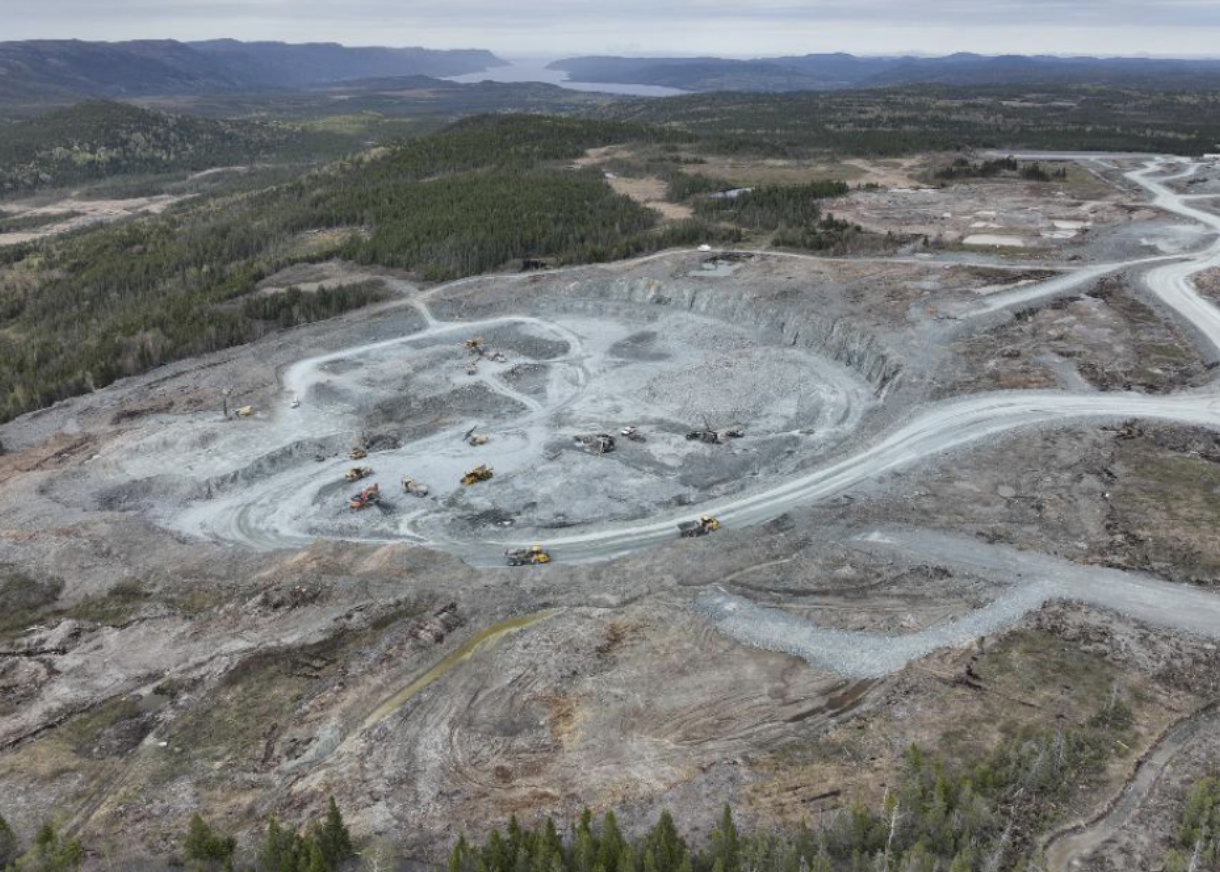
New Found Gold’s CEO explains Hammerdown’s US$3,279/oz Q3 AISC, the path to US$2,500/oz, and the fully funded Queensway Phase 1 build.
- New Found Gold declared commercial production at its Hammerdown Gold Mine on August 19, 2026. The mine produced 4,863 ounces of gold in Q3 2026 at 2.77 g/t, with zero lost-time incidents.
- Q3 all-in sustaining costs of US$3,279 per ounce was US$904 per ounce above the Hammerdown PEA. A non-reoccurring cost for stripping, brought forward ahead of winter, and infill drilling representing over 50% of this cost gap.
- Management expects additional efficiencies with grade control, a new crusher & ore sorter, and the Pine Cove gravity-CIL conversion to move costs toward a life-of-mine target of around US$2,500 per ounce.
- The revised Queensway PEA outlines an after-tax NPV of C$1.728 billion at US$3,600 gold. The Phase 1 Environmental Preview Report was registered on November 3, 2026.
- The company held C$167 million in cash and says Queensway Phase 1 is fully funded, with first material to Pine Cove targeted for Q4 2027.
New Found Gold: From First Gold at Hammerdown to the Queensway Build-Out
New Found Gold Corp. (TSX and NYSE-A: NFGC) has entered a new stage as a gold producer in Newfoundland and Labrador. The company declared commercial production at its 100%-owned Hammerdown Gold Mine on August 19, 2026. It is advancing its flagship Queensway Gold Project toward first delivery of mineralized material to the Pine Cove Mill in the fourth quarter of 2027. Both assets share a single processing hub, and Pine Cove’s permitted mill and tailings facility is central to the company’s phased growth plan.
CEO Keith Boyle described the company’s footprint in straightforward terms:
“We have our Hammerdown Gold mine that’s now in production. We have our Queensway project that we’re advancing for first mineralization delivery to the Pine Cove Mill.
Q3 2026 was Hammerdown’s first quarter of commercial production. The mine produced 4,863 ounces at an average grade of 2.77 g/t and recovery of 84.2%. The company sold 6,935 ounces at an average realized price of US$4,285 per ounce, for revenue of C$41.6 million. The figure drawing the most investor attention is an AISC of US$3,279 per ounce. How that cost gap closes, and what Hammerdown’s ramp-up period shows about Queensway, are central questions for the New Found Gold investment case.
Unpacking the US$3,279 AISC: Three One-Off Ramp-Up Costs
The largest contributor to the Hammerdown AISC variance was the decision to bring forward mining in the Rumbullion pit. Overburden stripping, blasting and ramp establishment had been scheduled for Q1 2027 but were completed in Q3 2026. The work lifted the strip ratio to 12.4, against 9.6 in the PEA, and added about US$350 per ounce to AISC.
Boyle said the timing was a deliberate trade-off:
“We brought forward stripping that was slated for early 2027, but we want to do it before the winter. Winter conditions in Newfoundland can be more difficult and more costly.”
Head grade of 2.77 g/t was 11% below the roughly 3.1 g/t assumed in the PEA, which added about US$135 per ounce to the AISC. Infill drilling to upgrade Inferred resources added about US$180 per ounce. Smaller contributors were:
- fuel surcharges on external service contracts, at about US$85 per ounce;
- higher mill labour, at about US$45 per ounce;
- Pine Cove water treatment, at about US$30 per ounce.
The company is assessing how elevated fuel and water treatment costs could affect its ability to close the variance.
Management’s life-of-mine AISC target for Hammerdown is around US$2,500 per ounce. Boyle confirmed that benchmark when asked about the long-term cost goal:
“The AISC in the quarter was $3,279. We’re targeting the life of mine $2,500.”
The Path Down the Cost Curve: Grade Control, Ore Sorting & the Mill Conversion
Grade-control drilling on a 5 m by 5 m pattern began at the end of April. It now covers most of the Hammerdown Phase 1 open pit and has expanded into the Rumbullion pit. Modelling of the high-density data is nearing completion, and the results are being built into mining practice.
Boyle said the new data is already changing how material is mined.
“Once you have a grade control model with that kind of drilling, you’re able to really identify the veins... The other thing that they’re starting to practice, because we have that definition now, is to actually blast the veins separately.”
Two capital projects are also expected to lower unit costs:
- Crusher and ore sorter. A permanent on-site crusher and ore sorter at Hammerdown is expected to be substantially complete in Q4 2026, with commissioning and ramp-up in early 2027. It is intended to send higher-grade material to the mill.
- Pine Cove conversion. The mill’s flotation-leach Merrill-Crowe circuit is being converted to gravity carbon-in-leach, which is expected to improve gold recovery.
Supplier contract negotiations and grade-control practices round out the effort:
“We feel comfortable that we’re doing the right things, but we’re still a few quarters away before we really hit our stride.”
The operation is already generating cash. Q3 income from mine operations was C$18.6 million, or 45% of revenue, and EBITDA was C$13.1 million. Operating cash flow before working capital changes was C$11.2 million, although the company still recorded a net loss of C$7.1 million.
Boyle described the cash flow as a significant milestone:
“We generated an operating cash flow of $11.2 million and for us that’s huge.”
Queensway: Mill Retool, Revised PEA & EPR Submitted
The Queensway Gold Project is advancing on three parallel tracks. The first is the Pine Cove gravity-CIL conversion, which remains on schedule to accept Queensway material in Q4 2027. An expansion of the mill to 1,400 tonnes per day is also targeted for that quarter, with initial Queensway feed of 700 tonnes per day through 2030.
The second track is the revised PEA and updated mineral resource estimate, released on October 22, 2026. At a base case gold price of US$3,600 per ounce, the study outlines:
- an after-tax NPV(5%) of C$1.728 billion and an after-tax IRR of 126%;
- 1.744 million ounces produced over a 15-year phased open-pit and underground mine life;
- a Phase 1 average head grade of 13.41 g/t;
- initial capital of about C$150 million;
- life-of-mine AISC of US$1,375 per ounce.
Measured and Indicated resources rose 38% to 1.92 million ounces. The PEA is preliminary and includes Inferred resources, and no Mineral Reserves have been defined.
Boyle said the plan was designed to show early cash generation:
“Production from Phase 1 at over 13 grams a ton, targeting over 100,000 ounces a year for those 2028 to 2030... really showing that, hey, this thing can generate cash.”
The third track is permitting. The Queensway Phase 1 Environmental Preview Report (EPR) was registered by the provincial government on November 3, 2026, and is now in a 35-day review period. Provincial legislation requires a ministerial decision within 45 days of submission, with a possible 14-day extension.
“We should expect decision by the minister, if not by the end of this year, into early in the first quarter.”
Applying Hammerdown’s Operational Lessons to Queensway
Boyle framed the Hammerdown ramp-up as preparation for Queensway. When New Found Gold acquired Hammerdown, the project was in development without an operating team or a grade-control program. Both had to be built from scratch.
He borrowed a line from Hammerdown’s general manager to describe how the two assets relate:
“Hammerdown, we’re just getting ready for the big show, which is Queensway.”
Queensway is starting from a stronger operational base. Grade-control drilling on a 5 m by 5 m pattern is already under way, with a chief geologist and modelling team in place. Mark Ross, General Manager, Mines, is assembling the engineering and mining team ahead of development. Mining is planned to start with a contractor before moving to owner mining.
Dilution control in the first Queensway benches is a key sensitivity given the high-grade nature of the deposit. Boyle said the Hammerdown processes will transfer directly:
“The processes we had to develop, all of them basically from scratch at Hammerdown... they’re all very transferable over to Queensway. It’s a carbon copy really.”
Queensway Phase 1 Funded, Stress-Tested & Still Optimizing
New Found Gold held C$167.1 million in cash and C$167.3 million in working capital at September 30, 2026. Boyle said this cash, together with about C$35 million of additional debt available to draw and incoming warrant proceeds, funds the roughly C$150 million Queensway Phase 1 build. Hammerdown cash flow is earmarked for G&A and exploration.
The revised PEA uses a base case of US$3,600 per ounce, below the Q3 realized price of US$4,285. Management has tested the funding plan at lower gold prices combined with operational setbacks.
Queensway drilling is focused on converting Inferred resources in the Phase 2 open pits and the underground, to support a feasibility study next year. The company is also testing extensions that could bring higher-grade ounces forward. The Dropkick Zone, about 11 km north of the AFZ Core, was added to the resource and moved into Phase 2 from Phase 3.
“We continue to optimize, looking to bring the higher grade forward.”
The Investment Thesis for New Found Gold
- Hammerdown reached commercial production on August 19, 2026, and generated C$11.2 million in operating cash flow before working capital changes in its first commercial quarter, with income from mine operations at 45% of revenue.
- Management attributes most of the US$904/oz gap between Q3 AISC and the Hammerdown PEA to timing and ramp-up items, the largest being about US$350/oz of Rumbullion pit stripping brought forward from Q1 2027 ahead of winter.
- Grade control drilling on a 5 m by 5 m pattern, a crusher and ore sorter due for commissioning in early 2027, and the Pine Cove gravity-CIL conversion are the main levers for moving Hammerdown toward its life-of-mine AISC target of around US$2,500/oz.
- The revised Queensway PEA gives an after-tax NPV5% of C$1.728 billion and a 126% IRR at US$3,600/oz gold, with payback in under one year and life-of-mine AISC of US$1,375/oz.
- Queensway Phase 1 averages 13.41 g/t gold and requires initial capital of about C$150 million, which is backed by C$167.1 million in cash, a further C$35 million of available debt and expected warrant proceeds.
- Management has tested the funding plan at US$3,500/oz gold combined with lower Hammerdown production and a Queensway delay and says Phase 1 remains fully funded under that scenario.
- Measured and Indicated resources grew 38% to 1.92 million ounces, partly from the addition of the Dropkick Zone, and the company holds more than 110 km of strike length across two fault zones at Queensway.
- Operating systems and teams built at Hammerdown, including grade control and mine planning, are being carried over to Queensway ahead of first delivery to Pine Cove in Q4 2027.
- Key risks include the timing of the Phase 1 EPR decision and later permits, continued fuel and water treatment cost pressure at Hammerdown, C$832 million of growth capital that depends on Phase 1 cash flow, Inferred resources in the later mine plan, and gold price sensitivity.
Hammerdown’s first quarter of commercial production delivered positive mine-level cash flow, but costs came in well above study assumptions. The company has broken the variance into specific components. The largest relate to the timing of stripping and early-stage grade reconciliation rather than to the underlying deposit. Whether costs move toward the US$2,500 per ounce life-of-mine target depends on how grade control, the crusher and sorter, and the Pine Cove conversion perform over the next several quarters. It also depends on how fuel and water treatment costs evolve. Hammerdown also tests the company’s operating capability ahead of Queensway, where the revised PEA outlines substantially higher grades and lower costs. The Phase 1 EPR decision, expected around year-end or early in Q1 2027, is the next major permitting milestone. Provincial and federal development permits follow. Funding appears sufficient for Phase 1 under management’s stated assumptions, and gold prices sit above the PEA base case. Execution on reconciliation and dilution control is the key variable to watch as New Found Gold works toward first Queensway feed in Q4 2027.
Macro Thematic Analysis
The gold price has changed the economics of moving from developer to producer. With realized prices above US$4,000 per ounce, an operation carrying ramp-up costs above US$3,000 per ounce can still earn positive margins. That gives new producers room to absorb early inefficiencies that would have done more damage at lower prices. New Found Gold’s Q3 results show this: AISC came in 38% above plan, yet income from mine operations reached 45% of revenue.
Ramp-up cost overruns are common across the sector. Grade reconciliation, dilution and the sequencing of waste stripping often take several quarters to stabilize. This is especially true at mines brought into production without established operating teams. Investors tend to judge new producers on the direction of costs over several quarters rather than on a single result. That puts weight on transparent variance reporting and clear remediation plans.
A broader theme is using existing infrastructure to cut development capital and timelines. Permitting and building a new mill and tailings facility in Canada can take years. By acquiring Hammerdown and its permitted Pine Cove facilities, New Found Gold can start Queensway Phase 1 with initial capital of about C$150 million. A larger on-site mill is deferred until Phase 2, when cash flow is available. Having each phase fund the next limits shareholder dilution, though it makes each stage dependent on execution in the previous one.
Investor interest in new gold supply from stable jurisdictions has grown with higher gold prices. High-grade projects that combine permitted processing infrastructure with near-term production timelines make up a relatively small share of the development pipeline. Boyle’s description of the company’s two assets captures the opportunity: “Hammerdown, we’re just getting ready for the big show, which is Queensway.” The coming quarters will test whether lessons from Hammerdown lead to cleaner execution at the larger project.
Analyst's Notes



Subscribe to Our Channel





Stay Informed


