




New Found Gold’s Queensway Advancement Highlights Execution Risk Considerations for High-Grade Canadian Gold Projects


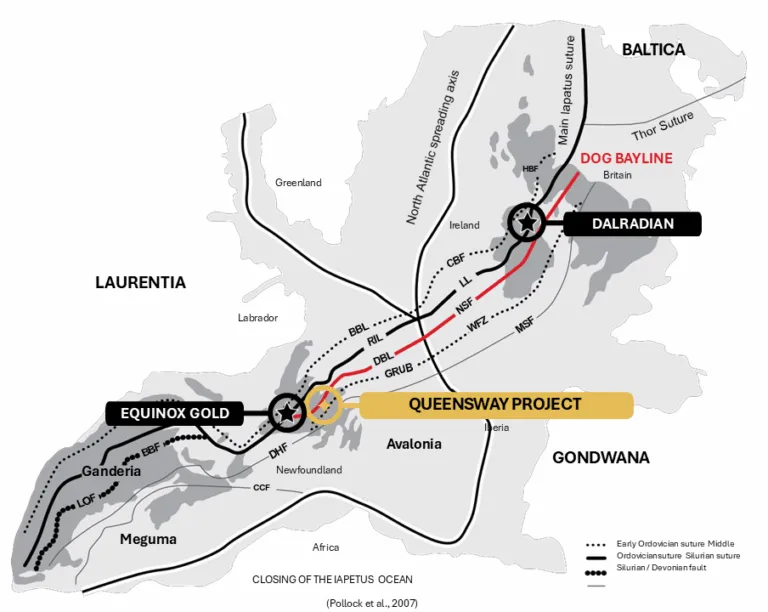
New Found Gold advances Queensway with WSP EPCM contract, targeting H2 2027 first gold pour. Permitted Pine Cove Mill reduces capital risk in top-tier jurisdiction.
- The Phase 1 EPCM contract with WSP Canada Inc., announced 26 January 2026, marks a transition from conceptual development to physical execution, narrowing the valuation gap between exploration optionality and development credibility.
- The fully permitted Pine Cove Mill materially reduces upfront capital expenditure requirements and compresses development timelines relative to greenfield peers.
- A defined regulatory, engineering, and construction schedule introduces time-bound valuation inflection points, with first gold pour from Queensway Phase 1 targeted for H2 2027.
- Operating in Newfoundland and Labrador, ranked among the Top 10 mining jurisdictions globally by the Fraser Institute's 2024 Annual Survey, reduces sovereign and permitting risk embedded in project net present value assumptions.
- District-scale discovery potential remains intact, maintaining optionality while advancing toward near-term production.
From Discovery Optionality to Execution Discipline
The transition from exploration success to development execution represents one of the most significant risk inflection points in the mining equity lifecycle. For gold developers in particular, the period between resource delineation and construction decision carries substantial valuation uncertainty. New Found Gold's advancement into Phase 1 EPCM engagement with WSP Canada Inc. signals a deliberate shift in corporate strategy, one that prioritises schedule discipline and capital efficiency over continued exploration-driven speculation.
The Market Shift From Exploration Narratives to Deliverability
Developers entering EPCM arrangements signal readiness for schedule, cost, and scope discipline. This engagement carries direct relevance for valuation frameworks. Reduced execution risk translates to lower discount rates applied to future cash flows, which in turn supports higher risk-adjusted net asset values.
EPCM as a Governance & Risk-Control Mechanism
Beyond their technical scope, Engineering, Procurement, and Construction Management (EPCM) arrangements impose governance frameworks that enforce cost control, procurement sequencing, and construction readiness verification. This structured approach reduces the probability of schedule overruns and budget exceedances that have historically challenged junior developers.
New Found Gold as a Case Study in Early-Stage Development
The company's recent corporate actions provide a framework for understanding how junior developers can systematically reduce execution risk while preserving optionality. New Found Gold's approach combines disciplined capital allocation with strategic infrastructure positioning, creating a differentiated development pathway.
What the Phase 1 EPCM Contract Signals to Capital Markets
The Phase 1 EPCM contract, announced 26 January 2026, encompasses Queensway site development and detailed engineering for an offsite milling facility. Specifically, the scope includes upgrading and expanding the Pine Cove Mill to process feed from both the Hammerdown mine and Queensway Phase 1.
The operationalisation of the July 2025 Preliminary Economic Assessment into engineering and site-level planning represents a fundamental shift in how the market should evaluate the Queensway project. The PEA outlined robust project economics including an after-tax NPV of C$743 million at a 5% discount rate and US$2,500 per ounce gold, an after-tax IRR of 56.3%, and life-of-mine all-in sustaining costs of US$1,256 per ounce.
Keith Boyle, Chief Executive Officer of New Found Gold outlined the market reception to this pivot:
"We released a PEA that demonstrates a robust project in a phased approach, mindful of capital allocation and potential dilution to the shareholders. That was well received by the market."
Scope Focus: Engineering First, Capital Later
The Phase 1 EPCM scope prioritises site development engineering and processing facility upgrade planning over full construction commitment. This staged approach reduces upfront capital commitment risk by allowing engineering validation before irreversible expenditure decisions. Site preparation work, access infrastructure, and detailed engineering studies can proceed while the company maintains flexibility on final investment decisions.
Capital Efficiency in a High-Cost Environment
Inflationary pressures on steel, labour, and reagents have materially altered the capital expenditure profiles of greenfield mining projects globally. Projects requiring new processing infrastructure face cost escalations that challenge economic assumptions embedded in earlier technical studies. In this environment, access to permitted processing capacity represents a structural competitive advantage.
The Strategic Value of Permitted Processing Capacity
The fully permitted Pine Cove Mill and tailings facility, secured through the 2025 acquisition of Maritime Resources Corp., provides New Found Gold with processing infrastructure that eliminates multi-year permitting timelines faced by greenfield developers. Brownfield upgrades to existing facilities offer more predictable cost profiles and compressed construction timelines compared to new mill.
Faster development timelines improve internal rates of return by accelerating first cash flow, while reduced capital intensity lowers financing requirements and associated dilution.
New Found Gold's acquisitions addressed this infrastructure requirement directly. Keith Boyle highlighted:
"We acquired Maritime Resources and ground with Exploits, and those were strategic acquisitions... We’re now putting our hands on milling facilities that were key in advancing and staying on track with the advancement of the Queensway project."
Hub-and-Spoke Processing Models & Margin Protection
Centralised milling economics offer flexibility advantages beyond initial capital efficiency. The Pine Cove Mill upgrade strategy allows the company to process ore from multiple sources, improving plant utilisation rates and reducing per-ounce processing costs. This operational flexibility provides margin protection against ore quality variability and enables optimisation of mine sequencing across deposits.
Permitting, Jurisdiction & Timeline Certainty as Valuation Drivers
Jurisdictional risk assessment has become increasingly central to mining equity valuation as investors incorporate regulatory uncertainty into discount rate assumptions. Newfoundland and Labrador's ranking among the Top 10 mining jurisdictions globally, according to the Fraser Institute's 2025 Annual Survey, provides institutional investors with confidence in permitting process integrity and fiscal stability.
Newfoundland & Labrador as a Mining-Positive Region
The province's established mining sector presence and supportive government policy framework reduces the jurisdictional risk premium that investors apply to projects in less stable regulatory environments. Comparison with jurisdictions facing permitting volatility or fiscal regime uncertainty highlights the embedded value of operating in transparent regulatory frameworks.
Keith Boyle addressed the regulatory environment and government engagement:
"Working in Newfoundland, the government's been great... We're targeting to submit our environmental assessment application for Queensway this first quarter, and expecting a good turnaround."
Defined Regulatory Milestones & Market Re-Rating Potential
The environmental baseline work at Queensway is substantially complete, and the Company plans to submit an Environmental Registration to the Newfoundland and Labrador Department of Environment, Conservation and Climate Change in late Q1 2026. Subsequent catalysts include an updated Technical Report with revised mineral resource estimate targeted for mid-2026, and first gold pour from Queensway Phase 1 targeted for H2 2027.
The predictability of regulatory timelines in Newfoundland provides a framework for catalyst-based investment strategies. Keith Boyle cited recent precedent:
"Firefly ended up getting their EA in 45 days. After the EA, we would expect the permits to come quickly thereafter."
The company's board composition reflects its commitment to navigating the regulatory environment effectively, including Dr. Andrew Furey, former Premier of Newfoundland and Labrador, alongside Paul Huet, Tamara Brown, Chad Williams, and Allen Palmiere. .
Preserving Exploration Upside While Advancing Toward Production
The tension between development focus and exploration investment represents a recurring challenge for companies transitioning from discovery to production. New Found Gold's approach seeks to balance these competing priorities through disciplined resource allocation.
High-Grade Core & Early-Stage Mine Planning
At-surface, high-grade mineralisation at Queensway carries direct implications for all-in sustaining cost profiles and mine plan economics. The property encompasses over 110 kilometres of strike extent, representing substantial exploration upside beyond the defined resources supporting initial development plans.
Melissa Render, President of New Found Gold, continues to lead exploration efforts. Keith Boyle addressed the continued exploration focus:
"Melissa Render is doing a great job finding gold, that is a key part for us... We continue to announce that, and we're well set up to really focus on having value accretion through the drill bit. We've got the property package to do it."
Financing Strategy, Shareholder Structure & Dilution Management
Development financing in current equity market conditions requires careful structuring to balance capital availability against shareholder dilution. New Found Gold has engaged specialist advisors and positioned existing assets to reduce external financing requirements.
Structuring Development Capital
The company announced the engagement of Cutfield Freeman & Co. Ltd. as its independent global mining finance advisory firm to structure the financing package for Phase 1 capital expenditures. The financing process is ongoing and running in parallel with engineering activities.
Hammerdown Cash Flow to Support Phase 1 Capex
The Hammerdown mine, which the Company is currently focused on bringing into steady-state gold production, provides additional financing flexibility. Cash flow from Hammerdown operations is expected to reduce the quantum of external capital required for Queensway development.
Keith Boyle noted:
"With Hammerdown coming into production, these gold prices is going to help us manage the amount of money that we have to raise externally in order to advance Queensway."
The Investment Thesis for New Found Gold
- EPCM engagement with WSP Canada Inc. reduces development and schedule uncertainty by imposing governance frameworks and third-party engineering validation on project advancement.
- The fully permitted Pine Cove Mill lowers capital expenditure intensity and improves internal rate of return resilience against cost escalation.
- Operating in a Top 10 mining jurisdiction according to the Fraser Institute supports lower valuation discount rates by reducing regulatory and sovereign risk.
- Clear milestone visibility through defined environmental and engineering timelines enables timing-based allocation decisions, with first gold pour targeted for H2 2027.
- District-scale exploration upside across 110 kilometres of strike provides long-duration value creation potential beyond initial mine life assumptions.
- Hammerdown cash flow during ramp-up reduces dilution risk by supporting Phase 1 capital requirements.
The transition from exploration to development addresses the primary valuation constraint facing high-grade discovery stories in current market conditions. The combination of the fully permitted Pine Cove Mill, a Top 10 jurisdiction ranking, and disciplined financing positions the company within a differentiated peer category. Evaluating gold development equities, the Queensway advancement provides a case study in systematic de-risking through staged execution and infrastructure leverage.
Phase 1 EPCM entry establishes a clearer execution framework, which in turn improves confidence around delivery timelines, as execution risk becomes more defined, valuation discounts typically applied to early-stage projects can narrow, improving access to capital required for subsequent development phases. With a first gold pour targeted for the second half of 2027 and project economics outlined in a completed PEA, Queensway is increasingly assessed through a development lens rather than a discovery-driven one.
TL;DR
New Found Gold's Phase 1 EPCM contract with WSP Canada Inc. marks its transition from exploration to development execution. The fully permitted Pine Cove Mill, acquired through Maritime Resources, eliminates multi-year permitting delays and reduces capital intensity. Operating in Newfoundland - a Fraser Institute Top 10 mining jurisdiction - minimizes regulatory risk. The July 2025 PEA outlined C$743 million NPV and 56.3% IRR at US$2,500 gold. Key milestones include environmental assessment submission in Q1 2026, updated resource estimate mid-2026, and first gold pour targeted for H2 2027. Hammerdown mine cash flow will help reduce external financing needs, limiting shareholder dilution during Queensway development.
Analyst's Notes





Subscribe to Our Channel






Stay Informed






















