




Oil Inventories Keep Falling Despite Higher Output, Raising Supply Risk


.png)
Onshore discoveries could add future oil supply where testing supports commercial production and competitive costs preserve margins.
- The International Energy Agency (IEA) reported observed global oil inventories 509 million barrels below end-February by end-September 2026, leaving less stored oil to cover supply disruptions.
- September’s 103-million-barrel increase in oil in transit offset most of a 113-million-barrel decline in on-land stocks, showing that recovering flows had yet to rebuild stored supplies.
- Emergency stock releases can cover near-term shortfalls, while replenishing inventories requires supply to exceed consumption.
- Appraisal drilling and testing help determine how much oil onshore discoveries could produce and at what cost, guiding spending on commercial development.
- Lower operating costs help preserve margins if replenishment reduces oil prices, while staged spending limits capital committed before production potential is tested.
Oil Inventory Draws Sustain the Case for Additional Supply
Higher production rebuilds oil inventories only when supply exceeds consumption. Until stocks recover, refiners have fewer stored barrels to cover delivery shortfalls, leaving oil prices more exposed to supply disruptions. Onshore discoveries could add supply where testing establishes recoverable volumes and development costs allow profitable production.
The IEA’s October 14, 2026 Oil Market Report (OMR) reported that observed global oil inventories ended September 509 million barrels below end-February. On-land stocks were at their lowest level since at least 2016, leaving less stored oil available to cover production or delivery interruptions.
In September 2026, global oil supply rose by 2.5 million barrels per day (b/d) from August to 102.3 million b/d, yet on-land inventories fell by 113 million barrels. A 103-million-barrel increase in oil on water limited the overall observed inventory decline to 10 million barrels, showing that higher production had not replenished stored supplies.
Emergency Oil Releases Cover Shortfalls While Drawing Down Stocks
Emergency oil releases can help refiners maintain operations when deliveries fall short, without waiting for new wells to start producing. Each release draws down stored barrels, making replenishment necessary to preserve protection against future supply interruptions.
In its October 2, 2026 statement, the Group of Seven (G7) committed to delivering 100 million barrels under existing stock-release pledges over four months, including substantial diesel volumes within the first 20 days. It also requested recommendations on replenishing stocks to restore protection against future supply disruptions.
In its October 7, 2026 update, the IEA reported approximately 325 million barrels released under its March collective action, with about 100 million barrels still to be delivered. Those outstanding commitments overlap with the G7’s October 2 pledge and should not be counted as a separate release. Around 1.1 billion barrels remained in publicly held emergency stocks, providing capacity for further releases.
Import Dependence Creates Opportunities for Domestic Oil Supply
Domestic oil production can reduce an importing economy’s reliance on overseas deliveries by replacing imported barrels. Conventional onshore discoveries offer a potential source of that supply where testing establishes production rates and costs that support competitive sales.
The IEA’s Türkiye 2026 review, published September 4, 2026, reports crude oil import dependence of almost 90% in 2024, creating an opportunity for domestic production to replace imported barrels.
Replacing imported oil requires domestic crude to meet refinery specifications and reach buyers at a competitive delivered cost. Crude quality, transport costs, and negotiated sale prices therefore help determine whether a discovery can generate profitable sales.
Appraisal Results Guide Investment in Future Oil Supply
Flow tests measure well production rates under specified operating conditions, providing evidence for production forecasts. Test duration and pressure behavior help assess whether initial rates could be sustained, while fluid characteristics and water production inform equipment requirements and operating cost estimates.
Best-estimate contingent resources (2C) describe potentially recoverable oil in known discoveries where commercial development remains conditional. Testing, development economics, approvals, funding, and sales arrangements help determine whether those resources can advance toward reserves and production.
Oil Supply Shortfalls Support Onshore Appraisal Investment
Depleted oil inventories reinforce the value of advancing existing discoveries toward commercial production. For onshore explorers, staged testing can help establish production potential.
Dune Oil is targeting fall 2026 testing of the C-1 well at Block M47 in Türkiye, aiming to advance its light-oil discovery toward initial production. The North Field has approximately 27.6 million barrels of attributable best-estimate contingent resources (2C). At US$72 oil, the company estimates an operating netback of US$50 per barrel after royalties, operating costs and trucking, indicating potential margins before income tax and drilling costs.
Scott Lower, President of Dune Oil, links planned exploration to regional oil supply shortages:
“We have four other defined structures that we intend to drill that can also potentially result in new discoveries that we're very excited about drilling in the future. This is going to be a big producing block and we're just at the outset of that and at a time where oil is scarce and prices are high especially in this region.”
Lower Oil Price Forecasts Increase the Value of Cost Discipline
Lower operating and delivery costs leave more revenue available to recover development spending if oil prices fall as inventories rebuild.
The US Energy Information Administration (EIA), in its October 6, 2026 Short-Term Energy Outlook (STEO), forecasts Brent crude averaging US$104.69 per barrel in the fourth quarter of 2026 and US$83.74 in 2027. Its model assumes Middle Eastern production and exports generally increase through the forecast period and excludes market developments after October 1. This provides a recovery scenario for assessing whether new production could cover operating costs and repay development spending.
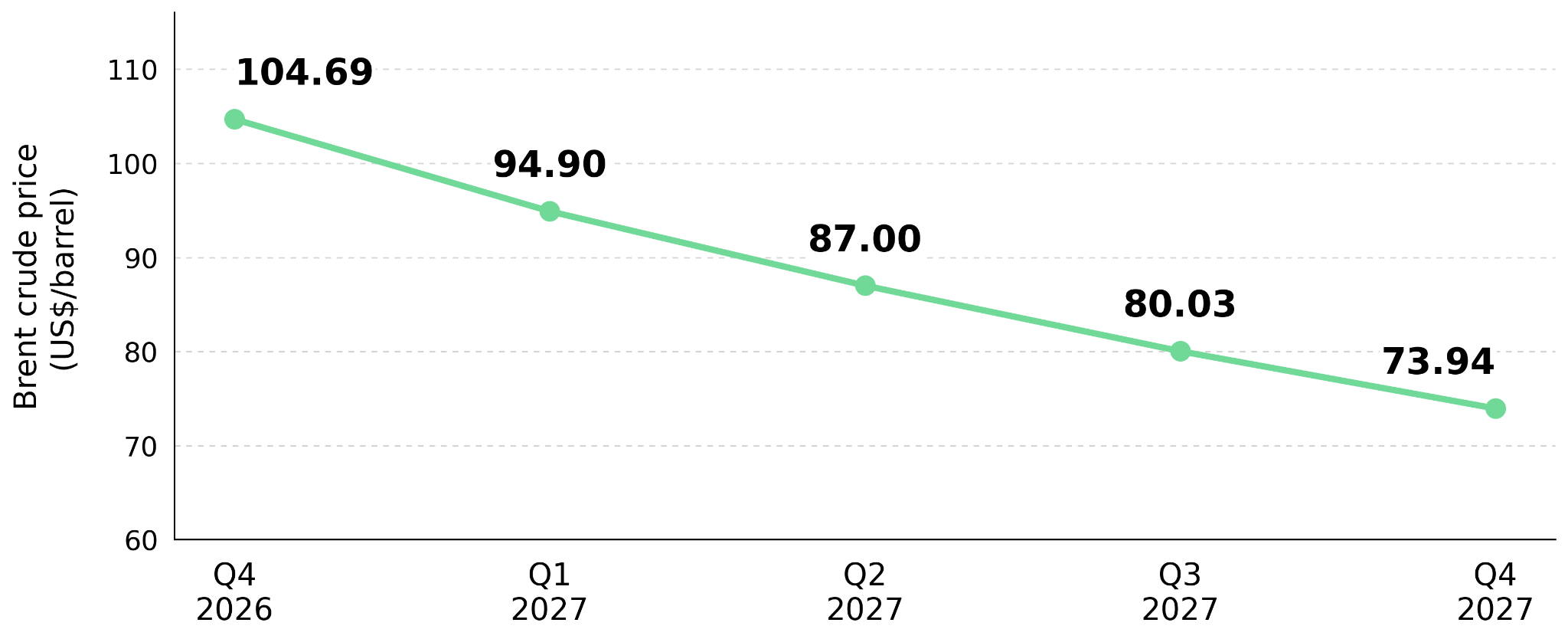
Operating netback measures revenue per barrel after royalties, production costs, and delivery costs, showing what remains before taxes, development spending, and other obligations. Comparing projected netbacks across stated oil price assumptions with upfront capital requirements helps assess whether production could repay development costs.
Sustained Inventory Rebuilding Would Strengthen Oil Supply Resilience
Sustained inventory rebuilding would provide more stored oil to cover delivery interruptions, reducing exposure to supply-driven price spikes. Comparing reported stocks with forecasts on the same basis helps assess whether projected replenishment is occurring.
The EIA’s October 6, 2026 STEO inventory table forecasts Organization for Economic Co-operation and Development (OECD) commercial inventories of crude oil and other liquids at 2,645 million barrels at the end of Q4 2026. It projects replenishment to 2,710 million barrels by the end of the first quarter of 2027 and 2,849 million by the end of the second quarter. These forecasts cover OECD commercial stocks and cannot be directly compared with the IEA’s observed global inventory decline.
Continued inventory draws would leave fewer stored barrels to cover delivery disruptions, preserving the case for additional commercially viable supply.
The Investment Thesis for Oil
- Explorers with discovered conventional resources offer potential future supply where appraisal supports recoverable volumes, sustainable production rates, and commercially viable development.
- Developers with low projected operating costs have more room to preserve margins if inventory rebuilding lowers oil prices.
- Producers that balance reinvestment with cash generation can support continuing supply while retaining funds to manage lower oil prices.
- Clear permitting requirements, defined fiscal terms, and enforceable sales agreements help explorers and developers assess development timing, costs, and potential revenue.
- Staged spending allows explorers and developers to assess test results before committing more capital, limiting expenditure before commercial viability is established.
Restoring oil supply resilience depends on replenishing inventories and sustaining economically viable production. Conventional onshore discoveries can contribute as appraisal establishes production potential and guides development spending. The strongest investment case combines competitive costs, access to buyers, and staged capital commitments, creating scope to earn returns through project progress across a range of oil prices.
TL;DR
Recovering oil production has yet to replenish depleted inventories, leaving fewer stored barrels to cover delivery disruptions. Emergency releases can bridge shortfalls while drawing down stocks. Conventional onshore discoveries offer potential future supply, particularly in import-dependent markets, where appraisal helps estimate recoverable volumes, production rates, and development costs. Dune Oil’s planned C-1 well testing illustrates this route toward commercial production. The investment case rests on competitive costs, access to buyers, and staged spending, with project economics assessed under lower oil price assumptions as inventories rebuild.
FAQs (AI-Generated)
Analyst's Notes





Subscribe to Our Channel


.png)





Stay Informed


