




Dune Oil's US$4.3 Million Tranche 1 Share: 7 Steps to M47 Production


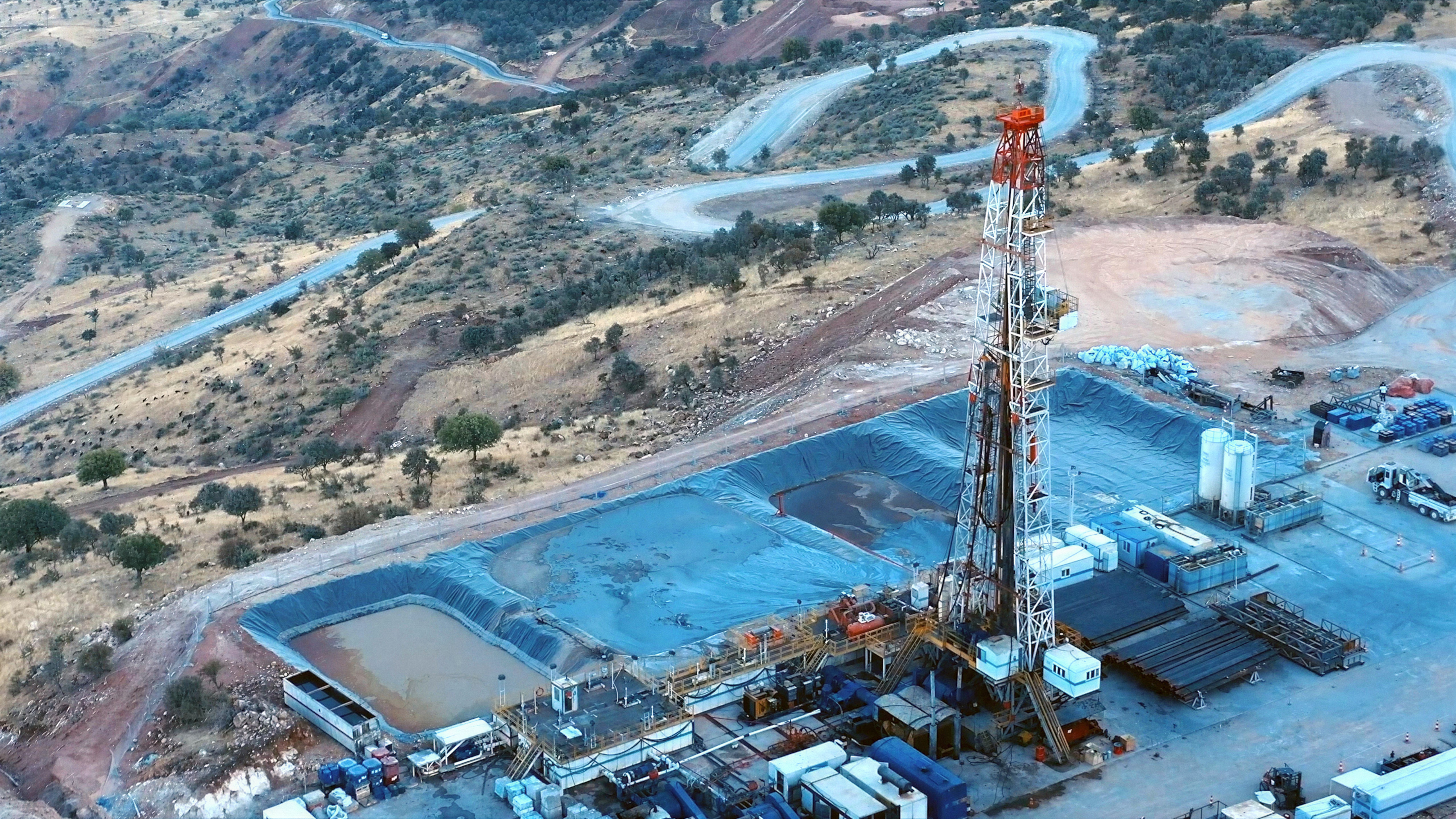
Dune Oil's fall 2026 seismic, C-1 test, and next lead well all follow a Tranche 1 raise still underway in October 2026.
Project Overview
Dune Oil (CSE: DUNE | OTCQB: DUNXF) is earning up to a 29% interest in the M47 oil exploration block, the C3 and C4 licenses in the Cudi-Gabar petroleum province of southeastern Türkiye, by funding US$15 million of work commitments across 2026 and 2027. The block's North Field has 27.6 million barrels of best-estimate contingent resources attributable to Dune Oil's 29% interest, per an evaluation by Chapman Petroleum Engineering, effective December 31, 2025.
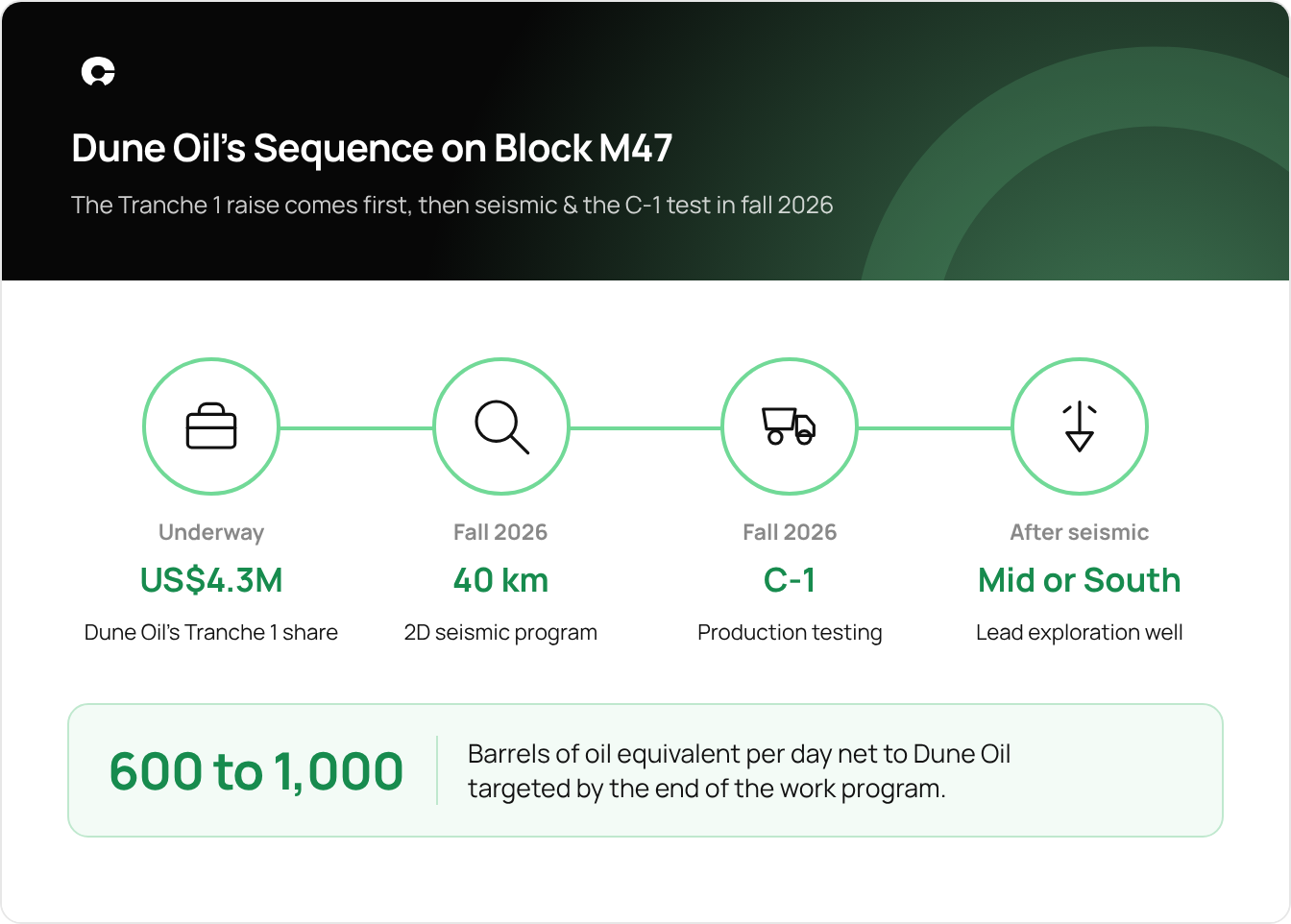
As of October 2026, the company's growth schedule runs in 7 stages. A Tranche 1 capital raise is underway, 2D seismic and C-1 production testing follow in fall 2026, and Mid- or South-Lead drilling follows the seismic. A Tranche 2 raise is scheduled for early 2027, full North Field production development from 2027, and production development for new discoveries from 2028. The raise is the first stage in that sequence.
1. Tranche 1 Funding Is Still Underway
Dune Oil's share of the first tranche is US$4.3 million, and as of October 2026, the Tranche 1 capital raise is still underway. President and Chief Executive Officer of Dune Oil, Scott Lower, put a month on that obligation in August:
"We have to come up with $4.3 million in September to fund operations, these operational commitments this year."
The placement tranches announced on September 15, 2026, added CAD$422,500 in gross proceeds from 2,816,667 units at CAD$0.15 per unit, and a further 133,333 units settled CAD$20,000 of debt. Each unit carries 1 share and half of a warrant exercisable at CAD$0.25 for 1 year, and the offering remains subject to Canadian Securities Exchange approval. Proceeds fund the M47 work program, investor relations activities, and general working capital. On October 15, 2026, the offering was upsized to up to CAD$4,000,000, including amounts closed to date and debt settlements, with a full close expected on or before October 20, 2026. By October 2026, Dune Oil had advanced US$800,000 toward the earn-in, with US$14.2 million in future commitments outstanding.
A revised farm-in agreement announced on October 15, 2026, sets a US$4.1 million advance for the initial 2027 post-seismic work program on or before November 15, 2026, and no further payments until November 15, 2027.
2. One Tranche Pays for the 2026 Field Program
The first tranche funds the 2026 field program on M47. It covers 1 to 2 new wells, a re-entry into C-1 and C-2 in the North Discovery, an early production facility (EPF), and a staged seismic program covering 40 kilometers (km). Dune Oil contributes US$4.3 million of that tranche, and GYP, the farm-in partner and local driller holding 20%, contributes US$2.5 million. Derkim, the block holder, has a 51% interest against a US$7 million commitment, and total capital committed across the 3 partners exceeds US$36 million.
Over 24 months, Dune Oil and GYP target a minimum capital program covering at least 4 production wells and 1 exploration well. Additional wells are expected to be paid for from development cash flow. Speaking in August, Lower named capital as the control for the 6 months ahead:
"We've got this over the next 6 months: money turns every lever."
Apart from the US$5 million GYP still owes on future well commitments, Derkim's and GYP's earlier commitments have already been spent.
3. Seismic Over the Mid & South Leads
The 2D seismic program scheduled for fall 2026 is intended to mature the North, Mid, and South leads for new prospective resources, and the next drilling locations are to be announced once it is complete. A high-resolution gravity study completed in May and June 2026 confirmed the presence of fault-related structures and identified priority leads across the license. As of August 2026, only about 25% of the block was covered by seismic. The 40 km program, to be acquired over about 6 weeks, is expected to generate 4 to 6 additional drillable exploration locations.
The program over the Mid-1 and South-1 leads was set to start in September 2026. The Mid-2 and South-2 structures will be assessed after the 2026 seismic event, and neither is included in the current resource report. By October 15, 2026, Dune Oil had selected the seismic contractor from several evaluated bids and advanced US$200,000 of an estimated US$600,000 net budget for kick-off.
4. C-1 Production Testing in Fall 2026
C-1 production and testing are scheduled for fall 2026, and a flow test is the step management identifies to convert much of the North Field resource to reserves. C-1, drilled in 2025, recorded more than 70 meters (m) of gross oil pay, the full thickness of oil-bearing rock. Its 38 m of net pay is the part good enough to produce from, and the well produced 63 barrels of oil on test. Drilling halted on lost circulation, the loss of drilling fluid into the rock, at 2,455 m. About 160 m of potential reservoir was left unpenetrated.
The re-entry plan is to cement the well, perforate the pay zone (punching holes through the casing into the rock), and install a pump for initial production testing. The target is a zone of light oil 8 m thick with 8% porosity, the share of the rock that is open pore space. Management is looking for a couple of hundred barrels a day from a vertical well in that zone. If that rate holds for a couple of months, management wants to drill a lateral of perhaps 300 m or 500 m, a horizontal section drilled along the pay zone.
5. A Mid- or South-Lead Well After the Seismic
An exploration well on the Mid or South Lead is planned after the seismic program to increase resources and add potential new reserves. TPAO drilled the Yatağankaya well on the neighboring M48 block, starting it in April 2026 and completing it in June 2026, just outside the M47 block. Gravity data and surface anticlines, upward folds in the rock layers, indicate that most of that structure lies on M47, and TPAO advises the same. The structure is not yet in the resource report.
Lower ties the location of the well to TPAO's result across the line:
"At the same time, we're going to move down and drill a well just on the block, close to the block line, after the seismic program is done. Just kitty-corner to the well that was just drilled, and made a discovery on the other side of the block line."
The Mid Lead (Lead 1 only) carries a best-estimate prospective oil in place of 47 million barrels net to Dune Oil's 29% interest, within a low-to-high range of 19 to 67 million barrels. The South Lead (Findik only) has a best estimate of 28.7 million barrels, within a low-to-high range of 11.6 to 40 million barrels. The southern lead area targets the Mardin Group, Sayındere, and Garzan formations at depths of 1,800 to 2,400 m. South Lead 1 is a 4-way closed structure, closing in every direction like a dome. Oil in place counts all the oil in the rock, not the share that can be recovered, and these figures are distinct from the North Field contingent resource.
6. Tranche 2 Funding in Early 2027
A second capital raise, scheduled for early 2027, will fund a minimum of 3 new wells. Dune Oil's share of that tranche is US$8 million, with GYP contributing US$2.5 million. The tranche also covers potential horizontal wells for increased production and potential additional 2D or 3D seismic.
Equity is the more likely source of that funding on a pre-production basis, as part of a company recapitalization. Once the US$15 million earn-in is complete, all costs are shared in proportion to each partner's interest.
7. From Work Program to Production
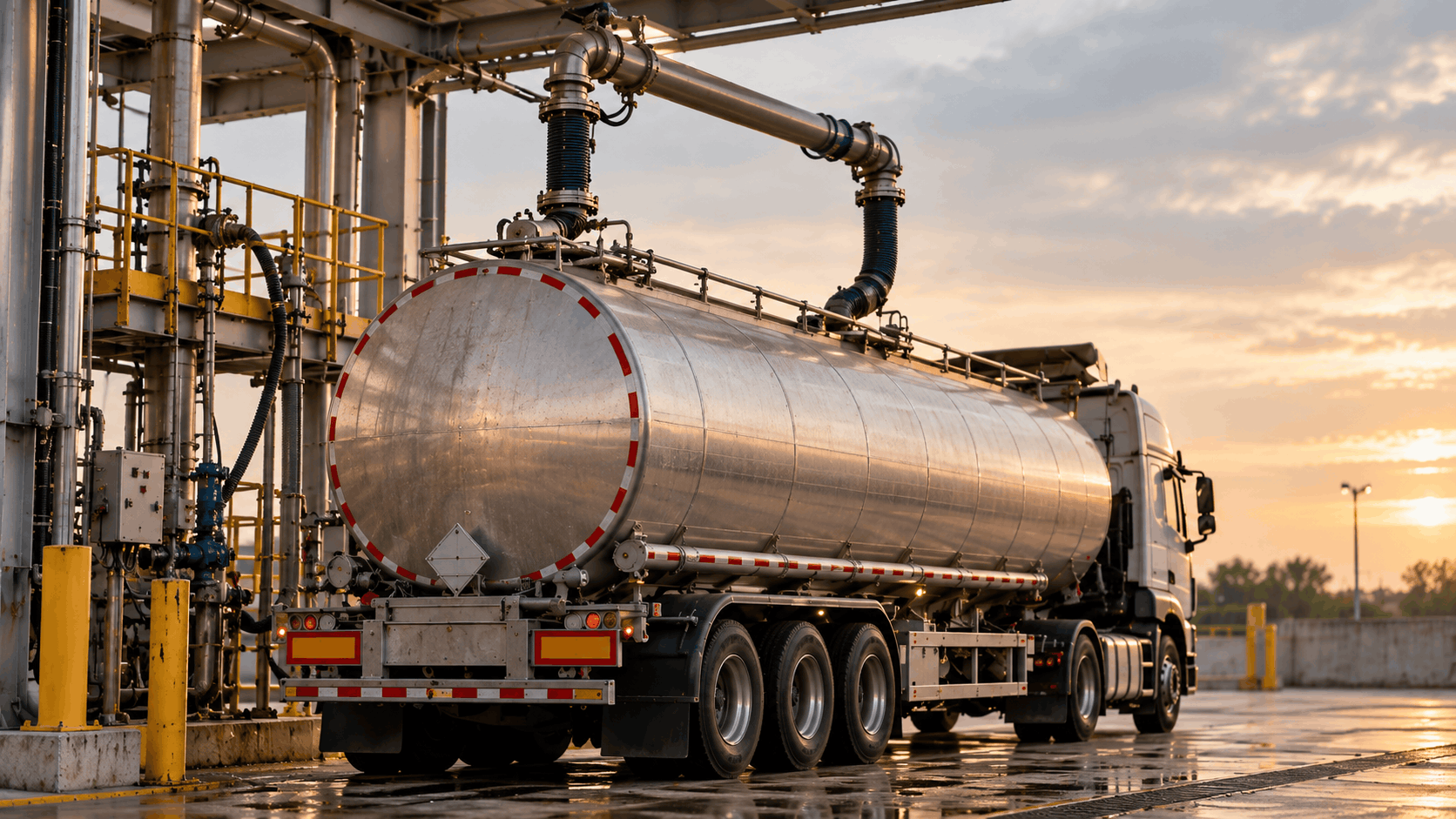
Full North Field production development is scheduled for 2027 and is built on the EPF and trucking to a refinery. The work program targets 600 to 1,000 barrels of oil equivalent per day of production net to Dune Oil by its end. Tanker trucks carrying 250 barrels each haul oil 130 km to the Tüpraş refinery, with no water separation needed early on, and a pipeline into the Esma Çevik system, completed in 2026, adds capacity.
Production development for new discoveries is scheduled to begin in 2028 and is contingent on making discoveries on the South and Mid leads. Both stages follow the Tranche 2 raise in the schedule.
Key Takeaways for Investors
- Dune Oil's US$4.3 million share of the first tranche is still being raised as of October 2026.
- The first tranche covers 1 to 2 new wells, the C-1 and C-2 re-entry, an early production facility, and 40 kilometers of staged seismic.
- A cemented, perforated, and pumped C-1 test in fall 2026 is the step management has identified to convert much of the North Field resource to reserves.
- Mid- or South-Lead drilling is planned after the seismic program to increase resources and add potential new reserves.
- A second raise in early 2027 funds at least 3 new wells, with Dune Oil contributing US$8 million.
Bottom Line
Dune Oil's 2026 program on M47 proceeds in order: the Tranche 1 raise, then the fall 2026 seismic and C-1 production test, then a Mid- or South-Lead well. The first tranche, with US$4.3 million from Dune Oil and US$2.5 million from GYP, funds 1 to 2 new wells, the C-1 and C-2 re-entries, the EPF, and the 40 km seismic program. Placement tranches of CAD$422,500 were announced on September 15, 2026. A C-1 flow test is the step management identifies to convert much of the 27.6 million barrels of North Field contingent resource to reserves, and the seismic precedes the next drilling locations. The disclosures that move this schedule forward are a Tranche 1 closing, the announcement of new drilling locations, and the start of C-1 testing. Each is a step toward the 600 to 1,000 barrels of oil equivalent per day the work program targets.
Analyst's Notes





Subscribe to Our Channel


Stay Informed


