




OPEC+ Quota Reset Could Cap 2027 Oil Supply & Reprice Non-OPEC Producers


Despite the oil sell-off, production below OPEC+ quotas could keep prices above forecasts, creating opportunities beyond the market's immediate reaction.
- Brent fell 4.2% to $108.64 a barrel on November 2, 2026, after Iranian and Qatari mediators circulated a draft proposal to end the US-Iran war.
- OPEC+ kept December output targets unchanged on November 1, 2026, and deferred its 2027 production framework to the November 29 ministerial meeting.
- Seven OPEC+ members remain well below their production targets, so the higher quotas restored in September have yet to translate into additional exports.
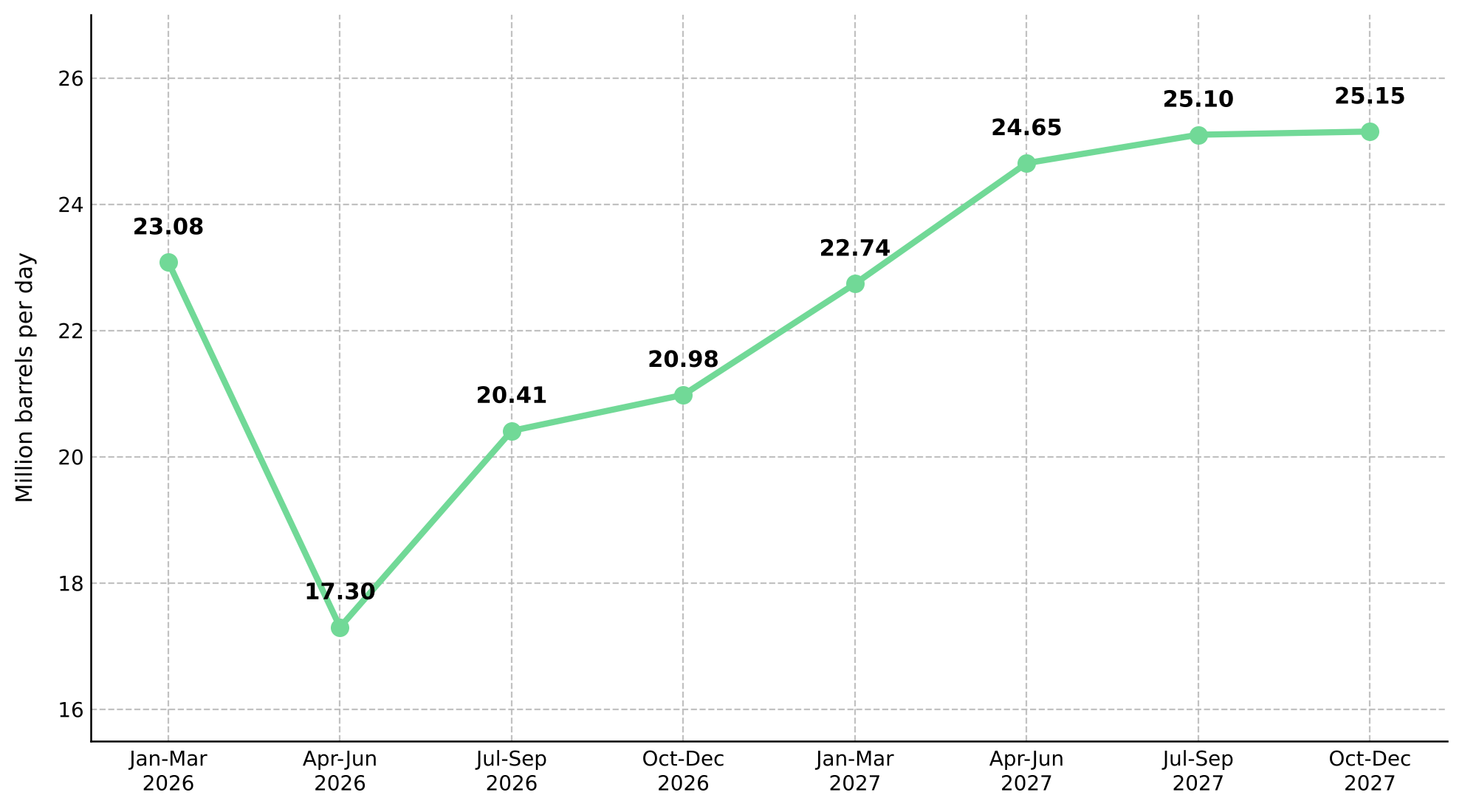
- US Energy Information Administration (EIA) projects OPEC crude output of 25.15 million barrels per day in the fourth quarter of 2027, up from a 2025 average of 24.63 million.
- OPEC+ could reverse the supply outlook on November 29 by scheduling the removal of roughly 2 million barrels per day in production cuts covering most members through 2026.
Iran Diplomacy Pulls Brent Down to $108.64
Brent crude futures fell $4.79, or 4.2%, to $108.64 a barrel, while US West Texas Intermediate (WTI) fell $4.41 to $99.71. The declines followed a third day of talks between Iranian and Qatari officials, with a draft proposal circulating and another meeting possible.
The sell-off reflected the increased likelihood of a US-Iran settlement rather than additional oil supply. Brent had ended October at a six-month high, while OPEC+ deferred its decision on authorized Gulf crude output for 2027.
September Quota Rollback Fails to Raise Delivered Oil Supply
Seven OPEC+ members, Saudi Arabia, Russia, Iraq, Kuwait, Algeria, Kazakhstan, and Oman, kept December production targets unchanged, with most still producing well below their limits. In September, the group completed the phased rollback of a 1.65 million-barrel-per-day cut agreed in 2023, increasing permitted output without raising delivered volumes.
OPEC+ deferred its 2027 production framework to a 21-country ministerial meeting on November 29. The group must first complete a production capacity review, due by mid-November after the war disrupted expansion projects across the Middle East. The resulting capacity baselines will determine member quotas and set the ceiling on 2027 oil output.
War-Affected Capacity Review Will Set 2027 Quota Baselines
A ceasefire would not automatically reset 2027 OPEC+ production quotas, as the mid-November review will establish baselines using capacity estimates made uncertain by the war. Those baselines will determine output limits even if production capacity later changes. Jorge Leon, Analyst at Rystad, said the group must plan around major uncertainty over the US-Iran war.
2027 Price Uncertainty Favors Flexible Producers Outside OPEC+ Quotas
Crude producers outside OPEC+ quotas face no production limits from the group, but their 2027 revenue remains exposed to oil prices influenced by the November 29 decision. EIA projects Brent falling from $104.69 a barrel in the fourth quarter of 2026 to $73.94 a year later.
For producers outside OPEC+ quotas, exposure depends on whether 2027 production is already committed. Goldman Sachs raised its forecasts, placing Brent at $140 a barrel in 2027 only if Gulf output remains 3.5 million barrels per day below its 2025 average. Producers with approved 2027 capital spending are exposed to that condition, while those with deferrable short-cycle spending retain flexibility.
The unpublished production capacity review leaves the November 29 decision uncertain, exposing positions tied to a single outcome to potential losses. Crude-linked funds face the full price move in either direction without a production-volume offset.
Who Benefits From OPEC+ Supply Limits
The 2027 oil supply outlook depends on OPEC+ production quotas, not just a Gulf settlement. Even if a settlement allows oil to move, the group still determines how much each member can produce and sell.
For crude producers outside OPEC+ quotas, the November 29 decision is a key factor in 2027 valuations. Any oil price forecast assuming peace will restore Gulf supply should await the production baselines authorizing that output.
Despite the sell-off, OPEC+ production limits tied to war-damaged capacity could keep oil prices above forecasts, benefiting producers outside the group's quotas.
Analyst's Notes





Subscribe to Our Channel




Stay Informed


