




Iran Peace Talks Pull Brent Lower & Lift the US Inland Barrel


WTI-linked producers face a smaller discount to global crude prices, with US inventories 4% below average supporting inland pricing.
- On October 29, 2026, December Brent fell 0.8% to $114.37 a barrel, while West Texas Intermediate (WTI) fell 1.2% to $101.50 as renewed US-Iran diplomatic contact reduced concerns over seaborne oil supply disruptions.
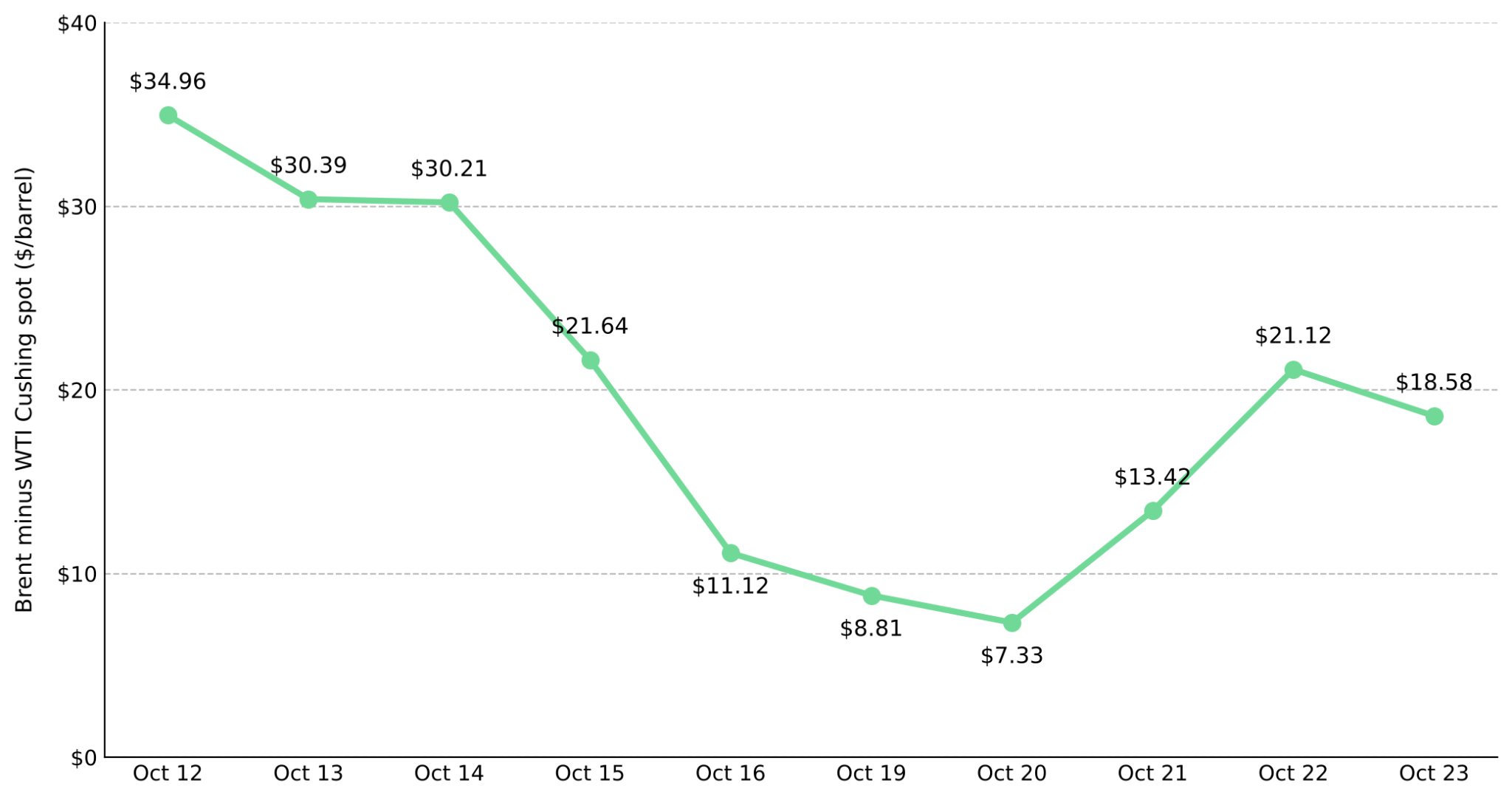
- Brent’s spot premium over WTI at Cushing narrowed from $34.96 a barrel on October 12, 2026, to $18.58 on October 23, reducing the price discount on US inland crude relative to Brent.
- Between October 12 and 23, 2026, WTI Cushing spot rose 15.5% from $94.99 to $109.72 a barrel while Brent spot declined, supporting WTI-linked prices for US onshore producers.
- Without a US-Iran agreement before November 3, 2026, Brent’s premium over WTI Cushing could remain at $12-$20 a barrel, while a signed deal could narrow the spread by reducing seaborne supply risks.
- US commercial crude inventories rising above 425 million barrels could weaken support for WTI Cushing prices, reducing potential revenue for US onshore producers.
US-Iran Talks Push Brent Down to $114.37
Oil prices fell after US Vice President JD Vance sent a letter to Iranian security chief Mohsen Rezaei seeking to restart peace negotiations, reducing concerns over Middle East supply disruptions. December Brent fell 0.8% to $114.37 a barrel, while WTI declined 1.2% to $101.50, reflecting lower perceived geopolitical supply risks.
Brent’s spot premium over WTI Cushing narrowed from $34.96 a barrel on October 12 to $18.58 on October 23, while the separate October 29 futures spread stood at $12.87. During the earlier period, WTI Cushing rose 15.5% from $94.99 to $109.72, while Brent declined. The narrower spot spread reduced the price discount on US inland crude, supporting WTI-linked prices for US onshore producers.
US Crude Stocks 4% Below Average Support WTI Prices
US commercial crude inventories fell 1.9 million barrels to 410.6 million, 4% below the five-year average, while refineries processed 16.5 million barrels a day at 92.8% capacity utilization. Crude imports rose 616,000 barrels a day to 6.4 million, with the four-week average reaching 6.3 million, up 9.3% year over year. Lower inventories supported demand for crude at Cushing.
Repeated Houthi attacks on Saudi energy infrastructure and President Trump’s threat to resume the war after the midterm elections support Brent’s seaborne risk premium. US-Iran peace talks could narrow that premium without directly changing crude inventories at Cushing.
Potential Supply Recovery Threatens Brent’s $18.58 Premium
Brent’s premium over WTI Cushing widened from $7.33 to $18.58 a barrel in three trading sessions, while US commercial crude inventories fell 1.9 million barrels, less than 0.5%, during the week ending October 23. Naeem Aslam of Zaye Capital Markets identified the key uncertainty as whether geopolitical normalization restores production and transportation capacity faster than global oil consumption recovers.
WTI’s 15.5% Gain Supports US Onshore Producer Pricing
Brent spot fell from $129.95 to $128.30 a barrel between October 12 and 23, while WTI Cushing spot rose from $94.99 to $109.72, supporting WTI-linked prices for US onshore producers. Separately, December Brent futures traded at $114.37 on October 29.
Crude prices received by producers reflect Brent’s seaborne risks or US inland inventory conditions, depending on their pricing benchmark. Ole Hansen, Head of Commodity Strategy at Saxo, said Chinese oil demand has likely peaked due to electrification, affecting overall oil prices rather than the Brent-WTI spread.
Whether US-Iran talks lead to a signed agreement before November 3 remains uncertain, but the Brent-WTI spread remains relevant beyond that deadline. However, a decline in WTI from $109.72 to $70 a barrel would cut the benchmark price by 36%, potentially reducing realized prices for US onshore producers and hurting shareholders.
How Does a Narrower Spread Support Valuations
The October 29 decline in Brent reflected reduced concerns over seaborne supply risks, including tanker movements, shipping routes, and insurance costs. Diplomatic negotiations do not directly change crude inventories at Cushing, while US commercial crude stocks remained 4% below their five-year average.
A narrower Brent-WTI spread reduces the pricing discount for US onshore producers, allowing WTI-linked prices to strengthen relative to Brent. Higher realized prices could support stronger valuations per flowing barrel compared with producers facing wider discounts.
Analyst's Notes





Subscribe to Our Channel









Stay Informed


