
Global Reactor Buildout Strengthens Demand for Future Uranium Supply


US utilities' unfilled uranium requirements highlight opportunities for long-term fuel contracts and investment in additional mining capacity.
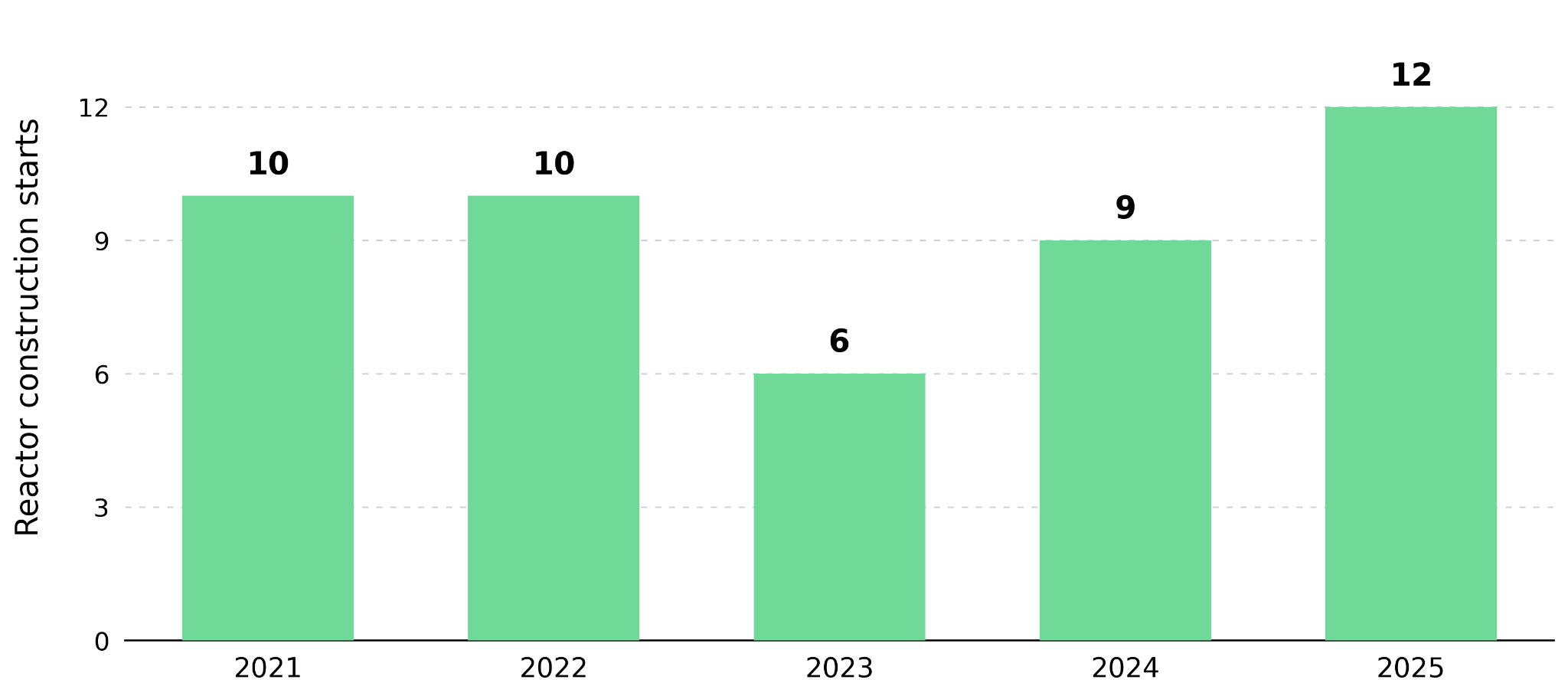
- Global nuclear capacity under construction has increased 16%, from 76 to 88 gigawatts electrical (GWe), according to the World Nuclear Association's (WNA) October 2026 outlook, strengthening the pipeline of future uranium fuel requirements.
- Each additional GWe of nuclear capacity requires approximately 300 to 450 metric tons of uranium for initial fueling, followed by around 150 metric tons annually, linking reactor construction directly to future uranium consumption.
- US nuclear utilities have 186.3 million pounds of unfilled uranium requirements through 2035, while long-term contracts accounted for 87% of uranium delivered in 2025, highlighting the importance of future supply agreements.
- Global uranium production reached 61,924 metric tons in 2024, its highest level since 2016, while exploration and development spending rose 46% during 2023-2024, demonstrating renewed investment in supply capacity.
- US nuclear operators purchased 46.9 million pounds of uranium oxide equivalent in 2025, while domestic-origin uranium accounted for just 7% of deliveries, highlighting opportunities to expand domestic production.
Nuclear Construction Growth Supports Uranium Supply Investment
WNA's October 2026 World Nuclear Outlook Report shows nuclear capacity under construction increased from 76 to 88 GWe, while planned capacity rose from 107 to 112 GWe. As these reactors enter operation, their initial fuel loads and subsequent refueling requirements will create additional uranium demand, supporting opportunities for long-term supply agreements.
At the International Atomic Energy Agency's (IAEA) October 2026 fuel-supply conference, industry representatives emphasized the need for long-term uranium purchasing commitments to support additional mining investment. Such agreements can provide uranium companies with greater certainty over future sales, helping finance production expansion and new projects.
Planned Reactor Startups Expand Future Fuel Requirements
WNA projects that 56 GWe of nuclear capacity currently under construction will enter operation by 2030, followed by another 32 GWe by 2035. WNISR recorded 73 reactors under construction as of July 1, 2026, up 10 from a year earlier and the highest number since 1987, with 37 in China and 36 elsewhere. These projected commissioning timelines and the geographic spread of reactor construction provide uranium suppliers with opportunities to plan future deliveries and secure long-term contracts across multiple markets.
Each additional GWe of nuclear capacity requires approximately 300 to 450 metric tons of natural uranium for initial fueling and 150 metric tons annually once operational. If the reported 12 GWe net increase in capacity under construction translates into additional operating capacity, it would represent approximately 3,600 to 5,400 metric tons of initial uranium requirements and 1,800 metric tons in recurring annual demand.
Unfilled Utility Requirements Open Uranium Contract Opportunities
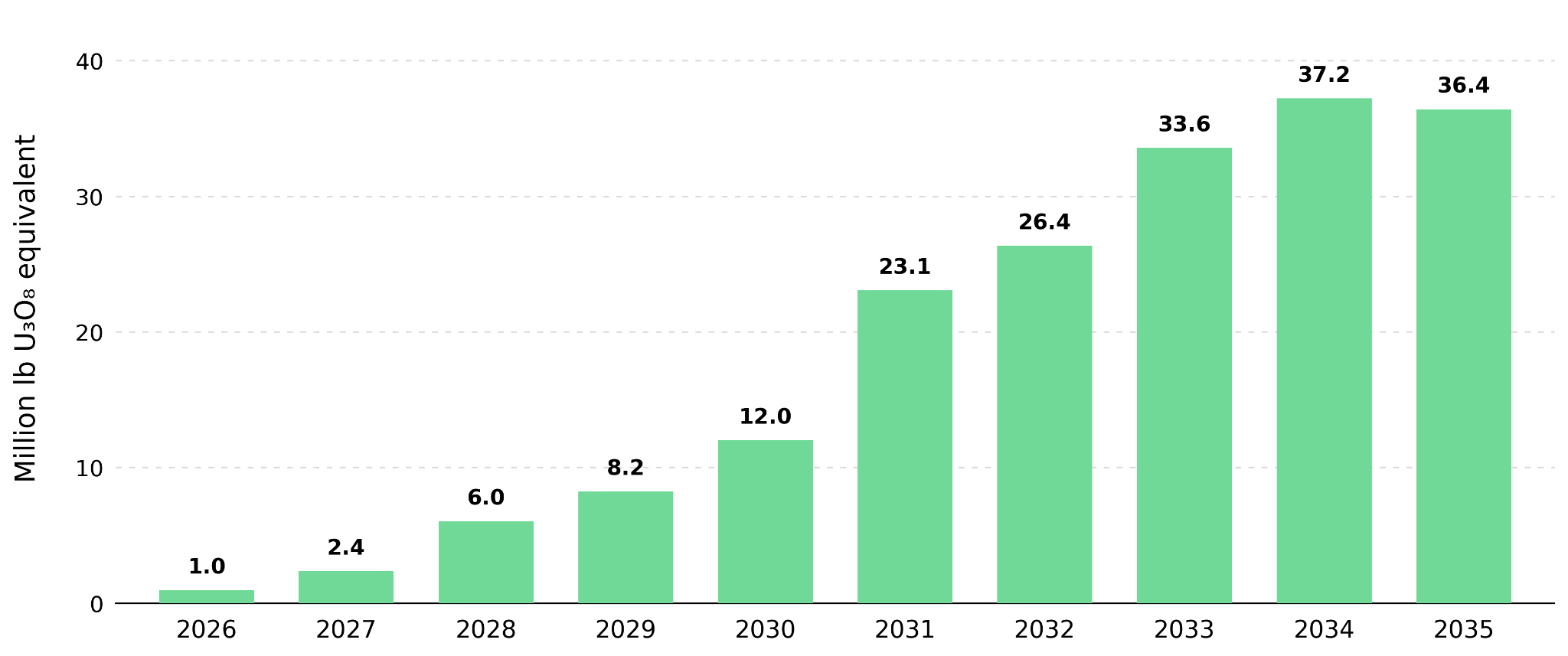
The US Energy Information Administration's (EIA) recorded 186.3 million pounds of unfilled uranium oxide equivalent requirements for US nuclear utilities between 2026 and 2035. Existing contracts allowed maximum deliveries of 174.1 million pounds, leaving nearly 52% of the 360.4 million pounds in maximum anticipated requirements unfilled. These outstanding requirements create opportunities for uranium suppliers to secure additional long-term delivery agreements.
Long-term contracts accounted for 87% of uranium delivered to US civilian reactors in 2025, demonstrating the importance of securing fuel supplies through advance purchasing agreements. Existing reactors continue purchasing uranium throughout their operating lives, while the WNA projects approximately 80 new reactors over the next decade, creating additional requirements for future uranium deliveries.
US Uranium Import Reliance Supports Domestic Production Expansion
US uranium production more than tripled from 657,000 pounds in 2024 to approximately 2.1 million pounds in 2025. However, US nuclear operators purchased 46.9 million pounds of uranium oxide equivalent in 2025, with domestic-origin uranium accounting for just 7% of deliveries. This highlights the opportunity for established US producers to expand their contribution to the country's nuclear fuel supply.
enCore Energy is expanding its South Texas operations after completing the first wellfield and satellite plant at Upper Spring Creek. With final production authorization expected by November 13, 2026, ahead of earlier guidance, the project is positioned to begin uranium extraction using the company's existing Rosita processing plant. At Alta Mesa, approvals for two additional production areas are expected in late 2026 and early 2027, supporting further uranium extraction growth in 2027.
William Sheriff, Executive Chairman of enCore Energy, explains why US uranium needs additional domestic production:
"The real key here is there aren't very many producers in the US. There's unlikely to be very many new ones in the next two or three years. There's one or two coming on, but in terms of significant ramp-ups, we're certainly limited."
Rising Uranium Investment Advances New Mine Development
In September 2026, the OECD Nuclear Energy Agency (NEA) and IAEA identified more than 8.1 million metric tons of uranium resources recoverable at estimated costs below US$260 per kilogram, up 2.1% from the previous assessment. With uranium mines typically requiring 15 to 20 years to develop, advancing these resources early is important to meeting future fuel requirements.
Global uranium production exceeded 116,000 metric tons during 2023-2024, approximately 20% above the preceding two-year period, largely through mine restarts and expansions. Over the same period, spending on uranium exploration and mine development rose 46% to more than US$1.78 billion, reflecting increased activity in evaluating uranium deposits and advancing potential new mining projects.
Atomic Eagle has expanded its uranium development portfolio by regaining a 60% interest and operational control of the Madaouela project in Niger, which holds a 116.5-million-pound uranium resource classified as a foreign estimate. At its Muntanga project in Zambia, recent testing achieved uranium recoveries of 81% to 86% with low acid consumption, supporting more cost-efficient processing. A converted resource estimate and scoping study for Madaouela are targeted for the first quarter of 2027, providing a clearer foundation for future development decisions.
Phil Hoskins, Chief Executive Officer of Atomic Eagle, highlights why future uranium shortages attract mine investment:
"If people understand that what we own is valuable, and particularly in a uranium market where the deficit comes, the time that this project's capable of coming online is going to be significant and people will be scrambling for new production assets.”
High-Grade Resources Strengthen Project Economics
NEA’s 2026 assessment emphasizes the importance of sustained investment in uranium resource development. Higher uranium grades can improve extraction economics, making resource quality an important consideration for future mining projects. Continued drilling around established high-grade deposits can help identify opportunities for further resource growth and strengthen their development potential.
IsoEnergy's latest drilling at its Hurricane South Trend in Saskatchewan recorded the strongest radioactivity readings to date, highlighting potential for further uranium resource growth. The nearby Hurricane deposit already hosts 48.6 million pounds of uranium oxide resources grading 34.5%. The company also holds a 33% interest in DISA Uranium, a US venture supported by US$105 million in financing to advance past-producing uranium assets and processing technology, providing additional exposure to future uranium production.
Expanding Uranium Discoveries Strengthen Future Supply Potential
Growing uranium requirements are strengthening the importance of discovering and advancing new deposits that could support future production. Continued exploration can help establish the size and potential of uranium discoveries, creating opportunities to expand the resource base and advance promising projects toward development.
ATHA Energy's latest drilling at its Angilak project in Nunavut intersected uranium mineralization in 21 of 23 holes, extending the RIB corridor from 1.45 to 3.4 kilometers and connecting the RIB North and RIB East discoveries. The program also identified a higher-grade zone spanning approximately 300 meters along strike and down dip, strengthening the project's resource growth potential and providing a larger area for further drilling and resource definition.
Troy Boisjoli, Chief Executive Officer of ATHA Energy, describes why large uranium assets matter for supply:
"I think it's clear to me what the market is looking for, and this is what the industry needs. It is large, scalable assets that can become a meaningful component to help solve what is nearly an existential supply deficit going into the 2030 decade."
Long-Term Fuel Demand Increases Need for Secure Supply Access
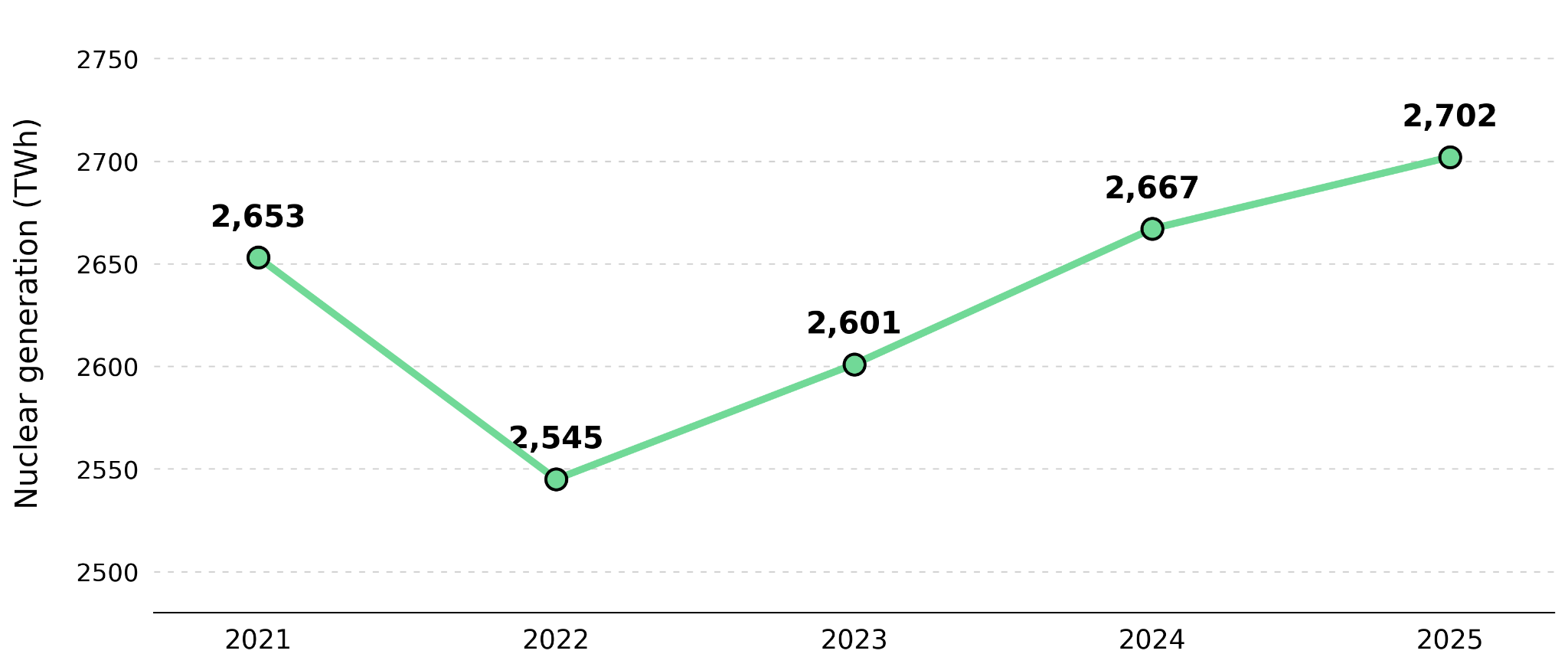
NEA and IAEA project annual uranium requirements rising from approximately 64,500 metric tons in early 2025 to between 84,800 and 143,900 metric tons by 2050, reinforcing the need for additional supply beyond the reactors currently under construction. WNA's October 27 conference report distinguished memoranda of understanding, which signal purchasing interest from long-term contracts that provide firmer commitments to future deliveries. These agreements can help uranium companies secure financing and advance production capacity ahead of future fuel requirements.
Access to future uranium supply also depends on ownership rights, with Kazakhstan's tighter uranium ownership rules demonstrating how national policies influence participation in new projects. As global reactor construction advances, the investment opportunity increasingly centers on converting future uranium requirements into secured sales agreements and commercially viable production.
The Investment Thesis for Uranium
- Producers with existing processing facilities can expand uranium output while reducing the need for new infrastructure, supporting more cost-efficient growth.
- Developers with promising resources and improving project economics can strengthen their prospects for financing and advance projects toward commercial production.
- Explorers expanding known uranium discoveries through successful drilling can increase resource potential and attract capital to support further exploration.
- Clear permitting processes and resource ownership rights can improve project development certainty, making uranium assets more attractive for long-term capital investment.
- Uranium projects with competitive extraction and processing costs can support stronger operating margins, improving their ability to remain commercially viable across different price conditions.
- Long-term uranium supply contracts can provide more predictable future sales, helping producers plan capacity expansion and developers secure financing for new projects.
The expanding global reactor fleet is creating long-term uranium requirements that extend well beyond initial fueling, strengthening the investment case for new supply. As utilities secure future fuel through long-term contracts, these commitments can provide the financial certainty needed to advance uranium projects and expand production capacity. This places greater importance on project advancement and the ability to secure future uranium sales, creating opportunities for lasting commercial value as nuclear capacity expands.
TL;DR
Global nuclear capacity under construction increased from 76 to 88 GWe, supporting additional uranium requirements for initial fueling and ongoing reactor operations. US nuclear utilities have 186.3 million pounds of unfilled uranium requirements through 2035, creating opportunities for long-term supply agreements. Meanwhile, uranium production and exploration spending are increasing, reflecting renewed investment in future mining capacity. With new uranium mines typically requiring 15 to 20 years to develop, producers expanding operations, developers advancing projects, and explorers identifying new resources each have a role in meeting future demand. Long-term contracts and competitive production costs remain important to converting growing nuclear fuel requirements into commercial opportunities.
FAQs (AI-Generated)
Analyst's Notes





Subscribe to Our Channel










Stay Informed