




Perseus Mining's Operating Assets: How the Three-Mine Portfolio Reduces Funding and Capital Risk


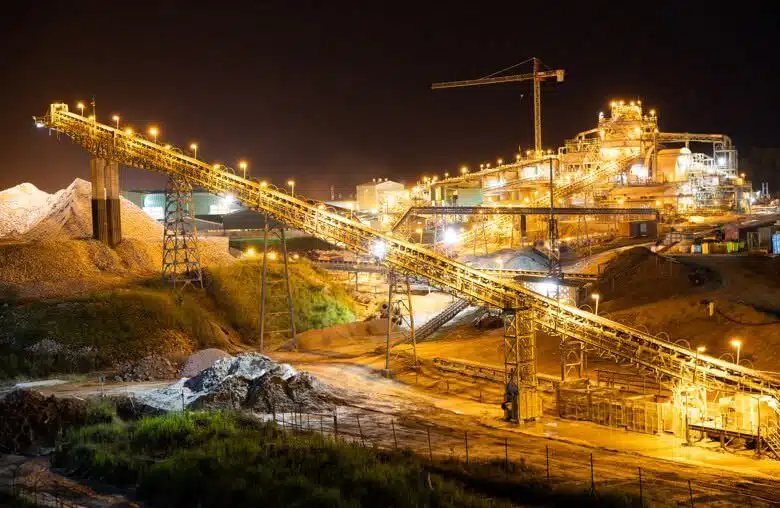
Perseus Mining's three-mine portfolio, US$755M net cash, zero debt, and self-funded Nyanzaga construction position it as a low-risk, high-margin mid-tier gold producer.
- Self-funded growth reduces dilution risk, as US$755M in net cash and bullion at 31 December 2025, zero debt, and a US$400M undrawn facility allow Perseus to execute underground expansion and Nyanzaga construction without equity issuance.
- Yaouré anchors long-term production visibility through 2.6Moz of Measured and Indicated resources, 1.4Moz of Proven and Probable reserves, and CMA Underground development that extends mine life to at least 2037 at a projected All-In Sustaining Cost of US$1,400–1,500 per ounce through FY30.
- Edikan's Nkosuo extension materially lowers blended cost risk, contributing 332koz in reserves at US$870–890/oz AISC and enhancing group margin resilience.
- Sissingué demonstrates capital discipline through a satellite pit strategy, with Bagoé mining operations having commenced in the December 2025 quarter, extending mine life to 2030 with modest incremental capital.
- Execution track record de-risks the growth narrative, with first ore confirmed at Yaouré Underground's Blika portal in January 2026 and Nyanzaga construction progressing ahead of schedule on the critical path.
Operating Leverage in a US$3,000+/oz Gold Market
Perseus Mining reported a weighted average gold sales price of US$3,437 per ounce in the December 2025 quarter, generating a notional cash flow of US$145M against a quarterly group All-In Sustaining Cost of US$1,800/oz. Fiscal year 2026 AISC guidance of US$1,600–1,760/oz, as disclosed in the December 2025 Quarter Report, indicates that the company expects to sustain meaningful margins across its operating portfolio even as underground development capital ramps at Yaouré.
All-In Sustaining Cost captures the full cost of maintaining production at existing operations, including sustaining capital expenditure, general and administrative expenses, and royalties. At the FY26 AISC guidance midpoint of US$1,680/oz, Perseus would still generate approximately US$520/oz in cash margin at US$2,200/oz gold, sufficient to continue funding sustaining capital and the Nyanzaga build without drawing on external financing.
Chief Executive Officer Craig Jones addressed the company's financial position directly:
"We've got over $800 million of money in the bank. We're covering our costs at the same time as having some headroom as well."
The margin profile across three operating jurisdictions, combined with a low-leverage balance sheet, provides Perseus with operational flexibility that is less common among mid-tier producers carrying net debt.
Yaouré Underground Development and Long-Term Production Visibility
Yaouré in Côte d'Ivoire is Perseus Mining’s highest-grade operating asset and a key contributor to group margins. The planned transition from open pit to underground mining at the CMA orebody marks a shift in the asset’s cost and production profile, with implications for capital intensity, mine life, and forward cash flow visibility.
The CMA orebody hosts 2.6Moz of Measured and Indicated resources and 1.4Moz of Proven and Probable reserves, confirmed against the most recent resource and reserve statement. Measured and Indicated resources represent geological confidence levels sufficient for economic evaluation; Proven and Probable reserves are a subset further validated through a feasibility study confirming economic extractability.
The CMA fault zone exhibits 20–45 metres of thickness, approximately 1,200 metres of strike length, and 450 metres of down-dip continuity. The underground feasibility study was completed in August 2023, with a Final Investment Decision reached in January 2025. Down-dip extension potential and the identified strike length suggest resource conversion upside beyond current reserve boundaries, subject to ongoing drilling.
First ore at the Blika portal was confirmed as a key milestone achieved in January 2026, as stated in the December 2025 Quarter Report.
Craig Jones commented on early underground performance:
"We're seeing very good cycle times already. The quality of the rock and the quality of the mining is very good. It's all looking positive for CMA Underground."
Cost Structure and Infrastructure Leverage
Projected weighted average AISC for Yaouré Underground is US$1,400–1,500/oz through FY30, sourced from the company's published Yaouré Mine profile. This compares favorably to the current group AISC, reflecting the grade improvement typically associated with transitioning from lower-grade open pit material to higher-grade underground ore. Underground operations carry higher per-tonne mining costs than open pit methods, but this is offset by improved ore grade, which reduces the volume of material processed per recovered ounce.
Yaouré's underground development leverages existing surface processing infrastructure, reducing the incremental capital intensity of the transition. The company does not need to construct a new process plant, tailings facility, or power supply. This infrastructure leverage has a direct positive impact on project Internal Rate of Return by reducing upfront capital requirements and shortening the payback period. The underground transition extends Yaouré's mine life to at least 2037, supporting a re-rating argument on Enterprise Value per ounce metrics relative to shorter-life peers.
Nkosuo Extension Enhances Group Cost Profile
Edikan, Perseus' operation in Ghana, processes ore through an 8 million tonne per annum facility and produced 177,167 ounces in FY25 from reserves of 980,000 ounces at a grade of 1.03 grams per tonne gold, as of 30 June 2025.
Operational Base
Edikan's mineralization is hosted in granite, with grade and continuity controlled by shear zone structures. The ore is classified as free-milling, meaning gold is recoverable through conventional gravity and cyanide leach processing without the additional complexity or cost of treating refractory or sulphide-bound mineralization. This simplifies processing, supports high recovery rates, and reduces reagent consumption relative to sulphide ore types.
Nkosuo Economics
The Nkosuo pit extension, supported by the Nkosuo Feasibility Study, adds 332,000 ounces of contained Proven and Probable reserves at a projected AISC of US$870–890/oz. Cut-off grade - the minimum grade at which material is economically worthwhile to mine and process - defines which tonnes are included in the reserve calculation. At current gold prices, Nkosuo's AISC generates substantial margins on these incremental ounces and materially improves the group's blended cost profile. The pit is located approximately seven kilometres from the existing processing plant, effectively leveraging sunk infrastructure capital and improving the IRR of the extension relative to a standalone development scenario.
Craig Jones noted the grade profile improvement anticipated from the Nkosuo sequence:
"The good thing for Edikan is that the Nkosuo pit is higher grade. We will see production at Edikan start to increase over the next three quarters."
When blended with Yaouré's projected underground AISC, Edikan's contribution keeps the group cost structure competitive across the portfolio.
Asset Optimization Through Satellite Deposits
Sissingué, also in Côte d'Ivoire, operates a 1.4 million tonne per annum Carbon-in-Leach processing plant and holds 373,000 ounces of Measured and Indicated resources and 237,000 ounces of Proven and Probable reserves. Carbon-in-Leach, or CIL, is a gold recovery process in which activated carbon is added directly to a leach slurry to adsorb dissolved gold, which is then stripped, refined, and recovered.
Mine life has been extended to 2030 through satellite pit development at Fimbiasso and Bagoé. Bagoé mining operations commenced during the December 2025 quarter, confirming that the satellite strategy has moved from development planning into active production. This approach allows Perseus to process ore from nearby deposits through existing infrastructure rather than constructing new standalone operations, reducing capital requirements and preserving free cash flow for deployment across the portfolio. Sissingué's primary investment relevance lies in its ability to generate steady cash flow while larger capital programs at Yaouré and Nyanzaga absorb growth spending.
Financial Resilience as a Strategic Asset
Perseus ended the December 2025 quarter with net cash and bullion of US$755M, zero debt, and an undrawn credit facility of US$400M. Growth capital expenditure for the quarter was US$61M, and the company paid US$45M in dividends - both funded from operating cash flows. The cumulative capital invested in the Nyanzaga project reached US$161M as of the December quarter.
Craig Jones addressed the company's capital self-sufficiency directly:
"Our current cash position says we can pay for all of our aspirations within our current cash flows. At this stage, there's no need for us to take on any debt. We can fund all of our aspirations through the cash that we have on the balance sheet."
In the current macro cycle, the distinction between net cash and net debt producers has become increasingly relevant for institutional allocators. Companies carrying significant debt face refinancing risk, higher interest burdens, and reduced flexibility to respond to cost inflation or project delays. Perseus' zero-debt position eliminates these constraints. EBITDA - Earnings Before Interest, Taxes, Depreciation, and Amortisation - generation at current gold prices is sufficient to fund both Nyanzaga construction and Yaouré underground development simultaneously. The undrawn credit facility provides additional optionality without a carrying cost, preserving balance sheet flexibility for opportunistic capital deployment.
The self-funded Nyanzaga construction is particularly significant for equity investors. Projects of comparable scale at other mid-tier producers have frequently required equity raises, introducing dilution risk. Perseus' capacity to fund Nyanzaga through internal cash flow removes this dilution overhang.
Ghana & Côte d'Ivoire Exposure Mitigates Concentration Risk
Perseus operates across three African jurisdictions: Ghana (Edikan), Côte d'Ivoire (Yaouré and Sissingué), and Tanzania (Nyanzaga). Ghana and Côte d'Ivoire have maintained comparatively stable mining regulatory frameworks in recent years, though West African sovereign risk remains a relevant consideration for institutional allocators. Both jurisdictions operate established royalty regimes and permitting processes that are familiar to institutional investors and have supported continuous operations across multiple cycles.
Perseus contributed US$167M in local procurement and US$85.6M in taxes and royalties across its operating jurisdictions, as reported in the December 2025 Quarter Report, reflecting the scale of its economic integration with host communities and governments. Craig Jones articulated the company's geographic focus as a deliberate strategic constraint:
"We are an African gold mining company, and that's where our strengths really lie. That's where our focus will continue to be."
Jurisdictional diversification across three countries reduces the impact of any single-country political or regulatory event on group production and limits concentration in any one royalty regime.
The Investment Thesis for Perseus Mining
- Perseus Mining's three-mine portfolio provides production that reduces the operational risk associated with single-asset producers, with each mine contributing significantly to group cash flow and cost management.
- The Yaouré Underground transition extends the company's highest-grade asset to at least 2037, improving reserve life and supporting EV/oz re-rating relative to shorter-life producers.
- Low-cost reserve additions at Edikan through the Nkosuo extension, at US$870–890/oz AISC, enhance group cost resilience and partially offset cost pressures elsewhere in the portfolio.
- The balance sheet - US$755M in net cash and bullion at 31 December 2025, zero debt, and a US$400M undrawn facility - eliminates near-term dilution risk and provides full funding capacity for Nyanzaga construction without recourse to equity markets.
- Confirmed execution milestones, including Blika portal first ore in January 2026 and Nyanzaga construction tracking ahead of schedule on the critical path, support the company's development track record.
- Jurisdictional diversification across Ghana, Côte d'Ivoire, and Tanzania reduces sovereign risk concentration and supports institutional allocation thresholds that limit single-country exposure.
- Fully funded Nyanzaga construction, with first gold pour targeted for January 2027 per public guidance in the December 2025 Quarter Report, provides a medium-term production growth catalyst not contingent on external financing conditions.
Perseus' three-mine structure delivers operating cash flow diversification, low-cost reserve additions, and self-funded development within a single balance sheet. The CMA Underground transition at Yaouré signals a significant shift from open pit dependency to a long-life platform capable of sustaining production at improved margins through the next decade. With Nyanzaga on track for first gold pour in January 2027 and Yaouré Underground delivering first ore on schedule, the company's investment case rests increasingly on the scale of production growth that can be layered onto a stable, low-cost operating base - supported by a balance sheet structured to fund it without shareholder dilution.
TL;DR
Perseus Mining operates a three-mine African gold portfolio — Yaouré (Côte d'Ivoire), Edikan (Ghana), and Sissingué (Côte d'Ivoire) — underpinned by US$755M in net cash and bullion, zero debt, and a US$400M undrawn credit facility at 31 December 2025. The company's highest-grade asset, Yaouré, is transitioning underground with first ore confirmed at the Blika portal in January 2026, extending mine life to at least 2037 at a projected AISC of US$1,400–1,500/oz through FY30. Low-cost reserve additions at Edikan through the Nkosuo extension improve group margins, while the Tanzania-based Nyanzaga project advances toward a January 2027 first gold pour — fully funded from internal cash flows, eliminating dilution risk for equity investors.
FAQs (AI-Generated)
Perseus is funding Nyanzaga entirely through operating cash flows and its existing cash reserves, which stood at US$755M in net cash and bullion as of 31 December 2025. The company also holds a US$400M undrawn credit facility as a contingency. CEO Craig Jones has confirmed publicly that no equity issuance or debt drawdown is required, removing dilution risk for existing shareholders.
The transition from open pit to underground mining at the CMA orebody leverages Yaouré's existing surface infrastructure — including its process plant, tailings facility, and power supply — reducing incremental capital requirements. The underground resource of 2.6Moz Measured and Indicated and 1.4Moz Proven and Probable reserves extends mine life to at least 2037, with a projected AISC of US$1,400–1,500/oz through FY30, improving margins relative to open pit operations.
Nkosuo extension adds 332,000 ounces of Proven and Probable reserves at a projected AISC of US$870–890/oz. Located approximately seven kilometres from Edikan's existing processing plant, the extension leverages sunk infrastructure capital, improving the project's IRR. When blended with group AISC, Nkosuo's low-cost ounces help offset higher-cost production elsewhere in the portfolio and improve overall margin resilience.
Perseus operates across Ghana, Côte d'Ivoire, and Tanzania — three distinct regulatory and political environments. While both Ghana and Côte d'Ivoire have maintained comparatively stable mining frameworks, West African sovereign risk remains a relevant consideration. Diversification across three jurisdictions limits concentration risk, meaning a regulatory or political disruption in any single country would not halt group production entirely. Perseus contributed US$167M in local procurement and US$85.6M in taxes and royalties across its operating jurisdictions, reflecting meaningful economic integration with host governments.
First gold pour at Nyanzaga in Tanzania is targeted for January 2027, as disclosed in the company's December 2025 Quarter Report. As of that quarter, construction was progressing ahead of schedule on the critical path and cumulative capital invested had reached US$161M. The project is being funded entirely from internal cash flows, with no reliance on external financing conditions.
Analyst's Notes





Subscribe to Our Channel



Stay Informed






















