




Precipitate Gold Keeps the Drills Turning in the Dominican Republic as a Pivotal 2026 Unfolds


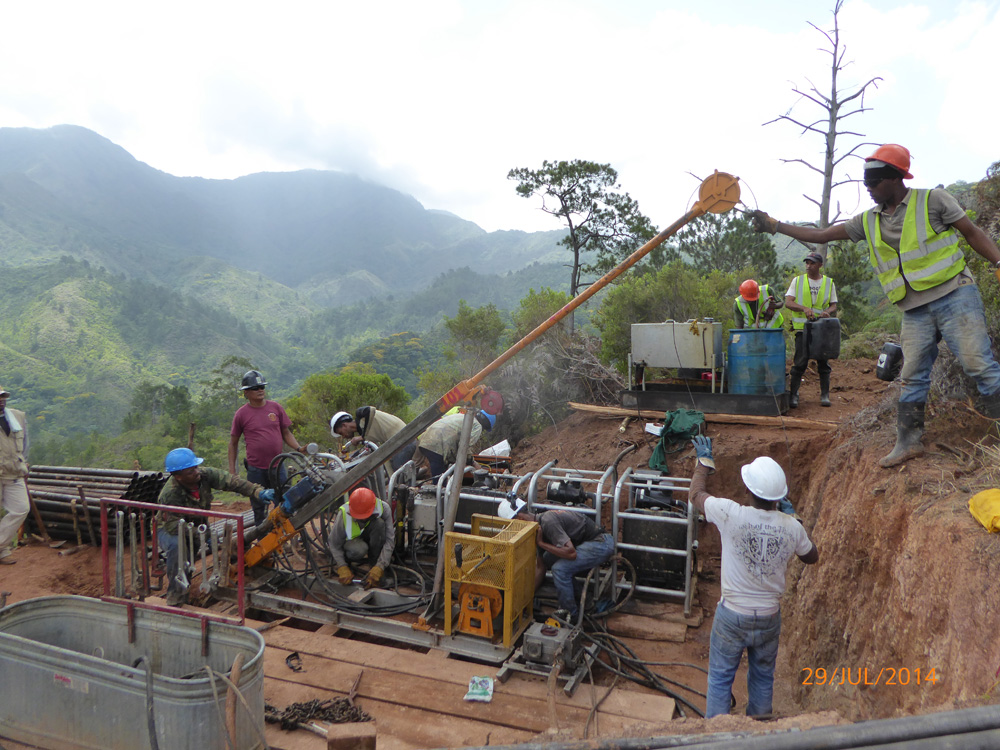
Precipitate Gold advances drilling at Pueblo Grande and Juan de Herrera in the Dominican Republic, backed by C$9M capital and strong Dominican investor support.
In the hills above Barrick's Pueblo Viejo mine, one of Latin America's largest gold operations, a drill rig has been steadily working through 2026 on ground that, until recently, nobody had bothered to test. Precipitate Gold Corp. (TSXV: PRG, OTCQB: PREIF) enters the second half of the year with two 100%-owned Dominican Republic projects either drilling or drill-ready, roughly C$9 million in working capital, and a shareholder base reshaped by a new wave of Dominican institutional money.
The Pueblo Grande Target
Pueblo Grande, which surrounds Barrick's Pueblo Viejo mine, has become Precipitate's near-term proving ground. Barrick itself once held the ground under a five-year exploration earn-in, spending roughly US$7 million and drilling 22 holes for about 6,000 metres without finding what it was looking for. Late last year, Precipitate's technical team went back through that historical dataset and found something Barrick appears to have missed: a cluster of induced polarisation chargeability anomalies, roughly 800 metres by 450 metres, sitting at depths of 100 to 330 metres in an area with no drill traces running through it. A follow-up geophysical survey confirmed the feature, and a diamond drill program followed in the first quarter.
Four holes are now complete at the Pueblo Grande Norte zone, totalling roughly 1,600 metres, with a fifth expected to push the program past 2,000 metres. Assay results are still pending, but the company says it expects them within weeks. Before drilling began, Wilson described the opportunity in characteristically plain terms:
"This is almost like an unexpected sort of lottery ticket here at the Pueblo Grande project. The hope here is that we can identify some meaningful mineralisation. The size of the target is quite sizable at about 800 metres by 400 metres. It's near surface, down from about 100 metres depth down to about 350. So relatively near surface, and it's maybe half a kilometre away from the edges of the open pit at one of the largest mines in the world."
Building a District at Juan de Herrera
If Pueblo Grande is the binary near-term test, Juan de Herrera is the slower, more deliberate build - and the project Precipitate's management treats as its flagship. The property runs 40 kilometres along Tireo Formation volcanics and shares a boundary with GoldQuest Mining Corp.'s Romero deposit, giving Precipitate a known geological setting and a working analog for what successful mineralisation looks like nearby.
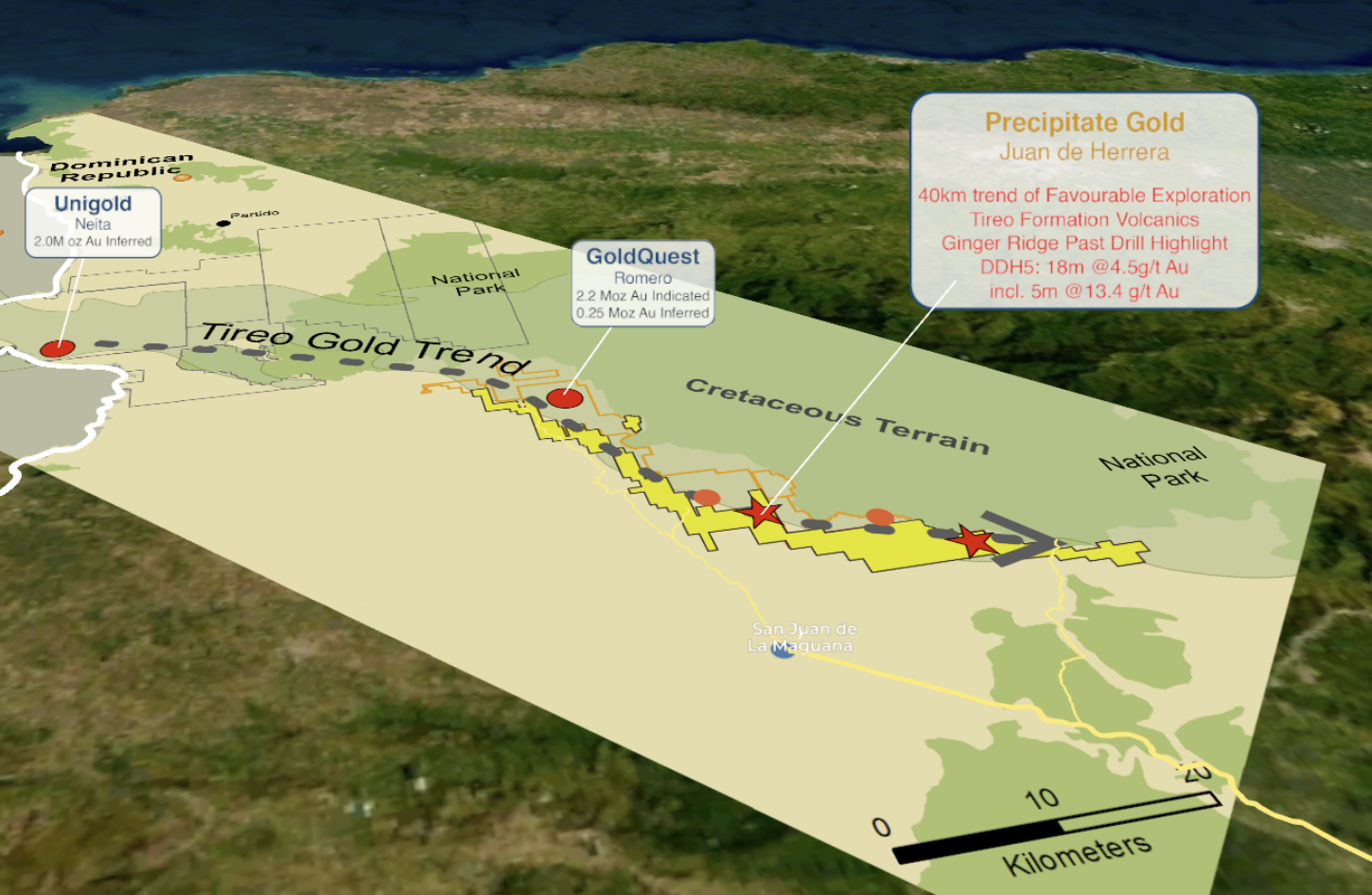
Over the past year, the company has collected more than 17,000 soil samples across the property, screening roughly 14,000 of them with handheld XRF analysis to flag about 8,000 samples worth sending to a lab. That work, paired with expanded induced-polarisation surveying completed last summer, has narrowed the list to four priority zones - Southeast, Centro, Jengibre South and CN - alongside earlier-stage targets like Ginger Ridge, where past drilling returned 13.4 grams per tonne gold over 5 metres, and the CN zone, where a hand-dug trench returned 32.2 grams per tonne gold and 286 grams per tonne silver over 5.1 metres. Many of these targets already carry drill permits, and the company says an extended IP survey has now linked the Jengibre South and Peak zones with a single, continuous chargeability corridor - exactly the kind of geophysical signature that has guided GoldQuest's own discoveries next door.
Dominican Capital, Dominican Confidence
None of this exploration would be happening on the current timeline without a shift in who's funding it. A C$6.5 million private placement closed on January 9, anchored by Dominican institutional investors who collectively now hold about 20% of Precipitate's shares. It's an unusual shareholder profile for a junior explorer, and one chief executive Jeffrey Wilson has pointed to as evidence the jurisdiction itself is changing.
"We're in a market now where the gold market has significantly changed and improved. We're in a jurisdiction where we feel like there's strong support and a will to see these projects advance because they want mining to become a more significant part of their economy."
The GoldQuest Yardstick
Precipitate's pitch to investors leans heavily on its neighbour's recent history. For years, Precipitate's share price tracked GoldQuest's almost in lockstep, despite GoldQuest carrying an advanced resource and Precipitate carrying none. That relationship broke down over the past year as GoldQuest's stock climbed sharply on environmental approval progress and advancing feasibility work - a divergence Precipitate's management frames as unfinished business rather than a settled valuation gap.
"It obviously validates what we've been saying for some time, which is that you can get things done in the Dominican Republic. The government does in fact want to support mining and does see mining as an integral part of the economy."
A Government Statement, and a Measured Response
That confidence was tested directly in early May, when Dominican President Luis Abinader announced a temporary halt to activities at GoldQuest's Romero project in San Juan province, following public concerns. Precipitate moved quickly to clarify its own position: the announcement was specific to Romero, which remains in environmental evaluation with no exploitation permit yet granted, and does not extend to Precipitate's projects.
Two of the company's three Dominican properties, Pueblo Grande and Ponton, sit outside San Juan province altogether, and all three remain in good standing on their existing exploration and drilling permits. Drilling at Pueblo Grande continued without interruption. For Juan de Herrera, which neighbours Romero and shares some of the same community geography, Precipitate has said it will stay close to local stakeholders and government officials before pushing the project further - treating the episode as a cue for patience rather than retreat.
Looking Ahead
It's a measured posture from a company that, on paper, has more going on than it has had in years: drill-ready ground at two projects, a third project at Ponton that is also fully permitted and drill-ready, board-level connections that include a GoldQuest co-founder and a former president of the Pueblo Viejo mining operation, and a Barrick royalty tucked into part of its Pueblo Grande land package as a quiet legacy of an old ground sale. None of it guarantees a discovery. But with assays pending from Pueblo Grande and an extensive 2026 drilling campaign still ahead across both projects, Precipitate's next few months look set to start answering some of the questions its neighbours have already been rewarded for answering.
Analyst's Notes





Subscribe to Our Channel







.jpg)
Stay Informed






















