




Silver Demand Shifts From Solar to AI & EV as Deficit Enters Sixth Year


Slow silver supply growth, AI and EV demand, and tighter trade controls support price resilience despite weaker solar demand and Fed rate risk.
- The Silver Institute forecasts a sixth consecutive annual silver deficit in 2026, while registered Commodity Exchange (COMEX) inventory stood at 99.31 million ounces on September 1.
- About 72% of forecast 2026 mine output comes from operations where silver is not the primary product, limiting how quickly supply can respond to higher prices.
- China continues to require silver export licenses, while India raised its effective import duty from about 6% to approximately 15%, changing physical trade flows and regional demand incentives.
- Industrial silver demand is forecast to fall 3% to 639.6 million ounces as photovoltaic use declines 19%, while AI data centers, EVs, and grid infrastructure partly offset the loss.
- Fed-funds futures priced roughly a 70% probability of a September rate hike after the September 10 PPI release, creating near-term price risk without directly increasing mine supply.
Silver Market Remains Undersupplied Into a Sixth Forecast Deficit Year
The Silver Institute’s World Silver Survey 2026 forecasts a 46.3 million-ounce deficit in 2026, which would mark a sixth consecutive annual shortfall. Registered COMEX inventory stood at 99.31 million ounces on September 1, providing a measure of immediately deliverable exchange supply as the broader market remains dependent on above-ground inventories to cover the shortfall.
Silver recorded a fifth consecutive market deficit in 2025, indicating that higher prices have not yet lifted supply or reduced demand enough to restore market balance.
72% Byproduct Supply Limits Silver’s Response to Higher Prices
About 72% of forecast 2026 mine output comes from operations where silver is not the primary product, so production decisions are driven mainly by the economics and capital spending of the host metal rather than silver prices. As a result, higher silver prices alone cannot generate a rapid increase in mine supply.
Peru’s National Institute of Statistics and Informatics reported that silver production fell 9.0% year over year in June 2026. Antofagasta lowered its 2026 copper production guidance from 650,000-700,000 tonnes to 625,000–655,000 tonnes after severe weather shut Los Pelambres in Chile, where copper concentrate also contains silver. None of these disruptions was driven by silver prices, showing how mine supply can decline independently of silver’s own price signal, allowing stronger demand to tighten the market before production has time to respond.
Solar Thrifting Reduces Silver Use as AI & EV Demand Provides an Offset
Silver investment demand is sensitive to changes in interest rates, Treasury yields, and the US dollar. Industrial demand responds more directly to technology deployment and manufacturing activity, so a single Fed decision does not determine the underlying consumption outlook. Global solar installations continue to increase, but the World Silver Survey 2026 forecasts photovoltaic silver demand falling 19% as manufacturers reduce silver loadings and substitute other materials, more than offsetting the effect of higher panel volumes.
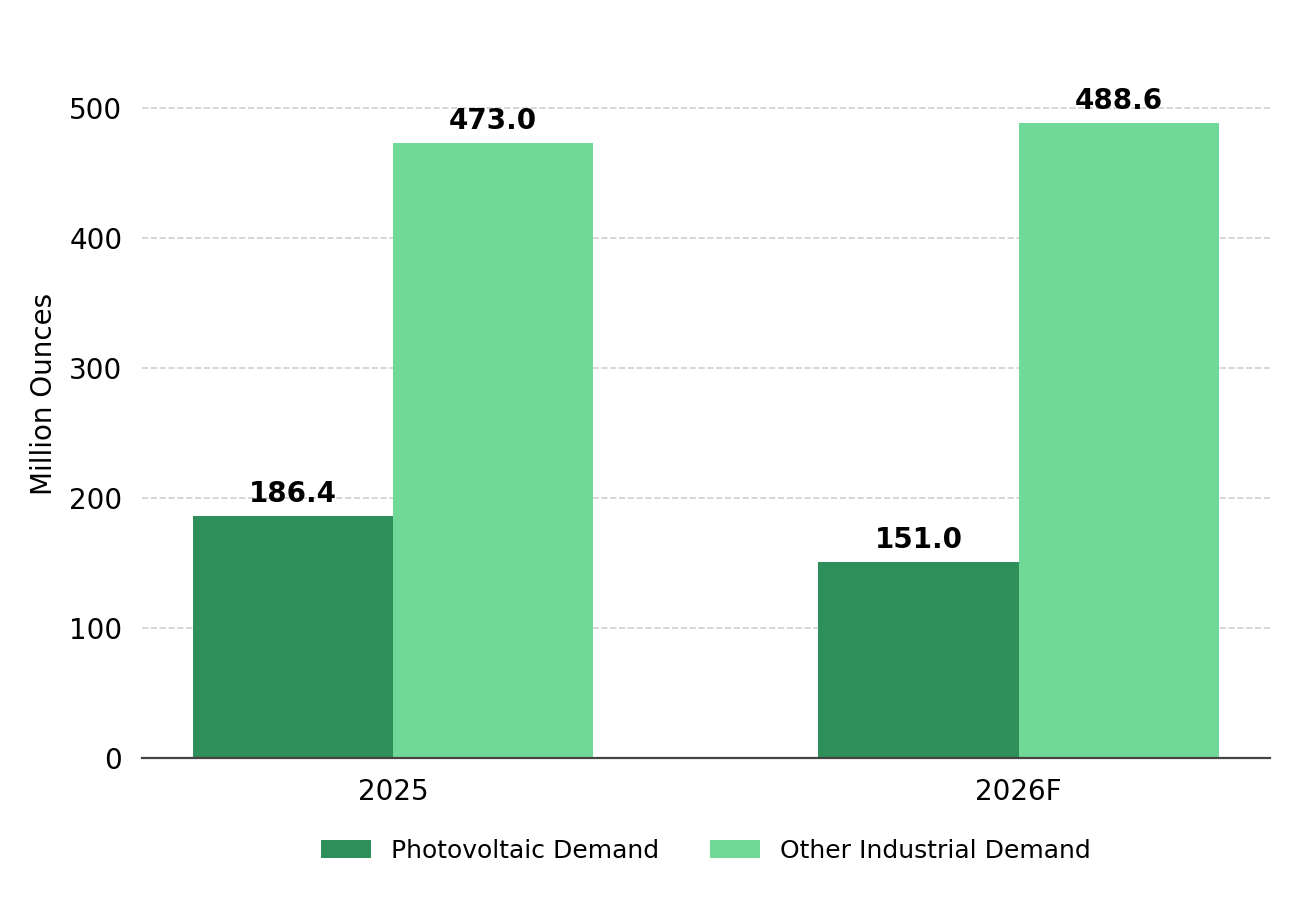
AI and data-center expansion is partly offsetting weaker photovoltaic demand, with the World Silver Survey 2026 forecasting data-center silver consumption to exceed 10% of electrical and electronics demand in the following year. Automotive electrification provides another longer-term demand channel, with the Silver Institute’s December 2025 technology report forecasting automotive silver demand to grow at a 3.4% compound annual rate between 2025 and 2031.
These industrial demand channels are driven by multi-year technology deployment and capital spending, so a single Fed decision can affect silver prices without determining the underlying pace of industrial consumption.
US Critical-Minerals Policy & Asian Trade Controls Shift Silver Supply & Demand
The US added silver to its final 2025 List of Critical Minerals on November 6, reflecting federal concern over the economic impact of potential supply disruptions. The designation increases silver’s strategic importance in US supply-chain policy, while the 2026 launch of the broader Project Vault critical-minerals reserve creates a mechanism for stockpiling eligible materials, although official disclosures do not yet confirm silver purchases through the program.
China’s 2026 silver export framework requires licenses and limits state-trading qualification to 44 approved enterprises, increasing administrative control over outbound supply. India moved in the opposite direction on demand, raising its effective silver import duty from about 6% to approximately 15% on May 13 and restricting selected silver import categories, measures intended to curb imports through higher domestic costs. These policies affect silver through different channels: China can constrain the availability of exported metal, while India’s higher import costs can reduce demand, leaving byproduct-dependent mine supply as the clearer source of pressure on the global deficit.
Silver’s 46.3 Moz Deficit Shifts Value Drivers Across the Development Curve
The Silver Institute’s forecast 46.3 million-ounce 2026 deficit affects companies differently across the development curve, with producers exposed through operating margins, developers through project economics and execution, and explorers through resource growth and valuation.
Higher Throughput Lowers Unit Costs & Expands Margins
Americas Gold & Silver’s Cosalá operation in Mexico and Galena Complex in Idaho show how different unit-cost positions create different margin exposure to the same silver price. In the second quarter of 2026, Cosalá reported cash costs of $16.91 per silver ounce sold versus $35.26 at Galena, an $18.35-per-ounce difference, while Galena’s completed No. 3 Shaft modernization and transition toward long-hole stoping target higher throughput and lower unit costs. The company maintained full-year AISC guidance of $30-$35 per silver ounce sold, compared with $36.92 in the first half, based on higher second-half production and guidance assumptions that include an MXN-to-US dollar exchange rate of 18:1.
For producers, the financial benefit of higher silver prices depends on unit costs, because lower-cost operations convert a larger share of price gains into operating margins.
Funding Coverage Puts Permitting & Construction in Focus
Vizsla Silver is targeting first silver production from the Panuco project in Sinaloa, Mexico, in the second half of 2027, leaving permitting and construction execution as the principal pre-production milestones. The November 12, 2025 Panuco Feasibility Study reported an after-tax NPV5% of $1.80 billion and an after-tax IRR of 111% under base-case prices of $35.50 per ounce silver and $3,100 per ounce gold. Vizsla’s March 2026 MD&A reported $457 million of total financing capacity against the feasibility study’s $238.7 million initial capex requirement, or about 1.9 times coverage, reducing financing risk relative to permitting and construction execution.
The company submitted Panuco’s Environmental Impact Assessment to SEMARNAT in February 2025, and the application remains under review. Receipt of the required permits is a gating milestone for a construction decision, after which project economics will depend on construction execution, commissioning, and the company’s targeted first production in the second half of 2027.
Resource Expansion & Project Economics Drive Valuation
GR Silver Mining’s Plomosas project in Mexico is valued primarily on resource growth and the economics that future technical studies can establish. GR Silver’s September 8 drilling update extended mineralized breccias at San Marcial at least 300 meters southeast and 75 meters down-dip beyond the 2023 resource boundary, while hole SMS26-04 previously returned 45.1 meters true width grading 1,623 grams per tonne silver. A Crux Investor analysis dated August 22 valued GR Silver at US$1.02 per in-situ silver ounce as of July 27 versus a US$2.58 selected-peer average, a company-defined benchmark that leaves the planned H1 2027 resource update and subsequent economic studies as key inputs to any re-rating.
Higher Fed Rate Expectations Pressure Silver Without Expanding Mine Supply
Earlier in 2026, rate markets were positioned for further Fed cuts, but renewed inflation pressure and resilient economic data shifted pricing toward the possibility of a rate increase. The policy outlook shifted in June, when the Fed’s Summary of Economic Projections showed 9 of 19 policymakers projecting at least one rate increase by year-end, before August payrolls rose by 162,000 versus the 56,000 Reuters consensus and strengthened the case for near-term tightening. After the September 10 PPI release, fed-funds futures priced roughly a 70% probability of a September hike, while the 10-year Treasury yield reached about 4.93%, its highest since October 2023, increasing the near-term opportunity cost of holding silver.
The August CPI release on September 11 and the Fed’s September 15–16 meeting are the next major monetary-policy catalysts for silver. Fed-funds futures priced a 71.3% probability of a 25-basis-point September hike early on September 11, leaving a hotter-than-expected CPI print likely to reinforce higher yields and the US dollar, while a softer reading could reduce hike pricing and relieve pressure on silver.
Neither the CPI outcome nor the Fed decision directly changes silver’s slow mine-supply response. A Fed decision can move silver through Treasury yields, the US dollar, and the opportunity cost of holding a non-yielding metal, while mine output remains governed largely by the economics and operating conditions of host-metal mines.
The Investment Thesis for Silver
- A sixth consecutive annual deficit is forecast for 2026, keeping the physical market undersupplied despite near-term changes in Fed policy.
- Lower-cost producers have greater margin sensitivity to higher realized silver prices because a larger share of each price increase can flow through to operating margins.
- For developers with financing capacity above initial capex requirements, permitting and construction execution become more important valuation variables than near-term access to capital.
- For explorers, drill results, resource growth, and subsequent economic studies can change enterprise value per resource ounce by providing new evidence on project scale, grade, and potential economics.
- About 72% of forecast 2026 mine output comes from operations where silver is not the primary product, limiting how rapidly higher prices can generate additional supply.
Silver recorded five consecutive annual deficits through 2025, while the high share of byproduct production continues to limit the speed at which mine supply can respond to higher prices. A more hawkish Fed can pressure silver through higher Treasury yields and a stronger US dollar, but it does not directly increase mine supply in the near term. Restoring market balance ultimately requires additional supply, lower demand, or releases from above-ground inventories.
TL;DR
Silver remains undersupplied entering 2026, while about 72% of forecast mine output comes from operations where silver is not the primary product, limiting the response to higher prices. Photovoltaic silver demand is forecast to fall 19%, but AI data centers, EVs, and grid investment provide partial offsets. China’s export controls and India’s higher import costs are also changing physical trade flows. Higher Fed rate expectations can pressure silver through yields and the US dollar without directly increasing mine supply. Across the development curve, producer margins depend on costs, developers face permitting and construction execution, and explorers depend on resource growth and project economics.
FAQs (AI-Generated)
Analyst's Notes





Subscribe to Our Channel










Stay Informed






