




Sovereign Metals Kasiya DFS Confirms 25-Year, Low-Cost Operation Positioned to Redefine Global Titanium & Graphite Supply Chains


Sovereign Metals’ Kasiya DFS outlines a 25-year, low-cost rutile-graphite project with US$2.2B NPV, strong margins and strategic supply chain relevance.
- Pre-tax net present value at 8% discount rate (NPV8%) of US$2.2 billion with 23% internal rate of return (IRR) and steady state earnings before interest, tax, depreciation and amortisation (EBITDA) of US$476 million per annum.
- Total revenue of US$16.2 billion over a 25-year mine life with initial capital expenditure (capex) to first production of US$727 million, delivering an NPV to capex ratio of 3.0x.
- Positioned to become the world's largest natural rutile producer at 222,000 tonnes per annum (ktpa) and natural flake graphite producer at 275 ktpa.
- Operating cost of US$450 per tonne product free on board (FOB) Nacala positions Kasiya as the lowest-cost graphite producer globally, with an incremental graphite production cost of US$216 per tonne.
- Non-binding offtake memorandums of understanding (MOUs) with Mitsui & Co. covering over 50% of Phase 1 rutile production and Traxys North America covering over 35% of Phase 1 graphite sales support project financing pathway.
Company Overview
Sovereign Metals Limited (ASX: SVM | AIM: SVML | OTCQX: SVMLF) is a mining development company focused on advancing the Kasiya Rutile-Graphite Project in Malawi, which hosts the world's largest natural rutile deposit and second-largest flake graphite deposit. The company is positioned to become a leading supplier of critical minerals for titanium metal and battery anode markets outside Chinese control.
DFS Confirms Investment Grade Economics with Rio Tinto Technical Oversight
Sovereign Metals announced on April 16, 2026, the completion of the Definitive Feasibility Study (DFS) for the Kasiya Rutile-Graphite Project, located in central Malawi, approximately 40 kilometres northwest of Lilongwe. The study demonstrates pre-tax net present value at an 8% discount rate (NPV8%) of US$2.2 billion, pre-tax internal rate of return (IRR) of 23%, and steady state annual earnings before interest, tax, depreciation, and amortisation (EBITDA) of US$476 million. The project generates a steady state annual free cash flow of US$452 million on a pre-tax, unlevered basis, with total revenue over the 25-year mine life reaching US$16.2 billion.
The study was undertaken with technical input and oversight from the Sovereign-Rio Tinto Technical Committee and conforms to the World Bank Group's International Finance Corporation (IFC) Performance Standards where applicable. The DFS builds upon the Optimised Pre-feasibility Study (OPFS) and incorporates empirical data from the Pilot Mining and Rehabilitation Program completed during 2024 and 2025.
Managing Director and Chief Executive Officer of Sovereign Metals, Frank Eagar, stated:
"The completion of this DFS marks a defining milestone for Kasiya and for the global titanium and graphite supply chains. To deliver a DFS of this quality, depth and confidence, rarely achieved by a pre-production company, reflects the calibre of partnerships that Sovereign has assembled around this project: Rio Tinto's technical expertise, alignment with IFC Performance Standards under our Collaboration Agreement, and offtake interest driven by US and Japanese supply chain security priorities."
Phased Development Strategy Delivers Strong Returns with Capital Efficiency
Initial capital expenditure (capex) to first production totals US$727 million, delivering an NPV to capex ratio of 3.0x. The phased development sees a 12 million tonnes per annum (Mtpa) South Plant commissioned from Year 1, with a second 12 Mtpa North Plant added from Year 5 to reach a total throughput of 24 Mtpa. Total life of mine (LOM) development capex reaches US$1.239 billion when the North Plant expansion is included, with sustaining capex of US$431 million.
Operating costs of US$450 per tonne product free on board (FOB) Nacala establish a low-cost position in both markets, providing substantial margin protection. Sensitivity analysis demonstrates project resilience, with both rutile and graphite prices simultaneously 25% lower than DFS assumptions, still delivering a positive NPV8% of US$913 million and pre-tax IRR of 15.2%. The project payback period extends 6.2 years from the start of production on an unlevered, pre-tax free cash flow basis.
Dual Critical Minerals Platform Addresses Western Supply Chain Vulnerabilities
At steady state, Kasiya will produce approximately 222 ktpa of natural rutile concentrate grading 95% or higher titanium dioxide, positioning Sovereign to become the world's largest producer of natural rutile. According to the United States Geological Survey (USGS), the United States currently produces zero titanium sponge domestically and remains 100% import-reliant, with record imports of 44,000 tonnes in 2025. Japan supplies over 70% of US titanium sponge imports, whilst China's share of global sponge production has risen to 70%. Global primary rutile supply faces a structural decline, with rutile reserves at Leonoil Company Limited's Area 1 Mine expected to be depleted within the next 2 to 3 years.
The project will produce approximately 275 ktpa of natural flake graphite grading 96% total graphitic carbon (TGC) at steady state, establishing Sovereign as potentially the world's largest natural flake graphite producer. China currently dominates global natural graphite production and processing, accounting for approximately 77% of worldwide output.
Kasiya's incremental cost of graphite production is estimated at US$216 per tonne, positioning Sovereign as the lowest-cost graphite producer globally based on public disclosures by listed graphite developers with studies at or beyond the pre-feasibility stage, including operations in China. In September 2024, Sovereign announced that Coated Spherical Purified Graphite (CSPG) produced from Kasiya natural flake graphite achieved first cycle efficiencies of 94.2 to 95.8%, with results above 95% representing a key specification for the highest quality natural graphite anode materials under Chinese standards.
Dry Mining Method & Tailings Management Validated Through Pilot Program
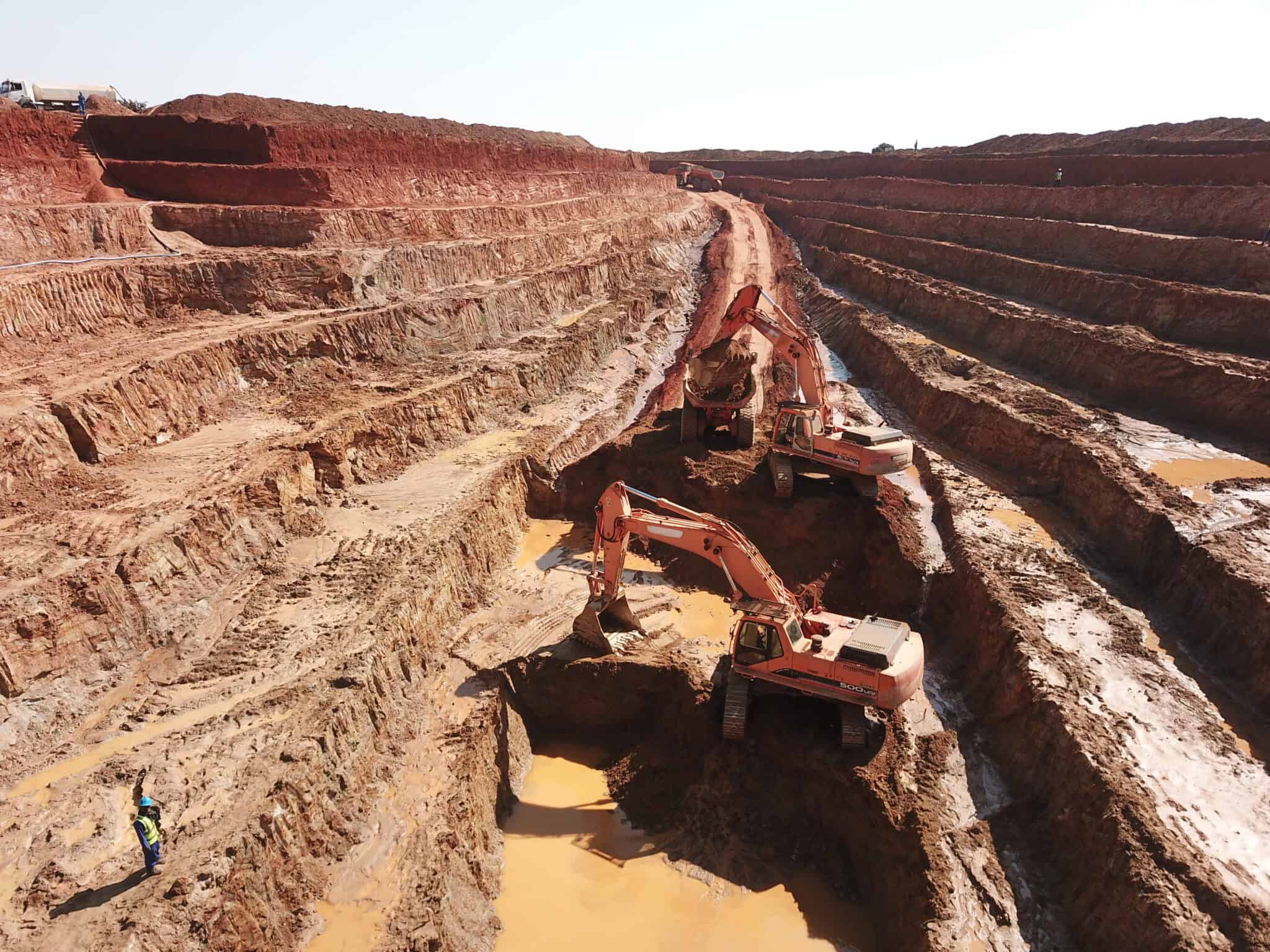
The DFS confirms a dry mechanical mining method using draglines and 100-tonne rigid dump trucks. The soft, free-dig saprolite orebody requires no drilling, blasting, crushing or milling. A two-bench approach maintains draglines above the water table, with a 5-metre top cut and up to 15-metre bottom cut. Using real-world data from the Pilot Mining and Rehabilitation Program, the company successfully excavated a test pit covering 120 metres by 110 metres to a depth of 20 metres. Post-mining, the rehabilitated pit achieved maize yields of 5.2 tonnes per hectare within six months of backfilling, over five times the local community average of approximately 1 tonne per hectare. The Wet Concentration Plant (WCP) employs low-energy gravity separation to produce Heavy Mineral Concentrate (HMC), which feeds to the Mineral Separation Plant (MSP) for electrostatic and magnetic separation, yielding rutile exceeding 95% titanium dioxide. Graphite-rich concentrate recovered from spirals is processed in a dedicated flotation plant.
A major advancement in the DFS is the elimination of a conventional Tailings Storage Facility (TSF), with all tailings stored via hydraulic co-disposal backfilling of mined-out pits designed in compliance with the Global Industry Standard on Tailings Management (GISTM). The 50:50 fines-to-sand backfill ratio closely matches the existing soil profile, supporting progressive rehabilitation. The DFS is based on connection to Malawi's national hydropower grid via a 132 kilovolt (kV) overhead line to the Nkhoma substation. The company entered into a non-binding memorandum of understanding (MOU) with a European-backed private equity fund to fund the development and construction of the 132 kV transmission line, estimated to cost approximately US$40.7 million. Products will be railed from a purpose-built dry port at the mine site along the Nacala Logistics Corridor to the Port of Nacala on the Indian Ocean, with transport cost estimated at US$117 per tonne FOB Nacala.
Strategic Partnerships Support Bankable Development Pathway
In March 2026, Sovereign executed a non-binding offtake MOU with Mitsui & Co. for up to 70,000 tonnes per annum of Kasiya natural rutile concentrate over an initial four-year term, representing over 50% of Phase 1 rutile production. In February 2026, Sovereign executed a non-binding MOU with Traxys North America for the marketing of graphite, targeting 40,000 tonnes per annum during Phase 1 and up to 80,000 tonnes per annum thereafter, representing over 35% of coarse flake graphite sales during initial production.
Under the Investment Agreement with Rio Tinto, if Sovereign raises debt finance for project development, Sovereign and Rio Tinto will negotiate financing arrangements in good faith. Rio Tinto holds the option to become the operator of Kasiya on commercial arm's-length terms, with exclusive marketing rights to 40% of annual production. Rio Tinto's option lapses if not exercised by the earlier of: (i) 90 days after the DFS announcement or 180 days if Rio Tinto advises it needs additional time; or (ii) Rio Tinto ceasing to hold voting power of at least 10%.
The company has entered into a Collaboration Agreement with the IFC, which provides a pathway to international project financing, with IFC holding rights to participate as a lender, mandated co-lead arranger, and/or investor. The DFS has been prepared in alignment with IFC Performance Standards, with Sovereign's on-the-ground social team of 22 core staff and a 90-member Community Liaison Team, representing a level of social preparedness rarely achieved at the DFS stage.
Ore Reserve & Metallurgical Recovery Support 25-Year Mine Life
The Ore Reserve estimate comprises 536 million tonnes (Mt) of Proven and Probable Ore grading 0.95% rutile (Rut95) and 1.56% TGC. The Proved Ore Reserve totals 78 Mt grading 1.03% rutile and 1.65% TGC, whilst the Probable Ore Reserve totals 458 Mt grading 0.94% rutile and 1.54% TGC. The open pit geometries are based on NPV maximised pit shells edited to comply with practical mining requirements and identified exclusion zones, with final geometries developed by applying a rutile cut-off grade ranging from 0.7 to 1.5% Rut95.
The company completed bulk rutile test work programs, concluding that a product with an average grade specification of 95.3% titanium dioxide can be successfully produced with the application of an average 97.6% recovery-to-product factor. Graphite recovery is 71.9% total, discounted by 3% in the first two years of operation, 2.5% in Year 3, 2.0% in Year 4, and 1.5% in Year 5 thereafter, conservatively adjusted to reflect scale-up from laboratory to plant conditions. Overall concentrate grades average 95.5% TGC with over 62% of graphite flake product being larger than 180 micrometres.
Heavy Rare Earth Potential Represents Third Revenue Stream
Monazite concentrate recovered from the rutile processing circuit contains exceptionally elevated levels of heavy rare earths dysprosium, terbium and yttrium, representing a potential third revenue stream at minimal incremental cost. All three elements are subject to Chinese export restrictions. The heavy rare earth potential has not been included in the DFS financial metrics. A dedicated monazite evaluation program is now underway to assess scale, recovery and economic potential.
Next Steps: Permitting, Offtake Conversion & Financing
Following completion of the DFS, Sovereign intends to apply for a Mining Licence to secure mineral deposits for mining. At this stage of Kasiya's development, the company notes no known issues or impediments to obtaining a Mining Licence under normal course of business. The company will continue key post-DFS workstreams, including permitting and financing activities required to advance the project to a final investment decision, with approximately A$29.2 million in cash on hand as at 31 March 2026 (unaudited).
The company intends to negotiate and convert the non-binding MOUs with Mitsui & Co. and Traxys North America into definitive offtake agreements, which will assist in securing future debt facilities to finance the project. The dedicated monazite evaluation program will assess the scale, recovery and economic potential of the heavy rare earth by-product stream, with results to be incorporated into future technical studies.
Rio Tinto's option period to elect operatorship and 40% marketing rights extends to either 90 days after the DFS announcement or 180 days after the announcement if Rio Tinto advises that it needs additional time to consider the exercise. Clarification of Rio Tinto's participation structure represents a key near-term catalyst that will inform the company's financing and development strategy.
FAQs (AI-Generated)
The DFS reports a pre-tax NPV8% of US$2.2 billion, a 23% IRR, and annual EBITDA of US$476 million, indicating strong project economics and capital efficiency.
Kasiya targets large-scale production of rutile and graphite, both critical minerals, offering a non-Chinese supply source for titanium and battery anode markets.
The project is positioned as the lowest-cost graphite producer globally, with operating costs of US$450/t FOB and incremental graphite costs of US$216 per tonne.
Partnerships with Rio Tinto (technical oversight), Mitsui & Co. (rutile offtake), and Traxys (graphite marketing) support financing, execution, and market access.
Sovereign will focus on permitting, converting MOUs into binding offtake agreements, securing financing, and advancing toward a final investment decision (FID).
Analyst's Notes





Subscribe to Our Channel


.png)


.jpg)
Stay Informed


