




Sovereign Metals' Kasiya DFS: 7 Things You Need to Know


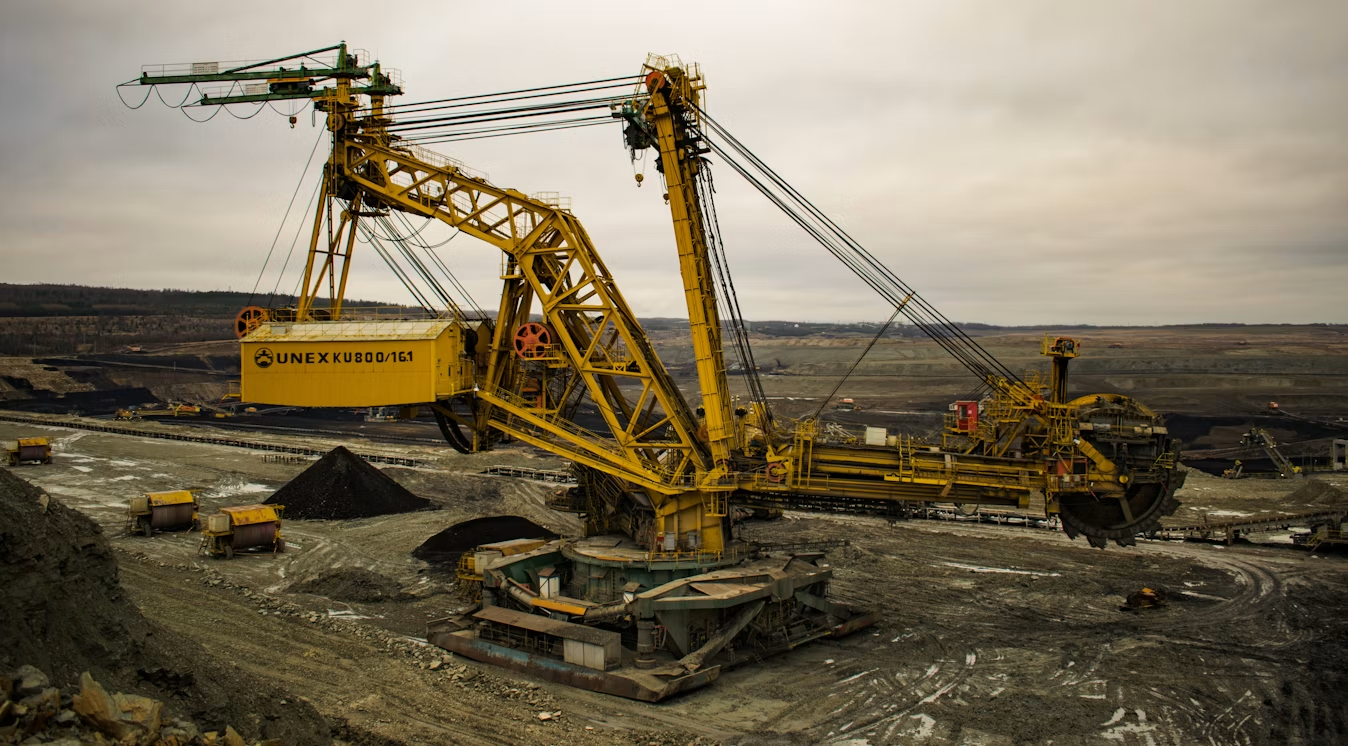
Kasiya's DFS is complete, but permitting approval and financing closure remain unresolved preconditions for the construction decision.
Project Overview
Kasiya is a dual-commodity natural rutile and natural flake graphite development project operated by Sovereign Metals (ASX: SVM | AIM: SVML | OTCQX: SVMLF). The company has completed a Definitive Feasibility Study (DFS) that establishes a 25-year mine life and a first-production capital expenditure (capex) of US$727 million. Completion of the study marks the end of the project's technical definition phase, but in itself does not constitute a construction decision. Two independent workstreams, Environmental and Social Impact Assessment (ESIA) approval and financing closure, must be resolved before a construction decision can be made.
1. DFS Completion & Project Economics
The DFS delivers confirmed project economics and validated engineering parameters but does not authorise construction.
The study returns a pre-tax net present value at an 8% discount rate (NPV8%) of US$2.2 billion and a pre-tax internal rate of return (IRR) of 23%, against first-production capex of US$727 million. Total life-of-mine development capital is US$1,239 million, with sustaining capital of US$431 million.
Three engineering changes are confirmed: dry mechanical mining using draglines replaces the prior hydro-mining method; in-pit co-disposal replaces a conventional tailings storage facility; and hydropower-sourced grid electricity replaces the independent power producer arrangement previously modelled in the Pre-Feasibility Study (PFS). The DFS was overseen by the Sovereign-Rio Tinto Technical Committee and aligned with International Finance Corporation (IFC) Performance Standards. A completed Pilot Mining Programme, developed with Rio Tinto's technical input, provided real-world validation across key study workstreams, and a Mineral Resource Estimate upgrade delivered the classification standard required for bankable project financing.
2. Production Scale & Mine Life
At design capacity, Kasiya is positioned to become the world's largest single-operation producer of both natural rutile and natural flake graphite.
Annual production is confirmed at 222,000 tonnes of natural rutile and 275,000 tonnes of natural flake graphite over an initial 25-year mine life, supported by a 2.1 billion tonne resource base. Development is staged across two processing plants, each rated at 12 million tonnes per annum: the South Plant commences in Year 1, and the North Plant commences in Year 5.
3. Critical Minerals Designation & Cost Position
Both commodities produced at Kasiya carry critical minerals designations from the United States and the European Union, placing Kasiya at the intersection of strategic supply policy across two separate commodity vectors.
Natural rutile is designated as essential for defence, industrial, and energy security applications, and with no other large-scale primary rutile developments at an advanced stage, Sovereign is positioned to become the only large-scale primary producer of natural rutile globally. A Memorandum of Understanding (MOU) with Traxys North America LLC for graphite offtake has been signed with one of only three trading houses selected to procure critical minerals for the US Government's US$12 billion Project Vault strategic reserve programme.
Kasiya's graphite is suitable for all major end-use markets and has characteristics comparable to those of top Chinese battery anode producers. The project's incremental cost of graphite production is US$216 per tonne. A potential monazite by-product containing dysprosium, terbium, and yttrium, rare earth elements subject to Chinese export controls and described as critical for defence systems and aerospace applications, is a continuing workstream not included in the current DFS.
Managing Director and Chief Executive Officer of Sovereign Metals, Frank Eagar, frames the cost position in competitive terms:
"We almost have the ability to take Chinese market share, with that operating cost. The potential of becoming a long-term secure source of supply of flake graphite, Kasiya is sitting very, very nicely within that opportunity."
4. ESIA Status & Permitting Path
All supporting specialist studies have been completed and integrated into the project design, but the ESIA has not been finalised or submitted for approval, leaving permitting as an unresolved and undated precondition for the construction decision.
All biological, social, and biophysical specialist studies have been concluded. Finalisation of the ESIA is listed as an upcoming milestone, but no target date for finalisation or regulatory approval is disclosed. A mining licence application is a further workstream. The permitting gate remains open until the ESIA is approved and the mining licence is obtained.
5. Community & Environmental Groundwork
A structured community engagement programme and completed rehabilitation trials constitute the social licence record underpinning the ESIA process, but do not substitute for regulatory approval.
Sovereign has established a 22-person core social team and a 90-member Community Liaison Team. Through careful planning and environmental buffers, Sovereign has minimised the direct loss of remnant natural habitat areas within the project footprint. Rehabilitation trials have been successfully conducted, and 28 local farmers have requested support to establish a post-closure farming co-operative.
6. Financing Structure & Capital Requirements
The IFC is positioned as a potential co-lead mandated lead arranger under an existing Collaboration Agreement, but no binding financing commitments have been secured.
First production capex of US$727 million requires project financing at scale. The Collaboration Agreement with the IFC establishes the institutional relationship for that financing process. No committed capital position has been established.
Eagar puts the IFC relationship plainly in the context of project financing:
"You'll also be aware that we've got the Collaboration Agreement with the IFC in place. That's on the project finance side of things."
7. Offtake Negotiations & Commercial Preconditions
Non-binding memoranda of understanding with Mitsui and Traxys are in place, but conversion to binding definitive agreements requires multiple independent approvals, constituting a specific precondition for financing.
Mitsui & Co. has signed an MOU covering up to 70,000 tonnes per annum of natural rutile concentrate for an initial 4-year period. Traxys North America LLC has signed an MOU for 40,000 to 80,000 tonnes per annum of graphite over a 5 to 10-year period. The binding conversion of the Traxys MOU is subject to board approvals and to Rio Tinto's rights under its Investment Agreement with Sovereign. Conversion of the Mitsui MOU is subject to Rio Tinto's rights under that same agreement. Rio Tinto holds an 18.5% strategic position, having invested A$60 million, and its consent under the Investment Agreement is a required condition for both definitive agreements.
Eagar is direct about the gap between current commercial agreements and the binding commitments the project requires:
"Obviously, getting this is a non-binding MOU, but getting it to, ultimately, the offtake agreement, I think it's a very, very positive step for the project as a whole."
Key Takeaway for Investors
- The Definitive Feasibility Study returns a pre-tax net present value of US$2.2 billion at an 8% discount rate, and a pre-tax internal rate of return of 23%, but completion of the study does not constitute a construction decision.
- Kasiya is positioned to become the world's largest single-operation producer of both natural rutile and natural flake graphite, with annual output of 222,000 tonnes of natural rutile and 275,000 tonnes of natural flake graphite per annum over a 25-year mine life.
- Both natural rutile and natural flake graphite carry a critical minerals designation from the United States and the European Union, and Kasiya's incremental graphite production cost of US$216 per tonne is described as competitive with Chinese producers.
- The ESIA has not been finalised or submitted for approval, with no disclosed target date for either step, leaving permitting as an open and undated precondition for the construction decision.
- The International Finance Corporation is positioned as a potential co-lead mandated lead arranger under an existing Collaboration Agreement, but no binding financing commitments have been secured.
- Non-binding memoranda of understanding with Mitsui and Traxys require conversion into binding definitive agreements, a process subject to board approval in the case of Traxys and to Rio Tinto's rights under its Investment Agreement in both cases.
Bottom Line
DFS completion advances Kasiya into the financing and permitting phase. The construction decision remains contingent on two independent critical paths: ESIA approval and financing closure. Neither carries a disclosed completion date, and each presents independent schedule risk.
Analyst's Notes





Subscribe to Our Channel



Stay Informed


