




Sovereign Metals: Mitsui MOU Adds Early Commercial Validation for Kasiya Rutile


Sovereign Metals’ Mitsui MOU gives early commercial validation for Kasiya’s rutile product and adds commercial context ahead of feasibility, permitting, and financing.
- Sovereign Metals signed a non-binding Memorandum of Understanding (MOU) with Mitsui & Co., Ltd. covering up to 70,000 tonnes per year of natural rutile concentrate from planned 2030 production.
- The agreement gives early commercial validation for Kasiya’s rutile product, which is the project’s main revenue line under current study-stage economics.
- Kasiya’s January 2025 optimised pre-feasibility study (PFS) outlined a pre-tax net present value (NPV) of US$2,322 million and an internal rate of return (IRR) of 27%, which gives added weight to early sales progress.
- The MOU places Kasiya more directly into Japan’s titanium supply chain, where product purity and impurity profile matter for high-specification end markets.
- The agreement remains non-binding and non-exclusive, while a definitive feasibility study (DFS), Malawi permitting, Rio Tinto’s rights, and project funding still determine delivery.
The Mitsui MOU & Commercial Scope
Sovereign Metals announced a Memorandum of Understanding (MOU) with Mitsui covering the sale and purchase of natural rutile from the Kasiya Rutile-Graphite Project in Malawi. The agreement introduces a named counterparty into the project’s rutile sales process and sets out an initial framework for potential supply from planned production.
The MOU covers natural rutile concentrate with titanium dioxide content above 95% and a product specification suited to the Japanese titanium industry. Indicative volume is up to 70,000 tonnes per year from planned 2030 production, with an initial 4-year term and a possible 5-year extension by mutual agreement.
The framework links Stage 1 to 12 million tonnes per annum throughput and Stage 2 to 24 million tonnes per annum throughput. Pricing would reference market prices for equivalent material at shipment, likely for free on board or cost, insurance, and freight terms. The MOU remains effective for 2 years and is non-binding and non-exclusive, aside from standard legal clauses.
Commercial Validation & Why Mitsui Matters
Mitsui’s role in the agreement is tied to more than product trading alone. Sovereign describes the group as active across resource development, manufacturing, sales, trading, logistics, and resource investment. In practical terms, that places the MOU within a broader industrial and commercial setting than a simple customer expression of interest.
Managing Director and Chief Executive Officer of Sovereign Metals, Frank Eagar, is direct about how the company reads this stage of the sales process.
“Obviously, getting this is a non-binding MOU, but ultimately getting to the offtake agreement, I think it's a very, very positive step for the project as a whole.”
The current stage remains preliminary. The document records a mutual intention to negotiate a definitive agreement, but it does not establish committed revenue, final pricing, or binding sales coverage. At this point, the MOU functions as an early commercial indicator for rutile rather than a completed offtake outcome.
Japan’s Titanium Chain & Policy Context
Japan occupies a central position in the announcement due to its relevant end-market for high-grade rutile. The country is the second-largest producer of titanium sponge after China and is associated with high-specification titanium alloys used in aerospace, defence, medical, and advanced manufacturing applications.
That market link is also product-specific. Sovereign describes natural rutile as the purest, highest-grade naturally occurring titanium feedstock, with titanium dioxide content and impurity levels suited to Japanese titanium producers. Toho Titanium and Osaka Titanium account for more than 60% of aerospace and defence-grade titanium metal production outside China and Russia, and Toho Titanium confirmed the suitability of Kasiya’s rutile for high-specification titanium products in June 2025. Against that backdrop, Mitsui sits within a market where feedstock quality is a core requirement.
The announcement also places the agreement within a broader critical minerals supply-chain context. Sovereign points to closer coordination among the United States, European Union, and Japan on supply resilience, while the United States sourced more than 70% of its titanium sponge imports from Japan in the first half of 2025. That places Japanese titanium production within a wider downstream chain spanning aerospace, defence, and advanced manufacturing.
Kasiya’s Asset Base & Why Rutile Commercialisation Is Material
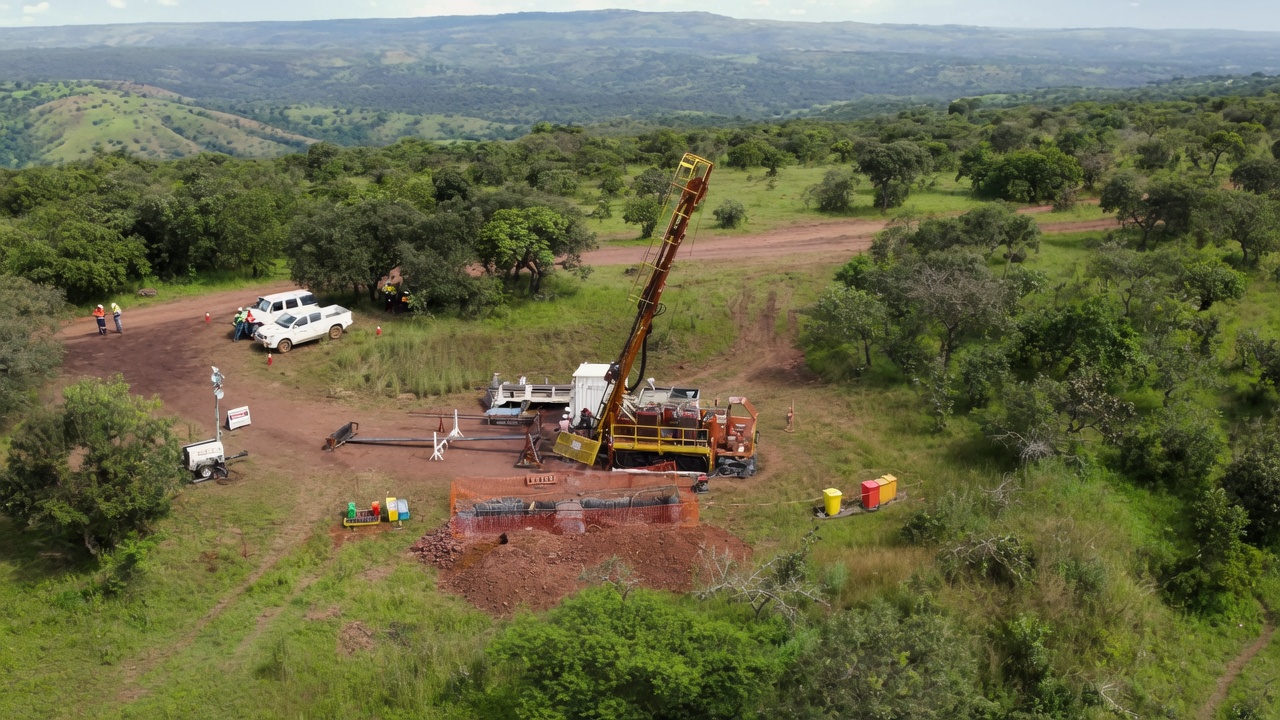
Kasiya’s scale is part of the reason this commercial step draws attention. Sovereign describes the project as the world’s largest known rutile resource, with 17.9 million tonnes of contained rutile, and the second-largest known flake graphite resource, with 24.4 million tonnes of contained graphite. The currently known mineralised area spans 201 square kilometres.
The physical setting is also relevant to how the project is being developed. Mineralisation is blanket-style and hosted in soft, friable saprolite, with weathered ore and very low sulphur levels. Sovereign also describes Kasiya as the only known deposit where graphite is a by-product of rutile production. That combination shapes both the processing context and the product mix.
The January 2025 optimised pre-feasibility study (PFS) provides the current economic frame. Sovereign reported a pre-tax net present value (NPV) of US$2,322 million, an internal rate of return (IRR) of 27%, average annual earnings before interest, tax, depreciation and amortisation (EBITDA) of US$409 million, and an EBITDA margin of 64%. Capital expenditure (capex) to first production was put at US$665 million, average steady-state rutile production at 246,000 tonnes per annum, average steady-state graphite production at 265,000 tonnes per annum, and operating cost at US$423 per tonne. These remain study-stage figures, but they show the scale at which rutile placement becomes commercially relevant before a definitive feasibility study (DFS) is complete.
Graphite Context & Broader Sales Coverage
Graphite remains part of the wider Kasiya project, but it is secondary to the present announcement. In the optimised PFS, graphite carries an incremental cost of production of US$241 per tonne, with concentrate grades of 96% to 98% carbon and very low sulphur levels. Testwork is also said to support suitability for 94% of graphite end uses.
The graphite component broadens the project’s product base, but Sovereign’s stated approach remains focused on mining and concentrate sale rather than downstream anode processing. That keeps graphite in the article as part of the project breadth and cost structure, rather than as the centre of the current news. Speaking in February about the earlier Traxys graphite MOU, Eagar noted that early agreements represent partial coverage rather than a finished marketing outcome:
“We are in discussions with others as well, for that balance. But it's certainly a good start.”
That approach is consistent with the broader sales process. Earlier commentary around Traxys was not presented as full placement, and Mitsui fits into the same pattern. The current picture is one of progressive sales coverage rather than completed offtake placement.
Execution Sequence & Development Constraints
The MOU sits within a broader development sequence that still includes DFS, permitting in Malawi, the mining licence application, the environmental impact assessment, and project funding arrangements. Those remain the principal project gates between commercial discussions and development.
Eagar is equally clear that commercial progress still sits inside that larger sequence.
“Mining license application, environmental impact assessment, and permitting. And then, really, it is into the funded agreements.”
Existing agreements also shape the route to any definitive Mitsui arrangement. Sovereign’s investment agreement with Rio Tinto, dated July 2023, remains relevant, and entry into any definitive Mitsui agreement is subject to Rio Tinto’s rights. The December 2025 collaboration agreement with the International Finance Corporation also connects to the project finance workstream.
The Investment Thesis for Sovereign Metals
- The Mitsui Memorandum of Understanding introduces early commercial validation for Kasiya rutile before any definitive sales agreement is in place.
- Kasiya’s rutile scale, at 17.9 million tonnes of contained rutile, gives commercial progress more weight than it would carry at a smaller project.
- Mitsui’s relevance is tied to Japan’s titanium chain and to the supply chain context Sovereign sets out around current Western-aligned critical minerals policy.
- The January 2025 optimised pre-feasibility study indicates material project economics, but those figures still need to be carried through definitive feasibility, permitting, and finance.
- Graphite broadens the project’s product mix and cost structure, but the current commercial focus remains on rutile as the main value driver.
- The Mitsui agreement remains non-binding and subject to Rio Tinto’s existing rights, further evidence still has to come from definitive offtake, approvals, and funding.
The current announcement marks progress in commercial positioning, but it does not change the project sequence. The DFS, Malawi permitting, legal rights under existing agreements, and funded development remain the main determinants of delivery.
TL;DR
Sovereign’s Mitsui MOU adds an early commercial framework for Kasiya rutile, the project’s primary product, and places the project more directly within Japan’s titanium supply chain. The agreement covers up to 70,000 tonnes per year of natural rutile concentrate from planned 2030 production, but it remains non-binding, non-exclusive, and subject to Rio Tinto’s existing rights. This commercial step provides earlier market validation for Kasiya, but it remains preliminary, as DFS, Malawi permitting, and funded agreements remain as the main execution requirements.
FAQs (AI-Generated)
Sovereign Metals signed a non-binding, non-exclusive Memorandum of Understanding with Mitsui & Co., Ltd. covering potential sales of natural rutile concentrate from the Kasiya Rutile-Graphite Project in Malawi. The framework covers up to 70,000 tonnes per year, with an initial 4-year supply period from planned 2030 production and a possible 5-year extension.
The product is natural rutile concentrate with titanium dioxide content above 95%, suited to the Japanese titanium industry. Stage 1 is linked to 12 million tonnes per annum throughput, Stage 2 to 24 million tonnes per annum throughput, pricing is still to be agreed by reference to market prices for equivalent material, and the Memorandum of Understanding remains effective for 2 years.
No. The agreement is non-binding and non-exclusive, except for standard clauses such as confidentiality, publicity, and governing law. Any definitive agreement would still need to be negotiated and would remain subject to Rio Tinto’s existing rights.
Japan is the second-largest producer of titanium sponge after China and is a relevant end-market for high-grade rutile feedstock. Sovereign also points to Toho Titanium’s prior confirmation of product suitability and to Japan’s role in broader critical minerals supply chain coordination with the United States and the European Union.
The project still needs to move through definitive feasibility study, permitting in Malawi, the mining licence application, the environmental impact assessment, and funded agreements. The Mitsui Memorandum of Understanding adds commercial context, but it does not replace those development and financing steps.
Analyst's Notes





Subscribe to Our Channel

.png)

.png)




Stay Informed


