




U.S. Gold Corp. Weighs Offtaker Debt Offers for US$394 Million CK Gold Build



U.S. Gold Corp targets 60-70% debt to fund its US$394M CK Gold build in Wyoming, backed by smelter demand for its clean copper-gold concentrate.
- U.S. Gold Corp is targeting 60% to 70% debt for the US$394 million CK Gold build, citing offtaker demand for its clean copper-gold concentrate.
- The March 2026 feasibility study shows a US$632 million after-tax NPV5%, a 27% IRR and a 2.5-year payback at US$3,250/oz gold, rising to US$1,155 million at US$4,500/oz.
- Construction is paused until the full capital stack is secured, and the company held US$27.1 million in cash as of July 31, 2026, which Bee said covers at least a year.
- President & CEO George Bee sees mid-tier producers needing to replace reserves as natural acquirers, but he ruled out a deal at current prices.
- Keystone in Nevada could go to a partner or a spin-out, with Greenstone Gulch ranked as the primary drill target.
Permitted gold developers face a hard choice when their share prices fall: raise equity at a discount and give away value the permits created, or wait. U.S. Gold Corp (NASDAQ:USAU) is taking the second route at its CK Gold project in southeast Wyoming, a copper-gold open pit with all major permits in hand and a feasibility study completed in March 2026. George Bee said the company needs about US$400 million in development capital and is targeting debt for most of it.
The plan rests on demand for CK Gold's concentrate. Smelters short of feed are offering debt linked to offtake, and George Bee, President & CEO, said the company holds indicative offers it has not yet accepted. With US$27.1 million in cash as of July 2026, and construction paused until the full capital stack is secured, U.S. Gold Corp is holding out for terms that limit dilution.
A Permitted Copper-Gold Open Pit Near Cheyenne
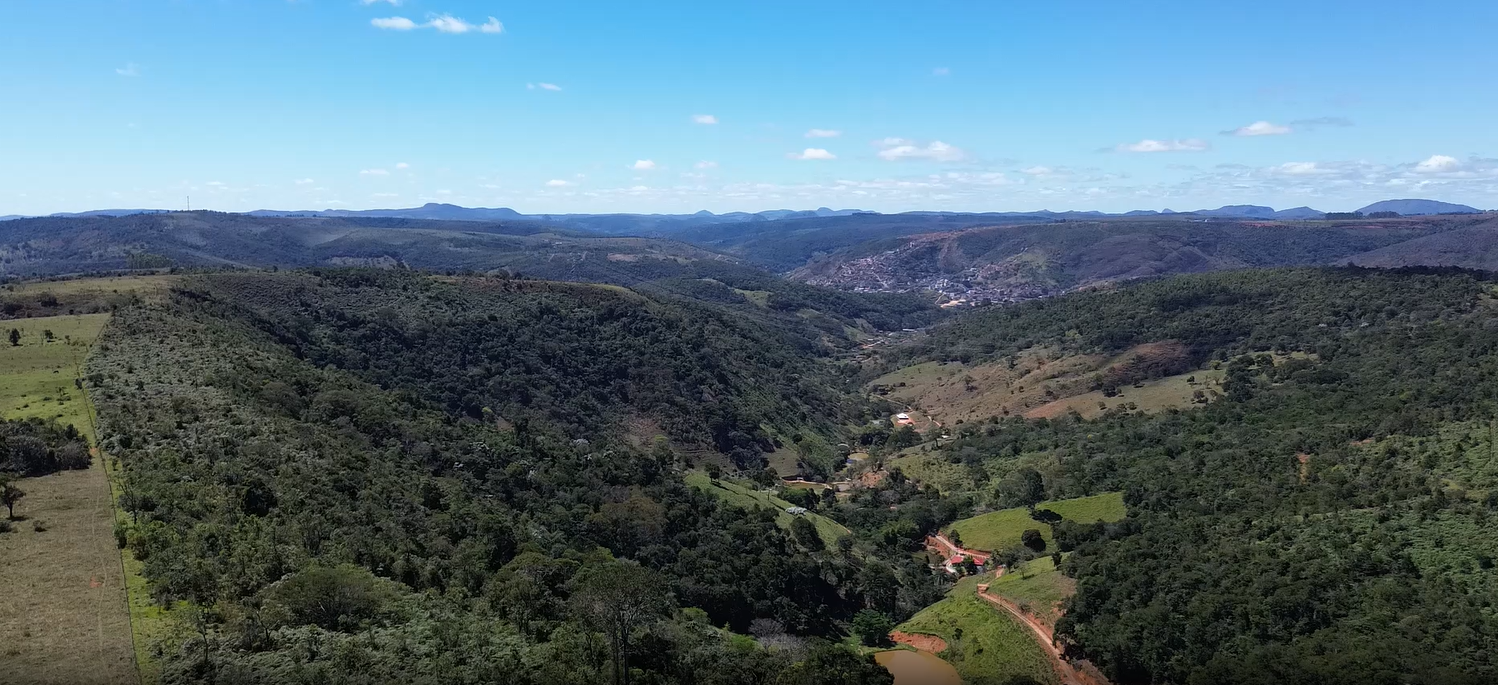
CK Gold lies about 20 minutes west of Cheyenne near Interstate 80, on Wyoming state land with a 2.1% royalty. Bee took the project from environmental baseline monitoring through permit applications, and by the end of 2024 it held its main approvals. The Mine Operating Permit was approved in April 2024 on a 10-year renewable term, and the air quality permit followed in November 2024.
The mine plan is a truck-and-shovel open pit feeding a flotation plant that produces a copper-gold concentrate for sale to smelters. The deposit is part of the Silver Crown Mining District, established in 1881, where early miners put visible gold and copper ore through stamp mills. CK Gold is designed to process 20,000 tons per day over an 11-year mine life.
Interview with George Bee, President & CEO of U.S. Gold Corp.
Feasibility Study Economics & Gold Price Sensitivity
The March 2026 feasibility study, prepared by Halyard-Micon International, covers what Bee called the first portion of the deposit's value. Proven and probable reserves contain 1.02 million ounces (Moz) of gold, 260 million pounds (Mlb) of copper and 3 Moz of silver, or 1.598 Moz on a gold-equivalent basis.
At base-case prices of US$3,250 per ounce (oz) gold, US$4.50 per pound copper and US$40/oz silver, the study shows an after-tax net present value at a 5% discount rate (NPV5%) of US$632 million, a 27% after-tax internal rate of return (IRR) and a 2.5-year payback. Initial capital is US$394 million including contingency, with US$35 million in sustaining capital. Output averages 85,000 gold-equivalent ounces a year over the mine life and 102,000 ounces in years 2 through 8. Bee put annual production above 100,000 gold-equivalent ounces.
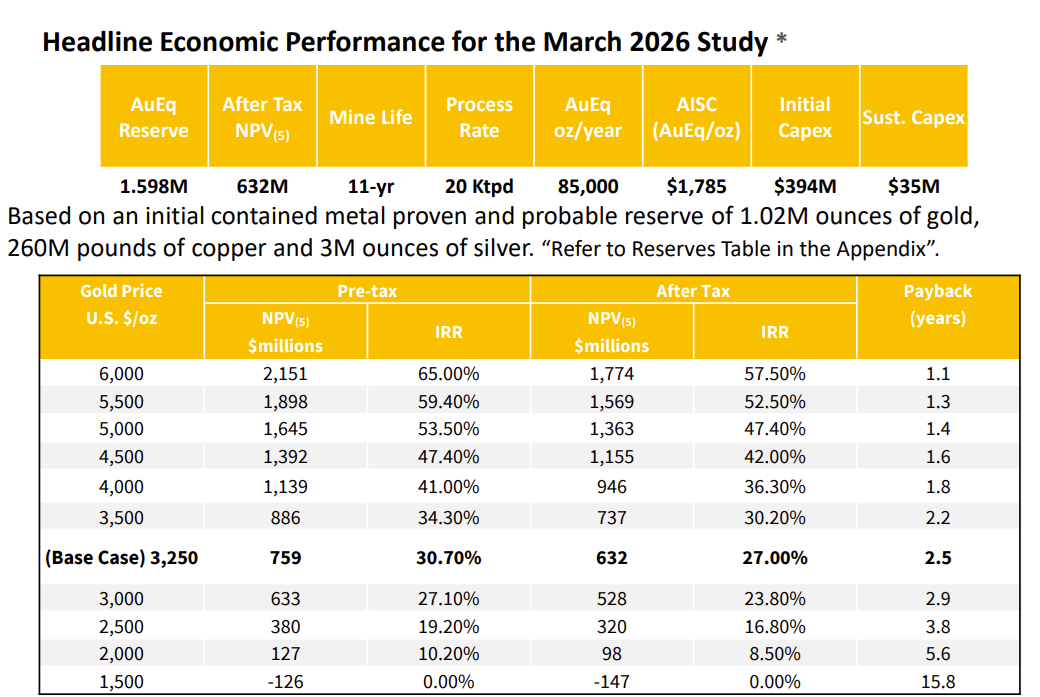
The study's sensitivity table shows how far the economics move with gold. At US$4,000/oz, the after-tax NPV5% rises to US$946 million with a 36.3% IRR. At US$4,500/oz, it reaches US$1,155 million with a 42% IRR and a 1.6-year payback. Resources exclusive of reserves add 590,000 gold-equivalent ounces in the measured and indicated categories and 677,000 inferred, and Bee said a US$3,000/oz gold price brings all of the measured and indicated material into the pit. He also pointed to longer-term options to improve gold recovery, which averages 71.5% in the study, and to sell aggregate from waste rock.
A Debt-Led Capital Stack Built on Offtaker Demand
Bee's financing plan starts with the product. CK Gold's concentrate carries a high precious metal content and few deleterious elements such as arsenic or mercury, which draw smelter penalties. Cleaner concentrate earns higher payables, and Bee said smelters can blend it with lower-grade concentrates to build an acceptable feed. With copper concentrate supply constrained, offtakers have offered debt packages and some potential lead orders on an equity component.
President and Chief Executive Officer of U.S. Gold Corp, George Bee, said investors have misjudged how the company will fund the build:
"One of the distressing things that we've found is that we see people under the notion that we would essentially blow up the cap table by equity financing. We don't need to do that. There's money out there, be it debt from offtakers or people interested in the project."
Bee said the company aims to place 60% to 70% of the cost in a debt package, which would shrink the equity portion. U.S. Gold Corp has an effective US$150 million shelf, but Bee said the current share price does not suit an equity raise. The stock traded as high as US$23.75 over the 52 weeks to October 2026, and Bee said analyst consensus targets are in the mid-US$20s.
Execution: Owner's Team, Contract Mining & a Paused Start
U.S. Gold Corp began early construction on the mine access road, then stopped. Bee said work will not resume until the whole capital stack is in place, so the company does not drain its treasury mid-build and return to the market short of funds. He said the cash covers at least a year at the current burn rate.
Most of the US$394 million goes to the processing plant. The company plans to bring in a mining contractor, which would start with civil works and earthworks and then move into contract mining. Bee said people he has worked with in the past are waiting to fill an owner's team. Halyard Micon International is assembling a group that can execute in the US.
Financing is the main open risk. No definitive agreement has been signed, and at US$2,500/oz gold the study's after-tax NPV5% falls to US$320 million. The Industrial Siting Permit is extended through December 2027, so a long delay would bring a renewal, and Bee said permits can be renewed without difficulty.
A 100,000-Ounce Producer Sized for Mid-Tier Portfolios
Bee said an asset of CK Gold's size does not change results for the largest miners, which look for producers of 0.5 to 1 Moz a year. It fits emerging juniors and mid-tier companies producing between 500,000 ounces and 3 Moz a year, many of which hold cash and need to replace depleted reserves.
He framed the appeal around jurisdiction. CK Gold is fully permitted in a state where the company knows the rules, with roads, rail and water already established. Companies with assets in higher-risk regions may want North American exposure, and the NASDAQ listing opens the stock to US investors. Bee said he has no control over takeover interest and that his focus is on financing and development. He said the company has no interest in a transaction at current prices.
Exploration Funded From Future Cash Flow
Before Bee joined and the company turned to CK Gold, the Keystone project in Nevada was its main target. Keystone covers about 20 square miles on the Cortez Trend, 11 miles from Nevada Gold Mines' Cortez complex, which has more than 51 Moz of gold produced or in reserves and resources.
Bee said Keystone shares Cortez's host rock, the Wenban limestone unit, along with the Eocene intrusive rocks linked to mineralisation there. Strong surface arsenic anomalies, a pathfinder element, point to deeper gold, which Bee sees as the larger opportunity beyond near-surface oxides suited to heap leaching. The company completed its geophysical work at low cost and ran the full dataset through the VRIFY AI platform, which ranked Greenstone Gulch as the primary drill target.
Current cash is reserved for CK Gold. Bee said the company would consider a partner for Keystone and the Challis Gold project in Idaho, or a spin-out into a separate entity. He also described an organic route, with CK Gold cash flow funding Keystone drilling after payback.
The Investment Thesis for U.S. Gold Corp
- U.S. Gold Corp holds all major permits for CK Gold on Wyoming state land, and its feasibility study shows an after-tax net present value of US$632 million at a 5% discount rate against initial capital of US$394 million.
- Management is targeting 60% to 70% of construction funding from debt, with offtakers interested because the concentrate is high in precious metals and low in penalty elements.
- Monitor for a definitive debt or offtake agreement, because construction stays paused until the full financing package is secured.
- At US$4,500 per ounce gold, the after-tax net present value rises to US$1,155 million and payback falls to 1.6 years, so project value moves strongly with the gold price in both directions.
- Resources exclusive of reserves, improved gold recovery and aggregate sales are not counted in reserve economics and represent possible additions.
- Keystone moving to a partnership or a spin-out would give the Nevada ground a separate value without drawing on CK Gold funds.
The case for U.S. Gold Corp depends on closing debt-led financing on acceptable terms. Permits, engineering and the offtake interest Bee described are already in place.
Macro Thematic Analysis
Mid-tier gold producers have spent several years mining through their reserves while gold, copper and silver prices rose. Bee said that has left many with cash on hand and reserves to replace. He argued that a fully permitted North American asset producing about 100,000 gold-equivalent ounces a year lets such a producer add output in a jurisdiction where the rules are known.
Bee summarised the acquirer's position:
"These folks have been depleting their assets over a number of years. Gold, copper and silver prices have been great. They've got cash on hand. They need to replace their reserves. So obviously, with the profile that we've got, we're an acquisition target."
Copper adds a second line of demand. Bee described copper as a strategic metal that everybody needs, and he said smelters seeking clean feed are prepared to fund new supply through offtake-linked debt. CK Gold's 260 Mlb of copper in reserves gives the project access to that pool of capital.
The recent pullback in gold and copper prices weighed on a basket of developer stocks, U.S. Gold Corp included. Bee said nothing has changed at the project, which remains fully permitted. The company's market capitalisation was US$245.6 million in October 2026.
TL;DR
U.S. Gold Corp's CK Gold project in Wyoming holds all major permits and a March 2026 feasibility study showing a US$632 million after-tax net present value at a 5% discount rate, a 27% internal rate of return and a 2.5-year payback on US$394 million initial capital at US$3,250 per ounce gold. George Bee said the company is targeting 60% to 70% of funding from debt, with smelters and offtakers drawn by a clean, precious-metal-rich concentrate. Indicative offers are unsigned, construction is paused until the full capital stack is secured, and Bee said the share price does not suit an equity raise. Mid-tier producers needing reserves are the likely acquirers, and Keystone in Nevada offers partner or spin-out optionality.
FAQs (AI-Generated)
Analyst's Notes





Subscribe to Our Channel



Stay Informed


