TRX Gold's Self-Funded Mill Build Aims to Triple Gold Output by Late 2027


TRX Gold targets an 80,000-100,000 oz run rate as a self-funded 3,500 tpd plant joins Buckreef's 2,000 tpd circuit. Updated PEA due early 2027.
- TRX Gold Corp. produced 29,650 ounces of gold at its Buckreef Gold Project in Tanzania in fiscal 2026, including a record fourth quarter of 8,173 ounces.
- The company is building a 3,500 tonnes per day (tpd) plant beside its existing 2,000 tpd plant at Buckreef, funded from operating cash flow.
- Management is targeting a run rate of 80,000 to 100,000 ounces of gold a year once most of the Buckreef expansion is complete in late 2027.
- An updated Preliminary Economic Assessment (PEA) targeted for around January or February 2027 will apply a lower cutoff grade that extends open pit mining at Buckreef.
- TRX Gold trades at 0.55x price to net asset value (P/NAV), below the 0.67x average for its producer and developer peers.
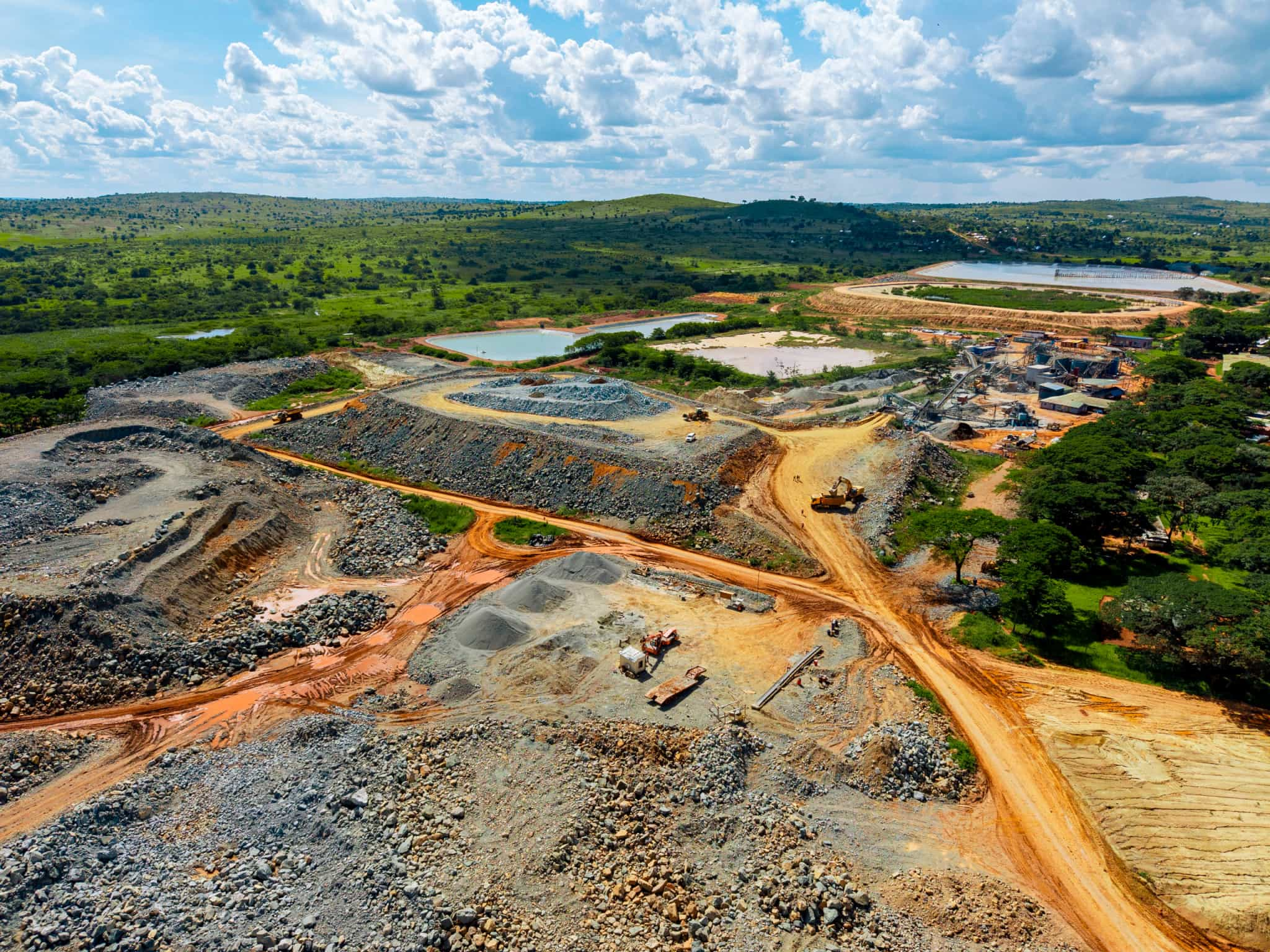
TRX Gold Corp. (NYSE American:TRX | TSX:TRX) is entering the period in which its largest self-funded expansion is scheduled to reach the mill. The company operates the Buckreef Gold Project in Tanzania's Geita District through a joint venture in which it holds 55% and STAMICO, the state mining company, holds 45%. Buckreef produced 29,650 ounces of gold in fiscal 2026, the year ended August 31, 2026, including a record fourth quarter of 8,173 ounces.
In a November 2026 interview with Crux Investor, management described the path from roughly 30,000 ounces a year to a run rate of 80,000 to 100,000 ounces. A new 3,500 tonnes per day (tpd) plant is being built beside the existing 2,000 tpd plant, for combined nameplate capacity of 5,500 tpd. The company is targeting completion of most of that work by late 2027, funded from operating cash flow, with an updated study on the larger operation targeted for around January or February 2027.
Fiscal 2027 Holds Steady, New Plant Ramps
The existing 2,000 tpd plant limits how much ore Buckreef can process until the new circuit is running. Management is targeting fiscal 2027 production in the same range as fiscal 2026, at around 30,000 ounces. Quarterly output will be uneven because Buckreef is a single asset.
The first quarter of fiscal 2027 includes most of the stage two waste strip and an upgrade to the existing plant, so it is planned as the weakest quarter of the year. Higher-grade stage two ore is scheduled to reach the mill around the end of the second quarter or the start of the third, when quarterly output is targeted to rise again. Both effects are planned.
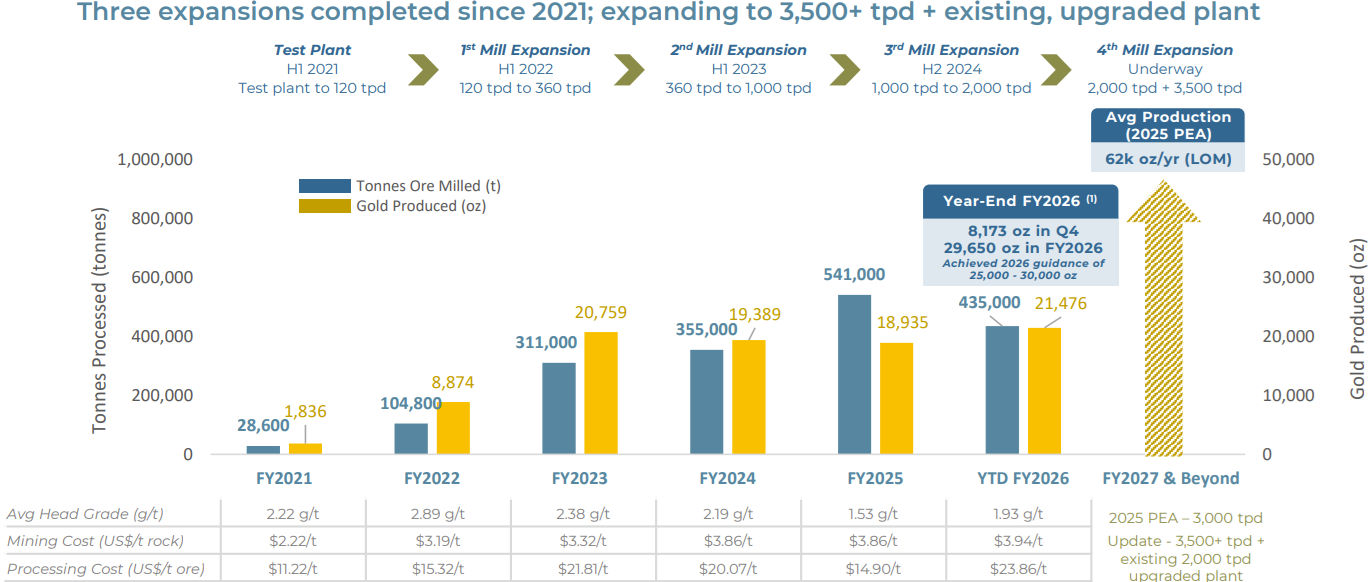
Management does not plan to reach the full 5,500 tpd in the first year of operation, since mining rates must ramp with the contractor on site. First-year throughput is targeted at around 4,250 to 4,500 tpd, against the 3,000 tpd modelled in the 2025 Preliminary Economic Assessment (PEA). The mine plan increases ore delivery in stages, with a higher strip ratio as more material moves to the mill.
Three Expansions of Operating Data
TRX Gold has scaled Buckreef in steps since 2021: a 120 tpd test plant in the first half of 2021, 360 tpd in the first half of 2022, 1,000 tpd in the first half of 2023 and 2,000 tpd in the second half of 2024. The company reports all three mill expansions as completed on time and on budget. Annual gold production rose from 1,836 ounces in fiscal 2021 to 29,650 ounces in fiscal 2026.
Those stages produced operating data that a study alone cannot supply. Chief Executive Officer of TRX Gold, Stephen Mullowney, said building in increments lowers risk in the people and metallurgy behind the plant as well as on the balance sheet:
"There's a lot of de-risking in that, in the fact that you got to grow your human capital, which can be bumpy. You got to understand metallurgy. Studies are great, but the actual results are better."
The results show in recent quarters. Gold recovery reached 84.9% in the third quarter of fiscal 2026, up from 67% a year earlier, and record quarterly throughput of 1,690 tpd was 16% higher year on year. The new circuit will treat ore whose metallurgical behavior the site team has measured at production scale over several years.
Updated Study: Lower Cutoff Grade, Longer Open Pit
The updated PEA, now targeted for around January or February 2027, will add recent drill results and the larger plant.
The company plans to lower the cutoff grade given current gold prices. That reduces feed grade somewhat but increases cash flow, and it extends open pit mining by roughly 1 to 2.5 years beyond the 2025 study before underground development begins. Mullowney estimated the open pit could supply 200,000 to 300,000 ounces at the targeted run rate, while stressing that the work is incomplete and the figures are not final. Underground timing stays flexible, and the company can go underground earlier if the plant needs feed.
The 2025 PEA, at 3,000 tpd and US$4,000 per ounce gold, modelled average annual production of 61,700 ounces, average earnings before interest, taxes, depreciation and amortization (EBITDA) of US$176.3 million with a peak of US$284.7 million in year 5, and a pre-tax net present value at a 5% discount rate of US$1,878.5 million.
Interview with Stephen Mullowney, Director & CEO of TRX Gold Corp.
Funding the Build From Cash Flow
Mullowney said the expansion is self-funded and the company remains comfortable after the recent pullback in gold prices. He put current cash costs at about US$1,600 to US$1,700 per ounce, close to the third-quarter figure of US$1,648 per ounce. He said TRX Gold generated about US$80 million of EBITDA in fiscal 2026 at an average gold price of roughly US$4,100 to US$4,300 per ounce, and that cash at the end of the fourth quarter was around US$30 million.
Borrowings stood at US$2.9 million at May 31, 2026, alongside US$40 million of supplemental liquidity from a US$25 million at-the-market facility and a US$15 million credit and gold prepayment facility. Mullowney said debt is an option, though he prefers borrowing once a company has cash flow. Since 2021, TRX Gold has invested US$90.5 million in Buckreef against US$19.1 million of original net capital raised and US$65.9 million of operating cash flow.
Mullowney contrasted this with a conventional route: a US$300 million build reaching scale in about 2 years, against US$50 million to US$75 million of upfront capital and 5 to 6 years to reach a similar point. He said the smaller-build model shortens payback and keeps the share count lower.
Growing the Numbers
Mullowney ties value creation to three multiples: EBITDA, price to net asset value (P/NAV) and resource ounces. He said US markets reward cash flow, revenue growth and EBITDA growth, and that TRX Gold's growth to date has come more from additional ounces than from the gold price.
The company trades at 3.0x enterprise value to 2027 estimated EBITDA against a producer average of 3.3x, and at 0.55x P/NAV against a producer and developer average of 0.67x, using share prices as of September 4, 2026. Drilling this year targets additions to a measured and indicated resource of 893,000 ounces at 2.57 grams per tonne (g/t) and an inferred resource of 726,000 ounces at 2.47 g/t, which would feed net asset value and earnings.
Mullowney acknowledged that African producers trade on lower multiples than North American peers, which the company cannot control. What it can control is the size of the underlying business, built with as little dilution as possible.
The Investment Thesis for TRX Gold
- TRX Gold produced 29,650 ounces of gold in fiscal 2026 and is funding a new 3,500 tonnes per day plant from operating cash flow, with borrowings of US$2.9 million at May 2026.
- Management is targeting a run rate of 80,000 to 100,000 ounces a year once most of the expansion is complete in late 2027.
- Fiscal 2027 production is targeted at around 30,000 ounces, with a weaker first quarter from pit stripping and a plant upgrade before higher-grade stage two ore arrives around mid-year.
- Monitor the updated Preliminary Economic Assessment, targeted for around January or February 2027, for the effect of a lower cutoff grade, an open pit extended by roughly 1 to 2.5 years and first-year throughput of around 4,250 to 4,500 tonnes per day.
- The company trades at 3.0x enterprise value to 2027 estimated earnings before interest, taxes, depreciation and amortization and 0.55x price to net asset value, below the peer averages of 3.3x and 0.67x.
- Three completed mill expansions and a gold recovery gain from 67% to 84.9% give management production-scale data for the new circuit, while commissioning, contractor ramp-up and diesel costs remain the main execution risks.
The case depends on the fourth expansion arriving on the same self-funded, on-budget basis as the three before it, with the updated study converting the larger plant into higher production and net asset value.
Macro Thematic Analysis
Tanzania's gold sector is drawing capital. There’s more than US$2 billion of mining mergers, acquisitions and initial public offerings in the country over the last 24 months, and a gold industry contributing around 10% of gross domestic product. Major producers operate in the same region as Buckreef, which is connected to the national power grid.
Mullowney distinguishes national headlines from day-to-day regulation. He pointed to permitting, labor supply and trade skills such as welding and concrete work:
"I've always separated what happens at the national political level and what happens at the operating level, and in the operating level I consider [it] less risky [than] North America, for instance. You can get your permits, a good labor supply there, the skill sets for welding, for concrete works, for all the things that you need to do."
Mullowney also cited Perseus Mining, which he said he believes will pour first gold in Tanzania in January and could reach 200,000 ounces within 18 months to 2 years. TRX Gold's route to 100,000 ounces takes about 5 years on far less upfront capital. The jurisdiction accommodates both a large upfront build and a staged one, and the staged route keeps the share count lower while the African discount persists in market multiples.
TL;DR:
TRX Gold produced 29,650 ounces of gold in fiscal 2026 at its Buckreef Gold Project in Tanzania. It is building a 3,500 tonnes per day (tpd) plant beside its existing 2,000 tpd plant, funded from operating cash flow. Management targets around 30,000 ounces in fiscal 2027, with a weak first quarter from stripping and a plant upgrade. It then targets a run rate of 80,000 to 100,000 ounces once most of the expansion is complete in late 2027. An updated Preliminary Economic Assessment around January or February 2027 will apply a lower cutoff grade that extends the open pit. The company trades at 0.55x price to net asset value against a 0.67x peer average.
FAQs (AI-Generated)
Analyst's Notes





Subscribe to Our Channel





Stay Informed