




Thistle Resources: 7 km Gold System, Ultra-High-Grade Antimony, and Fully Funded for Two Years


.webp)
Thistle Resources: diversified explorer with 7km gold system, ultra high-grade antimony at surface, VMS analog to Brunswick 12. Fully funded 2yrs in Canada's Bathurst Camp.
- Thistle Resources is a newly public precious metals and critical minerals explorer operating five projects in New Brunswick's Bathurst Mining Camp, with three priority targets including the flagship Middle River Gold deposit, a VMS target, and the high-grade Brunswick Antimony project
- Middle River Gold features two distinct gold zones - an upper zone from surface to 130m with 7 km of mineralised folding largely undrilled, and a deeper 400m zone showing the "strongest conductive response measured in Bathurst Mining Camp" with only 400m of strike tested to date
- Brunswick Antimony hosts ultra high-grade mineralisation at surface (>10% antimony, 1,800 g/t silver, 2.5 g/t gold) located just 500m from the historic Brunswick #12 mine, with antimony currently valued at $35,000-$55,000 per ton amid critical mineral supply concerns
- The company is fully funded for two years with exceptionally low drilling costs (~$100 CAD/meter), operates on 100% Crown land with 30-day permit turnaround, and has secured two drill rigs for continuous operations from July through December 2026
- Advanced geophysics from two independent firms (EarthEx and Abitibi Geophysics) have defined hundreds of drill targets across the portfolio, with the company targeting 2 million ounces at Middle River while maintaining optionality across gold, VMS, and critical mineral assets
Thistle Resources Inc. (TSXV:TRCG) represents a strategic entry point for investors seeking diversified exposure to both precious metals and critical minerals within one of Canada's most prolific mining districts. Founded in 2017 and recently listed on the TSX Venture Exchange, the company has assembled a portfolio of five projects in New Brunswick's Bathurst Mining Camp and Cape Breton, Nova Scotia. The timing of the company's public listing coincides with heightened market interest in both gold amid macroeconomic uncertainty and critical minerals - particularly antimony - as Western nations seek to reduce supply chain dependence on China. This combination positions Thistle at the intersection of two significant investment themes while operating in a jurisdiction known for supportive regulatory frameworks and established mining infrastructure.
Strategic Asset Prioritisation
Thistle's approach centers on three priority projects within its five-asset portfolio: the flagship Middle River Gold deposit, a large-scale volcanogenic massive sulfide (VMS) target, and the Brunswick Antimony project. This multi-commodity strategy provides multiple paths to value creation and de-risks the exploration process by avoiding dependence on a single asset or commodity.
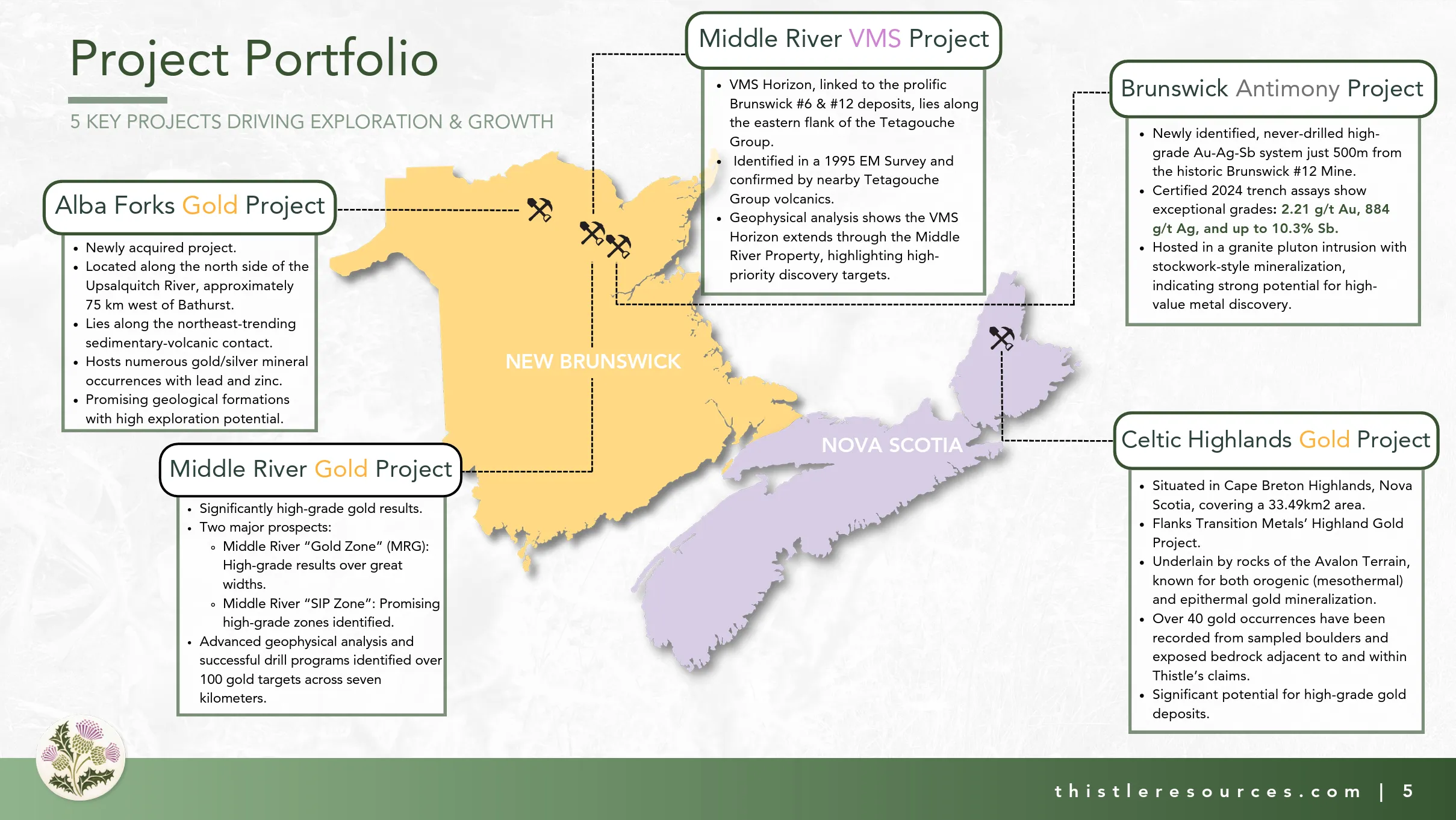
President and CEO Patrick Cruickshank explained the evolution:
"We founded the company in 2017. It started as just Middle River Gold. We acquired that project and then of course in Bathurst, New Brunswick, a world-famous VMS camp. So we started acquiring and growing our projects."
The company's two-year funded position allows management to execute systematically. For 2026, priorities include continued drilling at Middle River Gold and initial work at Brunswick Antimony, including UAV drone surveys and trenching. The larger VMS target is scheduled for 2027, reflecting a measured approach to capital deployment. The additional projects - Cape Breton Celtic Highlands (featuring gold, silver, platinum, palladium, and tungsten) and Alba Forks Gold - provide further optionality for future development or potential spin-out transactions.
Middle River Gold: Scale Potential in a Structurally Controlled System
The Middle River Gold deposit serves as Thistle's flagship asset and demonstrates significant expansion potential based on early-stage drilling and advanced geophysics. The system comprises two distinct zones: an upper zone extending from surface to approximately 130 meters depth, and a deeper zone at 400 meters that remains untested. To date, the company has drilled only 400 meters of what geophysics suggests is 7 kilometers of mineralised folding in the upper zone alone.
Early drilling results have been encouraging, with intercepts including 40 meters at 1.5 grams per ton gold over 120-meter widths. The consistency of gold intersections across widely spaced drill holes suggests continuity of mineralisation. Gary Lohman, COO & VP Exploration, noted the structural controls:
"The clustering of the gold, I mean this is structurally controlled. We've seen the rocks are silicified, there's carbonate. The critical mineral for identification here is the sulfides or pyrite or arsenopyrite and fuchsite or chrome mica."
What distinguishes Middle River is its magnetic signature - specifically, a magnetic low that caused the system to be overlooked during 50 years of previous exploration. Modern UAV drone magnetics have traced what the company calls the "S-Trend" - a sinuous pattern of magnetic lows extending seven kilometers on the property and continuing 15 kilometers northward, where historical trenches and soil geochemistry confirm gold occurrences.
Geophysical Targeting Confirms Deep Zone Potential
Thistle has invested heavily in geophysical surveys to define drill targets and build geological models. Two independent firms - EarthEx and Abitibi Geophysics - using different technologies reached the same interpretations, significantly increasing confidence in the targeting. The lower zone at 400 meters depth shows what has been characterised as "live chargeability," representing the strongest conductive response measured in the Bathurst Mining Camp.
The company's 3D modeling integrates multiple geophysical datasets, creating visual representations where higher chargeability responses appear as "mountains" in the digital terrain.
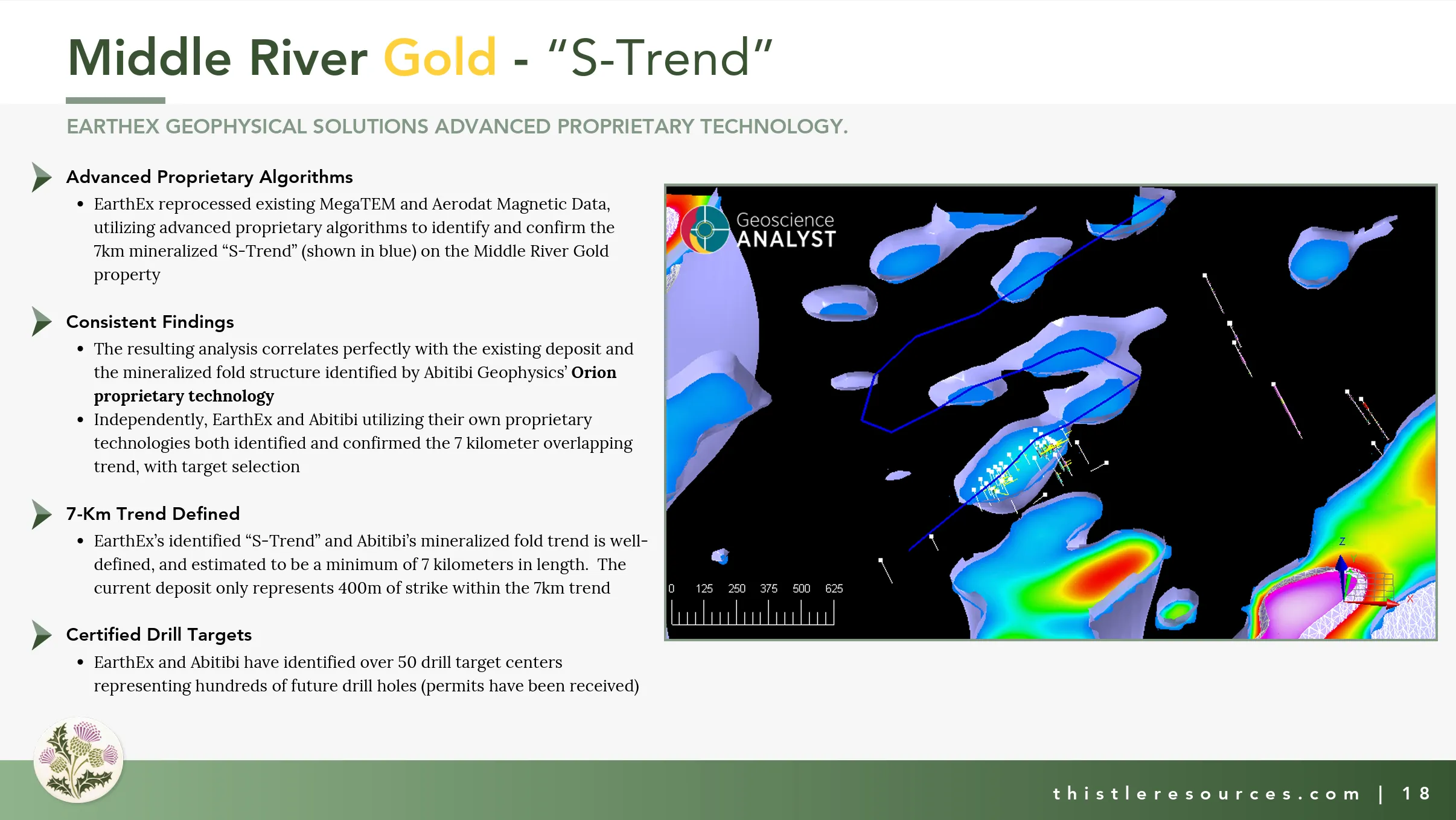
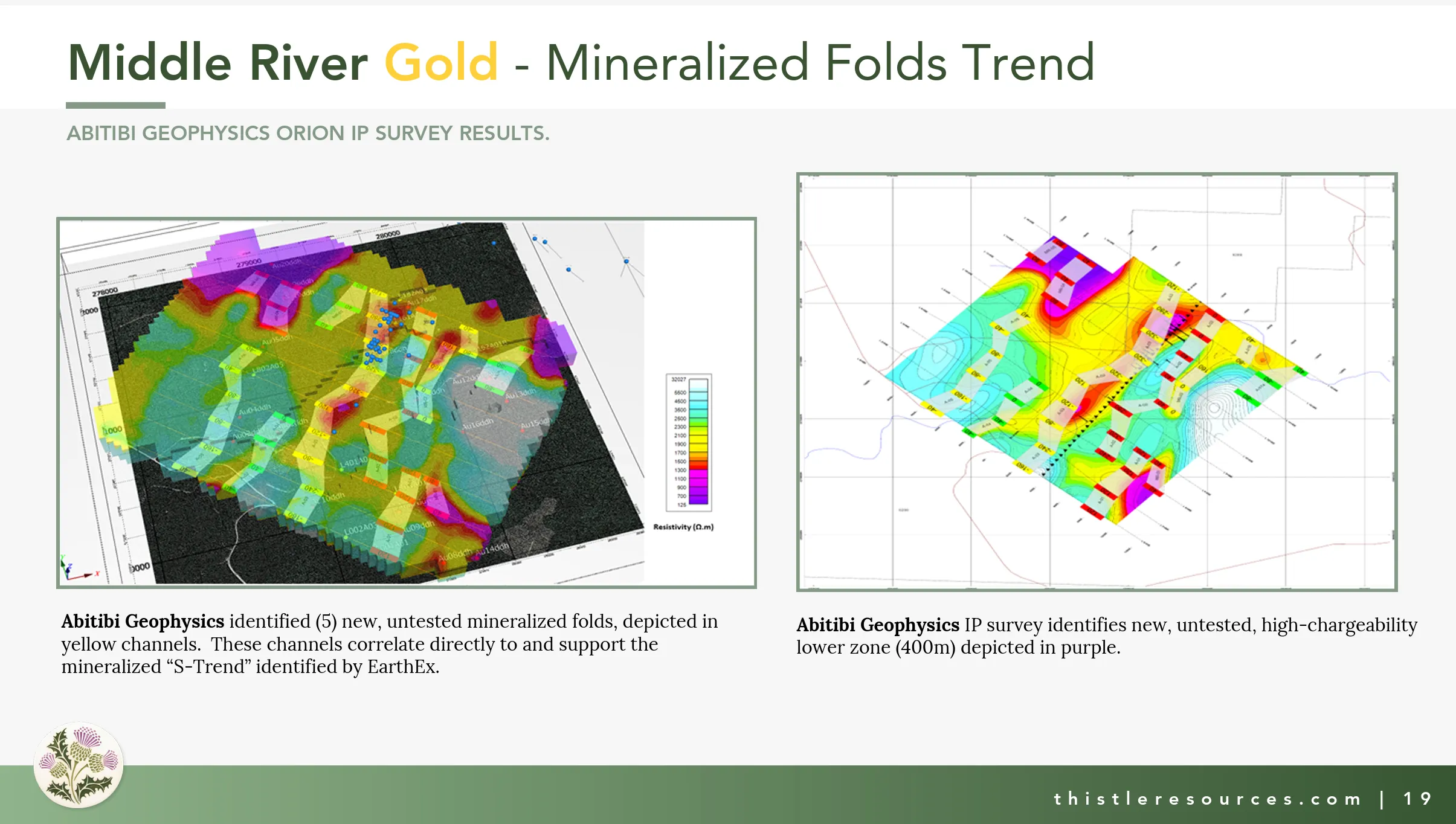
This deep zone presents significant exploration upside. The upper zone drilling to date has focused on relatively shallow targets (surface to 130 meters) where drilling costs average $100 Canadian per meter - exceptionally low by industry standards, translating to approximately $10,000 per hole. Testing the deeper 400-meter zone will require more capital but could substantially expand the resource envelope if the geophysical interpretations prove correct.
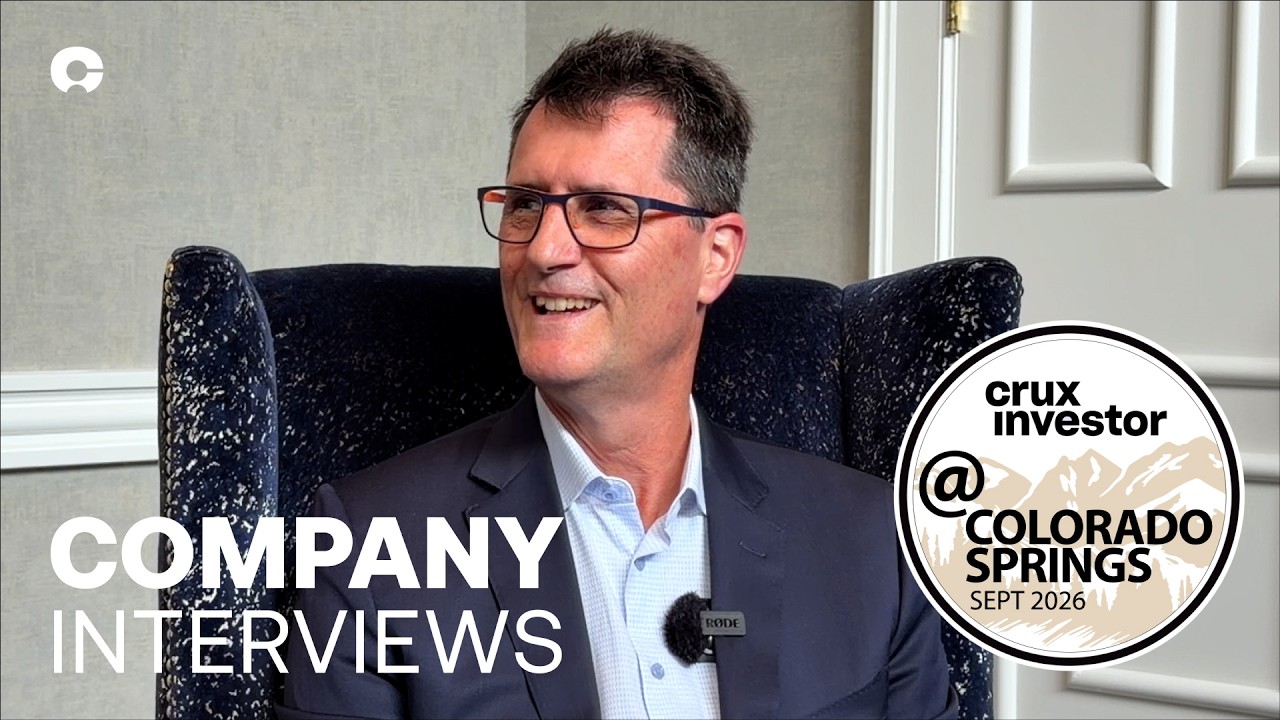
Interview with Gary Lohman, COO, and Patrick J. Cruickshank,CEO of Thistle Resources
Brunswick Antimony: Critical Minerals at Surface
The Brunswick Antimony project has emerged as a high-priority asset given current geopolitical dynamics around critical mineral supply chains. Located just 500 meters from the historic Brunswick #12 mine (which produced 335 million tons) and 800 meters from Brunswick #6 (105 million tons), the property benefits from proximity to world-class VMS infrastructure and geological knowledge.
The mineralisation is exceptional by any standard: greater than 10% antimony, up to 1,800 grams per ton silver, and 2.5 grams per ton gold - at bedrock, accessible through surface trenching. With antimony currently valued between $35,000 and $55,000 per ton and classified as a critical mineral by both Canadian and US governments, the economics are compelling even at small tonnages.
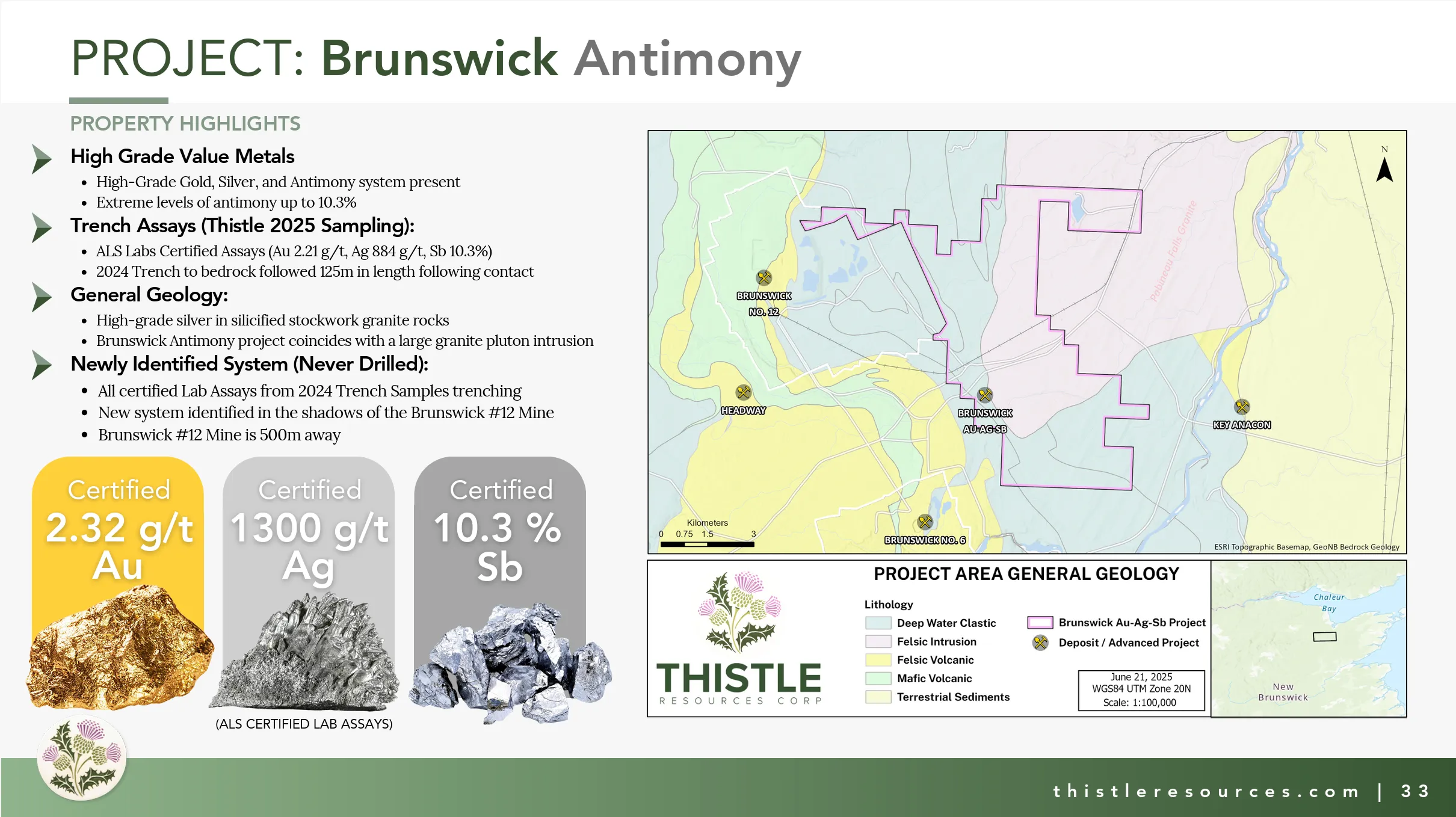
The project's 7-kilometer strike length potential remains largely unexplored. Planned UAV drone surveys will map the granite-sediment contact to guide trenching and drilling programs. Government support is tangible - the Lake George antimony mine, located 2.5 hours away, is being restarted, creating potential off-take scenarios and validating the strategic importance of domestic antimony production.
The VMS Opportunity: A Brunswick #12 Analog
Scheduled for drilling in 2027, Thistle's VMS target represents perhaps the highest-risk, highest-reward asset in the portfolio. The target measures 2 kilometers in length, dips at 17 degrees northward, and features the Brunswick Horizon running directly through its center with a folded nose structure. Cruickshank described it as "a carbon copy of the world-famous Brunswick #12."
The company has completed extensive geophysical work including electromagnetic grids, resulting in 10 drill-ready targets with Maxwell plate models prepared for depths of 500-700 meters. This represents the largest VMS target on the Brunswick Horizon in the Bathurst Mining Camp. Given the scale of the Brunswick #12 mine - one of Canada's most significant base metal producers historically - even a fraction of that scale would be transformative for Thistle.
The decision to defer VMS drilling to 2027 reflects capital discipline and the desire to advance nearer-term opportunities at Middle River and Brunswick Antimony first. This sequencing allows the company to build market awareness and potentially access capital markets at more favorable valuations as earlier-stage targets deliver results.
A Mining-Friendly Jurisdiction
Thistle operates in an exceptionally favorable jurisdiction. All properties sit on 100% Crown land, eliminating complications associated with private land acquisition or indigenous consultation requirements that can delay or derail projects in other regions. Permits are obtained within 30 days - a remarkable turnaround by Canadian standards.
Infrastructure access is excellent. The Brunswick Antimony project is accessible by SUV, while Middle River Gold sits just 5 kilometers from paved roads. The Bathurst area offers year-round drilling capability, avoiding the seasonal constraints that plague many Canadian exploration projects. Local service providers, including drilling contractors in Moncton (3 hours south), reduce mobilisation costs and support the local economy. Gary emphasised the community support:
"Being a mining community, it's exceptional. You've got the community behind you. The government's behind you. There's easy access not only due to prior work by the mining companies, [but also] forestry. Forestry's big in New Brunswick and we're getting into tens of thousands of kilometers of forestry access roads."
The combination of Crown land tenure, rapid permitting, established infrastructure, and community support creates an operating environment that minimises non-geological risk - a significant advantage over many emerging mining districts.
Funded Execution Strategy
Thistle has secured two drill rigs for deployment starting in July 2026, running through December. The initial container skid rig will be supplemented by a track-mounted rig better suited to the shallow drilling at Middle River, allowing faster setup times and lower operating costs. The company is fully funded for the next two years, eliminating near-term financing risk and allowing management to focus on execution rather than capital raising.
The drilling strategy at Middle River prioritises infill drilling on the first 400-500 meters of strike where initial success was achieved, spacing holes at 10-15 meter intervals to support resource estimation compliant with NI 43-101 standards. This systematic approach to resource definition should provide steady news flow and build confidence in the geological model before step-out drilling tests strike extensions and parallel zones.
At Brunswick Antimony, the 2026 program begins with non-invasive techniques - UAV drone magnetics to define the granite-sediment contact followed by trenching - before committing to drilling. This methodical approach reduces capital waste and provides additional geological information to guide higher-cost drilling decisions.
The Investment Thesis for Thistle Resources
- Diversified Commodity Exposure: Single equity provides exposure to gold (Middle River), base metals (VMS), and critical minerals (antimony, silver) reducing dependence on any single commodity price
- Exceptional Antimony Grade and Strategic Value: >10% antimony with 1,800 g/t silver at surface during critical mineral supply crisis; antimony valued $35,000-$55,000/ton with limited Western production
- Large-Scale Gold Potential: 7 km of mineralised folding at Middle River with only 400m drilled; deeper 400m zone showing "strongest conductive response in Bathurst Mining Camp" remains completely untested
- Capital Efficiency: $100 CAD per meter drilling cost (~$10,000 per hole) in shallow upper zone; fully funded for 2 years eliminates near-term dilution risk
- Multiple Discovery Catalysts: Three priority projects with drilling scheduled across 2026-2027 providing continuous news flow and multiple paths to value creation
- VMS Upside: 2 km target described as "carbon copy of Brunswick #12" (335M tons) scheduled for 2027; largest VMS target on Brunswick Horizon with 10 drill-ready targets
- Jurisdictional Advantage: 100% Crown land, 30-day permitting, year-round access, strong community support, and proximity to historic world-class mines in proven mining district
- Validated Geophysics: Two independent firms (EarthEx, Abitibi) using different technologies reached identical interpretations, de-risking target generation
- Near-Term Resource Definition: Systematic infill drilling at Middle River on 10-15m spacing supports NI 43-101 resource estimate while testing strike extensions
- Government Alignment: New Brunswick government supporting critical minerals development; Lake George antimony mine restart validates strategic importance and creates potential off-take
- Early-Stage Entry: Recently public company with market capitalisation likely below peers with comparable assets; limited analyst coverage creates information asymmetry opportunity
- Portfolio Optionality: Five projects create multiple exit strategies including potential spin-outs, joint ventures, or strategic sales of individual assets
Macro Thematic Analysis
The intersection of critical minerals policy and resource nationalism creates a structural tailwind for domestic North American antimony producers. China's export restrictions on antimony - used in flame retardants, batteries, and defense applications - have exposed Western supply chain vulnerabilities and driven prices from historical ranges of $10,000-15,000 per ton to current levels exceeding $35,000. Both Canadian and US governments have designated antimony as critical, with sovereign funds and stockpiling initiatives emerging. Thistle's Brunswick Antimony project, featuring >10% grades at surface just hours from the restarting Lake George facility, positions the company within this geopolitical realignment. As Cruickshank noted: "With the US and the Canadian critical mineral sovereign funds, there's a lot of support out there and stockpiling coming." The company's gold and VMS assets provide diversification, but the antimony exposure offers unique leverage to a supply-constrained, strategically important commodity where Western production is essentially non-existent.
TL;DR
Thistle Resources offers diversified exposure to gold, VMS base metals, and critical minerals antimony through five projects in New Brunswick's Bathurst Mining Camp, fully funded for two years with exceptionally low operating costs. The flagship Middle River Gold deposit shows 7 km of mineralised folding with only 400m drilled and a deeper untested zone displaying the strongest geophysical response in the camp, while Brunswick Antimony hosts ultra high-grade surface mineralisation (>10% antimony, 1,800 g/t silver) amid critical mineral supply constraints. Systematic drilling across three priority projects in 2026-2027 provides multiple near-term catalysts in a jurisdiction offering 30-day permitting, Crown land tenure, and strong government support.
FAQs (AI Generated)
Analyst's Notes





Subscribe to Our Channel




Stay Informed






















