




ValOre Targets Q4 PEA at Pedra Branca Amid Severe PGE Deficit


.jpg)
ValOre Metals CEO Nick Smart on Pedra Branca's 2.2Moz PGE-gold resource, metallurgical testwork and the Q4 2026 PEA amid a platinum supply deficit.
- ValOre's Pedra Branca resource has doubled since acquisition to 2.2 Moz 2PGE+Au, and more than 6,000 metres of later drilling has yet to be incorporated into the estimate.
- Platinum (+161% YoY) and palladium (+87% YoY) are rising against a multi-year supply deficit, with around 90% of global supply concentrated in three jurisdictions.
- Metallurgical testwork is comparing heap-leach and vessel processing routes, with the company targeting recoveries in the high 70% range.
- The company is targeting a Q4 2026 preliminary economic assessment (PEA), followed by licensing and an environmental impact assessment (EIA) in Q1 2027.
- ValOre's market capitalisation of around C$20 million sits well below those of PGE peers at comparable or more advanced project stages.
Platinum and palladium have spent 2026 doing what they haven't done in years: moving. Platinum is up 161% year-on-year and palladium 87%. Both metals are working through a multi-year supply deficit that has cut above-ground stocks by 42%, leaving under five months of coverage. Roughly 90% of global platinum group element (PGE) supply still comes from just three jurisdictions - South Africa, Zimbabwe and Russia - and all three face their own operational or geopolitical headwinds. Against that backdrop, ValOre Metals Corp. (TSXV:VO) is advancing one of the few PGE development projects outside southern Africa: the Pedra Branca platinum-palladium-gold project in Ceará State, Brazil. CEO Nick Smart sat down with Crux Investor to discuss the company's drilling, its metallurgical testwork and the PEA it is targeting for the end of 2026.
Platinum & Palladium: A Structural Supply Deficit
The investment case for PGEs rests on a demand base that has proven more durable than expected. Catalytic converters remain the principal driver of platinum and palladium demand. Hybrid vehicles are now the fastest-growing segment of global new vehicle sales, and they use 10-20% more PGEs than standard internal combustion engine vehicles. Several automakers have scaled back electric vehicle plans in favour of hybrids, so that demand pipeline has lengthened rather than shortened.
On the supply side, South Africa's ageing platinum operations face constrained electricity supply and rising diesel costs, while Russian supply carries its own operating risk. ValOre's investor materials cite World Platinum Investment Council data showing platinum in deficit through the rest of the decade, with the company putting the multi-year shortfall at 500-700 koz annually. Palladium is forecast to move into a modest surplus from 2027.
Project Overview: The Pedra Branca Resource
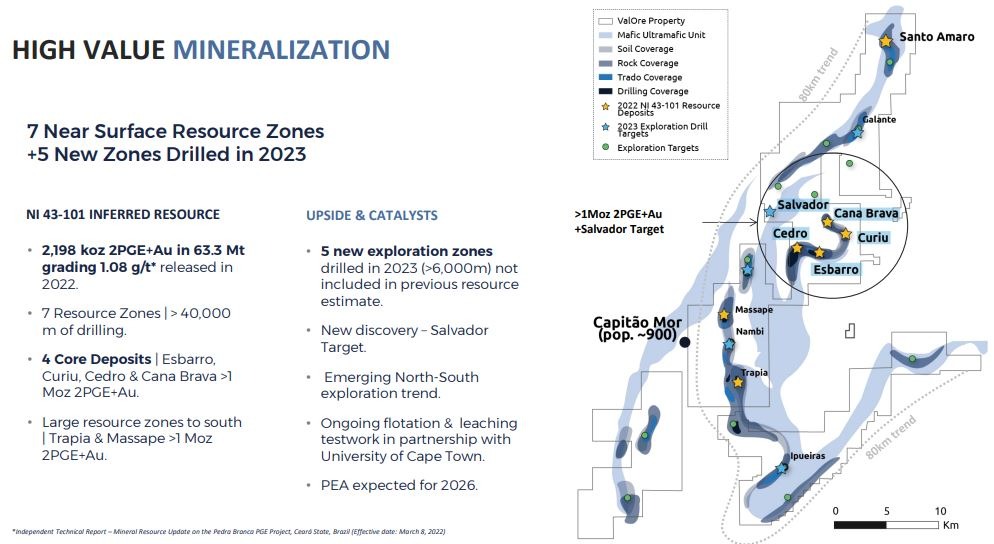
Pedra Branca is ValOre's 100%-owned, near-surface PGE-gold project. It spans 51,096 hectares and sits four hours by paved highway from Fortaleza's international port and airport. The company's 2022 National Instrument (NI) 43-101 inferred resource stands at 2,198 koz of platinum, palladium and gold (2PGE+Au) in 63.3 Mt grading 1.08 g/t, spread across seven resource zones. Four core deposits - Esbarro, Curiu, Cedro and Cana Brava - together hold more than 1 Moz 2PGE+Au. Two further zones to the south, Trapia and Massape, together also exceed 1 Moz.
The property carries a legacy advantage. It was previously explored by Anglo American and Anglo Platinum, and ValOre has built on their drilling data with a further US$10 million and 23,534 metres of its own drilling between 2020 and 2024. That work doubled the inferred resource from 1.1 Moz to 2.2 Moz. More than 6,000 metres drilled in 2023 across five new exploration zones sits outside the current estimate. That drilling is expected to feed an updated resource alongside the PEA.
"You could contextualise it in terms of economics: a 2 million ounce resource is something equivalent to perhaps a million ounces of gold, given the price difference between the two precious metals, and probably roughly similar all-in sustaining costs when you look at the processing and mining operations, depending on the setup."
Interview with Nick Smart, CEO, ValOre Metals Corp.
Metallurgy & the Route to a PEA
Metallurgical testwork has scaled up from one-litre shake flasks to stirred tank vessels, alongside column testing to assess heap-leach amenability. The project's weathered, oxidised material is harder to float, so a separate hydrometallurgical process is being developed for it. That material accounts for roughly 40% of contained ounces. The remaining 60% sits in fresh material suited to conventional flotation.
The company is targeting recoveries in the high 70% range, which Smart said is in line with expectations, with room to improve as the flowsheet is optimised. He described the trade-off the team is weighing. Heap leaching offers lower capital intensity but typically lower recoveries, while vessel processing recovers more at higher capital expenditure. The PEA is targeted for Q4 2026. It will assess those processing routes alongside throughput and scale options, and recommend a single preferred case for optimisation in later studies.
Competitive Positioning: Brazil's Emerging PGE Pipeline
ValOre sits within a small global set of PGE developers, and Brazil in particular has become a focal point. Bravo Mining Corp. (TSXV:BRVO), which is developing the Luanga project in Pará State, published its pre-feasibility study (PFS) in the week of the interview. Smart welcomed the milestone as validation for the sector rather than a competitive threat. Bravo is looking to establish a smelter complex within an export zone at the port of Barcarena to process PGE concentrate domestically. That could create an in-country outlet for Pedra Branca's future production. Smart said ValOre's marketability work at PEA stage is a global search, but a local processing option is one he would welcome.
"Brazil is a major end user, obviously with the automotive manufacturing sector that they've got within Brazil. For us, looking at it from our perspective, when we look at route to market, having a potential customer so close to us, up at the port of Barcarena in Pará State, that is logistically very attractive to us."
ValOre's presentation benchmarks the company against peers using market capitalisations as of 18 February:
- Bravo Mining was valued at C$440 million, at PEA stage at the time (recently announced their PFS).
- Platinum Group Metals Ltd. (TSX:PTM) was valued at C$389 million, with its Waterberg joint venture at definitive feasibility.
- Generation Mining Ltd. (TSX:GENM) was valued at C$236 million, with its Marathon project at feasibility.
- Stillwater Critical Minerals Corp. (TSXV:PGE) was valued at C$126 million, at resource estimate stage.
ValOre was valued at C$27 million on the same date and at around C$20 million as of 1 September 2026. The company attributes the gap largely to limited market awareness at this stage of the project's life.
Catalysts & Brazil as a Development Jurisdiction
Smart was explicit that Pedra Branca is unlikely to be developed as a single, maximum-scale build from day one. Instead, the company is favouring a step-wise approach: prove the process on an initial phase, secure licensing for that scope, and add further phases as the project is de-risked and cash flow builds.
"The most likely approach for us is a step-wise approach: develop it, prove the process, go down through a licensing route which allows us to open a phase one with the ability to add phases two and three in future."
That mirrors a broader shift among junior developers toward pulling production forward, rather than raising and drilling repeatedly to reach maximum scale before a construction decision.
Brazil's own mining sector is a tailwind. The country is a top-10 global gold producer, generating an estimated $3.8 billion annually, and is forecast to exceed $6 billion by 2030. It now graduates more mining engineers than the United States and Canada combined. Smart previously spent six years living in Brazil. He pointed to programmes linking Brazil's stock exchange (B3, formerly Bovespa) with the TSXV, and to a growing presence of Brazilian projects at international mining conferences. He also cited a developing national critical minerals framework aimed at fast-tracking permitting and licensing.
Investment Thesis for ValOre Metals
- Resource scale with room to grow: Pedra Branca hosts 2.2 Moz 2PGE+Au in the inferred category, double the resource at acquisition, and more than 6,000 metres of 2023 drilling across five new zones has yet to be incorporated.
- Near-surface, open-pit potential: The deposits sit near surface, so no deep-level underground development is required. That is a potential cost advantage over southern African PGE producers, which the PEA will need to test.
- Valuation gap versus peers: ValOre's market capitalisation of C$27 million in February compared with C$126 million for Stillwater Critical Minerals, the only peer in its presentation also at resource estimate stage.
- Clear 2026-2027 catalyst path: An updated resource estimate and the PEA are targeted for Q4 2026, with licensing and the EIA to follow in Q1 2027.
- Structural PGE tailwind: Platinum is forecast to remain in deficit through the rest of the decade, and automotive demand has been extended by the shift towards hybrid vehicles.
- Potential domestic route to market: Bravo Mining's proposed Barcarena smelter could offer an in-country buyer for Pedra Branca concentrate.
- Watch item: The high-70% recovery figure is a testwork-stage target rather than a final flowsheet result, so investors should track metallurgical results alongside the PEA.
Macro Thematic Analysis
The structural case for platinum and palladium is less about demand growth than about where new supply can realistically come from. Smart framed the concentration risk directly:
"You're talking about 90% of the world's supply coming from just three jurisdictions: South Africa, Zimbabwe and Russia. And all three of those jurisdictions have their own challenges."
Those challenges range from Russia's geopolitical isolation to South Africa's strained electricity and diesel supply. Several major platinum operations have also closed or been suspended since 2016. The concentration matters more because demand has proven sticky. Catalytic converters remain the dominant use, and the slower-than-expected shift to battery electric vehicles has extended that demand rather than displacing it.
Layered onto that is a smaller but symbolically important shift in investment and jewellery demand. Physical platinum bar and coin demand in China has grown from near zero in 2019 to over 400 koz in 2025. ValOre's materials estimate that switching just 1% of gold jewellery demand to platinum would double the metal's annual deficit. In a market this concentrated, new supply from a stable, near-surface, non-African jurisdiction could command a scarcity premium. That is the strategic position ValOre is aiming to occupy with Pedra Branca.
TL;DR
ValOre Metals is advancing its 100%-owned Pedra Branca platinum-palladium-gold project in Ceará, Brazil, one of the few PGE developments outside southern Africa. Platinum and palladium prices have climbed sharply against a multi-year supply deficit and highly concentrated global supply. The company's 2022 inferred resource of 2.2 Moz 2PGE+Au has already doubled since acquisition, with more than 6,000 metres of additional drilling still to be folded into an updated estimate. CEO Nick Smart is targeting a PEA for Q4 2026. The team is weighing heap-leach versus vessel processing for the project's weathered ore, and is pursuing a phased development path designed to bring production forward rather than maximise scale from day one. ValOre's market capitalisation of around C$20 million is well below peers at similar or more advanced stages, and the PEA is its next major opportunity to close that gap.
FAQ (AI Generated)
Analyst's Notes





Subscribe to Our Channel

.png)




Stay Informed


