




Viridis Advances Toward FID as Colossus Sets Benchmark in Rare Earth Grade, Scale, and Financing


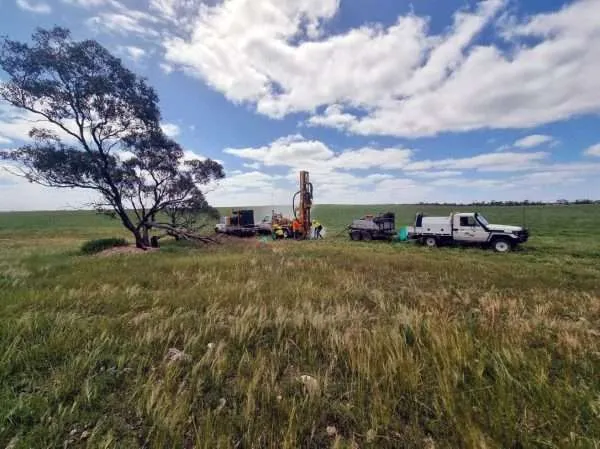
VMM: Colossus rare earth project hits highest-grade global resource, ships first MREC, inks Solvay LoI. FID targeted Q3'26. Western supply chain play.
- Colossus now hosts a 473Mt Mineral Resource @ 2,505ppm TREO / 592ppm MREO, including a Measured Resource of 31Mt @ 2,858ppm TREO / 758ppm MREO - the highest-grade Measured MREO resource of any Ionic Adsorption Clay (IAC) project globally, converted specifically to de-risk debt financing and reserve conversion.
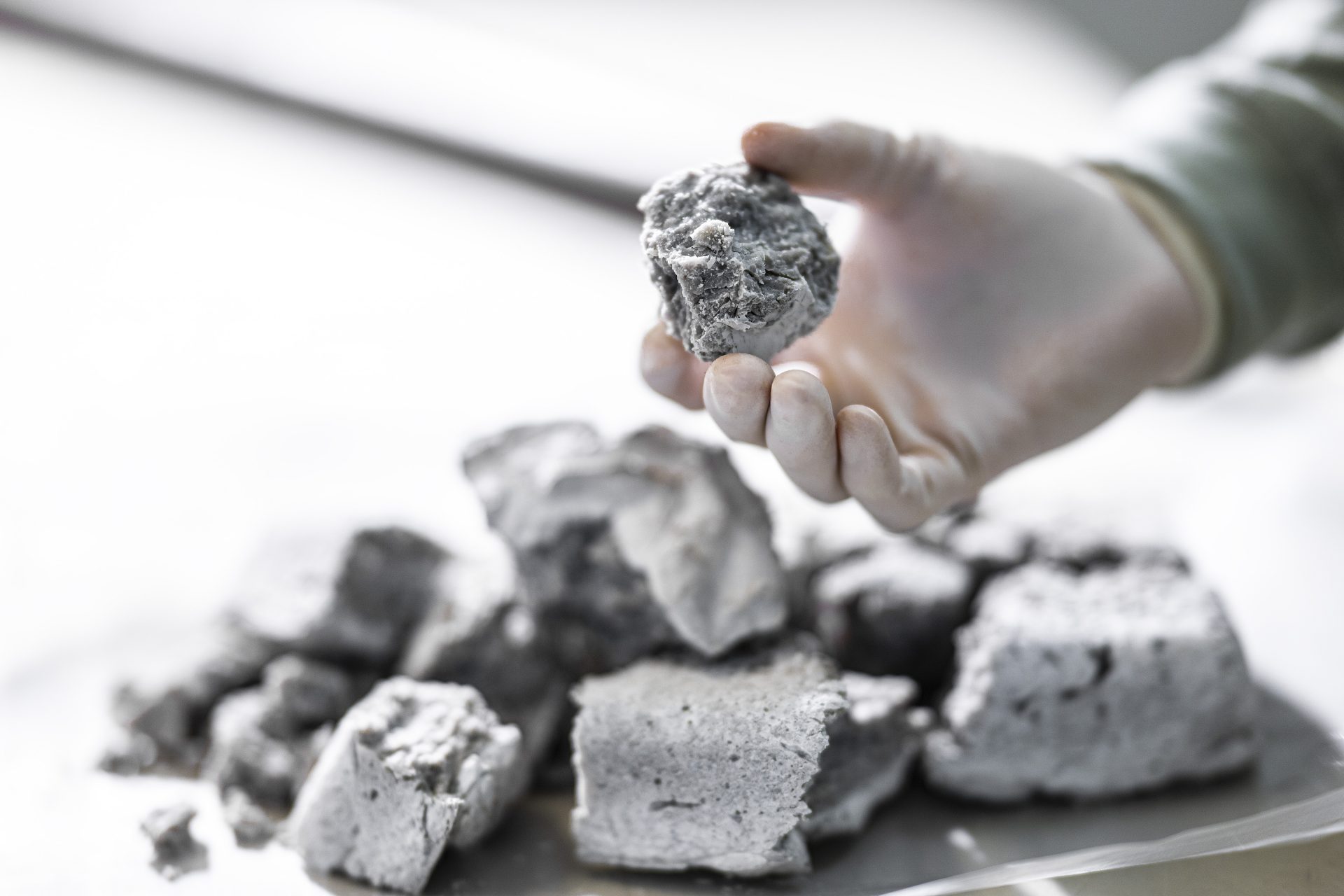
- Viridis has produced its first Mixed Rare Earth Carbonate (MREC) from a 100kg/hr Demonstration Plant - believed to be the largest semi-industrial, continuous-operation ionic clay processing facility outside China - directly enabling qualification samples for offtake partners.
- A binding Letter of Intent for a strategic offtake and technical partnership with Solvay (signed 2 June 2026) is progressing toward a definitive binding agreement targeted for Q3 2026, positioning Colossus product inside a European industrial rare earth value chain.
- Funding commitments include a US$30M binding placement from Ore Investments/Régia Capital (Brazilian Strategic Minerals Fund consortium), up to US$100M LOI from Export Development Canada, and up to US$50M Letter of Support from EFA - alongside a landmark site visit from EU Commissioner for International Partnerships Jozef Síkela, the sole critical minerals site visited during the EU-Brazil Investment Forum mission.
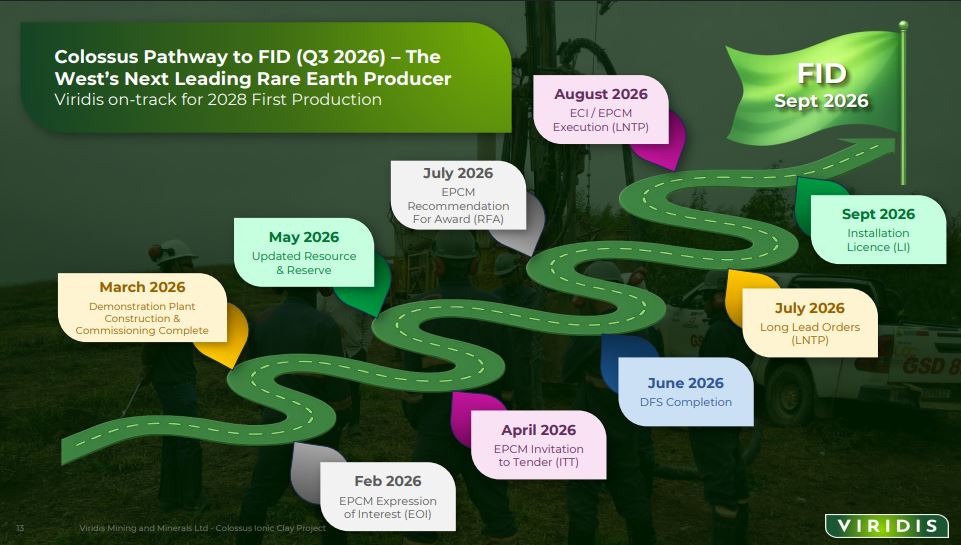
- With PFS economics of NPV8 US$1.41B, 43% IRR, US$358M capital intensity and a 2.0-year payback, combined with Installation Licence submission, transmission infrastructure contracted, and DFS due August 2026, Viridis is tracking toward FID in Q3/2H 2026 and first production in H1 2028.
The global rare earth market remains structurally distorted by concentration: China and Brazil together account for approximately 71% of global rare earth reserves, but China retains overwhelming dominance in processing, separation, and magnet-grade oxide production. This asymmetry - reserves versus refining capacity - has become a first-order strategic concern for Western governments as demand for neodymium, praseodymium, dysprosium and terbium (the "magnet rare earths," or MREO) accelerates across electric vehicles, wind turbines, defense systems, and electronics. The European Union's Critical Raw Materials Act and parallel U.S., Canadian, and allied initiatives explicitly target diversification of supply away from concentrated, single-country processing chains, extending support not merely to mine development but to integrated extraction-to-oxide value chains located in trusted jurisdictions.
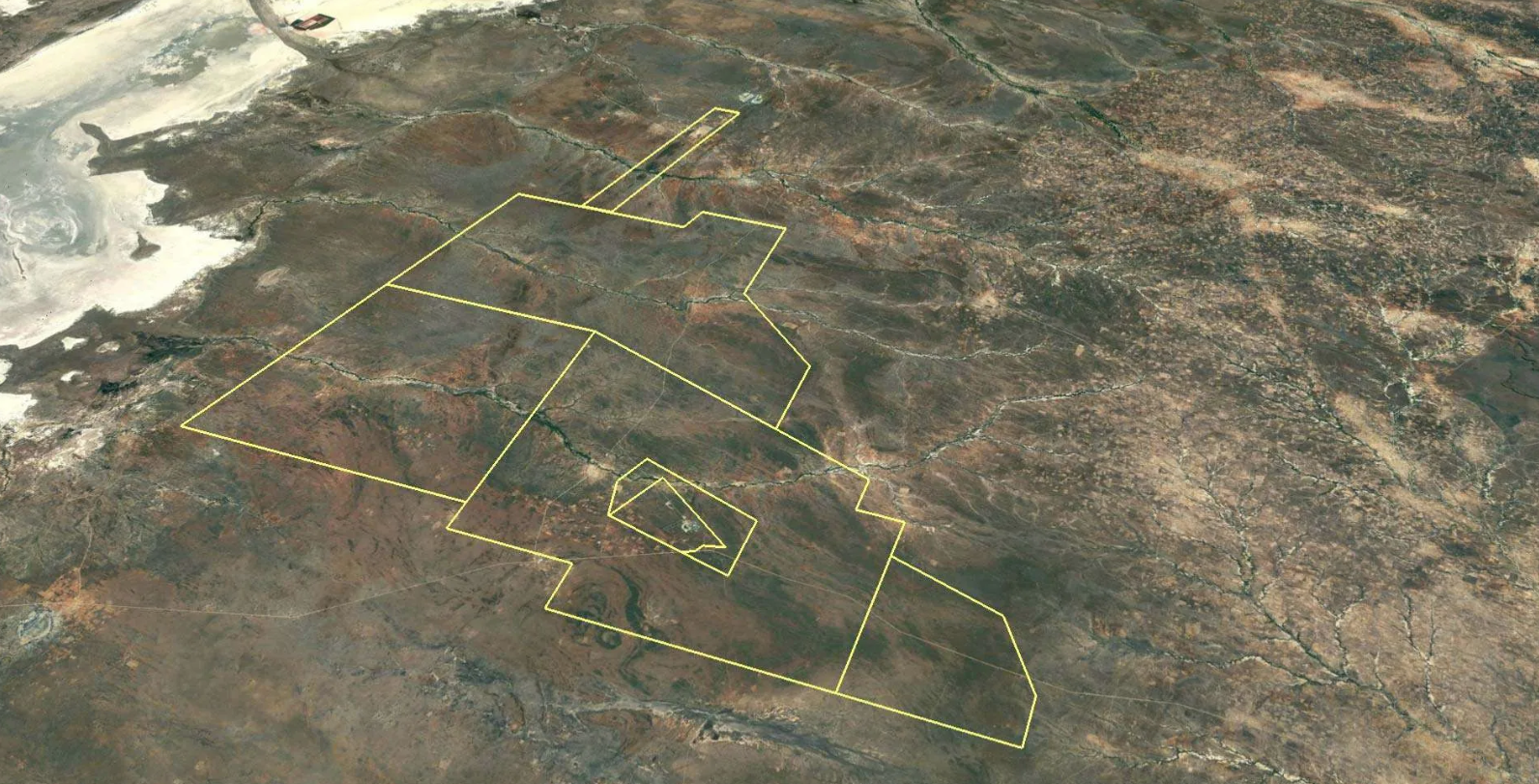
Brazil, holding the world's second-largest rare earth reserve base, is emerging as a primary beneficiary of this realignment - provided its resource base can be converted into bankable, ESG-compliant, processed product. It is within this context that Viridis' Colossus Project, located in the historically productive Poços de Caldas Alkaline Complex in Minas Gerais, has transitioned from a regional exploration story into a geopolitically relevant asset. The direct site visit by EU Commissioner for International Partnerships Jozef Síkela in June 2026 - during which Colossus was designated the sole critical minerals project visited across the EU's entire Brazil mission - is a material data point: it confirms that European policymakers view Colossus not as one of many rare earth prospects, but as a specific candidate for structured support mechanisms tied to supply chain resilience and investment certainty.
The Solvay Partnership
The 2 June 2026 execution of a strategic offtake and technical partnership Letter of Intent with Solvay - a leading European specialty chemicals group with established rare earth separation capability - represents the single most consequential commercial development in Viridis' evolution to date. Unlike a conventional offtake agreement, this partnership carries a technical services dimension, meaning Solvay is actively engaged in qualifying Colossus MREC product against its own downstream processing specifications. The Company's demonstration plant is now producing MREC samples specifically for this qualification process, with a binding agreement targeted for Q3 2026 - the same quarter as targeted FID. This sequencing is not coincidental: a locked-in, technically validated offtake partner materially de-risks project financing discussions with export credit agencies and lenders, who require revenue certainty before committing capital to a novel jurisdiction and processing route. Solvay's involvement also implicitly validates Colossus product quality (impurity profile, MREO content, and consistency) at a level that generic resource statistics cannot convey to capital markets.
Downstream Processing Strategy
Viridis' decision to construct and commission a fully-owned, 100kg/hr semi-industrial Demonstration Plant - rather than a smaller pilot facility - reflects a deliberate strategy to capture margin and de-risk scale-up simultaneously. The plant replicates the PFS flowsheet precisely, producing MREC with reported recoveries of 76–78% MREO and TREO content up to 60% in the carbonate product, with MREO exceeding 39% - figures the Company positions as best-in-class globally. This is strategically significant for two reasons. First, moving beyond raw ore or unprocessed clay into an intermediate carbonate product captures materially higher realized value per tonne than a raw feedstock sale, while avoiding the far larger capital and technical burden of full separation into individual oxides. Second, it mitigates single-point supply chain risk: MREC is a tradeable, bankable intermediate product that can be sold to multiple downstream refiners (Solvay being the anchor, not the sole counterparty), rather than requiring Viridis to control the entire value chain internally. The parallel Viridion joint venture with Ionic Rare Earths for separation, refining, and recycling - including delivery of separated rare earth oxides sourced from decommissioned MRI machines and wind turbines to Latin America's only magnet manufacturer - further extends this downstream optionality without requiring Viridis to bear full separation capex risk directly.
Western Stakeholder & Offtake Strategy
The capital stack assembled to date is itself a strategic signal. Beyond the US$30M binding placement from the BNDES/Vale-selected Ore Investments and Régia Capital consortium, Viridis has secured Letters of Support and Intent from Export Development Canada (up to US$100M) and EFA (up to US$50M), alongside engagement from Bpifrance and BNDES - a coalition of North American, European, and Brazilian development finance institutions. This is a materially different funding profile than typical junior resource financing, and it directly mirrors the stated policy objective of Western governments: to finance critical mineral projects in allied and partner jurisdictions as an alternative to Chinese-controlled supply. The prioritization of Solvay as anchor offtake partner, rather than an Asian buyer, reinforces this positioning and should be read as a deliberate strategic choice to align Colossus cash flows with Western industrial demand, not merely the highest available spot bid.
Conclusion & Valuation Outlook
The PFS base case (NPV8 of US$1.41B, 43% IRR, US$358M capital cost, and a 2.0-year payback against a conservative US$90/kg NdPr price assumption) already implies a valuation materially above the Company's ~US$241M market capitalization as of February 2026, suggesting the market has yet to fully price in either the grade upgrades from the July 2026 resource update or the strategic premium associated with Western supply chain positioning. Execution risk remains the primary variable: the Company must still finalize the Ore Reserve update, complete the DFS (targeted August 2026), convert ECA letters of support into binding project debt facilities, execute the EPCM contract, and convert the Solvay LoI into a binding agreement - all within a compressed Q3 2026 window ahead of FID. Should these milestones land as guided, Colossus would be one of the few Western-aligned, non-Chinese rare earth projects with simultaneous scale, grade, financing, and offtake certainty - a combination that historically commands a valuation premium over peers still carrying single-point execution risk. Investors should treat the Q3 2026 catalyst cluster (DFS, Solvay binding agreement, EPCM award, debt financing close, FID) as the definitive re-rating window for the stock.
TL;DR
Viridis Mining and Minerals has progressed from a resource-stage explorer to a near-fully-funded rare earth developer with operating downstream infrastructure, evidenced by first MREC production, a binding Solvay technical and offtake partnership pathway, and direct engagement from EU policymakers seeking to diversify critical mineral supply away from China. The Colossus Project's combination of the world's highest-grade Measured & Indicated MREO resource, industry-leading recoveries, and the lowest capital intensity among global ionic clay peers underpins a PFS-derived post-tax economic case (US$1.41B NPV8, 43% IRR) that is increasingly being validated by sovereign-linked and export credit agency capital rather than speculative equity alone. The core investment thesis has shifted: Colossus is no longer simply a mining project competing on grade and tonnage, but a strategic node in the emerging Western rare earth supply architecture, where scarcity of non-Chinese MREO feedstock - not just geological scarcity - is the primary value driver. With Installation Licence submitted, transmission infrastructure contracted, and FID targeted for Q3 2026, the remaining catalysts are execution-driven rather than conceptual, materially compressing the risk premium historically applied to pre-production rare earth developers.
FAQs (AI Generated)
Analyst's Notes





Subscribe to Our Channel


Stay Informed



