Copper, Rare Earths, Uranium, Nickel: Eastport's Four-Metal Bet on Electrification


Eastport Critical Metals (TSX-V:EVI) advances a four-metal Botswana portfolio led by district-scale Matsitama copper, with rare earth assays pending at Semarule.
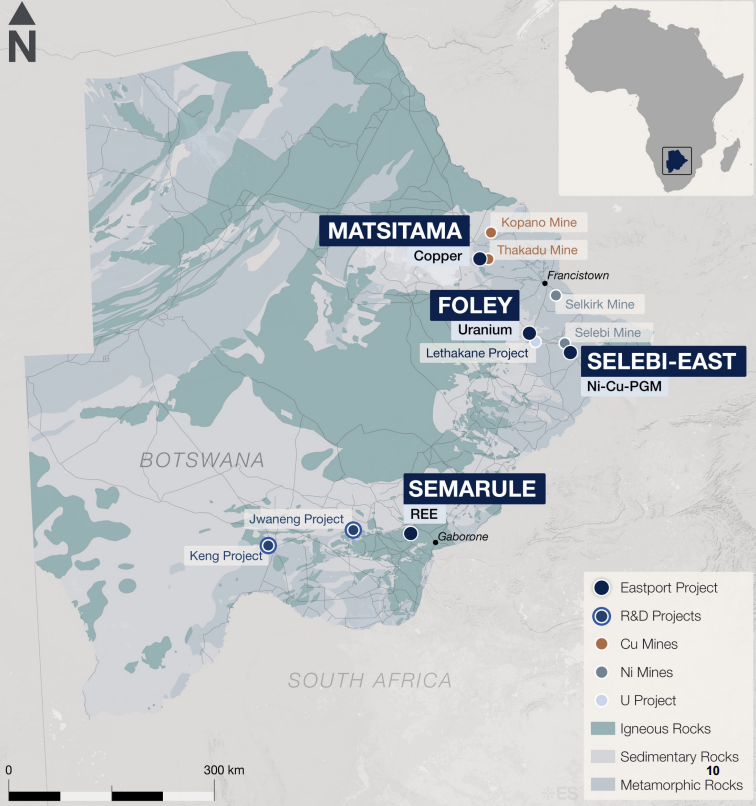
- Eastport Critical Metals (TSX-V:EVI) operates four critical-metal projects across Botswana: copper at Matsitama, rare earths at Semarule, uranium at Foley, and nickel-copper-PGM at Selebi-East.
- New CEO Daniel Major is sequencing exploration spend across the portfolio, starting with low-cost geophysics before committing to drilling.
- Matsitama's historical Nakalakwana Hill resource of more than 45.5 kt contained copper is not yet NI 43-101 compliant, though step-out drilling is extending the mineralised footprint east and west.
- A rare earth assay batch at Semarule was pending at the time of the interview and represents the portfolio's most immediate catalyst.
- Insiders hold 21.77% of shares outstanding, and management has signalled openness to spinning out individual projects as they mature.
Electricity demand is the thread running through every project in Eastport Critical Metals Corp.'s (TSXV:EVI) Botswana portfolio. Copper, uranium, rare earth elements and nickel each sit in the electrification supply chain, and the International Energy Agency's Global Critical Minerals Outlook 2026 forecasts copper demand growing 2.5-3.5%, rare earth demand rising 50-90% by 2040, and uranium demand climbing from roughly 180 Mlb to 320 Mlb U₃O₈ over the same period. Eastport, which listed on the TSX-V in November 2025 following its qualifying transaction with Penbar Capital, has built a six-project position across all four commodities in a jurisdiction the Fraser Institute ranks first in Africa and seventh globally for investment attractiveness. New CEO Daniel Major, who joined in July 2026, is now working through which of those projects earns the company's limited exploration budget first.
The Critical Metal Portfolio Across Botswana
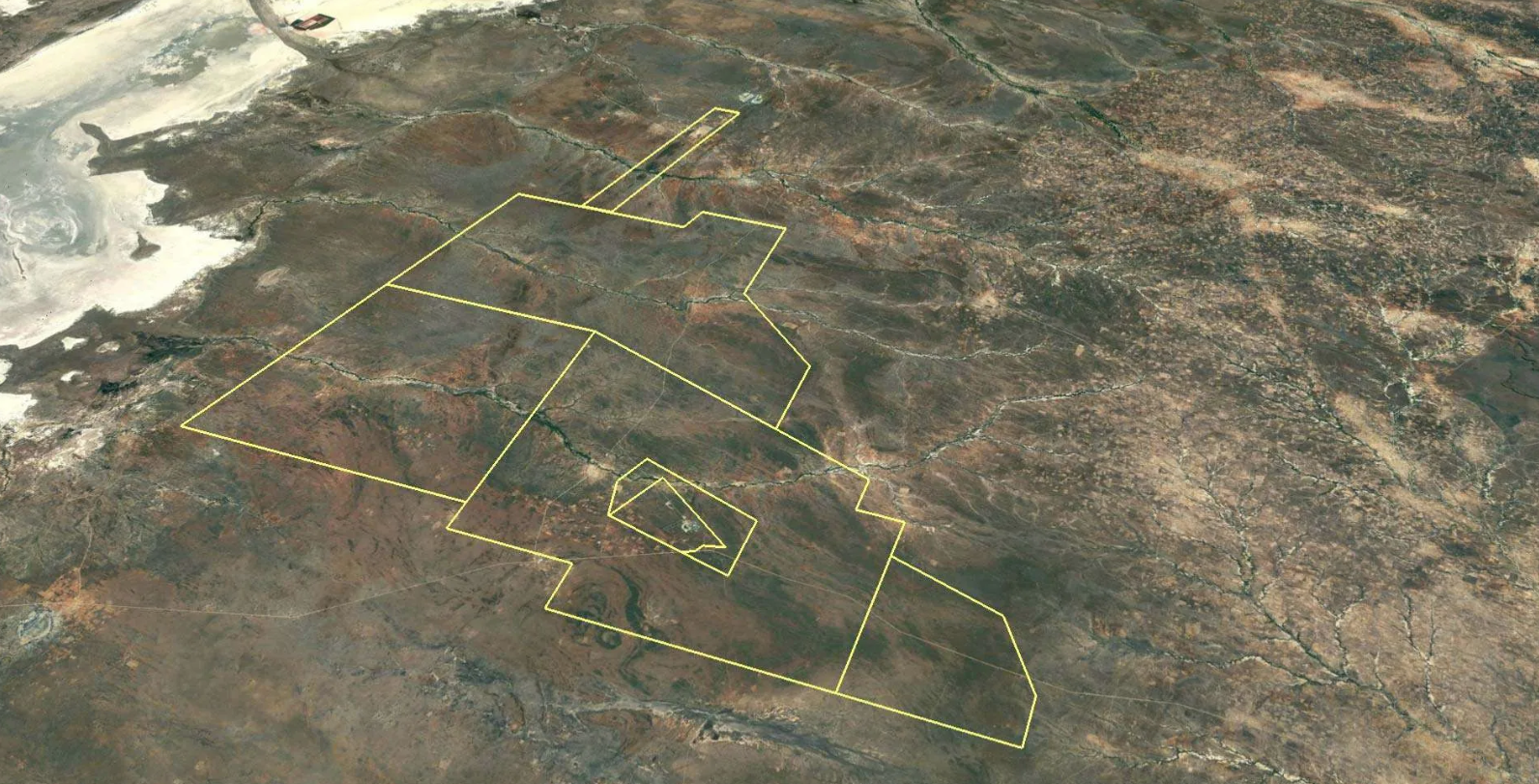
Matsitama is Eastport's largest and most advanced asset which is a 1,845 km² district-scale position across six prospecting licences, sitting adjacent to the historic Kopano (~1% Cu) and Thakadu (~2% Cu) mines, and about 10 km from the currently operating Moana mine, which Major describes as well over 50 million tons of 1%. The existing production context is part of the investment case: more than 50,000 metres of historical diamond drilling and over 115,000 soil samples already exist across the licence area, and the company has identified 20 priority targets, including the roughly 30 km "Copper Snake" trend in the licence's underexplored north.
The project's historical resource sits at Nakalakwana Hill, where a 2013 SRK Consulting estimate reports 6.8 Mt at 4,800 ppm Cu Indicated and 3.1 Mt at 4,294 ppm Cu Inferred - a combined 9.9 Mt at 4,640 ppm Cu, or more than 45.5 kt of contained copper. Eastport is explicit that this figure is historical only: it was classified under the superseded SAMREC 2007 code rather than current CIM standards, has not been verified by the company's Qualified Person, and cannot be relied upon as a current mineral resource under NI 43-101 until further data validation, drilling and metallurgical work are completed.
Drilling through 2025 and 2026 has extended the mineralised footprint well beyond the original Nak Main zone, with step-out holes to the east and west, Nak East and Nak West, confirming mineralisation continues beyond the currently defined area. Recent assay results include three holes intersecting more than 100 metres of copper mineralisation, with internal higher-grade zones running 0.5% to over 1.5% Cu, and the company reports mineralisation similar to Nak Main has now been identified at Nak East, correlating with the same mapped fold structures. For 2026, the priority is geophysics - gravity surveys across roughly 300 km², followed by an electromagnetic survey aimed at defining drill targets in the largely untested northern part of the licence.
Interview with Daniel Major, CEO, Eastport Critical Metals
Semarule: The Rare Earth Optionality
Where Matsitama offers scale and known copper, Semarule, a 250 km² licence roughly 40 km from Gaborone, is Eastport's earlier-stage rare earth optionality. The project hosts the Semarule Igneous Complex, a multi-phase alkaline syenite intrusion with rare-earth-bearing carbonatite dykes, and mineralised outcrop extends across approximately 15 km², rising up to 75 metres above regional cover. 2023 rock-chip sampling returned greater than 0.5% total rare earth oxides plus yttrium oxide, with roughly 25% of that comprising the higher-value magnetic rare earth oxides which Major flags as the ones that actually matter for the investment case, given global demand is concentrated in permanent-magnet applications. An eight-hole drill program has intersected mineralisation to depths exceeding 300 metres, and the company is awaiting a further batch of assay results, expected within three to four weeks of the interview, that management says will define the project's geology and grade profile.
Major is candid that rare earths carry a different playbook to base metals.
"It's not just about having a rare earth mine any longer. You have to have a pipeline, there has to be an endgame. You can't just produce a concentrate and hope to sell it. It has to get on track with everybody else."
The framing points toward an eventual standalone vehicle for Semarule if the assays confirm scale, the management has signalled the project could be spun out into its own listed entity, similar in structure to how Namibia Critical Metals has approached its own rare earth position next door.
Foley and Selebi-East: Earlier-Stage Upside
Eastport's remaining two priority-adjacent assets are earlier in their evaluation. Foley, a uranium project hosted in the same Karoo Supergroup sequence as the neighbouring Letlhakane uranium deposit (a 155 Mt resource at 345 ppm U₃O₈ for 118 Mlb contained uranium, on the disclosing company's own reporting - not verified by Eastport's Qualified Person), returned a maiden RC intercept of 8 metres at 553 ppm U₃O₈, validating the interpreted palaeochannel exploration model that guided the initial drill fences.
Meanwhile, Selebi-East is a 1,232 km² nickel-copper-PGM licence roughly 7 km east of the historic Selebi-Phikwe mining complex, which produced 40.5 Mt grading 0.64% Ni and 0.90% Cu between 1980 and 2016 under prior ownership. Eastport has reprocessed historical airborne radiometric and magnetic data over its own ground and reports nickel-copper-cobalt soil anomalies consistent with the host amphibolite sequence extending eastward into its licence.
Leadership With African Mining History
Major brings 35 years of mining experience spanning operations, development, banking and finance, including a stint as an equity analyst at HSBC and JP Morgan and a term as CEO of GoviEx Uranium Inc., where he took the company public and advanced a multi-jurisdictional African uranium portfolio. He is supported by Chairman Burns Singh Tennent-Bhohi, founder of the Glenpani Group and a veteran of natural resources recapitalisation transactions, and VP Exploration Rick G. Bonner, a geologist with more than 40 years across four continents, including work with BHP and Rio Tinto and prior founder credits on the Valencia uranium project in Namibia.
The board also includes David Newman, formerly Botswana's Ambassador to the United States and a High Court judge in the country from 2004 to 2015 - a rare combination of legal, political and in-country relationship experience for a junior explorer. Insiders collectively hold 21.77% of the 33,490,774 shares outstanding, a level of alignment Eastport highlights as a differentiator against typical junior-explorer ownership structures.
Portfolio Strategy: Sequencing, Not Sprawl
With four active commodities and a limited budget, sequencing is the central operational question, and Major was direct about the logic.
"If you looked at all of our projects, they all relate to one thing and that is electricity and the generation of electricity. They're all targeting towards the same growth cycle. And they're all early stage. So there's that ability to adjust as we go along."
The stated approach is inexpensive first-pass geophysics - Major put the cost of defining targets at "tens of thousands, not hundreds of thousands" of dollars - followed by RC drilling to confirm grade before committing to more capital-intensive diamond drilling and in-depth technical work. Rather than running every project to feasibility inside one company, Eastport has signalled openness to spinning out or partnering individual assets as they mature, given that copper, rare earth and uranium investors typically look for different things and don't want exposure diluted across dissimilar commodities in one vehicle.
The Investment Thesis for Eastport Critical Metals
- Matsitama offers the closest thing to near-term re-rating catalysts: step-out drilling has already extended mineralisation beyond Nak Main, and 2026 gravity and EM surveys across the underexplored Copper Snake trend could define the next drill targets.
- The Nakalakwana Hill historical estimate (>45.5 kt contained Cu) provides scale context but is not a current NI 43-101 resource - watch for confirmation drilling and a compliant resource update before treating the historical tonnage as investable fact.
- Semarule's outstanding assay batch, expected within weeks of the interview, is the key near-term catalyst for the rare earth story - management has said it will not release partial results and wants the full data set before defining geology and grade.
- Insider ownership of 21.77% is a meaningful alignment signal for a company this early-stage, though investors should note the company is pre-revenue and dependent on further financing to fund multi-project exploration.
- Foley and Selebi-East sit adjacent to established resources (Letlhakane, Selebi-Phikwe) but neither adjacency is independently verified by Eastport's own Qualified Person - treat both as favourable geological analogues rather than confirmed extensions.
- Management has signalled a willingness to spin out or partner individual projects rather than fund four commodities to feasibility inside one vehicle - a portfolio structure worth monitoring as projects mature at different rates.
- Botswana's tier-one jurisdiction ranking (Fraser Institute: #1 Africa, #7 globally) and existing rail, road and power infrastructure reduce single-country political risk relative to peers operating in less established African jurisdictions.
Macro Thematic Analysis
Eastport's four-commodity structure is a direct expression of the same electrification thesis driving capital toward critical minerals more broadly. Copper remains in structural deficit, with mined production supplying only an estimated 65-70% of demand even before accounting for grid expansion, EV adoption and data-centre buildout - a gap the IEA expects to widen as new mine supply is constrained by declining grades and long permitting lead times. Rare earths face a different kind of scarcity: the IEA's 50-90% demand growth forecast by 2040 collides with a supply chain where China controls both the bulk of mining and 80-90% of mid- to downstream processing, pushing the US, Japan and Europe toward their own REE strategies and creating openings for non-China-aligned projects with a credible offtake path.
Uranium's growth case rests on a genuine shift in nuclear sentiment - global nuclear capacity is forecast to climb from roughly 420 GW today to 550-700 GW by 2040 - even as mine supply continues to lag forecast demand. Botswana's stable jurisdiction ranking is what allows Eastport to run that multi-commodity thesis from a single country rather than spreading political risk across several.
TL;DR:
Eastport Critical Metals is a Botswana-focused explorer running four critical-metal projects under new CEO Daniel Major, former GoviEx Uranium chief. Flagship Matsitama Copper (1,845 km²) sits adjacent to producing and past-producing mines and hosts a historical (non-compliant) resource of >45.5 kt Cu at Nakalakwana Hill, with step-out drilling extending mineralisation east and west ahead of 2026 gravity and EM surveys. Semarule offers rare earth optionality with an outstanding assay batch pending. Foley (uranium) and Selebi-East (nickel-copper-PGM) sit adjacent to established regional deposits but remain earlier-stage. Insiders hold 21.77% of shares outstanding. Management favours cheap first-pass exploration and potential spin-outs over funding all four commodities to feasibility in one vehicle.
FAQ (AI-generated)
Analyst's Notes





Subscribe to Our Channel





Stay Informed