




US Critical Minerals Reserve Buys Inventory, Cutting China's Rare Earth Share


Project Vault adds $1 billion to US critical minerals stockpile as refining concentration hits 72%, favoring supply and refiners outside China.
US Critical Minerals Stockpile Draws $1 Billion, Adding a New Buyer for Raw Materials
Glencore and Mercuria each committed $500 million to VaultCo on 23 September 2026, the first participants in the private company running Project Vault. VaultCo will use Export-Import Bank of the United States (EXIM) financing to buy and store critical minerals that US manufacturers can draw on during supply disruptions. EXIM approved a direct loan of up to $10 billion for the program in February 2026.
The commitment turns financing into physical buying for the first time. That buying lands in a market where China processed to 95% of global lithium, cobalt, manganese and graphite in 2025, according to the International Energy Agency (IEA). Every tonne the reserve buys comes from the same refined pool US manufacturers already compete for.
Refining Concentration Rises to 72% as US Policy Funds Deals Over Processing
Excluding rare earths, the leading refining country's average share of refined supply rose to 72% in 2025 from 70% in 2023, per the IEA's Global Critical Minerals Outlook 2026. China leads most key energy minerals except nickel, where Indonesia leads. The two countries supplied more than three-quarters of refined supply growth between 2023 and 2025.
Washington has signed 160 critical minerals deals worth more than $40 billion since January 2025, by the administration's count. Over the same period, it canceled $7.5 billion in clean energy grants and ended electric vehicle tax credits, weakening the demand refinery financing depends on. Beijing extended export controls to graphite and lithium iron phosphate (LFP) cathode material in October 2025, then suspended some measures until November 2026.
China's November Export Control Deadline Sets Pricing Power for Ex-China Refiners
Refining capacity cannot be bought on a stockpile timeline. The IEA projects that China's rare earth refining share falls only to 70% to 73% by 2035, even with every planned project on schedule. Stephanie Gagnon-Rodriguez, director of Regional Clean Economies at C2ES, told Reuters:
"We need to see [these policies] stay in place for a longer period of time."
The consequence splits ex-China producers with operating refining capacity from concentrate-stage developers selling feed into Chinese refineries. The horizon is November 2026, when China's suspension lapses.
If controls return, graphite and LFP cathodes become the scarcest units, and ex-China refiners gain pricing power over manufacturers and the reserve. If the suspension is extended, stockpiling keeps buyers paying up. Amit Mathrani, executive director of energy transition at Rabobank, said companies will accept higher prices while uncertainty continues. Either way, concentrate-stage developers selling into Chinese refineries capture the smaller share.
Battery Materials Investment Falls 20%, Leaving Concentrate Developers Short of Capital
Investment by lithium, nickel and cobalt companies fell 20% in 2025, while copper-focused companies raised spending 8% (IEA). A retail portfolio built on lithium or graphite developers faces a thin equity funding market. It also faces a refined premium that accrues to the refinery rather than the mine.
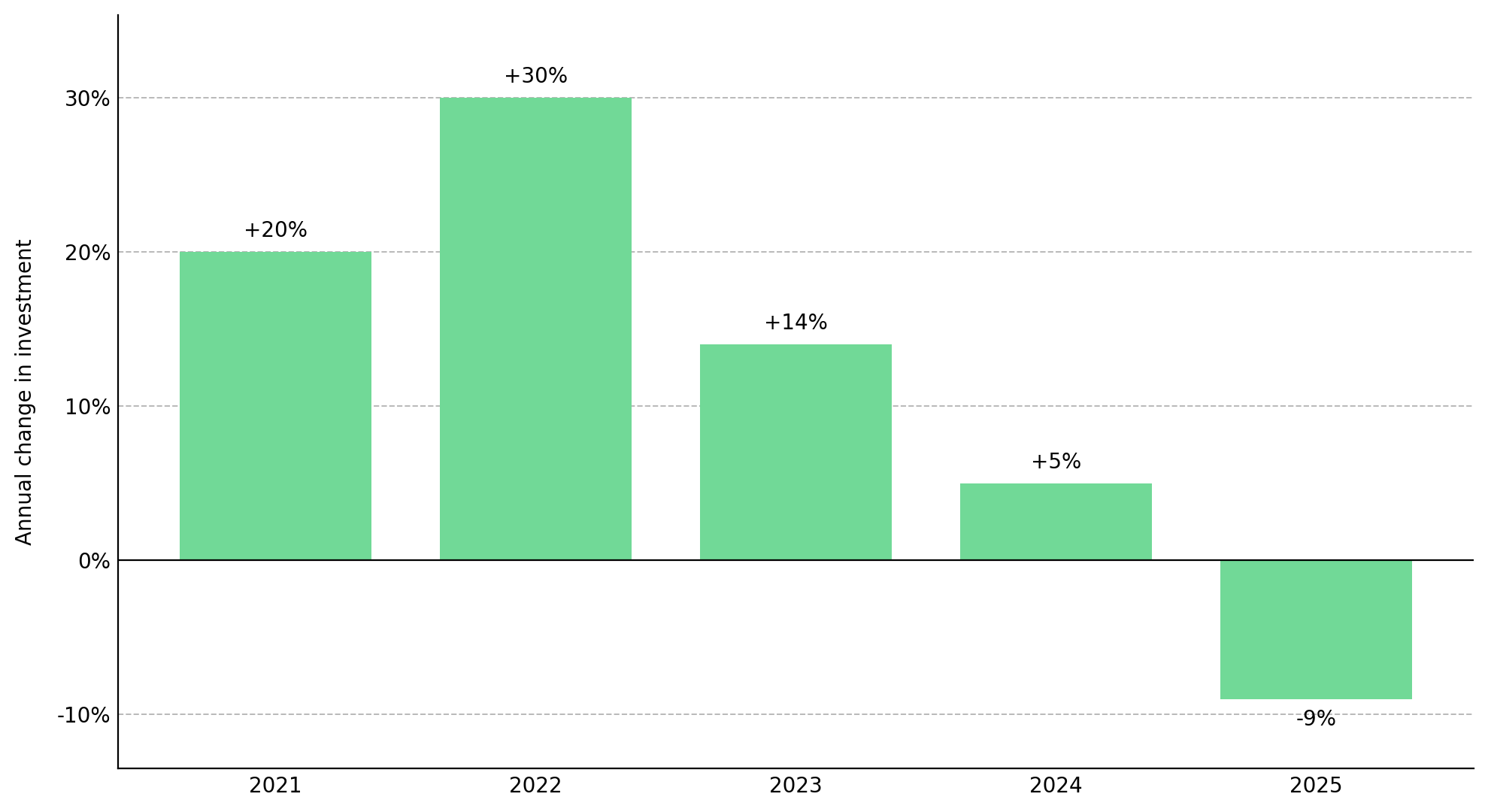
Capital leaving battery materials now thins the supply that arrives in the early 2030s: lithium specialists cut investment about 40% in 2025, while the IEA projects lithium demand rising more than threefold to 2040. Developers funded through construction face fewer competitors when that demand arrives. The limit is runway: the IEA also reports narrowing lithium supply gaps, and a recovery that outlasts a developer's cash rewards only the holders of its next financing.
Critical Minerals Policy Rewards Refining Control
Concentration fell only where capital reached the refinery. Rare earths, where US and Malaysian projects received targeted support, is the one segment where China's share declined to 85% in 2025 (IEA). In every other segment, public money buying inventory pays whoever controls the refining unit. The same holds for any mineral with dispersed mining and concentrated processing.
The ex-rare earths refining share falling back below 70%, its 2023 level, in the IEA's next annual outlook would show policy capital reaching processing. It would also give concentrate-stage developers domestic buyers.
Value has moved to the reserve's trading suppliers and to producers refining outside China. A funded path to a refined product belongs in a developer's valuation, not a risk footnote. Falling investment today thins the ex-China refining pipeline later, which extends the premium for projects that reach processing. Multi-year holders are paid for owning that step, and exposed if they own only the mine.
Analyst's Notes





Subscribe to Our Channel

Stay Informed



