




$100M Nickel & $20M Lithium Offtakes Signal Capital Shift as IEA Prices Risk at $6.5T


Capital shifts toward diversified battery metals as the IEA quantifies $6.5T of supply chain risk and regulatory decisions reshape nickel and lithium valuations.
- The International Energy Agency's Global Critical Minerals Outlook 2026 estimates that reinstating China's export controls on rare earths and battery chokepoint materials when the current suspension expires in November 2026 would expose $6.5 trillion a year of downstream production, quantifying the economic cost of concentrated supply chains.
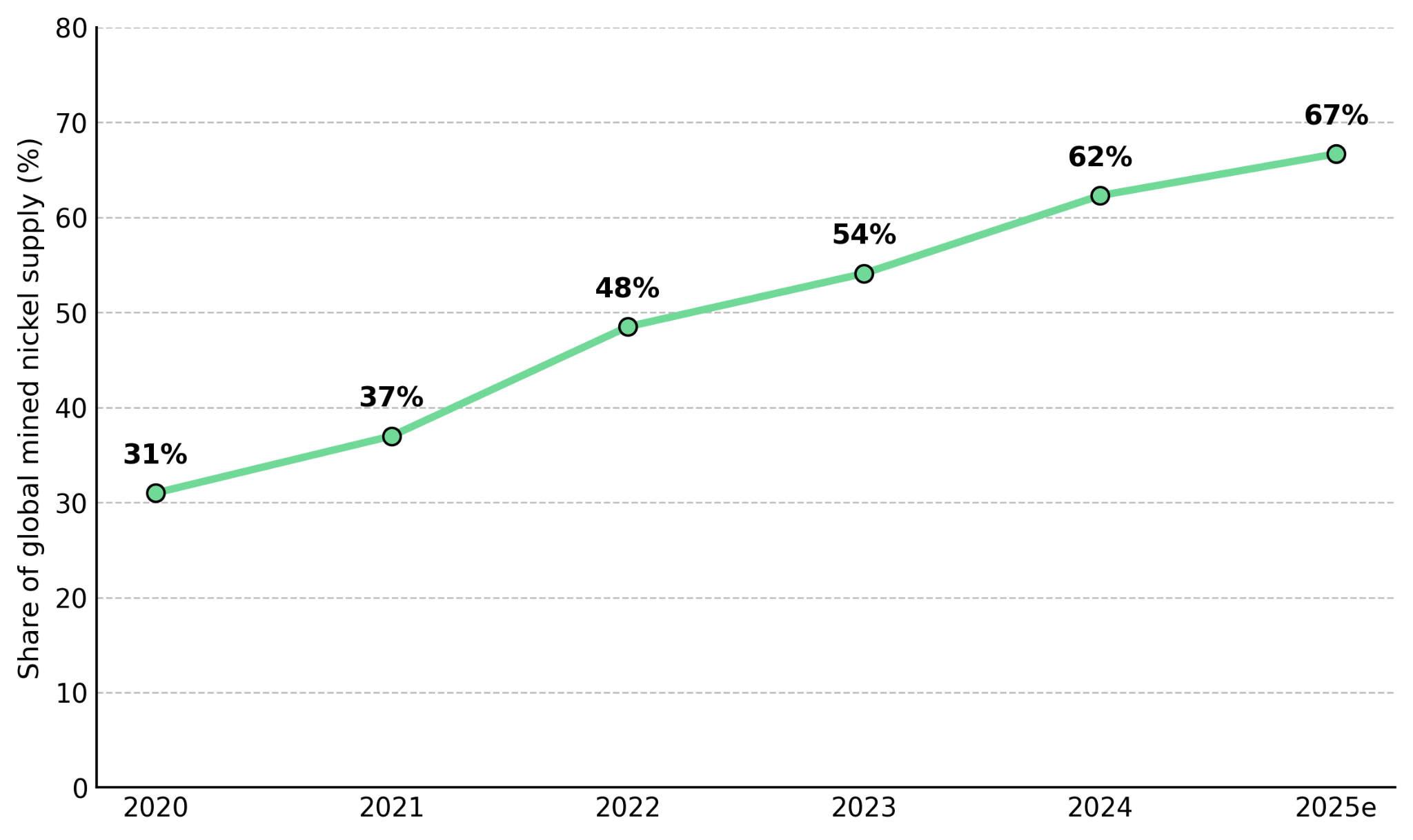
- Indonesia accounts for approximately two-thirds of global mined nickel supply, approaching the concentration OPEC once held in global oil production and exposing nickel supply chains to the same type of single-country concentration risk the IEA has quantified.
- China has centralized lithium mining license approvals even as new spodumene supply from Zimbabwe and Australia pushes spot lithium carbonate prices lower, creating opposing supply signals for the lithium market.
- China's electric vehicle and energy storage battery sales rose 49.1 percent year on year in June, while energy storage battery sales increased 67.5 percent, indicating that battery demand is growing faster than supply chain diversification.
- Valuations for nickel and lithium projects outside Indonesia and China have not yet been re-rated to reflect the IEA's $6.5 trillion downstream exposure estimate. Indonesia's nickel quota ruling and the expiry of China's export control suspension are the next regulatory tests of whether that valuation gap begins to close.
IEA Prices Supply Chain Concentration & Supports Higher Valuations for Diversified Battery Metals
The International Energy Agency (IEA) assigns a quantified economic cost to supply-chain concentration in its Global Critical Minerals Outlook 2026, estimating that China's expanded export controls on rare earths and battery chokepoint materials would expose $6.5 trillion a year of downstream production across the automotive, high-tech, defense, and energy sectors. Those controls, covering cathode materials, cathode precursors, graphite anode materials, and battery manufacturing equipment, were announced in October 2025, suspended for one year, and are scheduled to expire in November 2026. Even a full disruption of battery-grade graphite trade alone would place more than $300 billion a year of downstream production at risk.
The significance extends beyond graphite because the IEA's methodology provides a framework for quantifying concentration risk across the battery supply chain. If concentration risk can be modeled and quantified for one chokepoint material, the same framework applies to nickel, where Indonesia accounts for approximately two-thirds of global mined supply, and to lithium, where China's processing dominance and increasingly centralized mining license approvals concentrate control over supply. Quantifying concentration risk strengthens the case for nickel projects outside Indonesia and lithium projects outside China, where supply diversification could support stronger valuations as manufacturers and lenders place greater weight on jurisdictional security.
Indonesia's Nickel Dominance Increases the Value of Alternative Supply
Nickel supply concentration predates the IEA's 2026 report, but the report provides a framework for quantifying its economic implications. Data from the US Energy Information Administration and Macquarie indicate Indonesia accounted for approximately 67 percent of global mined nickel supply in 2025, approaching OPEC's historical peak share of global oil production of roughly 54 percent in the early 1970s. Indonesian nickel pig iron and mixed hydroxide precipitate production has driven most global supply growth over the past three years, while few sulfide or laterite projects outside Indonesia have advanced far enough to provide meaningful alternative supply.
Permitting Progress & Offtake Interest Strengthen Secure Nickel Supply
Canada Nickel is advancing the Crawford Nickel-Cobalt Sulfide Project in Timmins, Ontario, toward a construction decision targeted for 2027. The project holds 3.8 million tonnes of Proven and Probable contained nickel, the second-largest reserve base globally behind Norilsk in Russia, at a life-of-mine net C1 cash cost of US$0.39 per pound, placing it in the first quartile of the global nickel cost curve. Crawford has been selected for Canada's Major Projects Office and Ontario's One Project, One Process framework, and Samsung SDI holds a US$100 million option to acquire a 10 percent direct interest in the project alongside offtake rights, a battery manufacturer paying directly for nickel supply outside Indonesia's orbit.
Mark Selby, Chief Executive Officer of Canada Nickel, discusses the demand for non-Indonesian battery nickel supply:
"We're really now one of the only projects that can come online before 2030. There's about three of us that can conceptually get there, so they're keen to have that non-Indonesian offtake in place."
Development Readiness Supports Growing Demand for Secure Nickel Supply
Lifezone Metals has advanced its Kabanga Nickel Project in Tanzania, described by the company as one of the world's largest and highest-grade development-ready nickel sulfide deposits, following completion of its Feasibility Study in July 2025. The project has cleared its major infrastructure and social-license milestones, including a full transition to Tanzania's TANESCO grid power and completion of cash compensation payments to project-affected households, positioning it as one of the few advanced-stage nickel assets outside Indonesian control.
Ingo Hofmaier, Chief Financial Officer of Lifezone Metals, explains the growing demand for secure nickel supply:
"The key thing is the traceability of nickel sulfates that ultimately go through western smelters and end up in the defense industries or the stainless steel industry in the West. Nickel is one of the bigger commodities and still one of the strongest growing commodities, with more than 4% demand growth."
China Tightens Lithium Mining Control & Global Supply Offsets Price Pressure
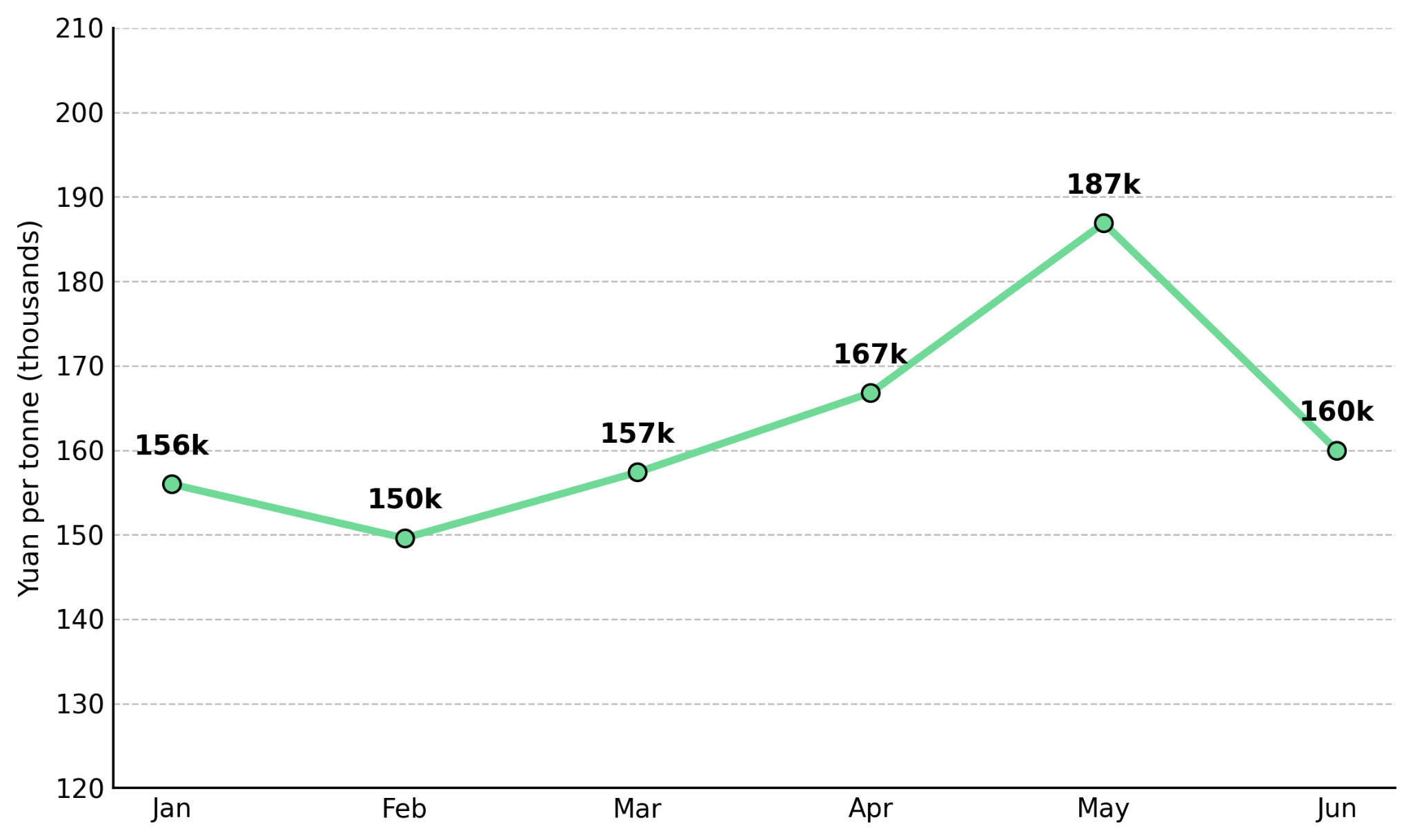
China is tightening domestic control over lithium mining even as global lithium supply expands. China's Mineral Resources Law Implementation Regulations, signed on May 15, 2026, shifted lithium mining license oversight from local governments to central authorities, making license renewals more difficult in Jiangxi and strengthening central control over domestic production. Despite tighter domestic regulation, battery-grade lithium carbonate prices have fallen from about Yuan 201,000 per tonne in May to around Yuan 150,000 per tonne as renewed spodumene shipments from Zimbabwe and additional Australian supply, including the restart of Bald Hill and the approved 6 percent expansion at Mt Marion, outweighed the impact of China's licensing changes.
Tighter Chinese mining controls and lower global lithium prices reflect different parts of the supply chain rather than conflicting market signals. China has centralized control over domestic lithium mining while increased spodumene supply from Zimbabwe and Australia continues to meet near-term demand, limiting the impact of stricter licensing on lithium prices. Whether imported supply continues to offset China's tighter domestic mining controls will determine the direction of lithium prices through the second half of the year.
Project Milestones Position New Lithium Supply Outside China
Lithium Ionic is advancing its 100 percent owned Bandeira Lithium Project in Minas Gerais, Brazil's "Lithium Valley," alongside two operating peer mines in the same district. In March 2026, the company secured binding five-year offtake agreements with Sichuan Yahua Industrial Group and Grand Chen Resources, two lithium-ion battery materials producers, backed by a combined US$20 million pre-payment facility tied to Bandeira's advance toward construction. Over the past weeks, the company secured construction-phase water access via a river lease agreement, exercising rights under an existing authorization from Brazil's national water regulator, completed a refined mine plan validating its September 2025 Feasibility Study, and issued requests for quotation to seven contractors for underground portal construction, positioning Bandeira as a near-term spodumene concentrate source outside both China and Australia.
Blake Hylands, Chief Executive Officer of Lithium Ionic, discusses the widening gap between lithium supply and demand:
"We're a trusted global trading jurisdiction that can send material anywhere in the world, with a clear path within the next year and a half to two years to be in production, feeding a massive gap that is going to be formed from the lack of supply coming online and a growing demand that's much faster than people are projecting."
Battery Sales Growth Outpaces Supply Diversification & Nickel Intensity Declines
Battery demand continues to grow faster than supply chain diversification. China's electric vehicle and energy storage system battery sales reached 196.0 gigawatt-hours in June, up 49.1 percent year on year, while energy storage system battery sales increased 67.5 percent, according to China Automotive Battery Innovation Alliance data. Higher battery production does not translate directly into higher nickel demand because lithium iron phosphate batteries, which contain no nickel, account for roughly four-fifths of Chinese battery production by volume, while nickel-manganese-cobalt batteries represent a declining share, allowing battery output to grow even as nickel intensity per battery declines.
Recycling Capacity Lags Battery Demand & Keeps Mined Supply Essential
New lithium recycling capacity remains too small to reduce China's dependence on mined supply. Narada Power's Jieshou facility is targeting 25,000 tonnes per year of battery-grade lithium carbonate, while Envision Green Energy's Hong Kong EcoPark facility is targeting 10,000 tonnes per year, according to SMM data published in July 2026. Combined, the 35,000 tonnes per year of announced capacity is smaller than a single month of Chinese lithium carbonate demand, which reached approximately 151,000 tonnes in June 2026. The gap suggests recycling will supplement rather than replace newly mined supply in the near term, preserving demand for development-stage lithium and nickel projects outside China and Indonesia. Over the longer term, China's consumption tax exemption for sodium-ion and solid-state batteries, effective September 1, 2026, aims to reduce dependence on virgin lithium and nickel by encouraging alternative battery chemistries rather than immediate substitution.
Regulatory Decisions Could Reprice Diversified Battery Metal Projects
The IEA's estimate that supply-chain concentration could expose $6.5 trillion a year of downstream production has not yet been reflected in the valuations of many nickel and lithium projects outside Indonesia and China. Near-term cost drivers, including the Fed's policy decision on July 29 and sulfur costs for Indonesian high-pressure acid leach operations affected by Middle East shipping disruptions, will influence operating margins. However, the larger determinant of long-term project value remains whether manufacturers assign higher value to diversified nickel and lithium supply.
Two regulatory decisions in 2026 will provide the first meaningful test of whether supply diversification begins to command a valuation premium. Indonesia's Ministry of Energy and Mineral Resources is due to rule on supplementary nickel mining quota applications by July 31, 2026, determining whether additional Indonesian supply keeps the nickel market in surplus. China's export control suspension is scheduled to expire in November 2026, and Beijing's decision will determine whether the IEA's estimated supply-chain exposure remains primarily theoretical or translates into higher commercial risk for downstream manufacturers.
The Investment Thesis for Battery Metals
- The IEA has quantified the downstream cost of supply-chain concentration, giving nickel and lithium projects outside Indonesia and China a measurable framework for assessing potential valuation premiums.
- Battery manufacturers are committing capital and securing offtake agreements before any broad re-rating of nickel and lithium projects outside Indonesia and China, indicating that long-term supply security is being valued ahead of public equity markets.
- Completed feasibility studies, government fast-track designations, and social license milestones reduce development risk for lenders and battery manufacturers evaluating long-term supply agreements, giving advanced nickel and lithium projects an advantage over earlier-stage peers.
- China's tighter domestic mining controls and its expansion of battery recycling and alternative chemistries have opposing effects on long-term lithium demand. Whether supply restrictions or reduced reliance on newly mined lithium has the greater influence will determine if future lithium price movements prove temporary or sustained.
- Indonesia's nickel quota ruling and the scheduled expiry of China's export control suspension over the next several months will test whether supply diversification begins to command higher valuations for nickel and lithium projects outside Indonesia and China.
The IEA has quantified the economic cost of battery-metal supply concentration, but public market valuations have yet to fully reflect that risk. Manufacturers and lenders are already placing greater emphasis on supply security through financing and offtake agreements, indicating that strategic considerations are beginning to influence capital allocation. Indonesia's nickel quota decision and China's decision on whether to reinstate export controls will determine whether supply diversification begins to command higher valuations for nickel and lithium projects outside Indonesia and China.
TL;DR
The IEA estimates that concentrated battery metal supply chains expose $6.5 trillion of downstream production, strengthening the investment case for nickel projects outside Indonesia and lithium projects outside China. Battery manufacturers are already securing diversified supply through financing and offtake agreements even though public market valuations have yet to fully reflect this risk. Meanwhile, China's tighter lithium mining controls, Indonesia's dominant nickel production, and growing battery demand continue to reshape supply dynamics. Upcoming decisions on Indonesia's nickel quotas and China's export controls could determine whether diversified battery metal projects begin to command higher valuation premiums.
FAQs (AI-Generated)
Analyst's Notes





Subscribe to Our Channel





.png)



Stay Informed


