




US Gold Corp's 3 Competing Catalysts Converge on One 18-Month Window


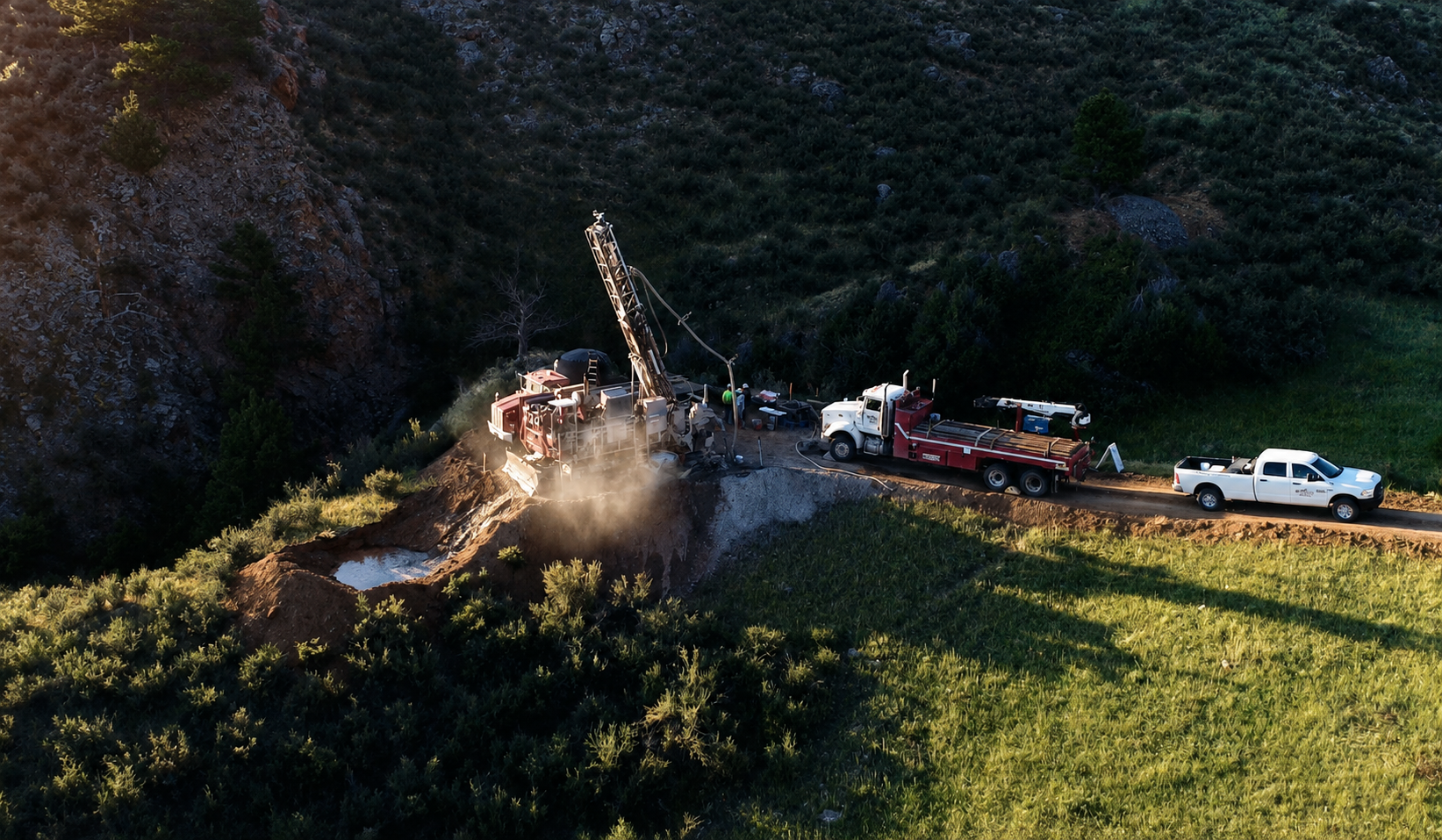
US Gold Corp targets a CK Gold construction decision by the second half of 2026. Inside the financing gate, the M&A review and the Keystone spin-out.
- US Gold Corp is targeting a construction decision for the CK Gold Project as early as the second half of 2026, and financing is the gatekeeper for every milestone along the way.
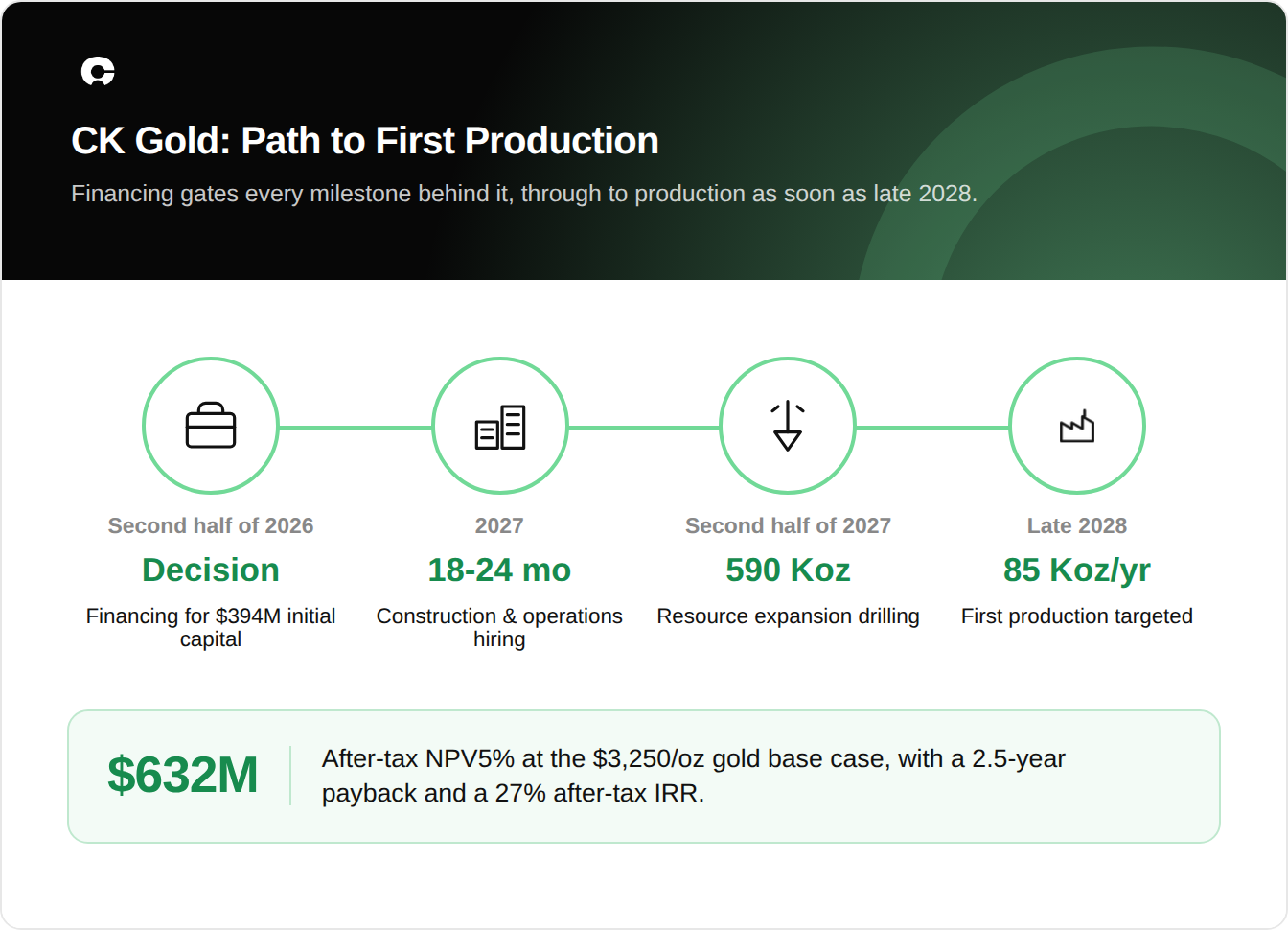
- The March 2026 feasibility study (FS) supports an after-tax net present value (NPV5%) of $632 million and an after-tax internal rate of return (IRR) of 27% at a gold price of $3,250 per ounce.
- A Special Committee and outside advisors are assessing merger and acquisition (M&A) interest while project financing discussions are running.
- A Keystone spin-out is under consideration as a third route, intended to advance Nevada exploration while minimizing additional dilution.
- Resource expansion drilling is anticipated in the second half of 2027, placing growth behind the construction decision rather than beside it.
Financing Gates Every Milestone Behind It
US Gold Corp (Nasdaq: USAU) has all major permits in hand at the CK Gold Project, which it describes as shovel-ready. The Wyoming Department of Environmental Quality approved the Mine Operating Permit in April 2024 on a 10-year renewable term, plus the water discharge and air quality permits in May and November 2024. The project sits on Wyoming state land with no direct federal involvement following a US Army Corps of Engineers jurisdictional delineation, and initial mine access road works have commenced.
Location removes cost lines from the budget. The site sits approximately 20 miles west of Cheyenne and 3 miles north of the Interstate 80 corridor, so the projected workforce of approximately 255 local direct jobs commutes daily, and the project requires no man-camp, avoiding both the capital to build accommodation and the cost to run it from the budget.
What remains is capital. The feasibility study (FS) issued by Halyard Micon International in March 2026, on base-case assumptions of $3,250 per ounce of gold, $4.50 per pound of copper, and $40 per ounce of silver, puts initial capital at $394 million plus $26 million of pre-production owners' costs, against reported cash of $30.7 million for the period ended April 30, 2026. At 16,528,663 shares outstanding, the market capitalization of $266.4 million as of September 1, 2026 is smaller than the $394 million the study says the mine costs to build, which rules out a fully equity-funded build as a realistic option. The company is targeting a construction decision by the second half of 2026 and is in discussions with potential debt, equity, streaming, and offtake partners.
Executive Chairman of US Gold Corp, Luke Norman, framed that preference:
"With 16.5 million shares outstanding, we don't want to see that balloon through project financing, so clearly we want to take as much debt as possible. This project lends itself tremendously well to debt and pays itself off very quickly, in under two years."
The payback is 2.5 years at the base case and 1.6 years at $4,500 per ounce of gold, which is what a lender underwrites.
Two Alternatives to Building It Alone
Two other processes compete for the same window, and both would replace the financing track rather than supplement it. The company has engaged advisors and formed a Special Committee to assess inbound merger and acquisition (M&A) interest, putting the board in a position to decide whether CK Gold is better built by US Gold Corp or by a counterparty that can already fund it. Separately, management is exploring a spin-out of Keystone as a standalone exploration company to minimize additional dilution. Keystone covers 20 square miles on Nevada's Cortez Trend, 11 miles south of Nevada Gold Mines' Cortez Hills Complex.
Norman attributes the inbound interest to the same valuation gap that constrains the equity option:
"It's triggered a heck of a lot of interest around the project, not just from a project financing standpoint, but now there are a lot of other mining companies looking at us."
These tracks are not independent. Each requires the same board and the same 12-to-18-month window, and the resolution of one forecloses or reprices the others. An agreed transaction at a premium to the $266.4 million market capitalization ends the financing question and caps shareholder participation in the study's $632 million after-tax value, while a debt package preserves it.
Growth Sits Behind the Construction Decision, Not Beside It
The exploration case is quantified and, on the company's own schedule, deferred until after the construction decision. The company reports resources exclusive of reserves of 590,000 gold-equivalent ounces measured and indicated, plus 677,000 inferred within the resource pit shell, against proven and probable reserves of 1,598,000 gold-equivalent ounces. The deposit is open below 800 feet and southeast along strike, with 2,900 feet of strike length untested.
Norman describes the reserve boundary as an artifact of the study rather than of the geology:
"80% of the drill holes that extended beyond that reserve continued in mineralization. This mineralization doesn't just disappear because it hit a hypothetical shell boundary."
Geophysical work has defined drill targets without testing any of them. An expanded drone magnetic survey and a gravity survey, completed mid-year 2026, along with a hyperspectral survey the company reports as complete, identified anomalies both above and below the proposed pit. All of it culminates, per the September 2026 corporate presentation, in an anticipated drill program in the second half of 2027, which means converting the 590,000 measured and indicated ounces into reserves would extend the 11-year mine life but would produce a result before the financing is priced.
Two other value sources sit outside the study on the same deferred basis: a non-binding letter of intent for rail ballast delivery to a major railway, against a local quarry selling crushed stone at roughly $20 to $25 per ton, and gold reporting to tailings rather than recovered in flotation that a later treatment step could capture.
The Sequence to 2028 & What Could Slip
Once funded, the build introduces no unproven process step that could push the schedule. Management is targeting an 18-to-24-month construction timeline, with first production as early as late 2028, and development and operations hiring during 2027. The study describes a 20,000-ton-per-day operation producing approximately 85,000 gold-equivalent ounces per year over an 11-year life, using crush, grind, flotation, and dry-stack tailings, with concentrate shipped off-site and life-of-mine (LOM) all-in sustaining costs (AISC) of $1,814 per gold-equivalent ounce on a co-product basis.
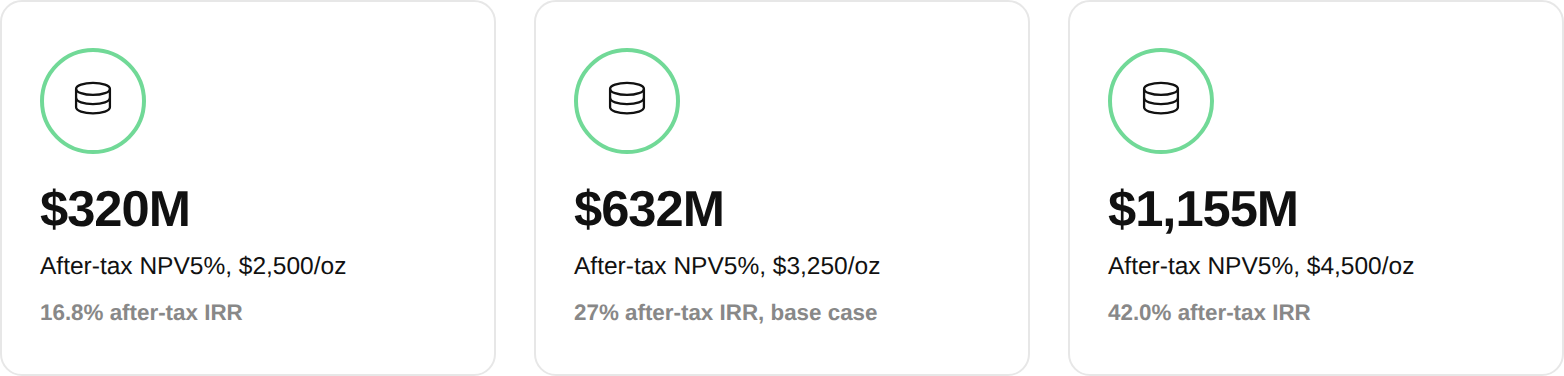
Commodity prices set the terms available for financing. The company shows after-tax net present value at a 5% discount rate (NPV5%) moving from $320 million at $2,500 per ounce of gold to $632 million at the $3,250 base case and $1,155 million at $4,500 per ounce, with the after-tax internal rate of return (IRR) ranging from 16.8% to 42.0%. Lenders size facilities against those figures, so the gold price during the negotiation window determines how much dilution shareholders absorb.
The watch points follow this order: a financing announcement, any construction start, and any Special Committee outcome over the next several months, then the Keystone spin-out, operations hiring, and the drill program through 2027. A slip at the financing gate moves the late 2028 production date and every milestone ahead of it, while a delay to the drill program changes only the size of the reserve, not the date when first revenue arrives.
The Investment Thesis for US Gold Corp
- US Gold Corp holds all major permits for the CK Gold Project on Wyoming state land with no direct federal involvement, removing the approval risk that normally sits between a completed study and a construction decision for United States developers.
- The March 2026 feasibility study supports an after-tax net present value of $632 million at a 5% discount rate, a 27% after-tax internal rate of return at a gold price of $3,250 per ounce, and a payback period of 2.5 years.
- A market capitalization of $266.4 million across 16,528,663 shares stands against that $632 million study value, and closing the gap without surrendering it to dilution drives management's preference for debt over equity.
- Three tracks run concurrently: project financing toward a construction decision, a Special Committee assessment of merger and acquisition interest, and a possible spin-out of the Keystone exploration asset in Nevada.
- Resources outside the reserve, gold recovery from tailings, and potential aggregate and rail ballast sales sit outside the study economics, with drilling to test the first of them anticipated in the second half of 2027.
- The project sits approximately 3 miles north of Interstate 80 and 20 miles west of Cheyenne, allowing approximately 255 local direct jobs to commute daily and removing the cost of a man-camp from the operating budget.
The permitting and engineering work behind the project is finished, and none of it returns anything until capital is committed. What determines the outcome is which track closes first: a debt-weighted financing preserves shareholders' claim on the study's $632 million after-tax value, while an agreed sale converts that value into a fixed premium and ends the study.
TL;DR
US Gold Corp has a fully permitted, feasibility-backed gold and copper project and $30.7 million of cash against a $394 million initial capital requirement. A construction decision is targeted for the second half of 2026, first production as early as late 2028, and resource expansion drilling not until the second half of 2027. A Special Committee assessing M&A interest and a possible Keystone spin-out compete for that same window, so the question is which track closes first.
FAQs (AI-Generated)
Analyst's Notes





Subscribe to Our Channel



.png)

Stay Informed






















