




i-80 Gold Values Its Projects at $2,175 Gold & Forecasts Its Cash at $3,600


i-80 Gold values its projects at $2,175 per ounce of gold and forecasts cash at $3,600 per ounce. Four studies to mid-2027 could reset both assumptions and the costs behind them.
- i-80 Gold's project valuations use a gold price assumption of $2,175 per ounce, with published sensitivities reaching $3,000.
- The same presentation uses $3,600 per ounce for anticipated cash flow from operations, a figure the company describes as in line with current long-term consensus prices.
- The $4.9 billion combined project net present value the company publishes sits on the lower assumption, not the higher one.
- Costs have already moved against the studies, including toll-milling rates agreed after the assessments were completed.
- Four technical studies targeted between the third quarter of 2026 and mid-2027 are where both prices and costs could be reset together.
What Has Happened
i-80 Gold Corp. (NYSE American: IAUX | TSX: IAU) reported second quarter 2026 results on August 10, 2026, and published a corporate presentation dated August 2026 carrying information current to the same date. The two documents present two different gold price assumptions, each applied to a different purpose, neither of which is wrong.
The company produced 11,098 ounces and sold 5,335 in the quarter, generating revenue of $24.3 million and gross profit of $8.6 million, at an average realized price of $4,522 per ounce. That realized price was itself below the $4,801-per-ounce average for the first half, a reminder that quarterly prices move in both directions. i-80 Gold held $464.6 million in cash at June 30, 2026, and reported a net loss of $52.5 million alongside pre-development, evaluation, and exploration expenses of $29.3 million.
What matters for how those assets are valued sits in the endnotes rather than the headline slides. Anticipated cash flow from operations assumes a gold price of $3,600 per ounce, which is in line with current long-term consensus prices. This confirms that the economics of the latest technical studies were completed using a gold price assumption of $2,175 per ounce, with sensitivities up to $3,000 per ounce.
Two Gold Prices in One Document
The split is functional rather than contradictory. The $3,600 assumption drives the anticipated annual gold output profile and the roughly 600,000-ounce-per-year target the company projects to build through the early 2030s. The $2,175 assumption, with sensitivity to $3,000, drives every net present value (NPV5%) and internal rate of return (IRR) for an individual project.
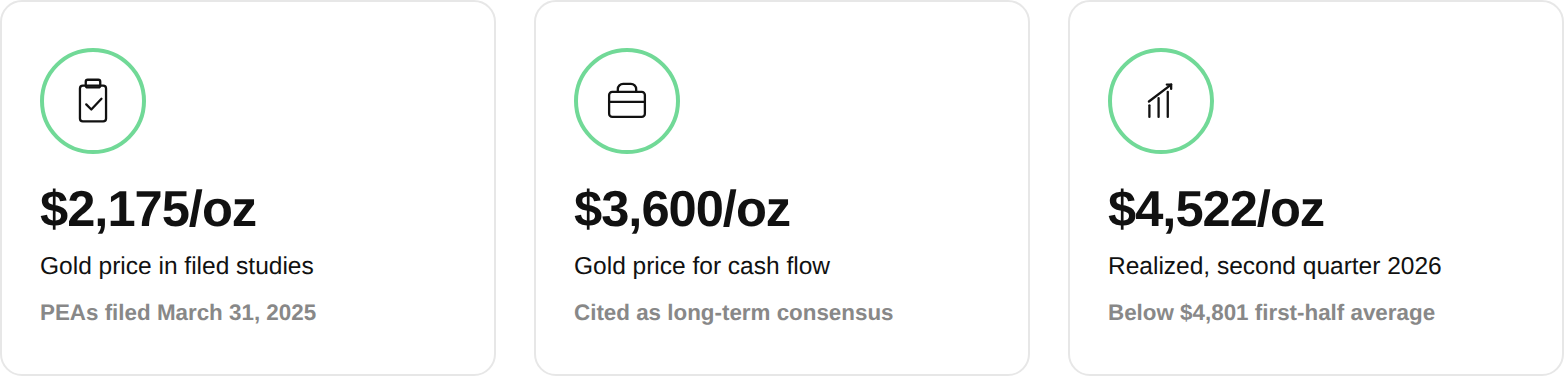
That places the two figures investors quote most often on opposite sides of the divide. The production growth story runs on the consensus-aligned price. The $4.9 billion portfolio value runs on a price the company itself no longer describes as consensus.
The reason is a difference in document status rather than intent. Project economics are based on preliminary economic assessments (PEAs) filed on March 31, 2025, and a filed technical report cannot be revised by changing a number in a presentation. Cash flow projections carry no such constraint. So the gap is not evidence of inconsistency on the company's part; it is evidence that one set of figures is anchored to a filing date, while the other is not.
What Sits on the Lower Assumption
The combined figure is a company-presented sum of project-level after-tax NPV5%: $1.6 billion at $2,175 per ounce and $4.9 billion at $3,000 per ounce. Both are engineering outputs from PEAs, the least advanced category of technical study, and neither nets out construction capital, development timing, corporate costs, or financing.
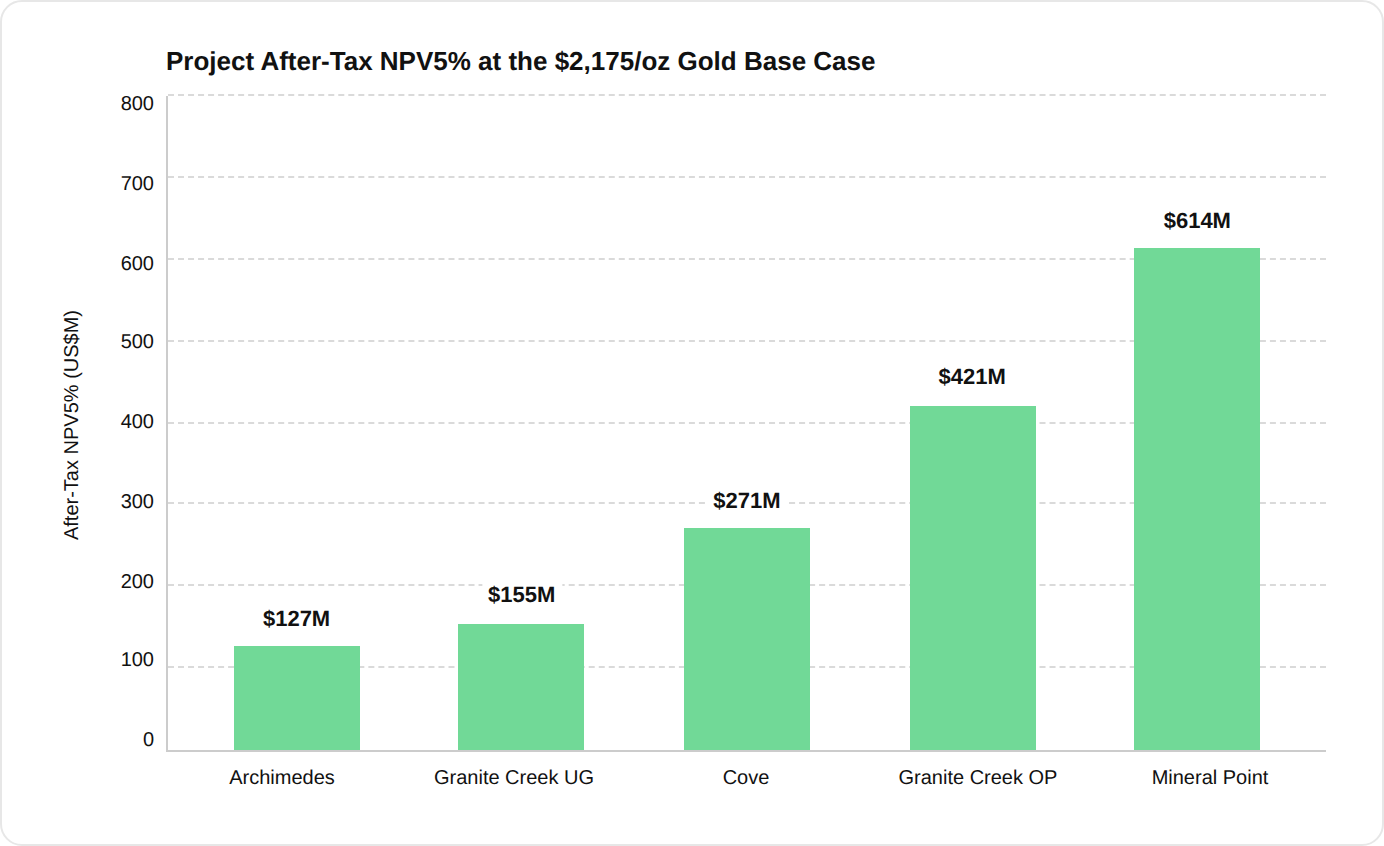
Among the four gold-only projects, Granite Creek Open Pit has the largest base-case value at $421 million with a 30% IRR, rising to $926 million and 52% on an all-in sustaining cost (AISC) of $1,225 per ounce. Cove Underground moves from $271 million at 30% to $626 million at 54%, with an AISC of $1,303 per ounce. Archimedes Underground moves from $127 million at 23% to $644 million at 81%, with the price at $1,893 per ounce. Granite Creek Underground, the only one currently producing, moves from $155 million to $373 million at $1,597 per ounce.
Mineral Point needs separate handling, because its upside case moves two commodity prices at once: gold from $2,175 to $3,000 and silver from $27.25 to $35.00 per ounce. The project holds 3.4 million ounces of indicated gold resource alongside 104.3 million ounces of indicated silver, so the silver assumption is material. Its move from $614 million and 12% to $2,343 million and 29% therefore reflects combined sensitivity, and because Mineral Point is the largest contributor at both price points, the $4.9 billion total embeds both a silver and a gold assumption. Note also that four of the five projects are not producing, so their AISC figures are study estimates rather than demonstrated results, and Mineral Point's $1,400 figure is per ounce of gold equivalent and therefore already includes silver credits.
The Cost Side Has Already Moved
A higher price assumption in the next studies would not arise in isolation, and i-80 Gold has already disclosed where costs have run ahead of the filings. The groundwater impact at Granite Creek Underground is not reflected in its assessment, and the company now expects to mine approximately 20% more material there. At Mineral Point, technical and permitting work has been brought forward from 2028 to 2026, and Archimedes feasibility costs have been brought forward from 2028.
Movement is not all in one direction. i-80 Gold expects Lone Tree refurbishment capital to come in lower in 2026 than guided, stating that management was conservative in estimating that spend during recapitalization planning to ensure sufficient capital was raised. Archimedes spending is expected to be higher, reflecting a decision to build a new worker change facility and additional offices rather than refurbish existing ones. Exploration expense is expected to be approximately $10 million lower due to drill rig availability and contractor staffing shortages. Advancing from a PEA to a feasibility study (FS) also raises the engineering confidence standard, which tends to add cost on its own. So the four studies could raise price assumptions and capital estimates in the same document, and a higher gold price offset by higher capital can produce a lower NPV5% than the assessment it replaces.
President and Chief Executive Officer of i-80 Gold, Richard Young, framed the quarter around physical progress:
"We delivered another solid quarter, with increased production from Granite Creek as the project continued to ramp up on plan, the advancement of Archimedes on schedule toward becoming our second underground mine, and the start of demolition at the Lone Tree Plant."
Broader Context
The pattern extends beyond one company. Development-stage producers routinely carry project economics filed against price decks set when the studies were commissioned, while continuously updating cash flow guidance. Where consensus prices have moved above the filed assumption, published NPVs reflect what a project was worth under a past set of inputs rather than current ones, and they converge only at the pace of each company's study cycle.
i-80 Gold makes the mechanism unusually visible because it states both assumptions in the same document and publishes a combined portfolio total. The company itself frames the resulting gap as a valuation disconnect, noting a market capitalization of $1.4 billion as of August 10, 2026, compared with the $4.9 billion combined figure.
What to Watch Next
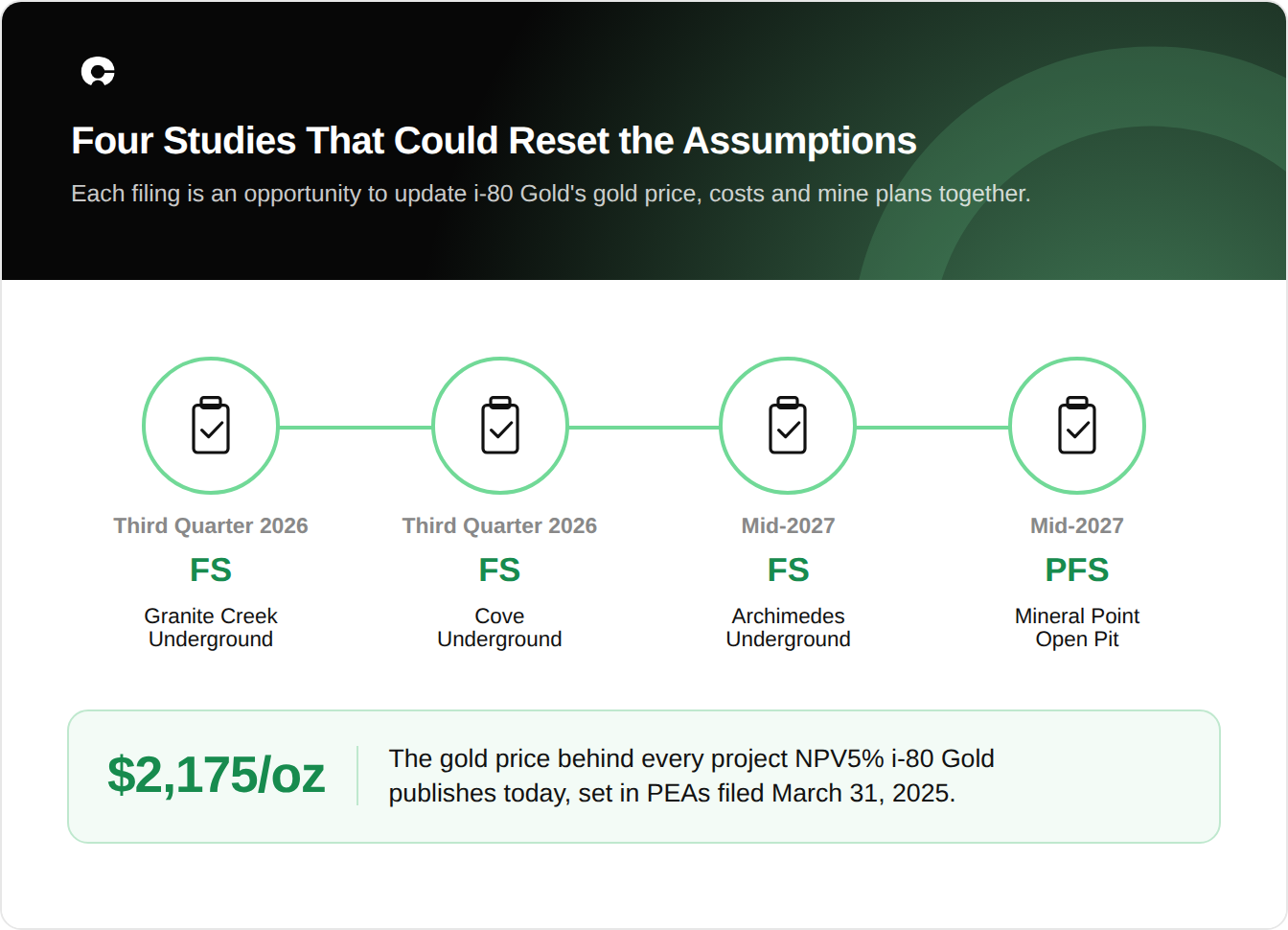
The Granite Creek Underground and Cove Underground FS, targeted for the third quarter of 2026 and unpublished at the time of writing, are the first chance to see which price i-80 Gold carries into a filed study, and whether it moves toward the $3,600 consensus figure it already cites or holds at $2,175. What matters is not the price alone but what moves alongside it, because a higher NPV5% driven by price against materially higher capital is a different result from a higher NPV5% with capital held flat, and only the second reflects a genuine improvement in project economics. Archimedes and the Mineral Point pre-feasibility (PFS) study will follow in mid-2027, with Mineral Point carrying the greatest weight, given $708 million in mine construction capital. Nearer term, the rate at which produced ounces convert into sold ounces, and the Lone Tree Plant refurbishment behind it, remains the test of the operating plan.
Analyst's Notes





Subscribe to Our Channel

.png)



Stay Informed






















