




Abitibi Metals Expands Western Down-Plunge Zone Returning 2.71% Copper Equivalent Over 7 Metres



Abitibi Metals reports B26 drill results in Quebec, extending Western Zone 300m with 2.71% CuEq over 7m, supporting resource growth and 2026 drilling.
Company Overview
Abitibi Metals Corp. [CSE: AMQ | OTCQB: AMQFF] holds an 80% interest in the B26 Polymetallic Deposit in Quebec, a joint venture with SOQUEM Inc., hosting an indicated resource of 12.96 million tonnes (Mt) at 2.08% copper equivalent and an inferred resource of 12.34 Mt at 2.20% copper equivalent per the NI 43-101 resource estimation, located 7 kilometres southeast of the formerly producing Selbaie Mine.
A Deposit That Keeps Growing
Abitibi Metals has released drilling results from B26 that extend the known boundary of the Western Down-Plunge Zone 300 metres beyond the 2024 block model boundary, with the company's 2026 infill and expansion campaigns actively underway.
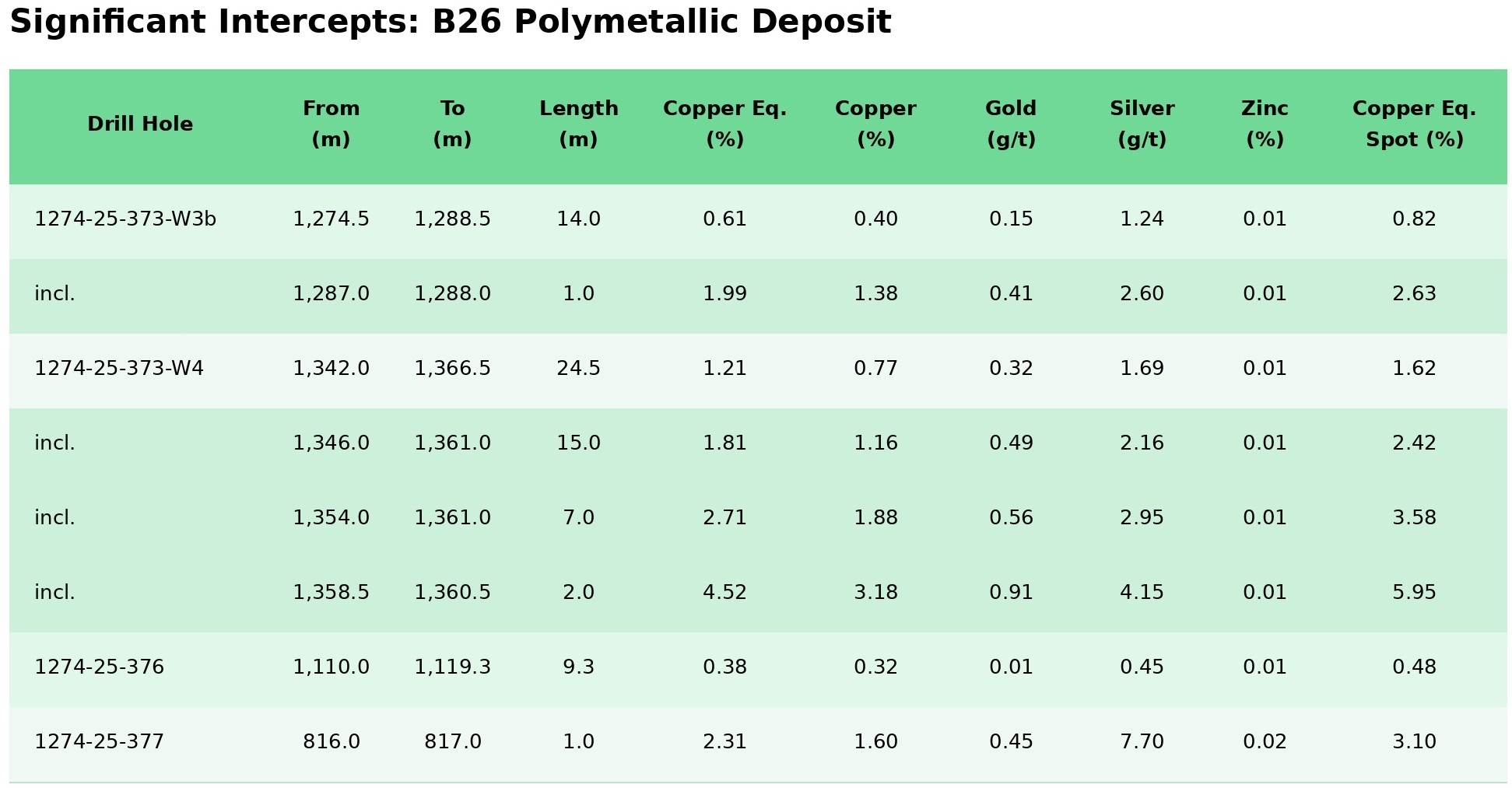
The headline result is 1.81% copper equivalent over 15 metres from 1,346 metres depth, with an inner interval of 2.71% copper equivalent (1.88% copper, 0.56 grams per tonne gold) over 7 metres and a peak of 4.52% copper equivalent over 2 metres.
The spatial extension reinforces management's view of a deeply rooted system. President and Chief Executive Officer of Abitibi Metals, Jonathon Deluce, commented:
"We continue to see strong evidence that mineralisation at B26 remains open and expanding, supporting the presence of a deeply rooted system."
Extending the Block Model by 300 Metres
A prior step-out had already cut the Copper Stringer Zone 150 metres west of the 2024 block model boundary, itself a meaningful extension. The latest step-out was designed to test the zone a further 150 metres beyond that point, and it succeeded in doing so. Taken together, the two results have pushed the known boundary of the mineralised block model 300 metres to the west of the 2024 boundary, a step-change in the spatial extent of the deposit. The High-Grade Copper Stringer Zone remains wide open to the west.
A third drilling result in this series cut the characteristic black chlorite-chalcopyrite envelope of the Copper Stringer Zone at the predicted depth, 70 metres from the prior step-out, confirming geological continuity at that spacing. It returned a lower-grade intercept of 0.61% copper equivalent over 14 metres, including a 1-metre interval of 1.99% copper equivalent. Deluce noted that grade variability within the mineralised envelope is an intrinsic feature of B26, already observed in the shallower portions of the deposit. The 70-metre spacing corresponds to the interval recommended by the company's resource consultant to advance intervals toward the indicated category, and further infill drilling is planned to better define the higher-grade lenses within this portion of the system.
Deluce attributed the grade variability to the step-out strategy and pointed to the resource consequence.
"Importantly, these results are already contributing to the expansion of the overall mineralised envelope, which we believe will translate into meaningful resource growth in the next update."
Large Step-Outs Demonstrate Geological Continuity
Beyond the Western Down-Plunge corridor, two additional step-outs, at approximately 200 metres and over 350 metres from the nearest drilling within the mineralised body, returned lower-grade intercepts but confirmed the persistence of the B26 mineralised system's characteristic dark chlorite alteration halos at distances that materially exceed standard resource definition spacing. The alteration zones measured 22 metres and 13 metres respectively, underscoring the scale of the system and its exploration potential. The deeper step-out also intersected initial mineralisation of 2.31% copper equivalent over 1 metre within a broader, lower-grade halo. The company views these observations as supporting in-hole pulse electromagnetic (EM) surveys to determine whether economic-grade mineralisation is present within the alteration envelopes at these distances.
Significant Intercepts
The table below presents the significant intercepts from this release. Copper equivalent values are calculated using metal prices of $4.50 per pound copper, $1.50 per pound zinc, $28.00 per ounce silver, and $3,000 per ounce gold, with recovery factors per SGS metallurgical test CACGS-P2017-047 (98.3% copper, 90.0% gold, 96.1% zinc, 72.1% silver). Spot copper equivalent values use $5.00 per pound copper, $1.35 per pound zinc, $48.00 per ounce silver, and $3,900 per ounce gold with the same recoveries. Intercept lengths are core lengths; true widths are estimated at 60% to 80% of core length.
Next Steps & Upcoming Catalysts
A third drill rig will be added over the coming weeks, bringing the total rigs to three, with infill drilling continuing within the Copper Stringer Zone at the 70-metre spacing recommended by the company's resource consultant to qualify intercepts for the indicated resource category. Additional assay results from pending drill holes are expected on an ongoing basis, with the company reporting strong visual indications of mineralisation in several of these holes. In-hole pulse electromagnetic (EM) surveys are also being considered as a follow-up for the two large step-out holes to better define the extent of alteration halos at a distance from the known resource.
Deluce framed the programme scale and its resource implications directly:
"Ongoing infill drilling is expected to further delineate higher-grade zones and enhance the project's overall quality. With a planned 40,000 metres of drilling in 2026, we are well-positioned to drive significant growth and unlock the full potential of the B26 Project. We are also encouraged by strong visual indications of mineralisation observed in several pending drill holes, with additional assay results expected over the coming weeks."
Regional drilling has also commenced, with results from that programme to be released as they become available. A resource update incorporating the expansion results is anticipated to reflect meaningful growth in the overall mineralised envelope.
FAQs (AI-generated)
It highlights a high-grade zone within a broader mineralised system, indicating strong metal content and potential economic value within the deposit.
It shows that mineralisation extends beyond previous limits, increasing the overall size and growth potential of the deposit.
This zone hosts high-grade mineralisation and remains open, making it a key target for expanding the resource base at B26.
Copper equivalent combines the value of multiple metals (copper, gold, silver, zinc) into a single metric to simplify grade comparisons.
The company plans continued infill and step-out drilling, adding a third rig, running geophysical surveys, and delivering a future resource update.
Analyst's Notes





Subscribe to Our Channel





Stay Informed


