




State-Held Ground Sets the Pace at Quebec's Selbaie VMS Camp


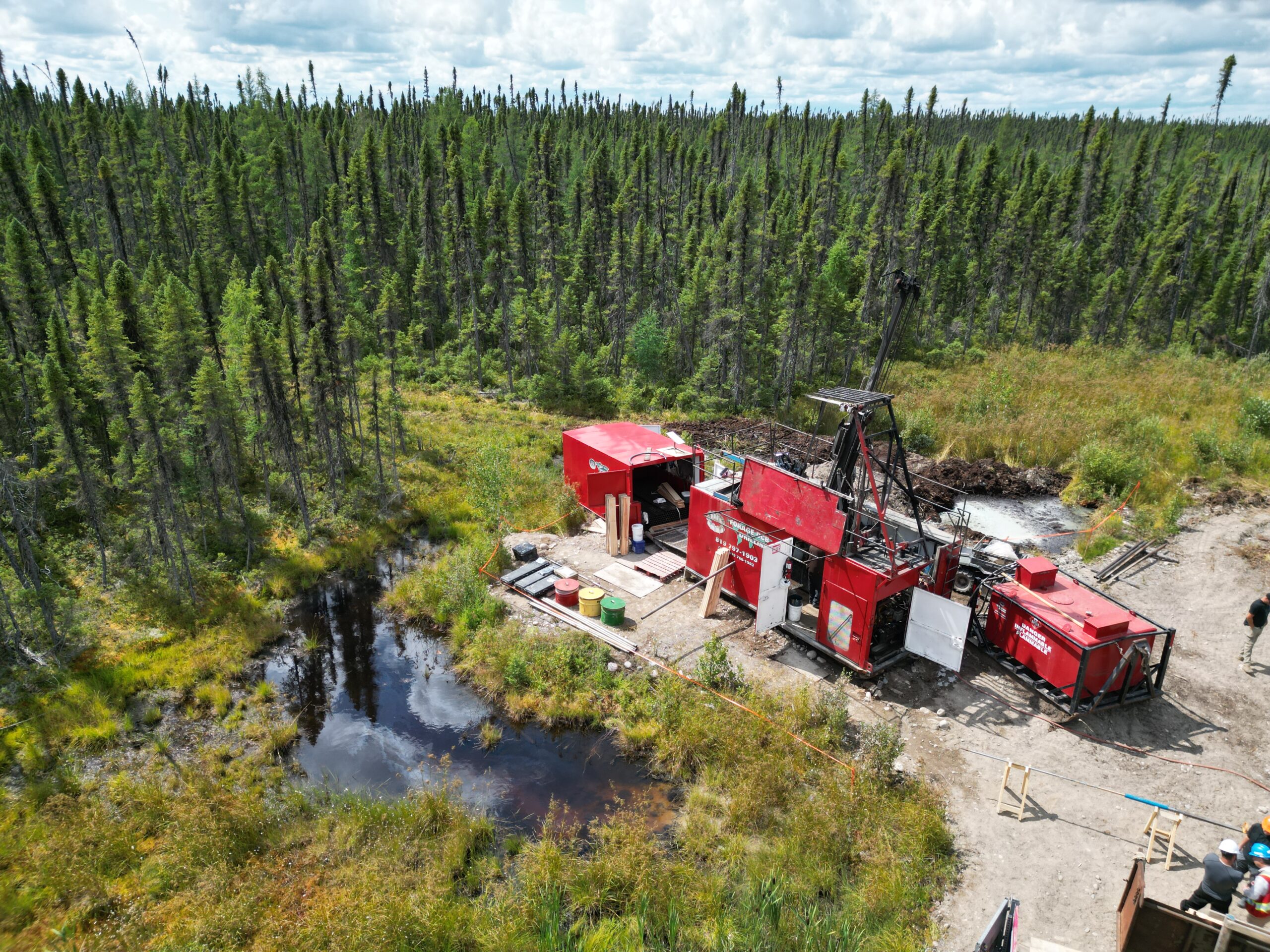
A Quebec state agency holds the ground around the Selbaie camp, so the junior there assembles the district through staged options and a right of first refusal.
- Volcanogenic massive sulfide (VMS) deposits occur in clusters, and management describes the more frequent case in these camps as deposits of 5 to 10 million tons.
- The economic unit in a clustered district is the processing facility, which puts land position ahead of drilling in the sequence.
- Around the Selbaie camp, the prospective ground adjacent to B26 is held by a Quebec state agency rather than by a commercial vendor.
- Juniors reach that ground through staged options, rights of first refusal, and joint technical committees, so technical work begins before commercial terms are in place.
- A right of first refusal fixes queue position but leaves the price, timing, and drilling that determine value in the counterparty's hands.
Volcanogenic massive sulfide (VMS) deposits form in clusters along favorable volcanic stratigraphic horizons, and management describes the more frequent case in these camps as deposits of 5 to 10 million tons. At that scale, a lens is one component of a mine, not a mine in itself, and the facility that treats several of them becomes the unit that has to clear an economic hurdle.
That ordering puts land position ahead of the drill bit. A company can define a single high-grade lens and still be unable to build the development case its geology supports, because the tonnage that would fill a plant over a mine life lies under ground it does not control. Where that ground belongs to a private neighbor, the answer is a transaction at some price. Where it belongs to the state, no transaction may be available at any price, and the whole district thesis then depends on instruments that fall short of ownership.
VMS Clustering & Central-Mill Economics
The geography of the camp governs the economics of development in this deposit style. Lenses repeat at intervals measured in kilometres (km), which produces several modest orebodies across a confined area instead of a single large one.
Camp history sets the ceiling on what that repetition can add up to. The past-producing Selbaie Mine operated for 20 years and produced 53 million tons. This belt can host systems well beyond the 5 to 10 million tons management describes as the more frequent case. A separate historical resource recorded for the same mine stands at 56.9 million tonnes grading 0.87% copper, 1.85% zinc, 0.55 grams per tonne (g/t) gold, and 39 g/t silver.
The development configuration that follows is a single plant drawing from multiple satellite deposits, and acquirers have been paying for assembled districts. Canadian mining mergers and acquisitions (M&A) rose 220% year-on-year in 2025 to C$62.1 billion, led by copper, gold, and critical metals transactions. In 2026, Eldorado Gold agreed to acquire Foran Mining, the developer of the McIlvenna Bay VMS project.
Option Structures & Rights of First Refusal on State Ground
When the surrounding ground is state-held, the instruments available to a junior are contractual rather than transactional. The prospective ground adjacent to B26 is held by SOQUEM Inc., a wholly owned subsidiary of Investissement Quebec, and access to it has been through a staged option and a right of first refusal, not an open sale process.
What juniors obtain instead is a staged earn-in on a single asset, plus a right of first refusal (ROFR) over the surrounding ground. The earn-in transfers ownership of the anchor deposit in exchange for exploration spending and milestone payments, and it can be completed early if the operator meets the milestones and spends ahead of schedule. The ROFR does something narrower: it guarantees the holder a chance to match a third-party offer on the neighboring properties, without setting a price or a date for the holder's own entry.
A third element sits alongside the first two. The agreement established a joint technical committee, which provides the company and the agency with a standing forum to develop the 2 assets in parallel, and technical integration work has begun under it before any commercial agreement regarding the neighboring ground exists. Joint metallurgical testing across 2 separately owned properties, to check whether their materials can share a processing route, is work that would ordinarily follow a deal and here precedes one.
Entry Terms, Counterparty Timing & Seasonal Access Limits
The gap these instruments leave open is control over price and information. A right of first refusal is a queue position, and the value of that position moves with drilling; the holder neither funds nor schedules. Exploration success on adjacent ground raises the cost of entry, the right protects, and the holder learns the result only when everyone else does.
Timing is equally external. An option agreement fixing entry terms has to be negotiated with a counterparty whose mandate, budget cycle, and disclosure obligations are tied to a provincial government, and no amount of drilling by the junior forces can alter that sequence. A 10-year term covers a long stretch of a mine development timetable, and it is also a decade in which the commercial terms of camp consolidation can remain unfixed.
Physical access imposes a third constraint that is easy to underestimate in a northern camp. Drill sites that can only be reached over frozen ground compress regional follow-up into the winter months, which can leave a discovery made in one program without a second hole for the better part of a year.
B26 & the Selbaie Camp
Abitibi Metals (CSE: AMQ | OTCQB: AMQFF | FSE: FW0) works both halves of this problem at once at B26, a polymetallic property 7 km southeast of the past-producing Selbaie Mine. The deposit was optioned and earned from SOQUEM under a 7-year agreement that was completed in 2.5 years. A definitive agreement announced on June 11, 2026, took the company to full ownership by acquiring SOQUEM's remaining 20% interest, and the company confirmed on July 29, 2026, that it owns 100% of the project.
The terms show what the state keeps after selling out of an asset. Consideration at closing was C$5 million in cash and C$2 million in shares, payable within 90 days, with a further C$6 million at feasibility study within 3 years of closing and C$6 million at a construction decision within 5 years. SOQUEM retains a 1% net smelter return (NSR) royalty, half the previous rate, and a 10-year right of first refusal covers the adjacent Wagosic and Carheil projects, which the agency still owns.
President and Chief Executive Officer of Abitibi Metals, Jonathon Deluce, treats the neighboring ground as future mill feed:
"We see that as a very strong standalone potential resource-stage project that could feed into a central development in the camp that feeds a central mill, with the flagship asset being B26, but complemented by other assets in the surrounding camp. I think that's what comes together to produce a tier one district and something that the majors are really fighting for."
The owned ground is where that case has to be built, and the 2026 program was the first systematic test of it. 4 holes totaling 3,285 metres (m) tested 3 of the 7 priority regional targets, returning 1.13% zinc and 51.51 g/t silver over 14.25 m from 455.75 m depth about 1.5 km west of the deposit, and 8.85 m at 0.47% copper equivalent plus 1 m of 332 g/t silver and 0.83 g/t gold at 501 m depth on a parallel trend 4.5 km north. That northern trend lies along strike from the historical Selbaie Mine; mineralization there is open in all directions, and no earlier hole had tested the corridor below 200 m vertical depth. Before Abitibi, the property yielded 123,787 m in 297 holes at an estimated $20,000,000 exploration budget, yet the mineralized intercepts annotated on the regional map begin at downhole depths such as 129.5 m and 284.3 m. Three historical holes drilled on an induced polarization anomaly cut a mineralized envelope over a 200 m strike length that remains open laterally and at depth, a scope that settles nothing about the 8.3 km of each trend, which still carries limited past exploration.
State Landholding & Development Objectives in Quebec
A state counterparty changes the character of the negotiation without making it easier. An agency owned by Investissement Quebec is bound by a mandate for provincial employment and economic value, so it wants the camp developed and is not indifferent between a buyer who will build and one who will hold. Many of Quebec's multi-million-ounce-equivalent developers have been acquired over the past 2 years, and the province offers year-round road access and substantial pre-existing infrastructure across the belt.
Deluce separates what the right of first refusal already secures from what has yet to be negotiated:
"We will continue to work towards structuring an option agreement that is able to cement our exact entry into both projects, which is still to be determined, but it is supported by the fact that we do have the ROFR in place. I can't speak on the government's behalf, but their alignment of this being the camp developed to create jobs and value for the province, everything aligns with what we're trying to do with the company."
Entry terms are undetermined, and the alignment described is one of the objectives, not of the contract. Meanwhile, the ground under the right of first refusal has itself been drilled by the Quebec government, and management describes the result there as a new standalone discovery, which moves the value of Abitibi's queue position without Abitibi touching a drill.
Industry Outlook
Camp consolidation in state-landholding jurisdictions is constrained by the sequencing of agency decisions more than by geology or capital. The geology is mapped, the acquisition bid for assembled districts is documented, and a junior with a funded program can prove its own ground on its own timetable. None of that shortens the interval between holding a ROFR and owning the ground it covers.
The practical response is to build the case that makes exercising the right worth its eventual price: proving the corridors continue on owned ground, running shared metallurgical work before terms are struck, and reaching an economic study that gives the camp a number. Abitibi is targeting an updated resource and a preliminary economic assessment for the first quarter of 2027, with environmental baseline work and Indigenous and community engagement across 2026 and 2027, and stage two metallurgical and geotechnical testing through 2026. Follow-up drilling on the western zinc-silver zone is planned for winter 2027, and all 4 existing regional holes are to be surveyed with downhole electromagnetic (EM) methods on resumption of work. The scarcity of developable copper-gold districts pushes acquirers toward camps instead of single deposits, while state landholding slows the assembly of exactly those camps.
For Deluce, the acquisition record follows from a shortage of remaining targets:
"Quebec is a very sought-after jurisdiction. A lot of the multi-million ounce equivalent developers have been taken over the last 2 years, and I don't think this M&A will stop."
Where the state holds the ground, that tension will be resolved less by what juniors discover than by when agencies decide to sell.
FAQs (AI-Generated)
Analyst's Notes





Subscribe to Our Channel





Stay Informed






















