




Atlas Salt & CN Explore Rail Logistics to Cut Delivered Salt Costs


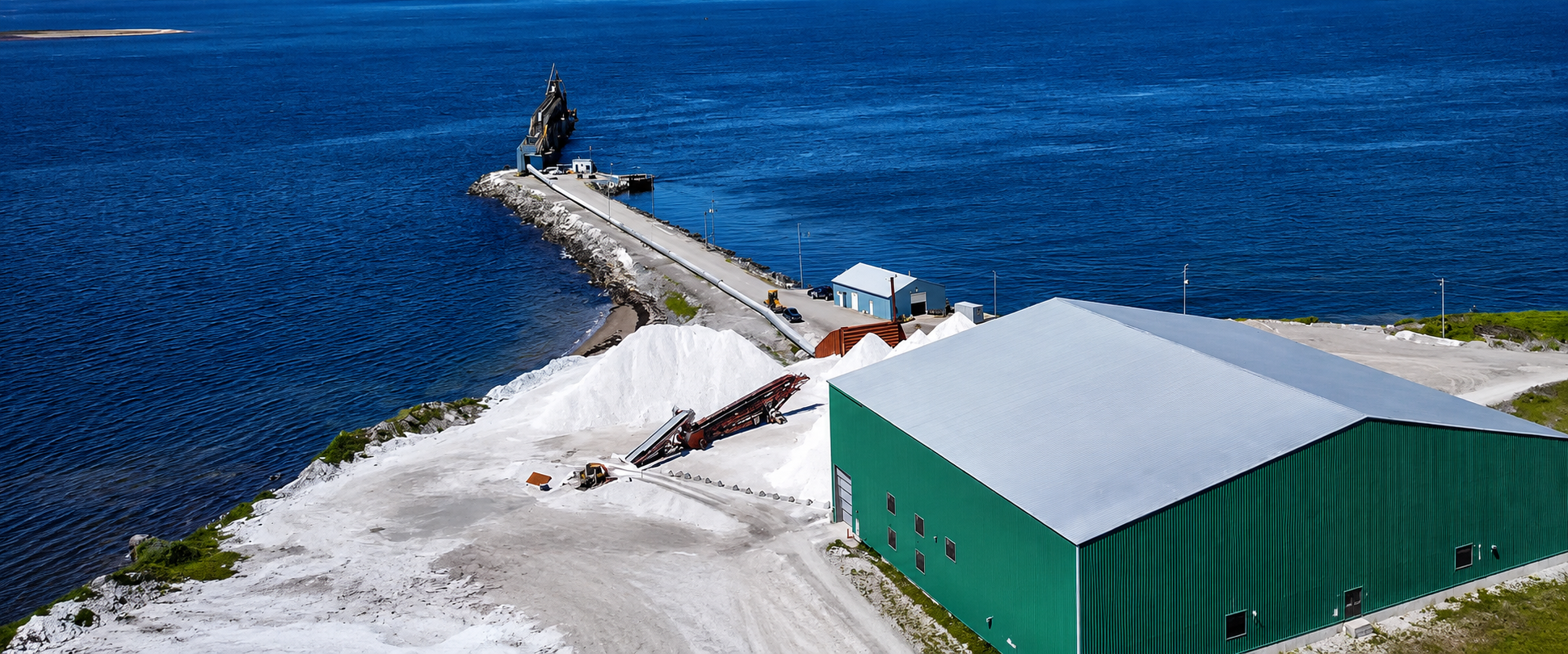
Atlas Salt and CN explore rail logistics for Great Atlantic, targeting lower delivered salt costs, broader markets, and potential upside to project economics.
- Atlas Salt has entered into a non-binding Memorandum of Understanding (MOU) with Canadian National Railway Company (CN) to explore multimodal rail solutions for distributing de-icing salt from the Great Atlantic Salt Project.
- The Company's all-in sustaining cost (AISC) of $34.9 per ton is quoted free-on-board (FOB) at Turf Point, and its cost-advantage narrative focuses on the marine leg versus overseas imports, leaving the post-port trucking leg the MOU targets unpriced in current disclosures.
- Under the MOU, Atlas Salt and CN intend to explore rail movement on CN-served lanes, railcar supply and equipment solutions, and transload arrangements that link Atlas Salt's marine distribution to CN's inland rail network and logistics partnerships.
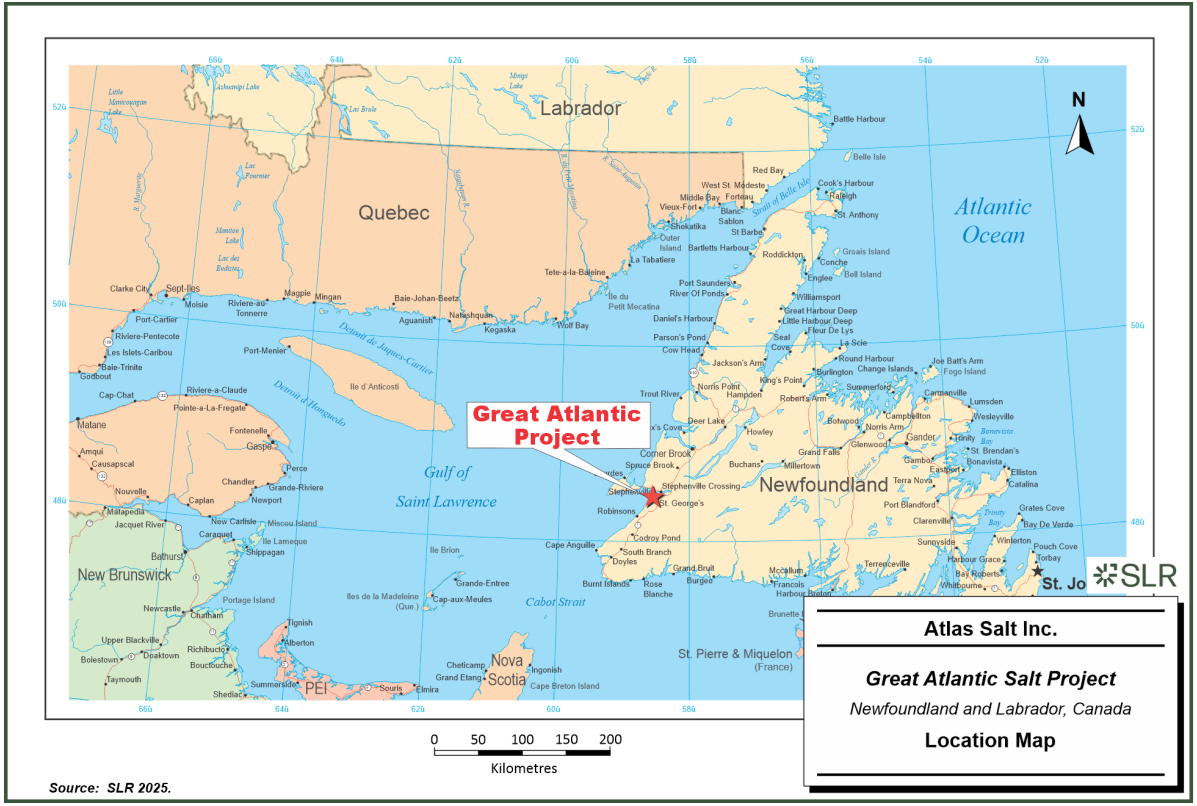
- Atlas Salt plots Charlotte, Washington, Philadelphia, New York, Boston, Montreal, Toronto, Ottawa, and Thunder Bay on a map illustrating its shipping-time edge over overseas imports; several inland points sit beyond an efficient truck haul from a coastal port.
- The MOU is non-binding and does not commit either party to a definitive agreement; the parties intend to jointly develop the scope, terms, and commercial framework of a potential partnership.
Atlas Salt Inc. (TSXV: SALT | OTCQX: SALQF | FSE: 9D00) has spent weeks updating investors on construction, permitting, and financing at the Great Atlantic Salt Project in Newfoundland and Labrador. Its latest announcement shifts the question: not whether the mine gets built, but how far the salt can travel once it leaves, and at what cost. A non-binding rail Memorandum of Understanding (MOU) with Canadian National Railway Company (CN) points at a segment of the project that neither the feasibility study (FS) nor the Company's own cost-advantage story has priced.
What the MOU Covers
The non-binding MOU sets up a framework for Atlas Salt and CN to jointly evaluate CN's bulk-freight rail network and related logistics relationships. It sits alongside the Company's existing marine-centric model, under which product ships by vessel from the Port of Turf Point to discharge ports along the eastern seaboard. Three areas are named for exploration: rail movement on CN-served lanes, railcar supply and equipment, and transload arrangements linking marine distribution with CN's inland network and logistics partnerships. Atlas Salt frames rail as a complement, not a replacement, and the MOU commits neither party to a definitive agreement.
A Cost Line Neither Disclosed Metric Currently Prices
The MOU carries more weight than a standard partnership update because of the way Atlas Salt's numbers are structured. The 2025 updated FS, which supports the project's after-tax net present value at an 8% discount rate (NPV8%) of $920 million, reports an all-in sustaining cost (AISC) of $34.9 per ton on a free-on-board (FOB) basis at Turf Point. That figure stops at the port. It does not capture marine freight to a discharge port, or the trucking leg from that port to the final customer, the leg the FS assumed would carry almost the entire distribution once product reached shore.
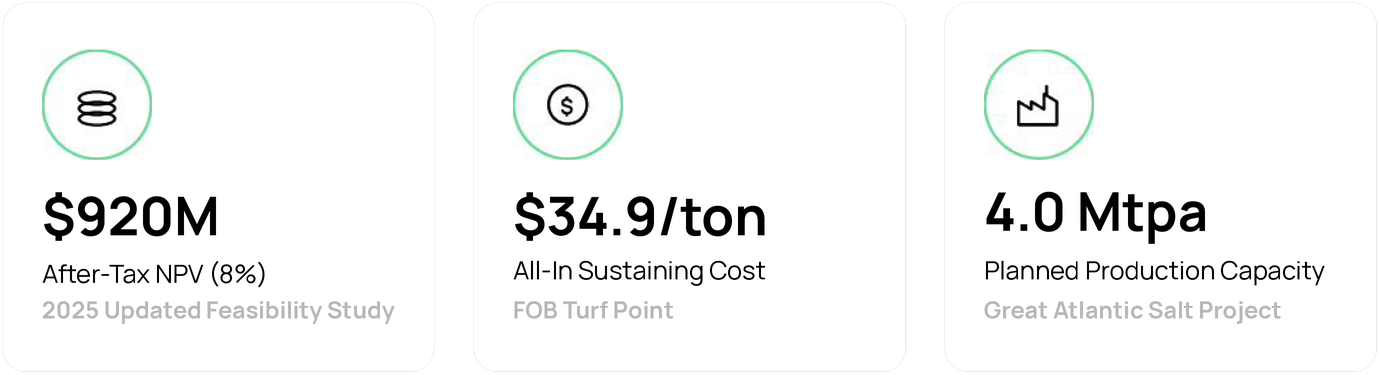
Atlas Salt's investor materials have so far framed logistics advantage in a different part of the chain. The Company's presentation measures that advantage by the spread between cost, insurance, and freight (CIF) and FOB pricing, the basis on which it positions itself against salt imported from Egypt and Chile, citing a roughly 3-day shipping window to Boston, compared with more than 14 days for those overseas competitors. That framing covers the marine leg, where Atlas Salt already holds a structural edge. It says nothing about the inland leg from the discharge port to the customer, the exact segment the CN MOU targets, and the one neither disclosure has priced.
Rail & the Addressable Market Question
Atlas Salt's own market materials estimate the North American de-icing salt market at 28.5 to 36 million tons annually, worth $2.3 to $2.9 billion. Atlas Salt plots Charlotte, Washington, Philadelphia, New York, and Boston on the coast, and Montreal, Toronto, Ottawa, and Thunder Bay further inland, on a map illustrating its shipping-time edge over overseas imports.
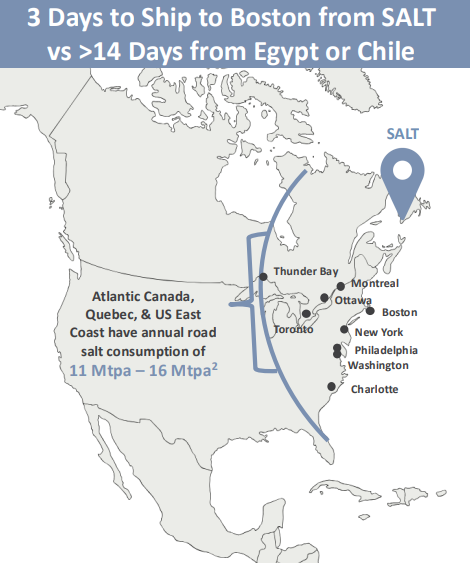
At a planned 4.0 million tons per year, Great Atlantic Salt is sized to serve a small fraction of that market on tonnage alone. The more relevant constraint may be how much of that footprint can be reached at a delivered cost that beats regional incumbents and ongoing imports, rather than the size of the reserve base.
A marine-only model naturally favors coastal discharge points close to Turf Point's shipping lanes, leaving inland centers such as Montreal, Toronto, or Ottawa dependent on the cost of the leg beyond the dock. That is precisely the leg the CN MOU proposes to test, and the reason rail reads as a lever on reach rather than an operational footnote.
Chief Executive Officer and Director of Atlas Salt, Nolan Peterson, tied the MOU to that same cost discipline:
"Logistics is the single largest driver of delivered cost in the de-icing salt business, and we are systematically engineering every leg of our supply chain to maximize our competitive advantages. Collaborating with a partner of CN's caliber to explore building out the rail component of our strategy is an important step, and it reflects the disciplined, cost and value focused approach we are taking across the Project."
Construction Continues in Parallel
Site work continues alongside the logistics discussion. Ground conditions at Great Atlantic Salt are coming in drier than engineers had modeled, an outcome that could meaningfully ease excavation of the project's 1.5 kilometer drift. That progress runs alongside earthworks, subgrade preparation, and site infrastructure planning, under the Town of St. George's permitting process, which now covers the early works program with a single approval.
Peterson has described that kind of early de-risking as central to how he runs the project:
"The more you can telegraph or have those discussions sooner rather than later, the better. Nothing worse than getting to start your drift development and the ground is completely different than expected. So, the sooner you start to see what the conditions are like, the sooner you start to amass that knowledge, the more comfortable you get and the more comfort you can give your lenders and backers."
What to Watch
The CN MOU is an early, non-binding step. Atlas Salt has not disclosed a timeline for when rail lanes, railcar arrangements, or transload terms might move toward a definitive agreement. Investors modeling the project off the 2025 updated FS should treat any delivered-cost or market-reach benefit from rail as upside to that study's trucking-based assumption, rather than as already reflected in the $920 million NPV8% figure or the $34.9 per ton AISC. Three markers are worth watching: whether the MOU converts into named lanes or committed volumes, whether inland markets such as Montreal or Toronto begin to appear in offtake discussions, and whether future disclosures start to break out delivered cost separately from the FOB Turf Point metrics reported to date.
FAQs (AI-Generated)
Analyst's Notes





Subscribe to Our Channel



.jpg)



Stay Informed


