West Red Lake Gold & Madsen: Shaft Refurbishment Targets Lower Costs & 2,000 Tonnes Per Day


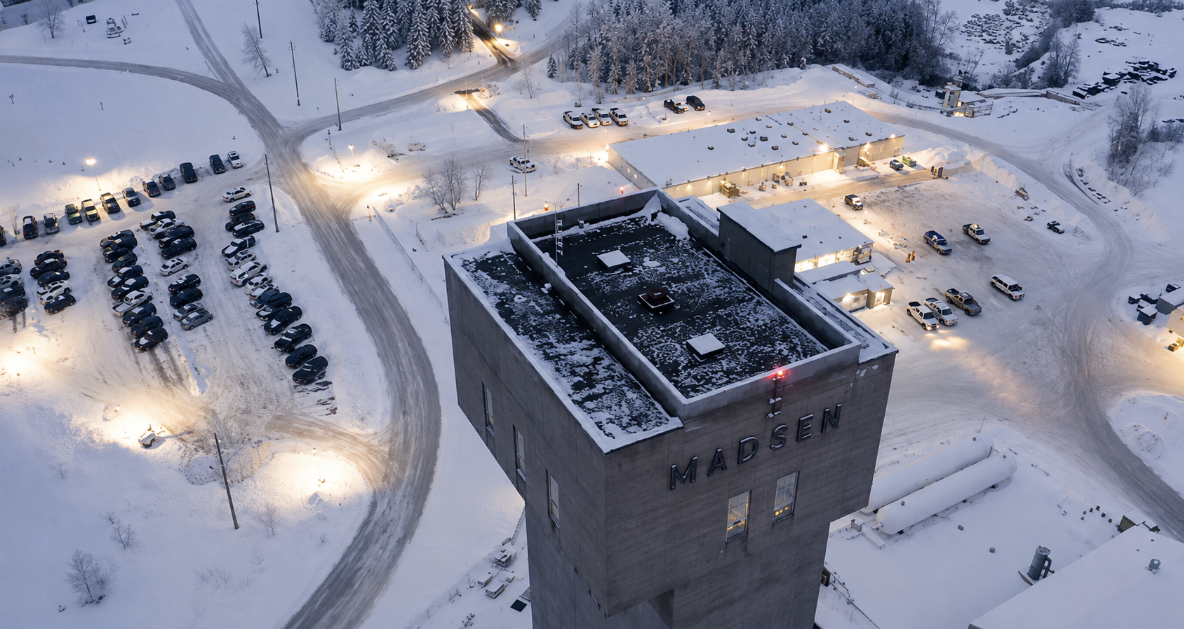
West Red Lake Gold advances Madsen shaft refurbishment, targeting lower costs and 2,000 tonnes per day of vertical hoisting capacity by 2028.
- West Red Lake Gold completed Phase 1 of the Madsen Shaft refurbishment, establishing a vertical hoisting capacity of approximately 200 tonnes per day.
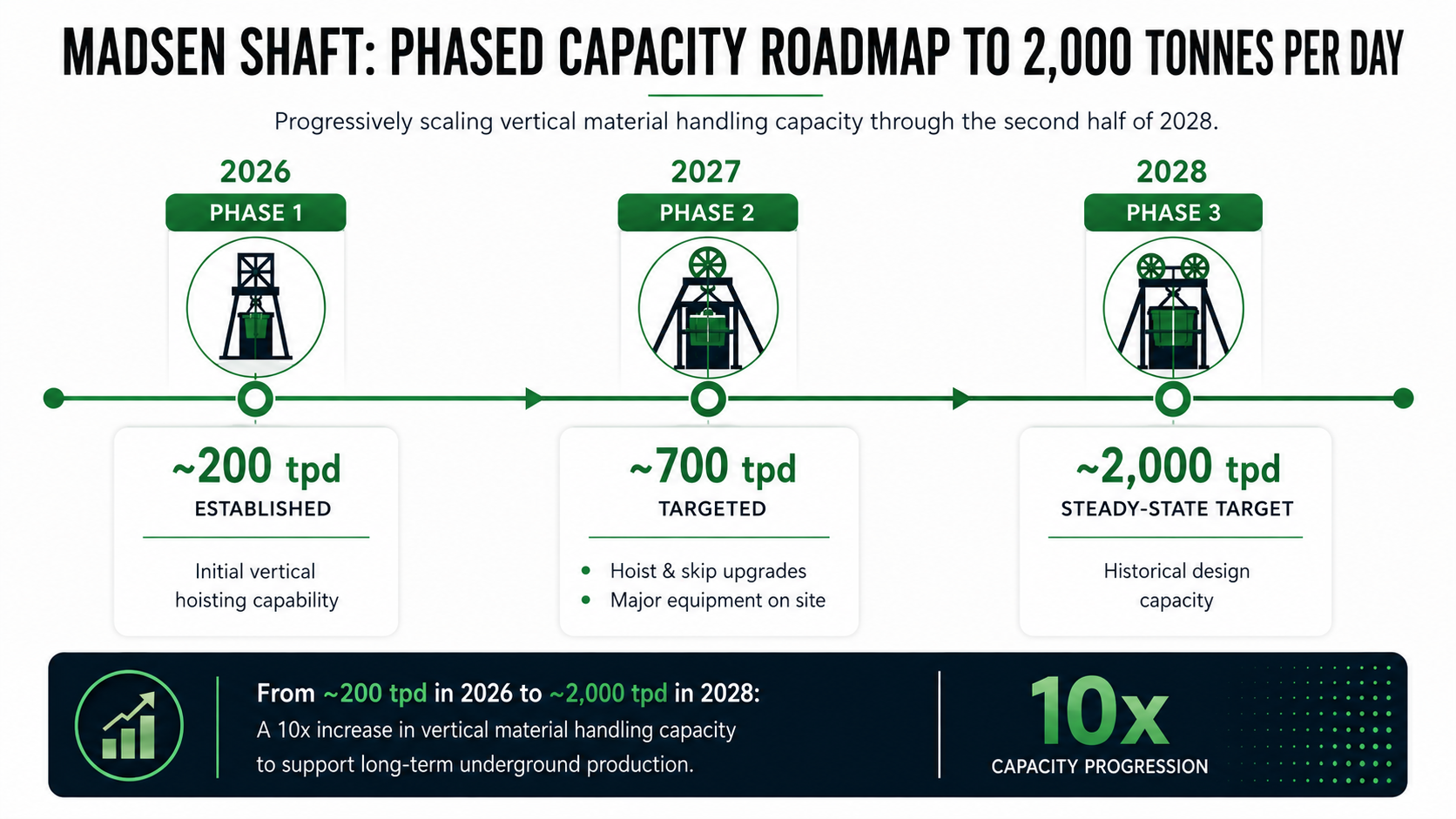
- Madsen’s shaft capacity is targeted to increase to approximately 700 tonnes per day in the second half of 2027 and 2,000 tonnes per day in the second half of 2028.
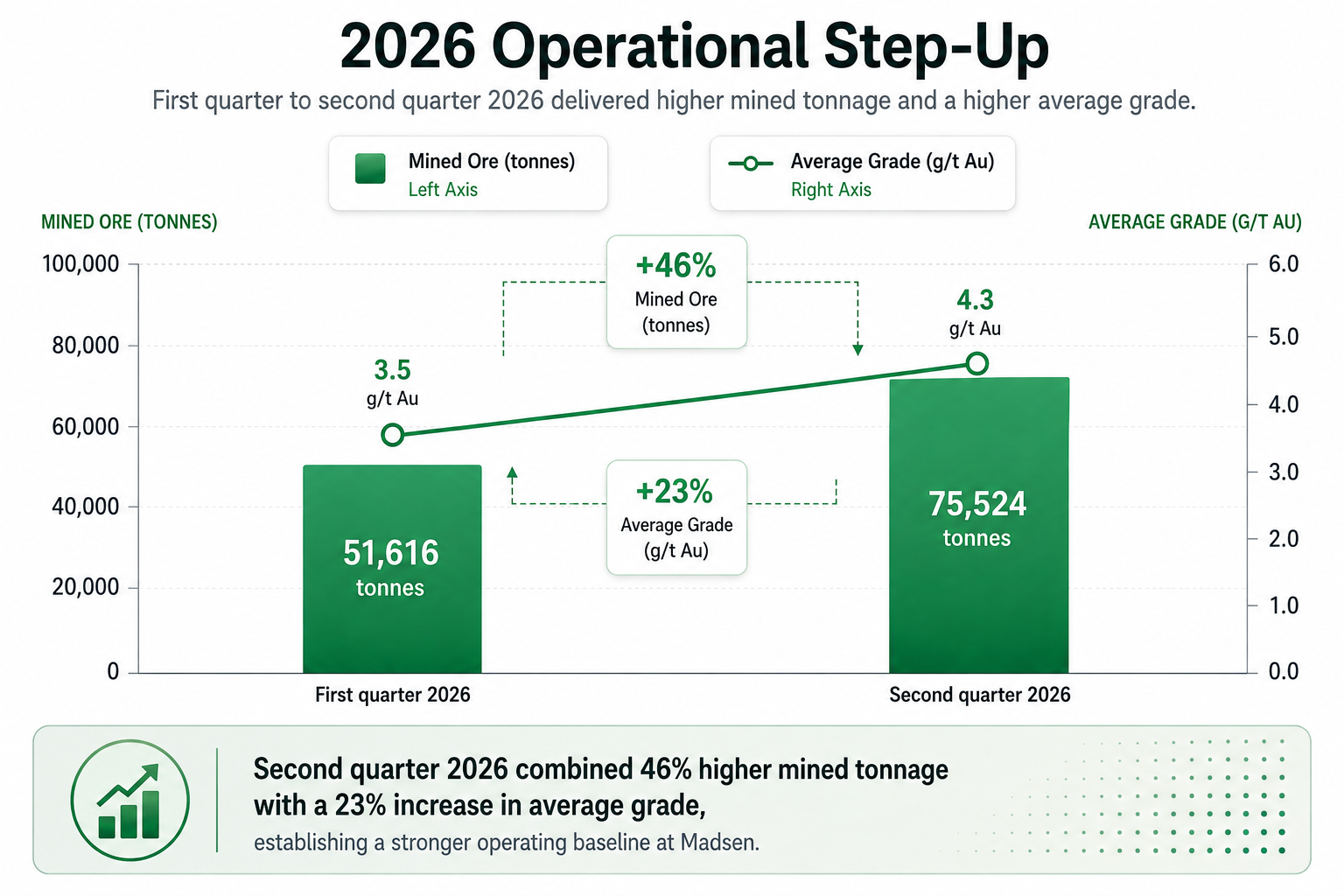
- Second-quarter 2026 mined ore increased 46% to 75,524 tonnes, while average gold grade increased 23% to 4.3 grams per tonne.
- Underground mining rates exceeded 1,000 tonnes per day from mid-quarter onward, while the permitted mill capacity remains at 800 tonnes per day, supporting surface stockpile growth.
- The next major catalysts are the joint Madsen-Rowan Pre-Feasibility Study (PFS) in the third quarter of 2026, Phase 2 shaft upgrades, and delivery against 2026 production guidance of 35,000 to 45,000 ounces of gold.
What Has Happened
West Red Lake Gold Mines Ltd. (TSXV: WRLG | OTCQX: WRLGF) has completed Phase 1 of its vertical shaft refurbishment at the Madsen Mine, demonstrating the capability to safely hoist waste rock and gold-bearing ore as the company continues its 2026 production ramp-up. Announced on August 13, 2026, the milestone establishes a functional vertical material-handling system that reduces reliance on long-distance underground truck haulage and complements Madsen's transition to bulk underground long-hole open stoping. The phased commissioning approach allows the company to progressively test and stabilize the hoisting system while advancing toward higher-capacity targets through the second half of 2028. West Red Lake Gold declared commercial production at Madsen on January 1, 2026, and identifies the shaft refurbishment program as a driver of lower unit operating costs and improved capital efficiency.
Dual-Haulage Mechanics & Fleet Modernization Synergies
Integrating the vertical shaft with the underground mobile fleet creates a highly flexible, dual-path material transport system designed to reduce underground haulage distances and lower tire and mechanical wear and tear on underground trucks. Rather than replacing underground trucking, the vertical shaft operates as a complementary logistical system. Underground trucks will continue to haul gold ore and waste from active stopes to the shaft loading stations on Level 10, located approximately 500 meters below the surface. The vertical shaft then handles high-lift haulage to the surface, eliminating long underground truck ramp journeys and directly reducing diesel fuel consumption and maintenance requirements.
This logistical optimization is progressing alongside a comprehensive fleet modernization program. The company directed significant capital last year toward purchasing brand-new underground trucks and loaders. This dual-haulage framework is highly timely, as the second-quarter 2026 operating statistics show a significant scale-up in operations. Average mining rates reached 878 tonnes per day, and average mill throughput reached 842 tonnes per day, compared with 573 tonnes per day and 572 tonnes per day, respectively, in the first quarter of 2026. This dual-path haulage setup provides a highly flexible material-handling system that scales with increasing mining rates, ensuring the mill remains fully utilized.
"We're getting that 75% to 80% availability. We're getting those materials in, we're getting the people we need, and so that's how all helping the transformation."
This dual-haulage framework is highly timely, as the second-quarter 2026 operating statistics show a significant scale-up in operations. Average mining rates reached 878 tonnes per day, and average mill throughput reached 842 tonnes per day, compared with 573 tonnes per day and 572 tonnes per day, respectively, in the first quarter of 2026. This dual-path haulage setup provides a highly flexible material-handling system that scales with increasing mining rates, ensuring the mill remains fully utilized.
Technical De-Risking via Model Reconciliation & Mining Shifts
A rigorous focus on geological model predictability and a transition to bulk long-hole open stoping have structurally de-risked the operational profile of the Madsen deposit, increasing gold recovery predictability. A primary technical risk identified by historical operators at the Madsen Mine was reconciling the geological model. To address this, the company has completed over 200,000 meters of underground definition drilling. This high-density drilling has allowed the company to define the deposit far ahead of the active mine plan, ensuring tight model-to-mill reconciliation and predictable gold recovery rates, which remained stable at 95.0% during the second quarter of 2026.
This geological predictability has supported a critical transition in mining methodology. While previous operators planned a high-cost cut-and-fill mining method, West Red Lake Gold has successfully used bulk long-hole open stoping for 100% of its underground extraction to date. This shift has been aided by higher gold prices, which lowered the economic cut-off grade and allowed smaller, adjacent gold mineralization to be incorporated into wider, highly productive stopes.
Williams highlighted that underground mining rates consistently averaged above 1,000 tonnes per day from mid-quarter onward, exceeding the mill's current permitted capacity of 800 tonnes per day. Williams explained the physical significance of stabilizing these development rates and building surface stockpiles:
"The mine is doing about a thousand tonnes of material on the ground a day, or very consistently every day. We've done, and going into the back end of the year, it'll be about a thousand tonnes of material every day underground. Our mill can do about 800 permanent, so that gives you the balance of that stockpile. It's building five or six thousand tonnes every month of a stockpile ahead of our saps."
At the end of the second quarter of 2026, the company reported a surface stockpile of 10,768 tonnes of high-grade ore, containing approximately 1,500 ounces of gold. This surface inventory provides approximately 0.5 months of mill feed buffer, insulating processing operations from temporary delays in underground stope sequencing.
Capital Arbitrage & Sunk Infrastructure Leverage
Refurbishing the existing shaft leverages more than $500 million in historical and modern sunk capital to bypass the massive capex requirements typical of junior gold developers, protecting shareholders from dilutive equity financing. The company's business model is fundamentally built on infrastructure leverage and capital efficiency within a tier-1 mining jurisdiction. The Madsen Mine camp holds more than $350 million in prior underground and surface investments, supplemented by approximately $150 million in capital deployed by the company since its acquisition. This massive aggregate footprint represents an exceptional capital arbitrage opportunity for the company.
Constructing a modern, fully permitted 800 tpd processing mill and sinking a deep vertical shaft from scratch are multi-hundred-million-dollar endeavors that typically require years of permitting, engineering, and construction. By refurbishing and progressively commissioning the existing vertical shaft, which historically operated for approximately five decades to Level 26, the company bypasses these capital hurdles. This infrastructure leverage allows the company to allocate its treasury cash directly toward exploration drilling and active underground mine development rather than redundant surface installations.
Operational Cash Flow Inflection & Financial Transition
The technical scale-up of the underground mine has successfully driven the company’s transition from financial cash breakeven in the first quarter of 2026 to active cash accumulation on the balance sheet in the second quarter of 2026, enabling debt repayment. Operational cash flow is the ultimate validator of mining execution. During the first quarter of 2026, operations at the Madsen Mine achieved a financial cash break-even baseline. As underground mining rates increased and average grades rose during the second quarter of 2026, the operation transitioned to active cash accumulation. This financial turnaround reflects the direct operational impact of higher mined ore tonnage and improved reconciliation of geologic grades.
This positive cash generation has substantial strategic value, enabling the company to build its balance sheet cash, which stood at approximately C$36 million on March 31, 2026, and begin paying down outstanding debt obligations.
Williams commented on how cash generation and debt service are being monitored alongside the production ramp-up:
"Getting that cash flow, are we building cash on the balance sheet? Are we gradually building that up over time? Because we've also started paying debt now. We took on some debt. We've debt loads to pay. So as we're ramping up, it's the right time to be ramping up because we're paying debt. So all those are good metrics as we're ramping up."
What to Watch Next
West Red Lake Gold Mines Ltd.'s phased Madsen Shaft expansion is shifting the company's risk profile from infrastructure construction toward operational execution and capacity scaling. Phase 2 targets approximately 700 tonnes per day in the second half of 2027 through hoist and skip upgrades, with major equipment already on site, while Phase 3 targets approximately 2,000 tonnes per day in the second half of 2028, restoring the shaft to its historical design capacity. Over the next 12 months, investors should watch for the joint Pre-Feasibility Study (PFS) expected in the third quarter of 2026, which will combine Madsen with the high-grade Rowan satellite deposit and model the integration of Rowan's 334,825-ounce Indicated Resource grading 13.03 grams per tonne with the central Madsen Mill. Other key milestones include progress on the Phase 2 hoist and skip upgrades, maintaining underground mining rates above 1,000 tonnes per day, and achieving 2026 production guidance of 35,000 to 45,000 ounces of gold as mining advances into the high-grade 904 and 4447 complexes.
FAQs (AI-Generated)
Analyst's Notes





Subscribe to Our Channel





Stay Informed