




Abitibi Metals Step-Out Drilling Extends the System Footprint: 7 Things You Need to Know


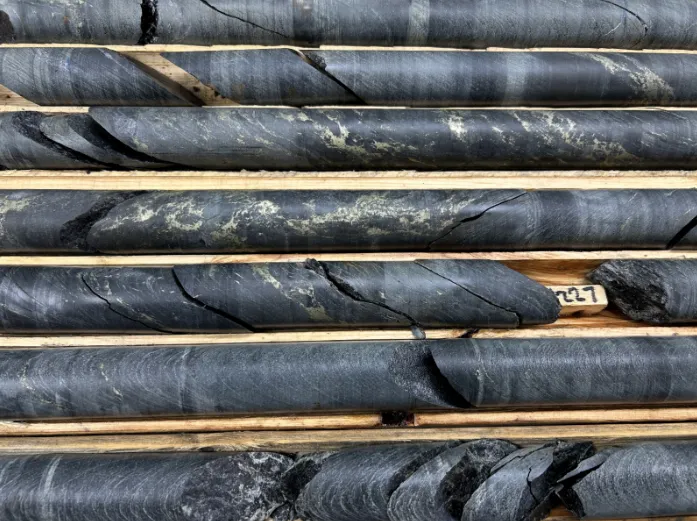
Abitibi Metals expands B26 with 150m step-out drilling, extending Western Plunge 300m beyond model limits, signalling resource growth and stronger re-rating potential.
Project Overview
Abitibi Metals Corp. (CSE: AMQ | OTCQB: AMQFF | FSE: FW0) released drill results confirming the expansion of the high-grade Western Down-Plunge Zone at its B26 Polymetallic Deposit in Quebec. The headline intercept, 1.81% copper equivalent over 15 metres, including 2.71% copper equivalent over 7 metres, comes from a hole drilled 150 metres beyond the previous step-out, collectively pushing the Western Plunge footprint 300 metres beyond the 2024 block model boundary. For Abitibi Metals, which holds an 80% interest in B26 in a joint venture with SOQUEM Inc., a subsidiary of Investissement Quebec, these are not routine infill results. They confirm that the Western Down-Plunge Zone extends beyond the 2024 block model boundary, with step-out drilling adding mineralised strike length that is not yet captured in the current resource estimate.
1. The 150-Metre Step-Out: Confirming the Western Plunge Remains Open
The headline result extends the Western Down-Plunge Zone to a total of 300 metres beyond the original 2024 block model boundary, confirming that the Copper Stringer zone is not closing to the west. The latest step-out hole intersected 1.81% copper equivalent over 15 metres starting at 1,346 metres depth, including a higher-grade interval of 2.71% copper equivalent over 7 metres, which itself contains a peak of 4.52% copper equivalent over 2 metres. The constituent grades of the 7-metre interval are 1.88% copper and 0.56 grams per tonne gold. The previous step-out already extended the deposit 150 metres west of the 2024 block model, and the latest hole stepped another 150 metres beyond that.
2. Grade Variability Is a Feature of the Deposit Architecture
One infill hole, drilled 70 metres from the previous step-out, returned only 0.61% copper equivalent over 14 metres, well below the grade of the flanking holes. The company addressed this directly, characterising grade variability as an intrinsic feature of the deposit already observed in its shallower portions. The purpose of this hole was to generate a cut at 70-metre spacing to meet the threshold required for upgrading resources to the Indicated category under the resource consultant's criteria.
This result is best understood within the context of the campaign's objectives rather than as a reversal. The high-grade Copper Stringer zone contains lenses of elevated copper concentration within a broader mineralised envelope. Infill drilling at 70-metre spacing is required to meet the resource consultant's threshold for upgrading material from the Inferred to the Indicated category, which carries direct implications for the confidence level assigned to future resource estimates. A 1-metre interval within this hole returning 1.99% copper equivalent confirms that economic-grade material exists within the intercept, even if the composite grade is lower.
3. The 200 to 350-Metre Step-Outs: Geological Continuity Without Economic Grades Yet
The two most aggressive step-out holes in the programme were drilled 200 metres and over 350 metres respectively from the nearest holes within the mineralised body. Neither returned a commercial-grade composite intercept. However, both intersected the characteristic dark chlorite alteration halos that define the B26 mineralised horizon, confirming geological continuity across these distances. The 200-metre step-out measured an alteration zone of 22 metres, and the 350-metre step-out measured 13 metres. The latter also intersected an initial mineralised interval of 2.31% copper equivalent over 1 metre within the broader halo.
These holes are reconnaissance drilling designed to map the outer boundaries of the system and identify where economic-grade structures may eventually be found. The company indicated that in-hole Pulse Electromagnetic (EM) surveys are planned as a follow-up.
4. The Copper Equivalent Calculation: Base-Case & Spot Pricing Assumptions
The copper equivalent metric cited throughout the release uses base-case commodity prices of 4.50 dollars per pound of copper, 3,000 dollars per ounce of gold, 28.00 dollars per ounce of silver, and 1.50 dollars per pound of zinc, with recovery factors derived from SGS metallurgical testing. A separate spot copper equivalent column in the intercept table applies 5.00 dollars per pound of copper, 3,900 dollars per ounce of gold, 48.00 dollars per ounce of silver, and 1.35 dollars per pound of zinc, producing materially higher equivalent grades across the same intervals.
The base-case and spot copper equivalent calculations produce materially different reported grades across the same intervals, as shown by the headline 7-metre interval moving from 2.71% copper equivalent under base-case pricing to 3.58% copper equivalent under spot pricing. The 2-metre peak interval moves from 4.52% copper equivalent to 5.95% copper equivalent. The recovery factors applied, 98.3% for copper, 90.0% for gold, 96.1% for zinc, and 72.1% for silver, reflect testwork conducted by SGS.
5. The Resource Base: What Exists & What These Results Are Adding To
The current mineral resource estimate, effective November 1, 2024, comprises two categories: 12.96 million tonnes Indicated at 2.08% copper equivalent and 12.34 million tonnes Inferred at 2.20% copper equivalent. The recent results do not yet modify these figures, but the company confirmed that step-out drilling is extending mineralisation beyond current model limits and that resource growth is underway. This resource base is the reference point against which any future estimate update will be measured, with 8,232 metres completed out of a planned 40,000 metres as the programme advances toward that update.
6. Programme Scale & Execution Status: Three Rigs, 40,000 Metres, & Pending Results
The 2026 drill programme targets 40,000 metres across four workstreams: resource expansion, infill drilling, regional exploration, and early-stage development work. A third drill rig is being added over the coming weeks to increase productivity. Minor technical issues with one rig caused limited delays that have since been resolved. The company described regional drilling as having commenced successfully, with additional results expected on an ongoing basis.
The addition of a third rig allows resource expansion, infill, and regional drilling to advance concurrently, rather than sequentially, within the 2026 programme year. Management noted strong visual indications of mineralisation in several pending drill holes, with assay results expected on an ongoing basis as the programme advances.
7. What to Watch: Resource Update, In-Hole EM Follow-Up, & Regional Results
The next resource estimate update is a key milestone, with the current step-out results and infill drilling both serving as inputs. The in-hole Pulse EM surveys planned for the two furthest step-out holes represent another inflexion point, where conductor detections would strengthen the case for a significantly larger system. Regional programme results will provide further context on the extent of mineralisation across Abitibi's broader land package surrounding B26. Drill result cadence over the coming weeks, the addition of the third rig, and resource modelling timelines are among the indicators of programme progress through 2026.
Key Takeaway for Investors
- The deposit's copper, gold, silver, and zinc profile is reflected in the copper equivalent calculation, where recovery-adjusted gold contributes alongside copper as a grade driver, as shown by the 7-metre interval grading 1.88% copper and 0.56 grams per tonne gold within the 2.71% copper equivalent composite, meaning the deposit's reported grade is not solely dependent on copper price performance.
- A 300-metre expansion of the Western Down-Plunge Zone beyond the existing block model boundary, confirmed at economic grade, supports the company's assessment that resource growth is underway, meaning the current resource figures do not yet reflect the full extent of mineralisation confirmed by this programme.
- The 40,000-metre drill programme, now being accelerated with the addition of a third rig, is designed to convert Inferred resources to the Indicated category while simultaneously testing the outer boundaries of the system through step-out and regional drilling, advancing both resource definition and system-scale expansion within the same programme year.
- Indicated resources grade 2.08% copper equivalent and Inferred resources grade 2.20% copper equivalent, with recovery factors established through SGS metallurgical testwork, representing the current quantified resource base that step-out and infill drilling are working to expand.
Bottom Line
The drill results indicate that the B26 Deposit's mineralised footprint is expanding beyond its current model limits, with the Copper Stringer zone now extended 300 metres beyond the 2024 block model boundary at economic grade. The deposit's multi-metal profile across copper, gold, silver, and zinc is reflected in base-case grades of 2.08% copper equivalent Indicated and 2.20% copper equivalent Inferred. With 8,232 metres completed out of a planned 40,000 metres and a third rig being added, the next resource estimate update will indicate whether step-out and infill drilling is converting new strike length into additional Indicated or Inferred tonnes.
FAQs (AI-generated)
The 150-metre step-out confirms that the Western Down-Plunge Zone remains open and extends mineralisation 300 metres beyond the 2024 block model, indicating clear resource expansion potential.
No. Grade variability reflects the natural architecture of the Copper Stringer zone, where higher-grade lenses occur within a broader mineralised envelope, consistent with earlier drilling.
The current resource of 12.96 million tonnes Indicated at 2.08% copper equivalent and 12.34 million tonnes Inferred at 2.20% copper equivalent, remains unchanged, but expansion drilling supports future growth.
The wider step-outs are designed to test system boundaries. While not all return economic grades, they confirm geological continuity, helping refine future drill targeting.
Near-term developments include the next resource estimate update, ongoing drill results from the 40,000-metre programme, in-hole electromagnetic survey outcomes, and the addition of a third drill rig to the programme.
Analyst's Notes





Subscribe to Our Channel





Stay Informed






















