




ValOre's Pedra Branca Update Starts to Narrow the Processing Risk


New metallurgical results at Pedra Branca point to separate processing routes for two material types, with scale-up and economic work still ahead.
- In March 2026, ValOre Metals released an update on metallurgical test work at its 100%-owned Pedra Branca platinum group elements (PGE) project in Ceará State, Brazil, covering bioleaching and caustic pre-treatment followed by cyanidation on two distinct material types.
- Bioleaching pre-treatment followed by cyanidation delivered 72.88% platinum and 74.07% palladium extraction from weathered Esbarro material over a 22-day leaching period, consistent with results from earlier testwork conducted over 60 days.
- Caustic cracking followed by cyanidation yielded 66.42% platinum and 78.81% palladium extraction from chromitite material, suggesting the potential for a dedicated processing route for that ore type.
- The results suggest that weathered and chromitite materials may respond to different processing pathways, a distinction that begins to address the technical uncertainty around treating near-surface ore at Pedra Branca.
- Larger-scale stirred tank reactor tests, heap leach column simulation, flowsheet development, and process economics assessment all remain ahead before the Preliminary Economic Assessment (PEA) targeted for completion at the end of 2026.
What Has Happened
ValOre Metals released results from ongoing metallurgical test work at its 100%-owned Pedra Branca platinum group elements (PGE) project in Ceará State, Brazil. The programme, conducted at the University of Cape Town, evaluated two pre-treatment approaches across two distinct material types: bioleaching followed by cyanidation on weathered Esbarro material, and caustic cracking followed by cyanidation on massive chromitite.
Bioleaching returned 72.88% platinum and 74.07% palladium extraction from weathered material over a 22-day leaching period. Caustic cracking returned 66.42% platinum and 78.81% palladium from chromitite. The results point to the potential for separate processing pathways for near-surface materials at Pedra Branca. The bioleach results were consistent across the 22-day and earlier 60-day test cycles, indicating reproducibility and a shorter leach duration.
From Resource Statement to Development Pathway
The March 26 update arrived at a point where the practical question for Pedra Branca is no longer only whether the asset holds a substantial resource, but whether that ore can be processed at recoveries and at a scale that supports a credible economic model. Metallurgical testwork is the mechanism by which that question gets tested before a Preliminary Economic Assessment can be attempted.
Chief Executive Officer and Director of ValOre Metals, Nick Smart, frames the challenge directly:
"You've got ounces in the ground, you've got an inferred resource statement, how do you take that forward, and are you a serious, credible developer in terms of progressing this project into being a mine and generating cash flow, because that's where the value really comes from. And that's the pathway that we've put ourselves on now, advancing the metallurgical test work."
The results represent one stage in that process, not a conclusion. What they offer is early technical evidence that two material types may warrant different treatment approaches, with implications for how a future processing circuit might be designed.
What Has Been De-Risked in Weathered Material
The metallurgical programme evaluated both bioleaching and caustic pretreatment as potential routes for weathered Esbarro material prior to cyanide leaching. Caustic pre-treatment returned 69.88% platinum but only 12.81% palladium from that material, suggesting limited effectiveness in the weathered zone. By comparison, the bioleach results were reproducible across both the 22-day and the earlier 60-day test cycles, suggesting that leach kinetics may support shorter treatment cycles in practice.
The weathered horizon accounts for approximately 30% of the total inferred resource PGE ounces at Pedra Branca. The rationale for directing a hydrometallurgical route for this material type relates to its mineralogical character: sulphides in the weathered zone are oxidised, reducing their amenability to flotation and making leaching-based approaches a more practical option for that horizon.
What the results clarify most directly is the comparison between the two pre-treatment routes on weathered material. Bioleaching appears to be the more effective approach for this ore type, and the consistency of results across the two test cycles indicates the finding is not attributable to a single trial.
Why Chromitite Could Matter Beyond the Lab
Massive chromitite at Pedra Branca represents approximately 5% of total inferred resource ounces but grades 6.4 to 8.5 grammes per tonne platinum, palladium, and gold, substantially above the project-wide inferred resource average of 1.08 grammes per tonne. Caustic cracking's palladium extraction of 78.81% from this material, paired with 66.42% platinum, points to the potential for a dedicated processing route for high-grade chromitite ore.
The result's significance at the mineralogical level concerns the PGEs contained within the chromitite matrix. Those elements are associated with a chromite-rich structure that resists conventional flotation and some leaching approaches. A pre-treatment step designed specifically for that matrix, if validated at scale, may open access to higher-grade material that bioleaching, the route under evaluation for weathered ore, would not reach.
Smart is precise on what the testwork opens up:
"What we're seeing now with this test work at the University of Cape Town is by applying a hot caustic pre-treatment, we can then subsequently leach those chromitite-associated PGEs, which opens a lot of interesting possibilities for us. So when we look at the early years of the life of mine, going in and collecting that chromitite material, processing it, and getting really high grades in the early years, we're looking at that and focusing on that as part of our early year mine plan."
Those mine sequencing implications remain conditional. Early-years chromitite processing is a possibility under evaluation, not a finalised mine plan.
De-Risking Beyond Metallurgy
Some development risk reduction at Pedra Branca sits outside the metallurgical programme. The mineralisation extends to the surface, and the mining method under evaluation is open-cast rather than underground, in contrast to South African PGE operations, which typically involve deeper extraction and more capital-intensive infrastructure.
The project is accessible via approximately 4 hours of paved highway from a deep-water port, with electricity available near the site. These characteristics bear on one of the practical constraints that typically weighs on junior development projects: the cost and complexity of moving ore to a processing facility and, eventually, product to market.
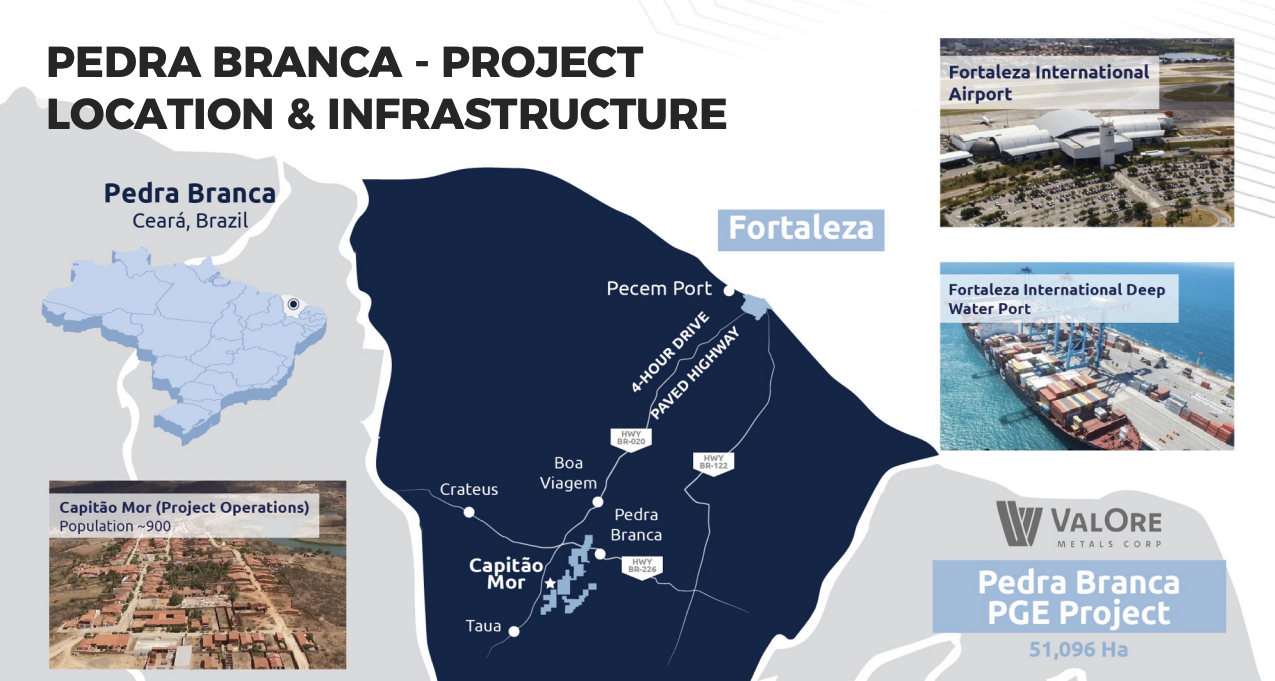
On the regulatory side, the Brazilian National Mining Agency has approved Final Exploration Reports for four of the project's deposit areas, Esbarro, Cedro, Curiu, and Cana Brava, advancing those claims to the Mining Concession Application Phase. The project encompasses 45 exploration licences covering 51,096 hectares in Ceará State.
What Still Needs to Be Proven Before the Preliminary Economic Assessment
The results represent an early-stage input into a process with substantial remaining steps before a Preliminary Economic Assessment (PEA) can be completed. Larger-scale stirred-tank reactor tests and the evaluation of alternative lixiviants are planned for the third quarter of 2026. Column tests for heap leach simulation are expected in the fourth quarter of 2026. Additional scale-up and variability work on the caustic cracking route, including evaluation of how it might integrate into a standalone or hybrid processing circuit, also remains ahead.
Smart is direct about the scope of what remains:
"We then scale up, and we go to processes which are more comparable to what you would have in an industrial scale, so stirred tank reactors, column tests to simulate heaps, and that'll give us a much more realistic view in terms of what our total extractions could be expected. We would focus on all the elements that go into that cost model, so the real beating heart of the PEA is the economic modeling that goes behind that, building up an estimation of capex, what is it going to cost to develop this mine, what do you need in terms of infrastructure brought to the site, what is the scale at which you're developing it, starting to look at the sequencing."
Beyond extraction rates, the PEA still requires the development of a capex model, assessment of infrastructure requirements, mine sequencing design, environmental inputs, and the regulatory pathway toward licensing. Process economics and scalability work for flowsheet development and preliminary design are expected in the fourth quarter of 2026, alongside preliminary water and power supply studies.
Broader Pedra Branca Context
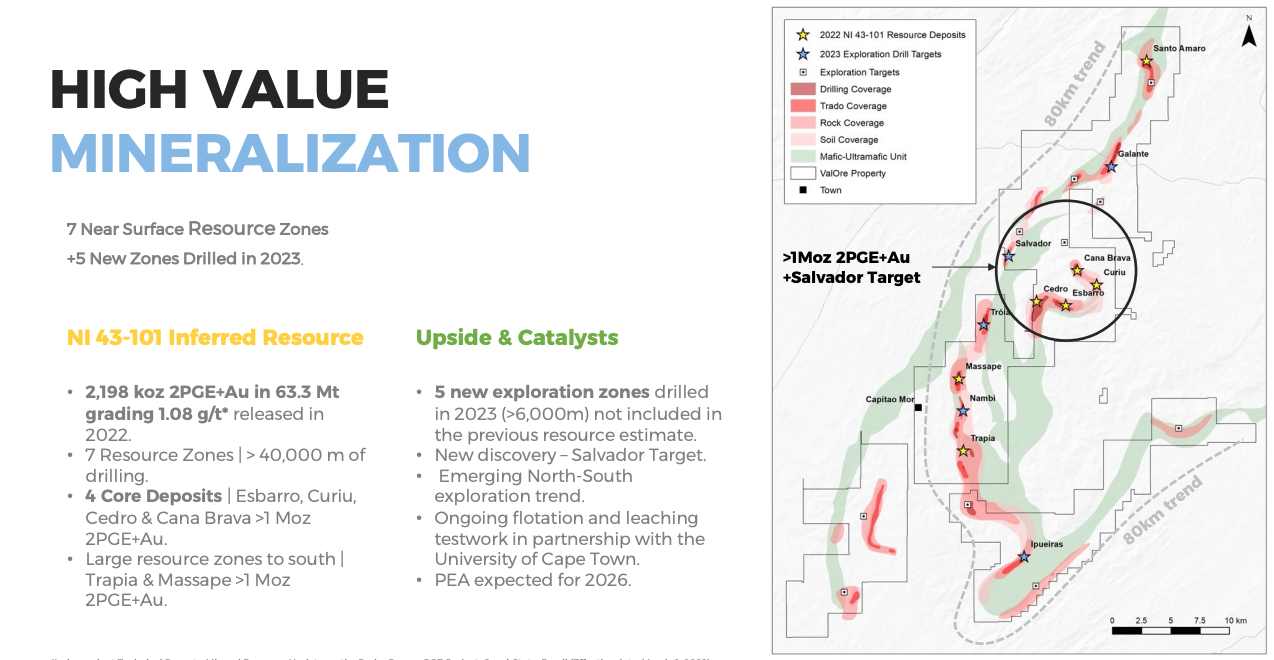
The resource underpinning the metallurgical programme is a 2022 NI 43-101 inferred resource of 2.198 million ounces of platinum, palladium, and gold in 63.6 million tonnes grading 1.08 grammes per tonne. The project spans seven distinct deposit areas. The Esbarro and Curiu deposits, both used as sample sources for the current test programme, hold 403,000 ounces of platinum, palladium, and gold grading 1.16 grammes per tonne in 10.8 million tonnes and 150,000 ounces grading 2.20 grammes per tonne in 2.1 million tonnes, respectively. Five exploration zones drilled in 2023 are not reflected in the current resource estimate.
The geometry of the deposit, with seven near-surface resource zones amenable to open-cast extraction, distinguishes Pedra Branca from South African PGE operations that typically require underground methods. Whether that characteristic translates into a meaningfully lower cost structure will depend on what the forthcoming flowsheet and engineering work produce.
What to Watch Next
The PEA is targeted for completion at the end of 2026. The path to that document runs through the third quarter of 2026, when larger-scale stirred tank reactor tests and alternative lixiviant assessment are planned, and through the fourth quarter, when heap leach column simulation, process economics assessment, and preliminary flowsheet design are expected to follow.
Beyond the PEA itself, licensing and Environmental Impact Assessment (EIA) work follow in the first quarter of 2027 in the current planning sequence.
The developments to watch are whether larger-scale testwork preserves or improves the extraction rates reported in the March results, whether heap leach simulation supports the route being studied, whether a workable flowsheet emerges from the economics assessment, and whether the PEA can translate the technical findings to date into a defensible development case.
FAQs (AI-Generated)
The programme evaluated two pre-treatment approaches on two distinct material types at Pedra Branca. Bioleaching followed by cyanidation was tested on weathered Esbarro material, while caustic cracking followed by cyanidation was applied to massive chromitite. Results from both were reported as extraction percentages for platinum and palladium.
Weathered material sits in the near-surface horizon and accounts for approximately 30% of total inferred resource PGE ounces. Sulphides in this zone are oxidised, limiting the effectiveness of flotation. Chromitite is a distinct ore type grading 6.4 to 8.5 grammes per tonne platinum, palladium, and gold, substantially above the project-wide average, and contains PGEs bound within a chromite-rich matrix that requires a different pre-treatment approach.
The results indicate that bioleaching is more effective than caustic pre-treatment for weathered material, and that caustic cracking may provide a viable route for chromitite. They do not establish commercial viability: larger-scale reactor testing, heap-leach simulation, flowsheet development, and full economic modelling all remain ahead of schedule before a Preliminary Economic Assessment can be completed.
Open-cast mining typically involves lower capital requirements and simpler mine design than underground operations. Because Pedra Branca's mineralisation extends to the surface and the company is evaluating open-cast methods, this characteristic may influence the project's cost profile. Whether that advantage materialises will depend on the engineering and economics work still to come.
The PEA is targeted for completion at the end of 2026. The path to that document includes stirred tank reactor tests and alternative lixiviant assessment in the third quarter of 2026, followed by heap leach column simulation, process economics work, and preliminary flowsheet design in the fourth quarter of 2026.
Analyst's Notes





Subscribe to Our Channel








Stay Informed


