




Abitibi's Right of First Refusal Opens Path From B26 to a Selbaie Copper District


Abitibi Metals' 10-year right of first refusal on SOQUEM ground near Selbaie and early regional drilling outline a path from B26 to a Québec copper district.
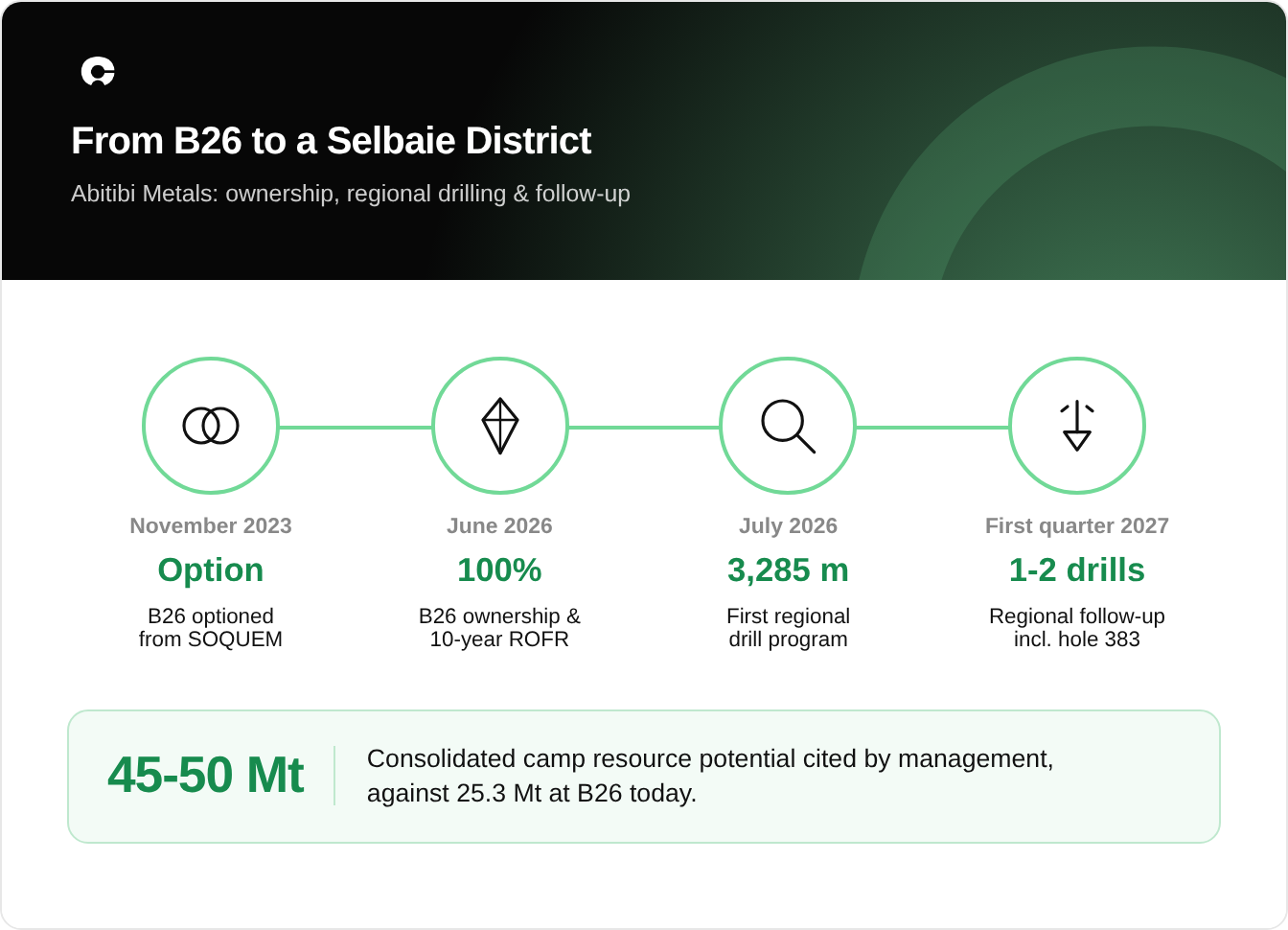
- Abitibi Metals owns 100% of the B26 copper-gold deposit in Québec after buying SOQUEM's remaining 20% interest in June 2026, with SOQUEM retaining a 1% net smelter return (NSR) royalty.
- The same transaction gave Abitibi a 10-year right of first refusal over SOQUEM's adjacent Wagosic and Carheil properties near the former Selbaie mine, which Chief Executive Officer Jonathon Deluce describes as a 60 million-ton deposit mined over 20 years.
- A first regional drill program of 3,285 meters intersected 14.25 meters of 1.13% zinc and 51.5 grams per tonne of silver about 1.5 kilometers west of B26, in the same volcanic host rocks as the deposit.
- Management sees potential for a consolidated camp resource of 45 to 50 million tonnes, compared with 25.3 million tonnes at B26 today.
- With about C$34 million in cash and no warrants, the company says it is funded through 2027 for drilling, development work and potential acquisitions.
Abitibi Metals (CSE: AMQ | OTCQB: AMQFF | FSE: FW0) has grown the B26 copper-gold deposit in northwestern Québec to 25.3 million tonnes since November 2023. Its 2027 plans go beyond that single deposit. B26 is one of several volcanogenic massive sulfide (VMS) prospects that SOQUEM, a Québec government exploration subsidiary, worked on around the former Selbaie mine. The terms under which Abitibi took full ownership give it first call on the neighboring properties SOQUEM still holds, and regional drilling has started testing the same host rocks beyond the deposit.
From Option to Full Ownership in 2.5 Years
Abitibi optioned B26 from SOQUEM in November 2023. No public company had held the project before. SOQUEM explored it for about 25 years and spent almost $30 million taking it from discovery to a resource of about 11 million tonnes. Abitibi completed the 7-year option agreement in 2.5 years. Resource tonnage has more than doubled since then, to 12.96 million tonnes Indicated at 2.08% copper equivalent and 12.34 million tonnes Inferred at 2.20% copper equivalent, effective January 1, 2026.
In June 2026, Abitibi bought SOQUEM's remaining 20% interest. SOQUEM remains a shareholder and keeps a 1% net smelter return royalty, half its previous level. The project has no other underlying royalties or streams. The deal also gave Abitibi a 10-year right of first refusal (ROFR) over SOQUEM's adjacent Wagosic and Carheil properties.
President and Chief Executive Officer of Abitibi Metals, Jonathon Deluce, tied full ownership to the company's next stage of growth:
"Not only do we now have 100% ownership, which is important for us in terms of permitting or from our strategic partners at Discovery or other producers reviewing the company, but we've been able to leverage that into our pipeline of next acquisitions, which includes a significant discovery at Wagosic."
The Government Relationship Behind the ROFR
Deluce says the Québec government's goals in the camp are job creation, resource development and faster project timelines. He says finishing the option in 2.5 years supported Abitibi's case. The company also has relationships in the region beyond mining. Deluce says his group founded Air Creebec, an airline partnered with First Nations. Abitibi uses First Nations-partnered drilling contractors, runs training and sponsorship programs, and has started a camp-scale memorandum of understanding.
The ROFR has limits. Abitibi has no ownership interest in Wagosic or Carheil and no right to any resources there. The ROFR gives the company first refusal on those properties but does not by itself deliver a transaction.
A Camp Built Around the Former Selbaie Mine
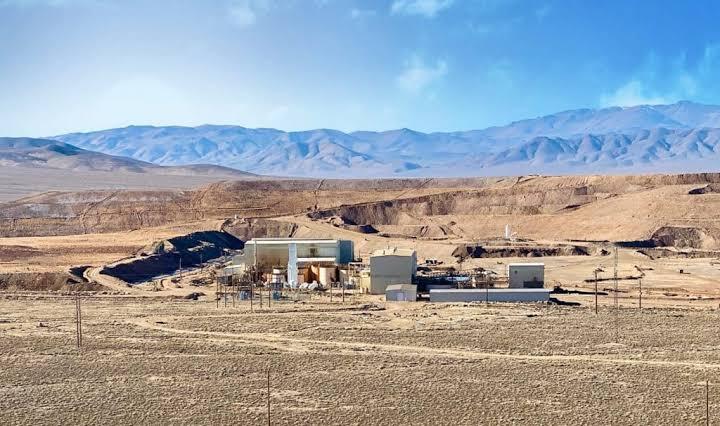
Deluce describes Selbaie as a 60 million ton deposit mined by open pit and underground methods over a 20-year life. Operations there were suspended in 2004. B26 lies about 7 kilometers southeast of the old mine on a brownfield property with road access and 120-kilovolt power. Deluce notes that VMS deposits occur in clusters, which drew SOQUEM to the camp. After optioning B26 to Abitibi, SOQUEM moved its budget to Wagosic and Carheil, where Deluce says it has made additional world-class discoveries. Abitibi also owns 100% of the Beschefer gold project, which SOQUEM was involved with.
Deluce described how close the district targets are:
"This isn't upside 100 km away; this is within a 12 km circumference, which shows us potentially the ability to build really a district."
The company says the district has seen no significant exploration since 1997. Historical drilling on its property mostly tested the upper 200 meters, and outside B26 no earlier hole had reached 400 meters depth.
First Regional Holes Cut B26-Style Host Rocks
On July 29, 2026, Abitibi reported its first systematic regional program: 3,285 meters in 4 holes. The holes tested 3 of 7 high-priority targets selected from historical drilling, induced polarization surveys and a 2025 airborne survey. One hole, about 1.5 kilometers west of B26, intersected 14.25 meters of 1.13% zinc and 51.5 grams per tonne of silver from 455.75 meters, at roughly 400 meters vertical depth. It cut the same felsic volcanic package and alteration style as B26, and the company interprets the zone as a possible peripheral expression of a new B26-like VMS system.
3 of the holes, about 4.5 kilometers northwest of B26, returned 1.0 meter of 332 grams per tonne of silver and 0.83 grams per tonne of gold from 501 meters. These are exploration results, not resources. Follow-up drilling is needed to determine whether the one of the hole zone is an extension of B26 or a new zone.
Downhole electromagnetic (EM) surveys are planned on all regional holes. 1 to 2 drills will work on regional targets in the first quarter of 2027, following up one of the holes and a Selbaie extension target to the north. The company has mapped an 8-kilometer trend of the rocks that host B26.
Funding the District Strategy Through 2027
Abitibi held about C$34 million in cash with no warrants outstanding, and projects C$28 million to C$29 million at the end of 2026. Deluce says that funds 40,000 meters of drilling in 2027, early development work and potential acquisitions, and the company states it is funded through 2027. Discovery Silver holds 9.9% following its May 2026 strategic investment, and Deluce and his family office own 21% of the company, with more than $14 million invested.
Deluce sees potential for a consolidated camp resource of 45 to 50 million tons with upside, compared with 25.3 million tonnes at B26 today. The next B26 resource update is targeting 30 to 35 million tons in the first half of 2027. Deluce links that scale to what producers want: a company building a camp wants confidence in 20 to 40 years of operations.
Several things remain unproven. Half of the B26 resource is Inferred; no economic study has been completed, and the regional results are early-stage exploration. The ROFR also covers only the 2 SOQUEM properties. The preliminary economic assessment (PEA) targeted for 2027 will give the first economic test of B26 itself.
Catalysts for the District Strategy
Over 2027, the district plan faces several tests: follow-up drilling at one of the holes and the Selbaie extension target, downhole EM results, any move on the ROFR or other acquisitions, the B26 resource update and the PEA. Regional discoveries and a transaction on SOQUEM ground would move Abitibi from a single asset toward the district scale that management describes.
FAQs (AI-Generated)
Analyst's Notes





Subscribe to Our Channel



Stay Informed


