




China’s Grid Spend Tops 600B Yuan, Supporting Copper Demand Beyond Housing


Copper project value depends on drilling results, development costs, and financing as electricity networks broaden demand beyond housing.
- China’s grid companies completed more than 600 billion Chinese renminbi (RMB) of fixed-asset investment through September 2026, funding electrical infrastructure that uses copper in cables and transformers.
- In the first nine months of 2026, property development investment fell 20.6%, while combined investment in grids, new energy storage, and charging infrastructure rose 15.3%, supporting electrical spending despite the housing downturn.
- China’s electricity use rose 3.9% in the first nine months of 2026, increasing the volume of power that networks must deliver.
- Defined power costs and infrastructure requirements help developers refine financing plans, while drilling results help explorers determine where further spending is justified.
- Grid spending alone does not establish total copper-demand growth, so project valuations should use price assumptions that accommodate aluminum substitution, procurement delays, and continued property weakness.
Grid Investment Broadens Copper’s Market as Property Spending Contracts
The National Energy Administration (NEA) reported on October 30, 2026, that China’s grid companies had completed more than RMB600 billion of fixed-asset investment by the end of September. This spending funds electrical infrastructure that uses copper in cables and transformers, supporting a demand channel beyond new housing construction.
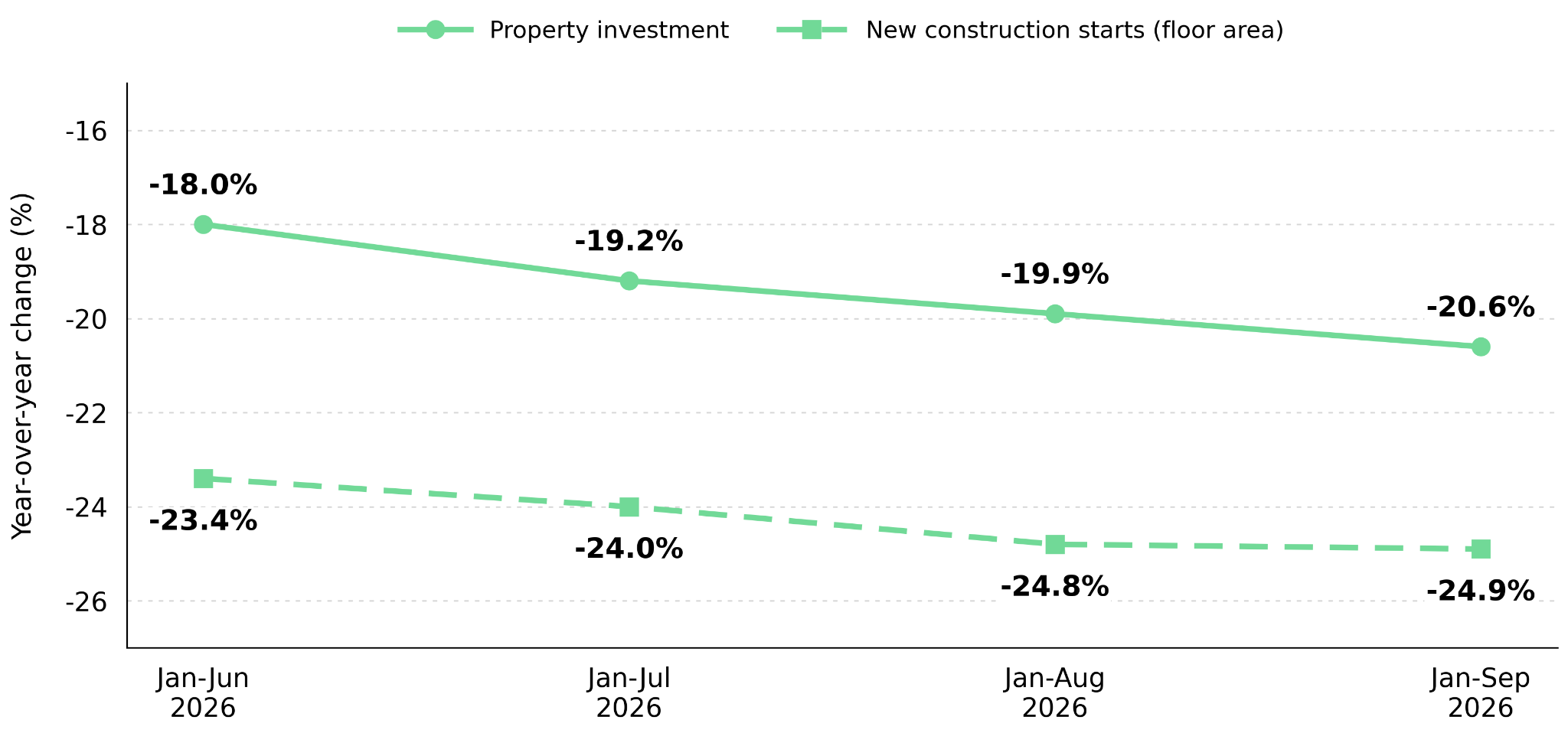
The National Bureau of Statistics (NBS) reported that property development investment fell 20.6% year over year in the first nine months of 2026. New construction starts declined 24.9% by floor area, while completions fell 25.1%. Copper-price assumptions used to value mining projects need to account for this construction weakness alongside the separate increase in electrical investment.
Rising Electricity Use Supports Copper-Bearing Network Equipment
China’s electricity consumption rose 3.9% year over year in the first nine months of 2026, while electricity use in high-technology and equipment manufacturing increased 8.7%. Electricity use in charging and battery-swapping services rose 55.4% over the same period.
Copper is used in underground cables and transformer coils, while aluminum is often chosen for overhead cables because it is lighter and cheaper. Investment in underground cabling can therefore support copper demand more directly than network expansion using aluminum overhead lines.
In its July 2026 Global Critical Minerals Outlook, the International Energy Agency (IEA) estimates that copper accounts for approximately 10–15% of transformer and power-cable prices. Higher copper prices can therefore raise equipment costs and reduce the volume that a fixed grid budget can purchase.
Infrastructure Planning Clarifies Copper Development Costs
Copper-project valuations depend on construction costs, operating expenses, and the time required to begin production. Engineering studies, power and water arrangements, and processing plans help define these costs and the financing needed to deliver future supply.
Marimaca Copper’s grid connection approval was upheld, alongside agreement on preliminary renewable-power terms for the Marimaca Oxide Deposit. Estimated electricity costs are close to the US$93 per megawatt-hour assumption in its Definitive Feasibility Study (DFS). The proposed terms exclude take-or-pay obligations during ramp-up, improving cost visibility and reducing exposure to payments for unused power as the project advances toward construction.
Resource Definition Clarifies Copper Restart Requirements
As electrical investment broadens copper demand, existing processing facilities offer a starting point for assessing additional supply. Better-defined mineralization can help align mine plans with plant capabilities and clarify the work needed for a potential restart.
Selkirk Copper’s October 15 drilling results support an updated Mineral Resource Estimate (MRE), targeted for the first quarter of 2027. Better-defined mineralization can help refine plans to deliver higher-grade material to Minto’s existing processing plant, strengthening the basis for feasibility work assessing the mine’s restart potential.
Colin Joudrie, President and Chief Executive Officer of Selkirk Copper, highlights copper shortages alongside demand for quality concentrates:
“This market is short copper and it's very short the quality of copper concentrates that we will produce.”
China’s Grid Plans Extend the Copper Demand Outlook
The NEA’s October 30, 2026, statement outlines more than RMB5 trillion in planned grid fixed-asset investment during the 15th Five-Year Plan period. That spending gives copper a source of equipment demand beyond 2026, with the timing of purchases tied to equipment orders. On the supply side, turning new targets into production takes years of drilling, engineering, and financing.
Fitzroy Minerals began a 5,000-meter drilling program at Buen Retiro after identifying nine untested targets. The program can establish which targets contain copper mineralization and warrant follow-up drilling.
Drilling Results Guide Further Copper Project Spending
Cobra Resources’ results at Manna Hill help narrow where to drill next. At Blue Rose, the company reported 74 meters at 1.02% copper from 70 meters. Follow-up drilling can test how far the shallow copper-gold mineralization extends and where deeper drilling is justified.
Abitibi Metals Corp’s planned drilling at B26 addresses the next question: how much of the deposit can be defined with greater confidence? The company reported 1.08% copper over 60.2 meters of core, including 3.42% copper over 9.2 meters. Testing whether those grades continue between holes and whether the deposit extends beyond its defined limits can inform the next MRE.
Mogotes Metals’ September 22 plan pairs further drilling at Filo Sur and Beskauga with an initial assessment of development costs at Beskauga. The company is targeting a Preliminary Economic Assessment (PEA) within 12 months of the update to test a development concept and establish an initial estimate of project costs.
Uneven Growth Keeps Copper’s Grid Opportunity Selective
China’s manufacturing Purchasing Managers’ Index (PMI) was 49.3 in October 2026, while the construction business-activity index was 48.0, both below the 50-point threshold separating expansion from contraction. High-technology and equipment manufacturing PMIs were 51.3 and 50.6, respectively, indicating expansion in those sectors despite weaker activity across manufacturing overall.
In S&P Global’s October 23, 2026, report, London Stock Exchange Group (LSEG) analyst Bruce Alway said electrical demand was not fully offsetting weakness in Chinese construction and appliances. He also described grid projects being delayed while buyers waited for lower copper prices, showing why planned investment need not generate immediate copper purchases.
The IEA’s Electricity 2026 report identifies network upgrades and better use of existing capacity as alternatives to some new construction. Copper-demand forecasts should therefore distinguish purchases of new cables and transformers from capacity gains achieved through changes to network operation.
The Investment Thesis for Copper
- Grid modernization and industrial electrification support copper demand beyond housing, so project revenue assumptions need not depend solely on a property recovery.
- Producers’ cash flow depends on realized copper prices and operating costs, while developers must account for construction spending and financing costs before production begins.
- Explorers can reduce uncertainty over potential output through drilling and processing tests, helping determine whether further study spending is justified.
- Permitting requirements, power and water terms, and community agreements help define the cost and timing of copper-project development.
- Restart valuations should reflect refurbishment costs, copper recovery, and the amount of suitable material the mine can deliver to the plant.
- Valuations should test lower copper prices to show how weaker demand would affect projected cash flow, project returns, and additional funding needs.
Copper’s role in expanding electricity networks supports an investment case that does not depend solely on a housing recovery. The opportunity lies in developers and explorers whose drilling, infrastructure planning, and economic studies clarify potential production, costs, and capital requirements. Assessing that progress against copper’s broader demand base helps identify where potential future cash flow can justify today’s project valuation.
TL;DR
China’s grid companies invested more than 600 billion yuan through September 2026, while property investment fell 20.6% over the same nine months. Grid expansion supports copper use in underground cables and transformers, providing demand beyond housing. This creates a broader market for potential future production, with developers’ and explorers’ returns dependent on resource confidence, costs, infrastructure access, financing, and production timing. Spending growth does not translate directly into copper purchases because equipment choices, aluminum substitution, procurement delays, and better use of existing networks affect metal requirements.
FAQs (AI-Generated)
Analyst's Notes





Subscribe to Our Channel














Stay Informed


